
Verwandte Artikel zu A World War 1 Adventure: The Life and Times of RNAS...
Inhaltsangabe
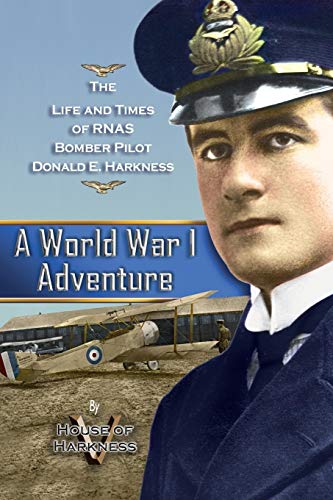
A deeply personal and revealing eyewitness narrative of one airman's life as a bomber pilot in England 's RNAS (Royal Naval Air Service) in WWI. It is a true story, an adventure, and a war memoir carefully constructed from Captain Donald E. Harkness's unpublished diaries, letters, sketches and photographs - only recently uncovered nearly a century later - that documented his remarkable experiences and military adventures over England, France and Belgium. The first book written by a highly decorated WWI flyer from New Zealand that captures the "behind the scenes" life of RNAS pilots, as well as the surprises, terrors, traumas, humor, and sheer excitement of an aerial form of combat never before experienced by anyone, anywhere - and only eleven short years after the Wright Brothers historic flight at Kitty Hawk. With a talent for writing, Don begins an epic journey at a major turning point in history when the world is poised at the dawn of flight, and bracing itself for unknown dangers of unprecedented sophistication and savagery. Don's journal reveals unique insights and vivid imagery of another time and experience, to wit: - the terror and devastation of a Zeppelin bombing raid in London - the training regimen of early flying schools, and their serious & comic episodes - the wonder, awe, and poetry of flying aloft in the majestic heavens - vivid bombing raids, plus the raid that earned him the DSC - his crash-landing and capture - working with the underground to help downed pilots evade capture - London's unrestrained exuberance on Armistice Day; . . . and much, much more.
Die Inhaltsangabe kann sich auf eine andere Ausgabe dieses Titels beziehen.
Auszug. © Genehmigter Nachdruck. Alle Rechte vorbehalten.
A World War 1 Adventure
The Life and Times of RNAS Bomber
By Donald E. HarknessAuthorHouse
Copyright © 2014 Bruce W. Harkness, Jeffrey T. Harkness, Timothy D. Harkness, Christopher W. Harkness, Donald E. Harkness, Jr.
All rights reserved.
ISBN: 978-1-4969-1409-5All rights reserved.
Contents
Introduction, xi,
Acknowledgments, xiii,
Author's Notes, xv,
Map of Northern Europe, xvii,
Early Life, 1,
A World Gone Awry, 29,
Photo Section: Wellington to Dover, 92,
Learning to Fly, 108,
Photo Section: Coudekerque, 175,
Coudekerque Aerodrome, 199,
Zeppelins, 276,
Photo Section: Internment and After the War, 337,
Internment, 349,
Letters Home, 404,
Armistice, 505,
After the War, 532,
Don's Last Flight, 541,
Postscript, 552,
People Index, 557,
CHAPTER 1
Early Life
"I would give anything to be able to use an aeroplane, especially at the present time when they are all-important to both Army and Navy."
DEH
A Kiwi Upbringing
Donald Ernest Harkness was born on August 27th, 1894, a cold and wintery day in Nelson, a small city on the north shore of the South Island of New Zealand. He was the second son and third child of George Alexander and Mary Blanche Talbot Harkness, she preferring to be called by her middle name rather than her first. Ella, his only sister, was born two years before him, and three brothers were born after him, Alec, Philip, and Euan, in that order. The oldest by three years was Keith, but he passed away suddenly at the all too early age of 14, the result of a schoolyard accident. Euan, born in 1905, was always called Nipper, or just Nip, for no other reason than the fact that he was the youngest.
We don't know much of Don's early life, though we do know from his letters that he was close to his siblings. They wrote often to each other while they were away on school trips, while on holidays, visiting relatives, or just for fun. Their father was the Chief Inspector of Schools on the South Island and was a strict, but loving schoolmaster to the children, and their mother was a teacher. They made sure the children got a well-rounded, proper English education and learned to read and write well at an early age, and little "Donny" became especially fond of writing as a result.
By the turn of the 20th century New Zealand was barely 60 years old as a British colony; some 620 years old as a country settled by Polynesians, and Don was in primary school learning all about it. He was also learning about his mother country, England, often calling it "Home" in his letters, as was the fashion, and soon, without ever being there, he knew all about it, too, from the reference books and schooling his parents provided, as well as the innumerable stories told to him by his traveling relatives. As a boy he also enjoyed taking things apart and rebuilding them, often making them better than they were before. He understood not just how things worked but why they worked, and read avidly about the new advances in technology that seemed to be everywhere – everywhere except New Zealand, that is. He longed to bring New Zealand into the modern age and help it reach a par with the great countries of Europe and America. He knew, however, that much work was still needed to build a modern infrastructure for New Zealand, and that required large numbers of engineers and construction workers. From an early age he therefore set out to make engineering his career and looked forward to the day when he'd be old enough to enter the workforce. But just before he got old enough, he saw a man fly like a bird in one of those new "aeroplanes" he'd heard so much about, and just as the romance of flight was taking hold of his young imagination, war was invading his Home country.
In early 1915 brothers Vivian and Leo Walsh began test flying a flying boat based on a Curtiss biplane that they had built themselves, and with this plane opened the New Zealand Flying School, the country's first, in October of that year. It was one of those early test flights that Don saw, rising off Mission Bay in Auckland's Waitemata Harbor, that so enamored him to flying. At the time, Don, then 20 years old, was in Auckland working an unpaid internship and taking his finals for the second year of classes he'd just finished at Canterbury College, New Zealand University's engineering college located in Christchurch, the largest city in the South Island. University rules back then required that students take their final tests in Auckland even though the colleges where their classes were held were often in cities hundreds of miles from there. Because he'd earned a scholarship in 1912 after graduating with honors from Nelson College, a highly regarded secondary school, Don didn't mind the inconvenience and used the opportunity to visit relatives and do a bit of sightseeing.
How to Defend England
When the first shots were fired, like so many young men his age, with a mixture of patriotism, exuberance and naiveté, Don jumped at the chance to defend England, but had the presence of mind to wait until after he'd researched his options and made a plan for himself before going off to war. Many of his friends didn't wait and left at the first calling in October, 1914 when the first ANZAC troopships bound for Europe were organized, and found themselves diverted en route to Egypt when the Ottoman Empire entered the war.
He didn't quite know what to make of the ground war – nobody did, actually – but from the sanitized yet still horrific newspaper reports of conflicts like the Battle of Mons, First Battle of the Marne, Siege of Antwerp, First Battle of Ypres, and dozens more in 1914 alone, he was pretty sure he wanted no part of the infantry. Instead, Don very much wanted to join the Royal Flying Corps but he quickly learned that securing flight training presented certain difficulties that needed to be sorted out first, not the least of which was how to pay for it and the travel to London, where most of the UK's flying schools were located. Though the New Zealand Flying School would eventually train 83 pilots for the war, with 75 making the trip to London, they were still months away from beginning operations by the time he was ready to leave, so for him, that wasn't an option. There was also the matter of what to do about his education which would have to be suspended until his return. The whole RFC enlistment process was, in fact, so confusing that no one knew exactly what to expect once they arrived in Europe. He put the matter on hold while he talked it over in the following letter with his father, ultimately deciding that his immediate courses should come first. Hopefully, by the time his current semester of classes ended in late May, the way to England, and the RFC, would become clearer for him.
'Nelmeshurst'
Remuera Rd
Sun. Jan.17, 1915
Dear Father,
You will excuse me worrying you with a letter, won't you, knowing as you will what it is for? I did hope to be able to ask you for two things, but one has got bumped on the head. The other is that you will be able to assist me financially as I have come to the end of my resources and could do with some more tin almost immediately, seeing that I have about seven more weeks to fill in up here, and the trip home as well. I spend about as little as I can possibly help, yet unless I stay in the same place all the time, I have to spend a good bit on tram fares alone.
As regard the other thing which I have hinted at, I...
„Über diesen Titel“ kann sich auf eine andere Ausgabe dieses Titels beziehen.
Suchergebnisse für A World War 1 Adventure: The Life and Times of RNAS...

Beispielbild für diese ISBN
A World War 1 Adventure: The Life and Times of Rnas Bomber Pilot Donald E. Harkness
Anbieter: Ria Christie Collections, Uxbridge, Vereinigtes Königreich
Verkäuferbewertung 5 von 5 Sternen

Zustand: New. In English. Artikel-Nr. ria9781496914095_new
Neu kaufen
EUR 30,29
EUR 13,22 Versand
Versand von Vereinigtes Königreich nach USA
Versand von Vereinigtes Königreich nach USA
Anzahl: Mehr als 20 verfügbar