
Verwandte Artikel zu Buffalo Soldiers: South of the Rio Grande
Inhaltsangabe
Captain Gilmore, an African American officer, and Jenkins Craves, an old buffalo soldier with combat experience, make an odd duo. But together they serve one mission. At the height of the Mexican Revolution, they are commanded to transport Lieutenant Calderon and several other Mexican prisoners to make an exchange for American prisoners. The mission should be simple, with the Americans being held in a small town a few days' ride from the pair's location, but as Gilmore soon finds, nothing is simple south of the border. Their team meets a young woman who travels alone to collect the belongings of a relative: a soldier shot dead by Mexican federal soldiers. Gilmore feels the need to protect this woman, so she joins their team. It's a good thing, too, as they are soon attacked by bandits, the Mexican Federal Army, and a variety of no-good turncoats. Despite these hazards, Gilmore and Craves are determined to complete their mission and save American lives . . . but who will save them?
Die Inhaltsangabe kann sich auf eine andere Ausgabe dieses Titels beziehen.
Auszug. © Genehmigter Nachdruck. Alle Rechte vorbehalten.
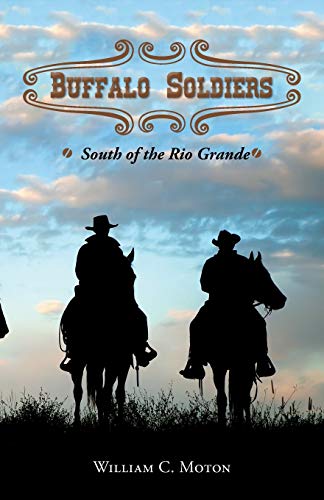
Buffalo Soldiers
South of the Rio Grande
By William C. MotonTrafford Publishing
Copyright © 2014 William C. Moton
All rights reserved.
ISBN: 978-1-4907-4729-3All rights reserved.
CHAPTER 1
Early morning, March 16, as the moon ducked behind the clouds that drifted over the small town of Columbus, New Mexico, ghostly shadows crept across the landscape full of cacti and mesquite. The air was cool, and there was little breeze. Inside the camp that guarded the armory, the soldiers slept. They were oblivious to the impending attack from the Lion of Northern Mexico.
Pancho Villa and his ragtag band of men numbering approximately four hundred came in from the southeast. They were unseen from the observation towers. They had left their horses outside of town then sneaked across the flanks and attacked the post from both sides. They robbed supplies and munitions at a great loss of life, mostly Mexicans. During the fight, they set fire to a hotel and carried torches. Unbeknownst to them, the torches made them easy targets. Even though they were surprised and outnumbered, the Americans put up a good fight. Afterward, the area in the center of town lay in ruin. The intruders left after a battle that lasted the better part of a half hour.
Pancho Villa led the remainder of his troop to their sanctuary in Northern Mexico. Diplomatic relations between the two countries were further strained by this bold crime. Acting from a need for retribution, an expeditionary army headed by General John J. Pershing was sent into Mexico. This army was called the Punitive Expedition. The Tenth Cavalry, better known as the buffalo soldiers, was a part of this force. Their orders were to catch the perpetrators of the attack on the American town and do whatever deemed necessary to stop the outrages along the border.
The expedition chased the revolutionaries though rough terrain and through the dustiest towns of the northern part of the country. The trail was long. They went through cold mountain passes where the water froze in the canteens carried by the men and the hair froze on their heads and faces. Then they rode through plains where the heat was almost unbearable. Some of the older soldiers, both white and black, could remember the long treks across the endless wastelands that separate the United States and the Mexican heartlands.
Some of the expeditions in the 1880s were into the Sierra Madre Mountains. Then, they were trying to catch roaming bands of Apache, Limpa, and Kickapoo raiders. These marauders would cross the border after committing unimaginable depredations. Apache descendants of those earlier renegades were serving as scouts with the expedition.
The hardship to be endured was only anticipated by a few of the old-timers. The mounted troops' diet consisted of fresh beef, hardtack, beans, and corn.
When they left the high altitudes, they were met by swarms of pests. The droppings from the many thousands of horses and pack animals from both parties produced enormous herds of horseflies and other varmints. Their nuisance came after sunrise, then would subside with the chill of the night, then return the following day. The rains during the season intensified the suffering.
Despite those problems, the army continued south. The army that was organized had been the largest put together to travel by land and rail since the Civil War. The last military actions the United States had been involved in had all occurred overseas; there was the Spanish-American War, there had been a small American presence at Peking during the Boxer rebellion, and there had been an ongoing fight in the Philippines against the Moros, the local Muslim independence fighters.
The United States government set up an official meeting in Connecticut. They were to discuss the crossing and recrossing of the borders by the military of each country in hot pursuit of outlaws. This arrangement had been made years before during the Indian wars. The Mexican government refused to participate. They wanted the United States to unconditionally return to the US. Meanwhile, the National Guard from several states, numbering 150,000, had been mobilized along the southern border.
The word from various Mexican generals had been that there should be no movement either east, west, or south by the American forces. General Pershing had distinctively assured them that the Americans would go north when he received orders from his superiors, and no one else. Mexican federal troops, estimated at ten thousand, had assembled on rails around Chihuahua City. It was understood that those troops were not there to pursue revolutionaries, but to drive out the Americans.
Initially, only ten thousand American troops had crossed the border, but before the incursion was over, twenty thousand Americans were there.
The Mexican Federale units were constantly fighting the rebels. When not doing so, they kept themselves at a distance while keeping a steady vigil on US troops' movements. There had been little interaction between these parties. The newly organized air units had done much of the reconnaissance. Most airplanes were soon put out of action by crashes caused mostly from experienced pilots. The army had to return to its old-fashioned methods, mainly small patrol. Some of these patrols had gone to capture Villa's high-ranking officers, the ones who had participated in the cross-border raids at Columbus. The men hunted were Julio Acosta, Roberto Sebastian, Canderlaro Cervantes, Antonio Angel, Cruz Dominique, Martin Lopez, and Nicholas Fernandez. Some of them were subsequently apprehended and sent back to face trial in the US courts.
Most were killed in various shoot-outs with American or Mexican federal troops. The Carrazana government had given a blanket pardon to the underlings of the Columbus operation. This further annoyed General Pershing. One of the officers in charge of these patrols got into a large firefight. It was none other than Lieutenant Patton, who later became the famous General Patton.
Many of the distances covered could have been cut by one-third; the problem was with the guides. The American scouts, including the Apache, had never been in the territory before. The local people, even when offered money, would only hunch their shoulders and say, "Quien Saba?" ("Who knows?") When asked other information, the same response, "Quien saba?" followed. When following guides who were paid, they inevitably chose the longest route to a particular place. It was obvious; these men worked against the progress of the expedition. This was from fear of reprisals or sympathy with the rebels.
At the town of Guerrero, Villa had escaped the night before, when the American forces had been taken in a circular route and brought into the town at the wrong entrance. Villa had been wounded in a shoot-out with Federales a few days before and had had his leg broken. He had it fixed by a local doctor then left town in a wagon with an escort of chosen men. Upon arriving, the troops were to witness something that soon would become common. When arriving at a federal garrison, the local authorities would execute any rebels captured. The rebels had done the same to them. The exception was only when troops from the local garrison consented to renounce the federals and join Villa's sometimes swelling, but lately dwindling, ranks.
After entering the small towns, the locals were always surprised when the Americans paid for food for the troops and fodder for their horses. These people were accustomed to a different experience. Before, any exchange with the warring faction meant the loss of their valuables. The word soon spread that the...
„Über diesen Titel“ kann sich auf eine andere Ausgabe dieses Titels beziehen.
Suchergebnisse für Buffalo Soldiers: South of the Rio Grande

Beispielbild für diese ISBN
Buffalo Soldiers: South of the Rio Grande
Anbieter: Ria Christie Collections, Uxbridge, Vereinigtes Königreich
Verkäuferbewertung 5 von 5 Sternen

Zustand: New. In English. Artikel-Nr. ria9781490747293_new
Neu kaufen
EUR 15,47
EUR 10,93 Versand
Versand von Vereinigtes Königreich nach USA
Versand von Vereinigtes Königreich nach USA
Anzahl: Mehr als 20 verfügbar