
Verwandte Artikel zu Space Opera (Volume 1) (Space Opera, The)
Inhaltsangabe
HUGO AWARD FINALIST FOR BEST NOVEL
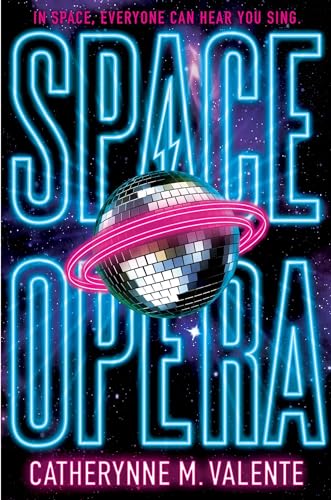
The Hitchhiker's Guide to the Galaxy meets the joy and glamour of Eurovision in bestselling author Catherynne M. Valente's wildly funny space opera spectacle, where sentient races compete for glory in a galactic song competition…and the stakes are as high as the fate of planet Earth.
A century ago, the Sentience Wars tore the galaxy apart and nearly ended the entire concept of intelligent space-faring life. In the aftermath, a curious tradition was invented—something to cheer up everyone who was left and bring the shattered worlds together in the spirit of peace, unity, and understanding.
Once every cycle, the great galactic civilizations gather for the Metagalactic Grand Prix—part gladiatorial contest, part beauty pageant, part concert extravaganza, and part continuation of the wars of the past. Species far and wide compete in feats of song, dance and/or whatever facsimile of these can be performed by various creatures who may or may not possess, in the traditional sense, feet, mouths, larynxes, or faces. And if a new species should wish to be counted among the high and the mighty, if a new planet has produced some savage group of animals, machines, or algae that claim to be, against all odds, sentient? Well, then they will have to compete. And if they fail? Sudden extermination for their entire species.
This year, though, humankind has discovered the enormous universe. And while they expected to discover a grand drama of diplomacy, gunships, wormholes, and stoic councils of aliens, they have instead found glitter, lipstick, and electric guitars. Mankind will not get to fight for its destiny—they must sing.
Decibel Jones and the Absolute Zeroes have been chosen to represent their planet on the greatest stage in the galaxy. And the fate of Earth lies in their ability to rock.
Die Inhaltsangabe kann sich auf eine andere Ausgabe dieses Titels beziehen.
Über die Autorin bzw. den Autor
Catherynne M. Valente is an acclaimed New York Times bestselling creator of over forty works of fantasy and science fiction, including the Fairyland novels and The Glass Town Game. She has been nominated for the Nebula and World Fantasy awards, and has won the Otherwise (formerly Tiptree), Hugo, and Andre Norton award. She lives on a small island off the coast of Maine with her partner, young son, and a shockingly large cat with most excellent tufts.
Auszug. © Genehmigter Nachdruck. Alle Rechte vorbehalten.
Space Opera 1. Boom Bang-a-Bang
Once upon a time on a small, watery, excitable planet called Earth, in a small, watery, excitable country called Italy, a soft-spoken, rather nice-looking gentleman by the name of Enrico Fermi was born into a family so overprotective that he felt compelled to invent the atomic bomb. Somewhere in between discovering various heretofore cripplingly socially anxious particles and transuranic elements and digging through plutonium to find the treat at the bottom of the nuclear box, he found the time to consider what would come to be known as the Fermi Paradox. If you’ve never heard this catchy little jingle before, here’s how it goes: given that there are billions of stars in the galaxy quite similar to our good old familiar standby sun, and that many of them are quite a bit further on in years than the big yellow lady, and the probability that some of these stars will have planets quite similar to our good old familiar knockabout Earth, and that such planets, if they can support life, have a high likelihood of getting around to it sooner or later, then someone out there should have sorted out interstellar travel by now, and therefore, even at the absurdly primitive crawl of early-1940s propulsion, the entire Milky Way could be colonized in only a few million years.
So where is everybody?
Many solutions have been proposed to soothe Mr. Fermi’s plaintive cry of transgalactic loneliness. One of the most popular is the Rare Earth Hypothesis, which whispers kindly: There, there, Enrico. Organic life is so complex that even the simplest algae require a vast array of extremely specific and unforgiving conditions to form up into the most basic recipe for primordial soup. It’s not all down to old stars and the rocks that love them. You’ve gotta get yourself a magnetosphere, a moon (but not too many), some gas giants to hold down the gravitational fort, a couple of Van Allen belts, a fat helping of meteors and glaciers and plate tectonics—and that’s without scraping up an atmosphere or nitrogenated soil or an ocean or three. It’s highly unlikely that each and every one of the million billion events that led to life here could ever occur again anywhere else. It’s all just happy coincidence, darling. Call it fate, if you’re feeling romantic. Call it luck. Call it God. Enjoy the coffee in Italy, the sausage in Chicago, and the day-old ham sandwiches at Los Alamos National Laboratory, because this is as good as high-end luxury multicellular living gets.
The Rare Earth Hypothesis means well, but it’s colossally, spectacularly, gloriously wrong.
Life isn’t difficult, it isn’t picky, it isn’t unique, and fate doesn’t enter into the thing. Kick-starting the gas-guzzling subcompact go-cart of organic sentience is as easy as shoving it down a hill and watching the whole thing spontaneously explode. Life wants to happen. It can’t stand not happening. Evolution is ready to go at a moment’s notice, hopping from one foot to another like a kid waiting in line for a roller coaster, so excited to get on with the colored lights and the loud music and the upside-down parts, it practically pees itself before it even pays the ticket price. And that ticket price is low, low, low. U-Pick-Em inhabitable planets, a dollar a bag! Buy-one-get-one specials on attractive and/or menacing flora and fauna! Oxygen! Carbon! Water! Nitrogen! Cheap! Cheap! Cheap! And, of course, all the intelligent species you can eat. They spin up overnight, hit the midway of industrial civilization, and ride the Giant Dipper Ultra-Cyclone till they puke themselves to death or achieve escape velocity and sail their little painted plastic bobsleds out into the fathomless deep.
Lather, rinse, repeat.
Yes, life is the opposite of rare and precious. It’s everywhere; it’s wet and sticky; it has all the restraint of a toddler left too long at day care without a juice box. And life, in all its infinite and tender intergalactic variety, would have gravely disappointed poor gentle-eyed Enrico Fermi had he lived only a little longer, for it is deeply, profoundly, execrably stupid.
It wouldn’t be so bad if biology and sentience and evolution were merely endearing idiots, enthusiastic tinkerers with subpar tools and an aesthetic that could be called, at best, cluttered and, at worst, a hallucinogenic biohazard-filled circus-cannon to the face. But, like the slender, balding father of the atomic age, they’ve all gotten far too much positive feedback over the years. They really believe in themselves, no matter how much evidence against piles up rotting in the corners of the universe. Life is the ultimate narcissist, and it loves nothing more than showing off. Give it the jankiest glob of fungus on the tiniest flake of dried comet-vomit wheeling drunkenly around the most underachieving star in the middle of the most depressing urban blight the cosmos has to offer, and in a few billion years, give or take, you’ll have a teeming society of telekinetic mushroom people worshipping the Great Chanterelle and zipping around their local points of interest in the tastiest of lightly browned rocket ships. Dredge up a hostile, sulfurous silicate lava sink slaloming between two phlegmy suns well into their shuffleboard years, a miserable wad of hell-spit, free-range acid clouds, and the gravitational equivalent of untreated diabetes, a stellar expletive that should never be forced to cope with something as toxic and flammable as a civilization, and before you can say no, stop, don’t, why? the place will be crawling with postcapitalist glass balloons filled with sentient gases all called Ursula.
Yes, the universe is absolutely riddled with fast-acting, pustulant, full-blown life.
So where is everybody?
Well, just at the moment when Enrico Fermi was walking to lunch with his friends Eddie and Herbert at Los Alamos National Laboratory, chatting about the recent rash of stolen city trash bins and how those “aliens” the blind-drunk hayseeds over in Roswell kept flapping their jaws about had probably gone joyriding and swiped them like a bunch of dropouts knocking over mailboxes with baseball bats, just then, when the desert sun was so hot and close overhead that for once Enrico was glad he’d gone bald so young, just then, when he looked up into the blue sky blistering with emptiness and wondered why it should be quite as empty as all that, just at that moment, and, in fact, up until fairly recently, everybody was terribly distracted by the seemingly inevitable, white-hot existential, intellectual, and actual obliteration of total galactic war.
Life is beautiful and life is stupid. This is, in fact, widely regarded as a universal rule not less inviolable than the Second Law of Thermodynamics, the Uncertainty Principle, and No Post on Sundays. As long as you keep that in mind, and never give more weight to one than the other, the history of the galaxy is a simple tune with lyrics flashed on-screen and a helpful, friendly bouncing disco ball of all-annihilating flames to help you follow along.
This book is that disco ball.
Cue the music. Cue the lights.
Here’s what you have to understand about intergalactic civil wars: they’re functionally identical to the knockdown, door-slamming, plate-smashing, wall-penetrating, shriek-sobbing drama of any high-strung couple you’ve ever met. The whole business matters a great deal to those involved and far, far less than the pressing issue of what to have for lunch to anyone outside their blast radius. No one can agree on how it started or whose fault it was, no one cares about the neighbors trying to bloody well sleep while it’s banging on, and not one thing in heaven or on Earth...
„Über diesen Titel“ kann sich auf eine andere Ausgabe dieses Titels beziehen.
Suchergebnisse für Space Opera (Volume 1) (Space Opera, The)

Beispielbild für diese ISBN
Space Opera 1 Space Opera the
Anbieter: World of Books (was SecondSale), Montgomery, IL, USA
Verkäuferbewertung 5 von 5 Sternen

Zustand: Good. Item in good condition. Textbooks may not include supplemental items i.e. CDs, access codes etc. Artikel-Nr. 00110711883
Gebraucht kaufen
EUR 3,42
Versand gratis
Versand innerhalb von USA
Versand innerhalb von USA
Anzahl: 2 verfügbar
Foto des Verkäufers
Space Opera (Space Opera, The)
Anbieter: Dream Books Co., Denver, CO, USA
Verkäuferbewertung 5 von 5 Sternen
Zustand: good. Gently used with minimal wear on the corners and cover. A few pages may contain light highlighting or writing, but the text remains fully legible. Dust jacket may be missing, and supplemental materials like CDs or codes may not be included. May be ex-library with library markings. Ships promptly! Artikel-Nr. DBV.1481497502.G
Gebraucht kaufen
EUR 5,55
Versand gratis
Versand innerhalb von USA
Versand innerhalb von USA
Anzahl: 1 verfügbar
Beispielbild für diese ISBN
Space Opera
Anbieter: ThriftBooks-Reno, Reno, NV, USA
Verkäuferbewertung 5 von 5 Sternen
Paperback. Zustand: Very Good. No Jacket. May have limited writing in cover pages. Pages are unmarked. ~ ThriftBooks: Read More, Spend Less. Artikel-Nr. G1481497502I4N00
Gebraucht kaufen
EUR 6,77
Versand gratis
Versand innerhalb von USA
Versand innerhalb von USA
Anzahl: 1 verfügbar
Beispielbild für diese ISBN
Space Opera
Anbieter: ThriftBooks-Reno, Reno, NV, USA
Verkäuferbewertung 5 von 5 Sternen
Paperback. Zustand: Fair. No Jacket. Readable copy. Pages may have considerable notes/highlighting. ~ ThriftBooks: Read More, Spend Less. Artikel-Nr. G1481497502I5N00
Gebraucht kaufen
EUR 6,77
Versand gratis
Versand innerhalb von USA
Versand innerhalb von USA
Anzahl: 1 verfügbar
Beispielbild für diese ISBN
Space Opera
Anbieter: ThriftBooks-Phoenix, Phoenix, AZ, USA
Verkäuferbewertung 5 von 5 Sternen
Paperback. Zustand: Very Good. No Jacket. May have limited writing in cover pages. Pages are unmarked. ~ ThriftBooks: Read More, Spend Less. Artikel-Nr. G1481497502I4N00
Gebraucht kaufen
EUR 6,77
Versand gratis
Versand innerhalb von USA
Versand innerhalb von USA
Anzahl: 1 verfügbar
Beispielbild für diese ISBN
Space Opera
Anbieter: ThriftBooks-Reno, Reno, NV, USA
Verkäuferbewertung 5 von 5 Sternen
Paperback. Zustand: Good. No Jacket. Pages can have notes/highlighting. Spine may show signs of wear. ~ ThriftBooks: Read More, Spend Less. Artikel-Nr. G1481497502I3N00
Gebraucht kaufen
EUR 6,77
Versand gratis
Versand innerhalb von USA
Versand innerhalb von USA
Anzahl: 1 verfügbar
Beispielbild für diese ISBN
Space Opera
Anbieter: ThriftBooks-Dallas, Dallas, TX, USA
Verkäuferbewertung 5 von 5 Sternen
Paperback. Zustand: Good. No Jacket. Pages can have notes/highlighting. Spine may show signs of wear. ~ ThriftBooks: Read More, Spend Less. Artikel-Nr. G1481497502I3N00
Gebraucht kaufen
EUR 6,81
Versand gratis
Versand innerhalb von USA
Versand innerhalb von USA
Anzahl: 1 verfügbar
Beispielbild für diese ISBN
Space Opera
Anbieter: ThriftBooks-Atlanta, AUSTELL, GA, USA
Verkäuferbewertung 5 von 5 Sternen
Paperback. Zustand: Very Good. No Jacket. May have limited writing in cover pages. Pages are unmarked. ~ ThriftBooks: Read More, Spend Less. Artikel-Nr. G1481497502I4N00
Gebraucht kaufen
EUR 6,81
Versand gratis
Versand innerhalb von USA
Versand innerhalb von USA
Anzahl: 1 verfügbar
Beispielbild für diese ISBN
Space Opera
Anbieter: ThriftBooks-Atlanta, AUSTELL, GA, USA
Verkäuferbewertung 5 von 5 Sternen
Paperback. Zustand: Fair. No Jacket. Readable copy. Pages may have considerable notes/highlighting. ~ ThriftBooks: Read More, Spend Less. Artikel-Nr. G1481497502I5N00
Gebraucht kaufen
EUR 6,81
Versand gratis
Versand innerhalb von USA
Versand innerhalb von USA
Anzahl: 1 verfügbar
Beispielbild für diese ISBN
Space Opera
Anbieter: ThriftBooks-Atlanta, AUSTELL, GA, USA
Verkäuferbewertung 5 von 5 Sternen
Paperback. Zustand: Good. No Jacket. Pages can have notes/highlighting. Spine may show signs of wear. ~ ThriftBooks: Read More, Spend Less. Artikel-Nr. G1481497502I3N00
Gebraucht kaufen
EUR 6,81
Versand gratis
Versand innerhalb von USA
Versand innerhalb von USA
Anzahl: 1 verfügbar