
Verwandte Artikel zu The Last Boy at St. Edith's (MAX)
Inhaltsangabe
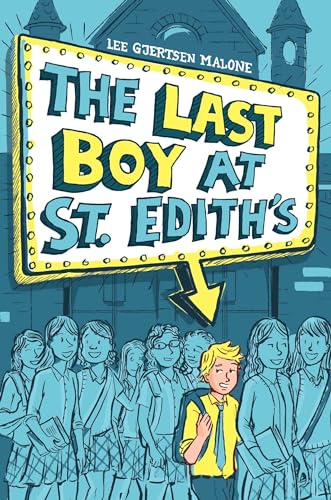
A seventh grade prankster is determined to escape the all-girls academy where he’s the only boy—by getting expelled—in this “spectacular debut” (Kirkus Reviews) that’s perfect for “fans of Jerry Spinelli’s Crash and Loser” (Booklist).
Seventh grader Jeremy Miner has a girl problem. Or, more accurately, a girls problem. 475 of them to be exact. That’s how many girls attend his school, St. Edith’s Academy.
Jeremy is the only boy left after the school’s brief experiment in co-education. And he needs to get out. But his mother—a teacher at the school—won’t let him transfer, so Jeremy takes matters into his own hands: he’s going to get expelled.
Together with his best friend Claudia, Jeremy unleashes a series of hilarious pranks in hopes that he’ll get kicked out with minimal damage to his permanent record. But when his stunts start to backfire, Jeremy has to decide how far he’s willing to go and whom he’s willing to knock down to get out the door.
Die Inhaltsangabe kann sich auf eine andere Ausgabe dieses Titels beziehen.
Über die Autorin bzw. den Autor
Lee Gjertsen Malone is a Massachusetts transplant via Long Island, Brooklyn, and Ithaca, New York. As a journalist she’s written about everything from wedding planning to the banking crisis to how to build your own homemade camera satellite. Her interests include amateur cheese making, traveling, associating with animals, shushing people in movie theaters, kickboxing, and blinking very rapidly for no reason. She lives in Cambridge, Massachusetts, with her husband, daughter, and a rotating cast of pets.
Auszug. © Genehmigter Nachdruck. Alle Rechte vorbehalten.
The Last Boy at St. Edith’s
ONE
IT WAS THE THIRD DAY of the ninth week of school when Jeremy Miner decided to get kicked out of seventh grade.
He’d been sitting on a school bus waiting to go to MacArthur Prep to cheer on his sister Rachel and the rest of the St. Edith’s championship volleyball team. He’d been late, one of the last people on the bus, which meant he had to sit up front behind Mr. Reynolds.
Jeremy probably should have liked Mr. Reynolds more than he did. Reynolds was the language arts teacher, and Jeremy loved to read, not to mention he was the only male teacher at the school and the faculty advisor of the Film Club, Jeremy’s favorite after-school activity.
But there was something irritating about Reynolds. Maybe it was the fussy way he laid his finger next to his mouth when he was listening to a student, or how he called Jeremy “Mr. Miner” with such overpronounced emphasis on the “Mr.” that the girls in the back of the class would titter.
The driver was starting to close the door when Claudia darted onto the bus and slid into the seat next to Jeremy, the yard of ball chain wrapped around her neck and wrists looking like armor in contrast to the shredded pink tights she wore under her plaid skirt.
“Did you hear?” she hissed.
Claudia Hoffmann was one of Jeremy’s best friends. She was a year older than everyone else in their grade because her mother was Italian and her father was German and they’d lived in London, New Zealand, and Hong Kong when she was little. Somewhere along the way she missed a year of school. Claudia sometimes took the extra year as permission to dominate everyone else. (Not that she actually needed permission to do what she wanted most of the time.)
“No, what?”
“Andrew Marks transferred to Hereford Country Day.”
Jeremy let out a long breath and slumped down in his seat. “Oh no.”
Jeremy hadn’t particularly liked Andrew—nobody did—he brushed his teeth only about once a week, for one, and he talked about the Boston Red Sox far more than any one person should ever talk about anything. Andrew was the kind of guy Jeremy’s mom always said he should “make an effort with” and “try to get to know better.” But Jeremy figured that probably meant spending more time with Andrew, and since the time they spent together as the sole members of the boys’ tennis team was already pretty tedious, he couldn’t see how hanging out even more would improve things.
But Andrew did have one redeeming quality—he was male.
Because Jeremy had a girl problem. Or, more accurately, a girls problem. Four hundred and seventy-five of them, including his older sister, Rachel, who was in the eighth grade, and his younger sister, Jane, who was in fourth. That’s how many girls went to St. Edith’s Academy.
At home it was just his mom and his sisters. Jeremy’s dad was off saving the oceans in his solar-powered research boat. And now the only other boy in school had thrown in the towel, a day Jeremy had dreaded for two whole years.
“Why’d he transfer now?” Jeremy demanded, loud enough that Reynolds’s head poked up over the seat. He lowered his voice. “Why not over the summer?”
“I guess he was on a waiting list?” Claudia said. “Or maybe he came back and everybody else was gone and he decided to bail. Who knows? Andrew Marks is a moron.”
“You only say that because he never wanted to be in your movies.”
“No,” she said, cocking her head. “I say that because it’s undeniably true. He likes bad rap and professional wrestling. But that’s not the issue.”
“You bet that’s not the issue. Besides, lots of boys like stuff like that—”
“You don’t,” she said.
He ignored the interruption. He was used to them with Claudia. “The point is now I’m the last boy in the whole entire school.”
Jeremy had a list, buried deep in his desk drawer at home. Twenty-six names. A list of all the boys who had attended St. Edith’s. He’d made it in fifth grade, when they’d all pledged to transfer or get kicked out.
He’d vowed not to be the last one. Over the years he’d added a number to each of their names as they left, counting down, one by one, from twenty-six, every time swearing he would be next. But now his list was down to number two, Andrew Marks. And there was only one name left: Jeremy’s.
It was never supposed to come to this. He’d always hoped that his mom would let him transfer, or that some of the other boys would hang on until the end of eighth grade. Being one of a few boys, even if he didn’t especially like any of them, was manageable. Being the only boy was something else entirely.
St. Edith’s was what you might call a failed experiment. Founded in 1879 as an all-girls school—the words ACADEMY FOR GIRLS were still carved in the limestone above the imposing front doors—but faced with declining admissions, the board of trustees had decided to start admitting boys right before Jeremy was old enough for first grade.
But few boys ever wanted to attend. The school had a long-standing reputation as a staid and chaste academy for girls that no amount of rebranding could change. And the failure to attract male students meant boys’ sports suffered, which made it even harder to convince boys to come.
In a last-ditch effort, the trustees added a football team as a way to attract boys who wanted to play but perhaps would not have made the team at other, more sports-savvy schools. The problem was a football team needed thirty or forty kids to be really viable, and there were only fifty-two boys in the whole school, with only about twenty old enough to play.
So, in a controversial move that was infamous in the annals of western Massachusetts private schools, the trustees decided to make football mandatory.
Mandatory football was a disaster right from the start.
They didn’t call it that, of course. They called it “Fulfilling the physical education requirement through team sport,” and they made all the girls play on teams too, to make it fair. But it basically meant mandatory football for all the boys in seventh and eighth grade.
The football coach was Ms. Brewster, who also coached the badminton and lacrosse teams and seemed to think the only differences in football were the shape of the ball and a little bit of tackling. This was a catastrophic error, as seen in the team’s first game against coed MacArthur Prep.
Tiny seventy-five-pound seventh graders were crushed by onrushing linebackers. A boy who had never run for anything, not even a bus, collapsed, wheezing, in the end zone. And James McPhee, whose family had emigrated from Ireland and who was under the impression he was learning to play a slightly more physical version of soccer, saw the line of broad-shouldered players from the other team steaming down the field toward him, turned, and ran off, never to be heard from again.
Their team name—the Amazons—didn’t help either.
Jeremy was only in fourth grade at the time, so he wasn’t forced to play. Instead he stood dumbly on the sidelines, holding his embarrassing French horn, and prayed they would cancel mandatory football before he was old enough to join the team.
He got his wish.
Boys complained...
„Über diesen Titel“ kann sich auf eine andere Ausgabe dieses Titels beziehen.
Suchergebnisse für The Last Boy at St. Edith's (MAX)

Beispielbild für diese ISBN
The Last Boy at St. Edith's (MAX)
Anbieter: World of Books (was SecondSale), Montgomery, IL, USA
Verkäuferbewertung 5 von 5 Sternen

Zustand: Good. Item in good condition. Textbooks may not include supplemental items i.e. CDs, access codes etc. Artikel-Nr. 00093157306
Gebraucht kaufen
EUR 5,11
Versand gratis
Versand innerhalb von USA
Versand innerhalb von USA
Anzahl: 1 verfügbar
Beispielbild für diese ISBN
The Last Boy at St. Edith's
Verlag:
Simon & Schuster Children's Publishing, 2016
ISBN 10: 1481444352
ISBN 13: 9781481444354
Gebraucht
Hardcover
Anbieter: Better World Books: West, Reno, NV, USA
Verkäuferbewertung 5 von 5 Sternen
Zustand: Good. Pages intact with minimal writing/highlighting. The binding may be loose and creased. Dust jackets/supplements are not included. Stock photo provided. Product includes identifying sticker. Better World Books: Buy Books. Do Good. Artikel-Nr. 13026880-6
Gebraucht kaufen
EUR 6,08
Versand gratis
Versand innerhalb von USA
Versand innerhalb von USA
Anzahl: 1 verfügbar
Beispielbild für diese ISBN
The Last Boy at St. Edith's
Verlag:
Simon & Schuster Children's Publishing, 2016
ISBN 10: 1481444352
ISBN 13: 9781481444354
Gebraucht
Hardcover
Anbieter: Better World Books, Mishawaka, IN, USA
Verkäuferbewertung 5 von 5 Sternen
Zustand: Very Good. Former library copy. Pages intact with possible writing/highlighting. Binding strong with minor wear. Dust jackets/supplements may not be included. Includes library markings. Stock photo provided. Product includes identifying sticker. Better World Books: Buy Books. Do Good. Artikel-Nr. 11079155-75
Gebraucht kaufen
EUR 6,08
Versand gratis
Versand innerhalb von USA
Versand innerhalb von USA
Anzahl: 1 verfügbar
Beispielbild für diese ISBN
The Last Boy at St. Edith's
Anbieter: ThriftBooks-Dallas, Dallas, TX, USA
Verkäuferbewertung 5 von 5 Sternen
Hardcover. Zustand: As New. No Jacket. Pages are clean and are not marred by notes or folds of any kind. ~ ThriftBooks: Read More, Spend Less. Artikel-Nr. G1481444352I2N00
Gebraucht kaufen
EUR 7,40
Versand gratis
Versand innerhalb von USA
Versand innerhalb von USA
Anzahl: 1 verfügbar