
Verwandte Artikel zu How to Manage Disruptive Change: Adaptability | Leadership...
How to Manage Disruptive Change: Adaptability | Leadership | Vision | Technology | Talent - Softcover
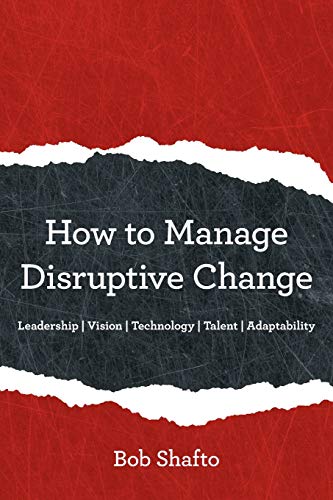
Inhaltsangabe
Adaptive leadership is a style that encourages sharing, listening to suggestions, seeking out uncomfortable opinions and ideas. Sometimes, saying, ?Tell me what you think I do not want to hear.? With collective wisdom decision-making, the combined cognitive differences can uncover hidden problems and opportunities, leading to perspective-shifting conclusions.
In an environment of disruptive change, strategic planning as we know it is no longer workable. Accelerating change makes the future less knowable and impossible to plan for, which is why organizations must be flexible, resilient, and innovative.
Today?s form of planning involves a process of progressive realization, the concept that knowledge, understanding, and perspectives are transient over time. Adaptive organizations are creating team-based business models designed to experiment, prototype, learn, and discover the future.
The book describes why adaptive leadership, vision, digital transformation and winning the talent war are strategic imperatives. Demanding attention, understanding, and action. They cannot be delegated; they must be led.
Get a set of management guidelines, concepts, and principles for succeeding amid disruptive change with the wisdom, lessons, and insights in this business guidebook.
Bob Shafto took over a failing computerization project at New England Mutual Life Insurance Company and transformed it into a leader in this area in subsequent decades. He has much to teach today?s leaders about adapting to disruptive digital transformations.
JoAnne Yates
Sloan Distinguished Professor of Management
MIT Sloan School of Management
Die Inhaltsangabe kann sich auf eine andere Ausgabe dieses Titels beziehen.
Über die Autorin bzw. den Autor
Bob Shafto
earned a bachelor's degree in actuarial science from Drake University. He managed computer systems for Guarantee Mutual, was a senior-systems engineer at Electronic Data Systems Corp. He joined New England Mutual Life as vice president and chief information officer. After a series of promotions, Mr. Shafto was appointed to Chairman of the Board and Chief Executive Officer (CEO). Mr. Shafto has more than thirty-five years of computer systems development, project, and executive management experience.
Auszug. © Genehmigter Nachdruck. Alle Rechte vorbehalten.
How to Manage Disruptive Change
Leadership | Vision | Technology | Talent
By Bob ShaftoArchway Publishing
Copyright © 2018 Managing Disruptive Change LLC.
All rights reserved.
ISBN: 978-1-4808-7125-0All rights reserved.
Contents
Introduction, vii,
1 Confront Reality of Disruptive Change, 1,
2 Adaptive Leadership — Followers, 5,
3 Shared Strategic Vision, 12,
4 Teams, Projects, Project Management, and Facilitation, 16,
5 Invest in Intangible Assets, 25,
6 Experimentation, Prototyping, and Discovery, 30,
7 Winning the Talent War, 35,
8 Digital Transformation, 54,
9 Virtual Organizations, 83,
10 Fifth-Generation Wireless Networks, 87,
11 Cybersecurity, 93,
Conclusion, 119,
Acknowledgments, 121,
Index, 123,
About the Author, 135,
CHAPTER 1
Confront Reality of Disruptive Change
The Status Quo Is an Illusion — Not Sustainable
If we could picture disruptive change by graphically displaying the speed (frequency) and the volatility (amplitude), we could appreciate the broad impact of the continually changing range of interrelated causes. We could see that both the speed and volatility are quickening. Today's environment has more disruptive change than at any time in history.
Technology will continue to get smaller, faster, more intelligent, networked, and integrated into everything. As the demographics and the customer requirements, tastes, and behaviors continue to change, so must the products and services that businesses offer.
Research shows that consumer behavior is changing. Many are moving to online retail, not getting married, not having as many children, downsizing their living space, cutting back on purchases, aggressively seeking deals, and preferring fresh and healthier food choices.
For example, for the millennials generation, seventy-three million strong, their primary source of news and information is the internet. They are highly educated and technologically connected and expect businesses to adjust to their needs. They communicate much differently than the earlier generations. The millennials will change the world more than any other generation.
Some businesses have become victims of disruptive change, while the fortunes of others have waxed and waned. Growth markets come and go. Everything has a shelf life.
In today's uncertain business environment, both the threats and the opportunities are accelerating. Albert Einstein said, "Our world is a product of our thinking; it cannot be changed without changing our thinking."
However, humans have been remarkably adaptive to change. We have learned to survive and prosper no matter what life, the environment, or technology throws at us. In our paradoxical world, organizations resist change with a powerful bias for the status quo. Many of us prefer consistency, keeping everything the same, a preference for the current and sticking with decisions made previously. The status quo is frequently used as a reference point for decision-making.
Behavioral science research has found that when faced with complicated issues, we have a mental shortcut that allows us to decide quickly and efficiently, where our current emotions of fear, pleasure, and surprise influence our decisions. In other words, emotions play a leading role when we face multifaceted judgments.
Our emotions rate more involved decisions on a bipolar scale that is good or bad, suggesting that we base many of our judgments not only on what we think about the decision but how we feel about it.
Understanding the heuristic effect, the mental shortcut that allows people to make judgments when dealing with complex problems is central to creating an adaptive organization.
The executive leadership must thoughtfully frame the communications based on how people think and instinctively decide. Clearly articulating the reality of the situation and the choices that influenced the decisions. Employees need to hear an exciting vision of growth and opportunity — a unique, genuine, compelling, and believable story. A story about innovative products and services created by cross-functional project teams. A strategic vision where employees can learn, develop, contribute, and bring value to the organization.
Disruptive change from developments in technology and changing demographics will create new challenges and new opportunities at every turn. The impact of disruptive change will require an organization to think differently and rethink everything.
CHAPTER 2Adaptive Leadership — Followers
Collective Wisdom — Progressive Realization
Organizations fail when the leadership's focus is on the status quo, the current operational effectiveness and efficiencies, the shareholders' reaction to quarterly earnings, and the traditional top-down strategic planning, control, and decision-making processes. Disruptive change has undermined the effectiveness of conventional strategic planning.
Failure comes from the following:
• not future-proofing the organization
• not creating a resilient business model
• not offering a strategic vision for the horizon
• not understanding:
* disruptive change
* digital transformation
* cybersecurity
• not focusing on talent management and employee satisfaction
• thinking they have all the answers
* not realizing that the future is discovered through prototyping and experimentation
• not building mutually beneficial business partnerships
• not investing in intangible assets
Strategic decision-making is about choices. The CEO and the leadership team are responsible for setting the organization's direction. In the shadows of doubt and uncertainty, they must find solutions for the impacts of disruptive change, digital transformation, and cybersecurity. So, how can you plan an organizational direction when you cannot predict the outcome of your choices? The answers are adaptive leadership, collective wisdom, an adaptive business model, and a process of experimentation, learning, and discovering.
Today's form of planning involves a process of progressive realization, the concept that knowledge, understanding, and perspectives are transient over time. Progressive realization uses a network of cross-functional teams to design and create alternatives, then test, measure, learn, rethink, and restart.
Adaptive leadership is a style where the CEO encourages sharing, the expression of ideas, and an active participatory role in decision-making. The management team should have unfettered discussions, ask questions, listen, have open dialogues and vigorous debates, challenge assumptions, and think long-term.
The team should avoid underestimating the threats or missed opportunities by narrowly framing the discussions. They should rethink the organization's strengths, weaknesses, and competitive positions. They should be innovative and consider a wide variety of options, then apply their collective wisdom to the risks and opportunities of the choices.
The CEO should consider introducing diverse ways of thinking and different reference points about the choices by adding a chief talent officer, a chief customer officer, and a chief artificial intelligence officer to the leadership team.
With collective wisdom decision-making, the leadership team's combined cognitive differences can create unique permutations and produce new innovative solutions. However, the most important...
„Über diesen Titel“ kann sich auf eine andere Ausgabe dieses Titels beziehen.
Suchergebnisse für How to Manage Disruptive Change: Adaptability | Leadership...

Beispielbild für diese ISBN
How to Manage Disruptive Change: Adaptability | Leadership | Vision | Technology | Talent
Anbieter: Ria Christie Collections, Uxbridge, Vereinigtes Königreich
Verkäuferbewertung 5 von 5 Sternen

Zustand: New. In English. Artikel-Nr. ria9781480871250_new
Neu kaufen
EUR 20,74
EUR 11,05 Versand
Versand von Vereinigtes Königreich nach USA
Versand von Vereinigtes Königreich nach USA
Anzahl: Mehr als 20 verfügbar