
Verwandte Artikel zu She Was Like That: New and Selected Stories
Inhaltsangabe
A NEW YORK TIMES 100 NOTABLE BOOKS OF 2019 SELECTION
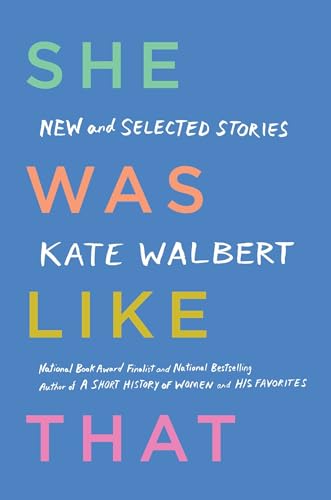
From Kate Walbert, the highly acclaimed, National Book Award nominee, comes a dazzling, career-spanning collection of new and selected stories.
In these twelve deft, acutely funny and often heartbreaking stories, Kate Walbert delves into the hearts and minds of women. Her characters are searchers, uneasy in one way or another. They yearn for connection. They question the definitions assigned to them as wives, mothers, and daughters; they seek their own way within isolated, and often isolating, circumstances, reveling in small, everyday epiphanies and moments of clarity.
In the riveting opening story “M&M World,” a woman is plunged into panic when she briefly loses one of her daughters at the vast and over-stimulating Times Square store. In “Slow the Heart,” a single mother tries to ease tension at the dinner table with Roses and Thorns, the game she knows the Obamas played in the White House. In “Radical Feminists,” a woman skating with her two children encounters the man who derailed her career years earlier. And in the poignant, “A Mother Is Someone Who Tells Jokes,” a mother reflects on the nursery school project that preceded her son’s autism diagnosis. This is a deeply moving, resonant collection from a writer “rightly celebrated for her ability to capture the variety and vulnerability of women’s lives with a combination of lyricism and brawn” (NPR).
Die Inhaltsangabe kann sich auf eine andere Ausgabe dieses Titels beziehen.
Über die Autorin bzw. den Autor
Kate Walbert is the author of seven works of fiction: She Was Like That, longlisted for the Story Prize and a New York Times Notable Book of the Year; His Favorites, an Atlantic Monthly Best Book of the Year; The Sunken Cathedral; A Short History of Women, a New York Times Book Review 10 Best Books of the Year and finalist for the Los Angeles Times Book Prize; Our Kind, a National Book Award finalist; The Gardens of Kyoto; and the story collection Where She Went. Her work has appeared in many publications, including The New Yorker, The Paris Review, The Best American Short Stories, and The O. Henry Prize stories. She lives with her family in New York City.
Auszug. © Genehmigter Nachdruck. Alle Rechte vorbehalten.
M&M World
Ginny had promised to take the girls to M&M World, that ridiculous place in Times Square they had passed too often in a taxi, Maggie scooting to press her face to the glass to watch the giant smiling M&M scale the Empire State Building on the electronic billboard and wave from the spire, its color dissolving yellow, then blue, then red, then yellow again. She had promised. “Promised,” Olivia said, her face twisted into the expression she reserved for moments of betrayal. “Please,” Olivia whined. “You said ‘spring.’?”
She had said “spring.” This she remembered, and it was spring, or almost. Spring enough. Spring advancing, the trees newly budded, the air peppery. Regardless, it felt too early to go home when the light shone this strongly, slanting across Central Park in the way of late March, early April; plus, the city had already collectively sprung forward. Spring has sprung, the grass has ris’.
“All right,” she found herself saying. “Just once. Today. Just once. This is it.” Breaking her resolution to stop qualifying—five more minutes, this last page, one more bite—and wishing, mid-speech, she would stop. She has tried. Just as she has tried to be more easygoing, but when push comes to shove, as it always will, she is not easygoing. And she qualifies. It’s a verbal tic: first this and then that. A constant negotiation—action then reward, or promise of reward. What is it that the books say? Screw the books.
She takes the girls’ hands and holds tight, changing course, crossing Central Park West to Central Park South. The girls suddenly delighted, and delightful, straining ahead, buoyant. They are gorgeous, bright-eyed, brilliant girls: one tall, one short, pant legs dragging, torn leggings, sneakers that glow in the dark or light up with each step, boom boom boom. They break free and race across, bounding onto the sidewalk, their hands rejoined like paper cutouts, zigzagging here, zigzagging there, Maggie clutching Zoom Zoom with her free hand, choking the thing, its dangly legs and arms, its floppy, flattened ears.
Ginny follows them quickly, remembering how her heart would literally stop as Olivia—then what? four? five?—would run to this same corner, the light not yet changed. Her daughter had only to step into traffic, to veer off the curb. She never did. Olivia climbed the stone seals at seal park in Chelsea, the bronze bears in the playground outside the Metropolitan Museum; she teetered on their heads and could so easily have slipped—she did slip, once, but it was nothing. Still, Ginny had to wake her every hour that night, shake her out of her sleepy fog. “Who am I?” Ginny had said, Olivia’s blue princess pajamas silky beneath her grip, Olivia’s shoulders so thin. “Mommy?” Olivia said, squinting, pupils the right size, shrinking: constricting or contracting, she never knew which, but, whatever, correctly—she was fine. And then, a bit older, those other sneakers—wheelies? heelies?—and Olivia careering along the sidewalk, wheels where the heels should be, the speed! And downhill, too, with nothing to hold on to, no way to stop. The pediatrician had said the most dangerous thing was trampolines, even with nets. And then the rented house that summer had one, netless, in the backyard. She had watched as the girls bounced higher and higher. She couldn’t get them off, Olivia and now Maggie, just like her big sister. She had stood vigil at the window, or next to the rail in her hat and long sleeves buttoned at the wrist, the girls slathered with sunscreen. The point is, her heart stuck in her throat, always in her throat.
Ginny hurries to catch up. One has tripped the other accidentally on purpose and now the other howls as if singed with fire.
“Stop it,” Ginny hisses. “Right now. Period. Stop it or no M&M World.”
They stop, Olivia smiling to clear the air, though the air stinks: they’re near a line of carriages and their horses.
“Please,” Maggie’s saying. “Please. Please.” And so they circle around, petting Blackie, petting Whitey, petting Gummie with the drippy nostrils, the one the driver says loves sugar—“Yes, yes, next time we’ll bring a sugar cube”—and Whinny and Happy and the other one, its long yellow teeth reminding her: she needs to bleach. Suddenly everyone’s teeth are whiter than her own; they wear them like necklaces. And their faces, too, seem suspiciously doctored, first one line then another magically evaporating, a whole generation of women paying for erasure.
“Ouch,” Maggie says. She holds one hand flat as instructed, the brown carrot there, a gift from the driver. The driver laughs. “No danger,” he says. The horse roots and chews. “You’re fine,” Ginny says. She strokes the soft hair of the horse’s muzzle, the horse nuzzling Maggie’s tiny palm; it wears a hat with a feathered plume, as if it had trotted here from the stables of a fallen tsar. Ginny leans into its solid skull, and the horse stares back at her with a huge watery eye. Where am I? it wonders, or something equivalent, and she thinks of the whale in Patagonia that asked the same thing. This was years ago, before the girls were born, when she and the girls’ father took a trip to Chile.
They were there for vacation; there to see animals. Animals had been promised, including whales. A center existed, manned by earnest students, young men and women from all over the world who spoke Spanish beautifully and wore thin silver bracelets with a symbol that meant something. They piloted the boats and explained to the tourists the seriousness of the venture, the need for extra donations. The tourists kept quiet, mostly, standing on the side of the boat where they’d been told to stand, given the radar and various other instruments that would determine the location of the whales—sometimes a female with a calf or two or, rarer, a male on its own. The whales communicated over great distances, as everyone knew, but the students could intercept their communications, or decipher them: regardless, somehow the students knew what the whales were saying, or might be saying, and so could steer the boat in the right direction, where, for a fee, the tourists could take pictures of the whale surfacing or of the plume of water from the blowhole, or sometimes, even, if the tourists were very lucky, of a whale jumping gracefully as if showing off.
On this particular voyage, the one Ginny found herself on with the girls’ father, Ginny chose to stay on the side of the boat with more shade. She was hot, she told the girls’ father. He could call her if anything exciting happened. She had opened her book: War and Peace, a paperback edition she had picked up in the paperback exchange in Santiago, where they had stayed for a few days before heading south. She had been at a good part, a really good part, and so perhaps it took some time for the whale to get her attention. She had had, when she later thought about it, the feeling of being watched. And so she had looked up from her place in War and Peace and seen the whale, a female, she would learn, uncharacteristically alone, lolling before her on the surface of the water. She folded the corner of her page and stood, shading her eyes; then she walked to the boat rail to get a better look. She didn’t call the girls’ father; she didn’t call anyone. She looked down at the...
„Über diesen Titel“ kann sich auf eine andere Ausgabe dieses Titels beziehen.
Suchergebnisse für She Was Like That: New and Selected Stories

Beispielbild für diese ISBN
She Was Like That: New and Selected Stories
Anbieter: World of Books (was SecondSale), Montgomery, IL, USA
Verkäuferbewertung 5 von 5 Sternen

Zustand: Good. Item in good condition. Textbooks may not include supplemental items i.e. CDs, access codes etc. Artikel-Nr. 00092171544
Gebraucht kaufen
EUR 4,08
Versand gratis
Versand innerhalb von USA
Versand innerhalb von USA
Anzahl: 2 verfügbar
Beispielbild für diese ISBN
She Was Like That: New and Selected Stories
Anbieter: BooksRun, Philadelphia, PA, USA
Verkäuferbewertung 5 von 5 Sternen
Hardcover. Zustand: Very Good. With dust jacket. It's a well-cared-for item that has seen limited use. The item may show minor signs of wear. All the text is legible, with all pages included. It may have slight markings and/or highlighting. Artikel-Nr. 1476799423-11-1-29
Gebraucht kaufen
EUR 5,51
Versand gratis
Versand innerhalb von USA
Versand innerhalb von USA
Anzahl: 1 verfügbar
Beispielbild für diese ISBN
She Was Like That : New and Selected Stories
Anbieter: Better World Books, Mishawaka, IN, USA
Verkäuferbewertung 5 von 5 Sternen
Zustand: Very Good. Former library copy. Pages intact with possible writing/highlighting. Binding strong with minor wear. Dust jackets/supplements may not be included. Includes library markings. Stock photo provided. Product includes identifying sticker. Better World Books: Buy Books. Do Good. Artikel-Nr. 19008010-6
Gebraucht kaufen
EUR 5,97
Versand gratis
Versand innerhalb von USA
Versand innerhalb von USA
Anzahl: 1 verfügbar
Beispielbild für diese ISBN
She Was Like That : New and Selected Stories
Anbieter: Better World Books: West, Reno, NV, USA
Verkäuferbewertung 5 von 5 Sternen
Zustand: Very Good. Former library copy. Pages intact with possible writing/highlighting. Binding strong with minor wear. Dust jackets/supplements may not be included. Includes library markings. Stock photo provided. Product includes identifying sticker. Better World Books: Buy Books. Do Good. Artikel-Nr. 19008010-6
Gebraucht kaufen
EUR 5,97
Versand gratis
Versand innerhalb von USA
Versand innerhalb von USA
Anzahl: 1 verfügbar
Beispielbild für diese ISBN
She Was Like That: New and Selected Stories
Anbieter: ThriftBooks-Atlanta, AUSTELL, GA, USA
Verkäuferbewertung 5 von 5 Sternen
Hardcover. Zustand: Very Good. No Jacket. May have limited writing in cover pages. Pages are unmarked. ~ ThriftBooks: Read More, Spend Less. Artikel-Nr. G1476799423I4N00
Gebraucht kaufen
EUR 6,62
Versand gratis
Versand innerhalb von USA
Versand innerhalb von USA
Anzahl: 1 verfügbar
Beispielbild für diese ISBN
She Was Like That: New and Selected Stories
Anbieter: WorldofBooks, Goring-By-Sea, WS, Vereinigtes Königreich
Verkäuferbewertung 5 von 5 Sternen
Paperback. Zustand: Fair. A readable copy of the book which may include some defects such as highlighting and notes. Cover and pages may be creased and show discolouration. Artikel-Nr. GOR015091158
Gebraucht kaufen
EUR 28,77
EUR 6,52 Versand
Versand von Vereinigtes Königreich nach USA
Versand von Vereinigtes Königreich nach USA
Anzahl: 1 verfügbar