
Verwandte Artikel zu Setting Fires: A Novel
Inhaltsangabe
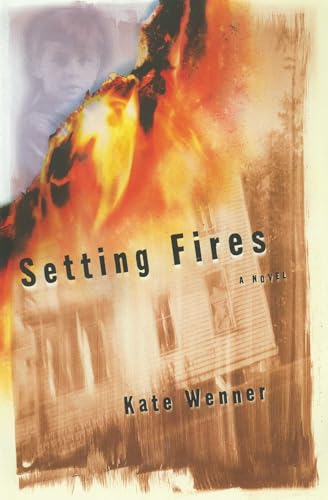
Setting Fires is the gripping story of Annie Fishman Waldmas, a documentary filmmaker, wife, and mother of two young children, who uses her professional skills to unravel the shocking secrets behind the two fires that come to dominate and haunt her life.
The novel begins with a pair of phone calls that shatter Annie's contentment forever. The first brings news that Annie's country house in Connecticut has burned, in an area where two other Jewish-owned buildings have also recently burned down. The second and far more distressing call informs Annie that her beloved father -- the family patriarch, burdened by a lifelong shame that Annie will soon uncover -- has been diagnosed with cancer.
Gradually, as Annie and her father forge a new and closer bond, he is able to acknowledge his history of poverty, his struggle for survival, and the near-tragedy it led to. Annie's determination to help her father find peace and forgiveness before dying meshes inextricably with her determination to find and expose the anti-Semitic arsonist who threatens her own family.
Annie's passionate search reaches back four generations from the early roots of the Fishman clan in Russia and New York to the modern-day lives of Annie, her siblings, and their divorced parents. At the same time, it throws Annie's relationships with her own husband and children into chaos, and rocks the family life on which she has always depended for stability and support. Not until Annie discovers and resolves the final truths -- by her own wit, perseverance, and self-knowledge -- can she reestablish the harmony she treasures.
Kate Wenner, an award-winning former producer of 20/20, makes a startling fiction debut in this powerful novel about a courageous woman's struggle to come to terms with a complex family history.
Die Inhaltsangabe kann sich auf eine andere Ausgabe dieses Titels beziehen.
Über die Autorin bzw. den Autor
Kate Wenner was raised in California during the 1950s, graduated from Harvard, and traveled throughout Europe, the Middle East, East Africa, and Central and South America before moving to New York, where she spent fourteen years as an award-winning producer for ABC's 20/20. Wenner is the author of the novel Setting Fires and a memoir, Shamba Letu: An American Girl's Adventures in Africa. She lives in New York City and the Berkshires with her husband, artist Gil Eisner, and their two children.
Auszug. © Genehmigter Nachdruck. Alle Rechte vorbehalten.
Chapter One
Two fires taught me lessons about my life, two fires separated by nearly six decades. The second fire was mine, but the first was my father's, and it happened in 1931, when he was fourteen years old.
My father, Abraham David Fishman, was a short boy with large dark eyes, a Buster Brown haircut, skinny arms, and bowlegs. He was the youngest of four children living in a dreary, two-room apartment on Flatbush Avenue in Brooklyn. Abie's father was long dead. Abie's mother was a walnut-faced woman with the shape of a fireplug, who pursued her small family's survival with brutal tenacity. It had taken Minnie Fishman -- an immigrant from Russia -- three decades in America to reach the pinnacle of all her hopes: her own dry goods shop stocked with everything from bolts of fabric to ladies' undergarments.
There had been other fires in Minnie Fishman's stores, but they were a dim and mostly forgotten part of young Abie's experience. The fire that changed his life, the one that became indelible, took place on Christmas Eve, a night of plummeting temperatures before a dusting snow.
As usual, Abie was helping his mother and sister in the store. Even though they were Jews (by birth, if not by practice), Christmas was an important season for the Fishmans, a time to sell to the Italian immigrants who had moved into the neighborhood. Because of the holiday they had been busy sorting and organizing merchandise until midnight. As they prepared to lock up, Minnie ordered Abie to bring in the empty cardboard boxes he had stacked in the alley that morning. Abie didn't understand why his sister, Fanny, older by five years, was pulling the paper stuffing from the boxes and spreading it across the floor. Or why Fanny and Minnie were whispering. Or why they ran out to hush him up when he whistled a John Philip Sousa march as he cranked up the awning.
At home, two short blocks away, Abie and Fanny were hurried into bed. Their mother pretended she had been sleeping when the police came pounding at the door. Terrible news: Her dry goods shop was blazing. The Fishmans ran back up the street they had just come down. Abie saw the yellow-orange flames flicking through the broken windows. The new snow touched his eyelids.
Minnie Fishman wailed in despair, holding her head between her hands and rocking it back and forth as if to deny the awful thing that was happening to her. The Irish policemen nodded in sympathy. The poor Widow Fishman. To think of such bad luck at Christmastime.
Minnie Fishman was an expert at self-induced fainting. She crumpled right on the spot, and the policemen shooed everyone away so they could minister to the fallen widow. Unnoticed, my father stepped back into the protective shadows of the night. He felt the heat, and when he smelled the oddly familiar stench of burning cotton, the scrim of childhood lifted. At fourteen, Abie Fishman was now old enough to see clearly. As the flames grew and destroyed all of Minnie Fishman's unsold and insured merchandise, the drama that formed my father's character, the story of his life, began.
My fire happened fifty-six years later. At that time I did not know about his fire. I'm sure that in a way he didn't really know about it either. My father had dedicated himself to leaving his past behind. He had been a poor boy, and now he was a wealthy man. Doggedly he had used his wits and his will, tackled life's adversities, and won. He had gained the trust and admiration of other wealthy men who turned their money over to him so he could double and triple its value in real estate investments. He protected their profits with clever foresight and a rigorous manipulation of the federal tax codes. He did not break laws, but he found the gray areas where interpretation could be argued. My father knew he was smart, and he relished his intelligence. Sometimes he would muse proudly about how we peripatetic Jews had developed our splendid brain pool by constantly having to pull up stakes and move on with nothing but the cargo between our ears. At other times, in a less sanguine mood, when a cranky antagonism overcame him, Abe Fishman would explain that the reason he had resolutely turned his back on his Jewish roots was because the words "Jew" and "poor" were synonymous to him.
The date of my fire was October 4, 1987. When I got the call, I was working in my eighth-story office, the back half of a converted loft in the Tribeca section of downtown New York. From that perch, where I had a sliver of a view of the Hudson River, I ran my own small documentary production company, which had won a respectable number of awards for programs that investigated injustices done to women and children. That was my niche.
I could never manage to eat much before the sun went down, so during the daylight hours caffeine kept me going. The phone call came at eleven-thirty in the morning, about the time I had finished my third cup of coffee. A neighbor who lived a quarter of a mile down the road from our country home, a small farmhouse in the town of Brookford, Connecticut, had spotted smoke pouring from our chimney. Maybe it was only something wrong with the furnace, but to be on the safe side she had summoned the fire department.
I telephoned the house, hoping to talk with the firemen as soon as they arrived, but each time I dialed, the phone was busy. I called the operator. She put me on hold while she checked the line. I stared at the second hand on my watch as I waited for her return. In a minute and forty-two seconds she was back. Our phone line had shorted out. I might want to call the local fire department to have them go over and take a look. Just a precaution, she assured me. Better to feel secure.
Panicked, I called my husband, Josh. At eleven-thirty in the morning he'd be holed up in his cubby in a corner of the newsroom of The New York Times poring over the pile of photographs that were under consideration for the next edition of the newspaper. Josh's job was to select the pictures of the politicians, heroes, and criminals that illustrated The Times each morning. He would have preferred to be the one taking the photographs, but the truth was his temperament was more suited to coping with the frenetic pace of the newsroom than it was to being out on the streets of the city battling other newspaper photographers for the best shot.
"The house in the country might be on fire," I said quickly, getting in the crucial information before he could bark at me for calling.
"Annie, I've got to get into the front page meeting."
"Josh, did you hear me?"
My second line was ringing. I put Josh on hold while I picked it up. It was our neighbor, confirming that indeed there was a fire. At that very moment our beloved country house, the place that had depleted our small savings nine years back, the run-down Colonial we had joyfully restored to its original simplicity, the peaceful retreat where we had brought our children when they were newborn babies -- our home and refuge from New York City life -- was burning out of control.
Three hours later (an hour for Josh to meet his photo deadlines and two hours for us to drive northeast at a terrifying speed) Josh and I fell silent as we rode up the last hill to our house. I had been biting my cuticles raw for the last hour of the drive, and now I dropped my smarting hand over Josh's as he shifted into a lower gear. He did not look away from the road, but he opened his long fingers to enclose mine.
Pickup trucks lined the road in front of our house. They belonged to the local men who coped with town emergencies -- the men who manned the town ambulance, drove snowplows and salt trucks through frigid winter nights, put out fires. These men would come at any time of day or night to pull a neighbor's car out of a snowbank or to ferry a child with a broken arm...
„Über diesen Titel“ kann sich auf eine andere Ausgabe dieses Titels beziehen.
Suchergebnisse für Setting Fires: A Novel

Beispielbild für diese ISBN
Setting Fires
Anbieter: Revaluation Books, Exeter, Vereinigtes Königreich
Verkäuferbewertung 5 von 5 Sternen

Paperback. Zustand: Brand New. reprint edition. 301 pages. 9.50x6.25x1.00 inches. In Stock. Artikel-Nr. x-1476790744
Neu kaufen
EUR 24,30
EUR 11,77 Versand
Versand von Vereinigtes Königreich nach USA
Versand von Vereinigtes Königreich nach USA
Anzahl: 2 verfügbar