
Verwandte Artikel zu A Vision of Fire: Book 1 of The EarthEnd Saga
Inhaltsangabe
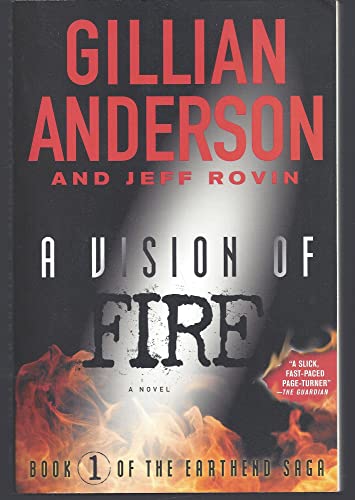
A Vision of Fire is the explosive first novel from iconic X-Files star Gillian Anderson and New York Times bestselling author Jeff Rovin: “Fans of Douglas Preston and Lincoln Child will find a lot to like” (Publishers Weekly).
Renowned child psychologist Caitlin O’Hara is a single mom trying to juggle her job, her son, and a lackluster dating life. Her world is suddenly upturned when Maanik, the daughter of India’s ambassador to the United Nations starts speaking in tongues and having violent visions. Maanik’s parents are sure that her fits have something to do with the recent assassination attempt on her father—a shooting that has escalated nuclear tensions between India and Pakistan to dangerous levels—but when children start having similar outbursts around the world, Caitlin begins to think that there’s a stranger force at work.
In Haiti, a student claws at her throat, drowning on dry land. In Iran, a boy suddenly and inexplicably bursts into flame. On the Pakistan border, a young man feels a burning in his chest and, against his will, opens fire on Indian troops. With Asia on the cusp of nuclear war, Caitlin must race across the globe and uncover the supernatural links between these seemingly unrelated cases in order to save her patient—and perhaps the world.
The first in a series, A Vision of Fire is a pulse-pounding thriller that will leave you gasping for more.
Die Inhaltsangabe kann sich auf eine andere Ausgabe dieses Titels beziehen.
Über die Autorinnen und Autoren
Gillian Anderson is an award-winning film, television, and theater actor and producer, writer, and activist. She currently lives in London with her daughter and two sons.
Jeff Rovin is the author of more than one-hundred books, fiction and nonfiction, both under his own name, under various pseudonyms, or as a ghostwriter, including numerous New York Times bestsellers. He has written over a dozen Op-Center novels for the late Tom Clancy. Rovin has also written for television and has had numerous celebrity interviews published in magazines under his byline. He is a member of the Author’s Guild, the Science Fiction Writers of America, and the Horror Writers of America, among others.
Auszug. © Genehmigter Nachdruck. Alle Rechte vorbehalten.
A Vision of Fire
CHAPTER 1
It was an unseasonably warm October morning, better suited for a stroll than a stride, but Ganak Pawar and his daughter maintained their usual quick pace up the east side of Manhattan. The permanent representative of India to the United Nations, veteran of thirty years as a foreign-service officer, wore a practiced expression of tolerance. Sixteen-year-old Maanik seemed especially energized by the blanket of sunlight that spilled across York Avenue.
“Papa, your presentation last night was amazing!” Maanik said. “I couldn’t get to sleep for hours, my brain was alive with so many ideas.”
“That is gratifying,” her father replied.
“It’s time for people to think differently about Kashmir and you made that point with the General Assembly,” she said. “I’m glad CNN covered it, it was totally inspiring.”
“I am glad you feel so. I am not being universally thanked for it.”
“Papa, you got in their faces. That took courage!”
Ganak smiled. “I ‘got in their faces,’ did I?”
“You know what I mean,” his daughter said, grinning. “Anyway, don’t be so modest, especially now. Now is the time for a determined follow-up.”
Ganak wasn’t sure if it was courage or desperation that had compelled him to show the video of a Kashmiri mother immolating herself over her dead son. Tensions occurred in Kashmir every few years but this time it felt different. Thirty-two people had died in two days, and Pakistan and India were once again rattling their nuclear sabers. Perhaps that familiar, tired bragging had driven Ganak to suggest they make Kashmir a UN protectorate. If the UN temporarily governed the region, as it had in Kosovo for nine years, that could buy time for the populace to choose whether to join one country or the other, or to opt for independence . . .
“Papa?”
“Yes?”
“I want to be part of that follow-up,” Maanik said, bouncing in her stride with excitement. “You should hear my ideas.”
He smiled as he regarded her. She looked so mature in her brown faux leather jacket over a dark blue dress. Her leggings were orange and gold, one leg striped horizontally, the other swirling in a feather pattern. She had sewn the disparate halves together herself and matched them with an orange and gold scarf. He noticed with surprise that she had begun to pluck her eyebrows, and though her black hair had always been strong and thick, the way she arranged it over her shoulder was a recent development.
She is so unlike her mother, he thought. When the Pawar family had moved from New Delhi to Manhattan two years ago and Maanik started at Eleanor Roosevelt High School, the girl immediately began to change. Where her mother, Hansa, was reflective, Maanik did her thinking aloud. Where Hansa planned, Maanik improvised. Hansa embraced tradition but Maanik liked to Rollerblade on the sly with the son of the Canadian ambassador. The Pawars’ American bodyguard, Daniel—who was walking a few paces behind them—was charged with clandestinely keeping an eye on the young lady when she was not at home.
Ganak couldn’t decide whether he was concerned at her shrugging off the old ways or if he was proud that she lived her own life. Hansa did not like it but Ganak was not sure, and his diplomatic skills were sometimes tested at home in ways that could rival the current crisis in Kashmir.
Thinking of India and Pakistan pulled down the edges of his smile. These days, walking Maanik to school was one of his only refuges.
“Maanik, I want to hear your ideas but I must caution you, sometimes it is wise to pause after a push.”
“How can that be wise?” she asked. “If something is moving, why not keep it in motion?”
“I read the reports from home before we left this morning. India and Pakistan are both infuriated even while the rest of the world applauds the idea of a protectorate.”
“That’s my point,” Maanik said, undaunted. “Now you need to convince India and Pakistan.”
“Ah. It is that simple?”
“Maybe not so simple, but my ideas can help with that. I’ve been thinking up op-eds for you, press releases, but especially”—she turned and walked backward, facing him and glowing—“what if you let me interview you on video, talking about the situation? Networks would eat that up, parents would watch it with their children, it would be casual and nonthreatening but with our hearts in it, you know? We could get people used to your proposal through conversation instead of arguments. If we get it just right, maybe it could go viral.”
Ganak was impressed. Maanik had prepared a presentation of her own. This revelation about his daughter was one of the reasons that, even in the middle of a crisis, he insisted on maintaining their half-hour, no-cell-phones walk to school.
“Those are very creative ideas, Maanik.”
“Okay! So the next step is, I take a break from school and get an internship with you at United Nations headquarters. Actually, school will probably count that as a class—”
Ganak interrupted. “Interns at the headquarters must be in graduate school. High school students are out of the question.”
“But, Bapu”—she softened him with the Hindi word for “Daddy”—“I have the intelligence and the desire and right now my help is crucial.”
“I appreciate your interest, but every member of the staff is well-credentialed, not just well-intentioned.”
“An exception can be made—”
“Exceptions are the exceptions,” he said.
Maanik frowned. “I don’t even understand that.”
“It means no. I’m sorry, Maanik.”
She turned and walked forward again, visibly frustrated. “So I am supposed to just waste my days thinking up ideas and never making any of them happen?”
“You are a very exceptional young lady—”
“And I am telling you, I am wasting time at school.”
“You are learning about other lives, other times.”
“While I ignore the fact that our homeland could erupt into war? I am trapped in irrelevance, Bapu. I want to help.”
“Your books are not irrelevant.”
“Really? And what if one crazy officer in one of the armies actually prepares to launch a warhead this time? What would you do, talk to him about a novel you read? Or a poem?”
“Maanik, my life, you are about to lose this argument.” He smiled.
“Oh?” She stopped on the corner of Seventy-Sixth Street, shifted her weight onto one hip, and raised her eyebrows at him. “How?”
He grinned. “You are young and impatient. I have been where you have been, but you have not been where I have been.”
Maanik turned suddenly to the six-foot-two blond man with the crooked nose who stood behind them. “Daniel, do you think that’s a good argument?”
“I am neutral in this, ma’am,” said the bodyguard with a smile. Behind the reflective sunglasses his eyes were on the pedestrians who moved around them,...
„Über diesen Titel“ kann sich auf eine andere Ausgabe dieses Titels beziehen.
Suchergebnisse für A Vision of Fire: Book 1 of The EarthEnd Saga

Beispielbild für diese ISBN
A Vision of Fire: Book 1 of The EarthEnd Saga (1)
Verlag:
Simon & Schuster/ Simon451, 2015
ISBN 10: 1476776539
ISBN 13: 9781476776538
Gebraucht
Softcover
Anbieter: World of Books (was SecondSale), Montgomery, IL, USA
Verkäuferbewertung 5 von 5 Sternen

Zustand: Good. Item in good condition. Textbooks may not include supplemental items i.e. CDs, access codes etc. Artikel-Nr. 00099372604
Gebraucht kaufen
EUR 5,79
Versand gratis
Versand innerhalb von USA
Versand innerhalb von USA
Anzahl: 2 verfügbar
Beispielbild für diese ISBN
A Vision of Fire: Book 1 of The EarthEnd Saga (1)
Verlag:
Simon & Schuster/ Simon451 (edition 451st ed.), 2015
ISBN 10: 1476776539
ISBN 13: 9781476776538
Gebraucht
Paperback
Anbieter: BooksRun, Philadelphia, PA, USA
Verkäuferbewertung 5 von 5 Sternen
Paperback. Zustand: Very Good. 451st ed. It's a well-cared-for item that has seen limited use. The item may show minor signs of wear. All the text is legible, with all pages included. It may have slight markings and/or highlighting. Artikel-Nr. 1476776539-11-1
Gebraucht kaufen
EUR 5,80
Versand gratis
Versand innerhalb von USA
Versand innerhalb von USA
Anzahl: 1 verfügbar
Beispielbild für diese ISBN
A Vision of Fire: Book 1 of the Earthend Sagavolume 1
Verlag:
Simon & Schuster/ Simon451, 2015
ISBN 10: 1476776539
ISBN 13: 9781476776538
Gebraucht
Paperback
Anbieter: ThriftBooks-Phoenix, Phoenix, AZ, USA
Verkäuferbewertung 5 von 5 Sternen
Paperback. Zustand: Good. No Jacket. Pages can have notes/highlighting. Spine may show signs of wear. ~ ThriftBooks: Read More, Spend Less. Artikel-Nr. G1476776539I3N00
Gebraucht kaufen
EUR 6,09
Versand gratis
Versand innerhalb von USA
Versand innerhalb von USA
Anzahl: 1 verfügbar
Beispielbild für diese ISBN
A Vision of Fire: Book 1 of the Earthend Sagavolume 1
Verlag:
Simon & Schuster/ Simon451, 2015
ISBN 10: 1476776539
ISBN 13: 9781476776538
Gebraucht
Paperback
Anbieter: ThriftBooks-Dallas, Dallas, TX, USA
Verkäuferbewertung 5 von 5 Sternen
Paperback. Zustand: Good. No Jacket. Pages can have notes/highlighting. Spine may show signs of wear. ~ ThriftBooks: Read More, Spend Less. Artikel-Nr. G1476776539I3N00
Gebraucht kaufen
EUR 6,12
Versand gratis
Versand innerhalb von USA
Versand innerhalb von USA
Anzahl: 1 verfügbar
Beispielbild für diese ISBN
A Vision of Fire : Book 1 of the EarthEnd Saga
Anbieter: Better World Books, Mishawaka, IN, USA
Verkäuferbewertung 5 von 5 Sternen
Zustand: Good. Reprint. Pages intact with minimal writing/highlighting. The binding may be loose and creased. Dust jackets/supplements are not included. Stock photo provided. Product includes identifying sticker. Better World Books: Buy Books. Do Good. Artikel-Nr. 7533213-6
Gebraucht kaufen
EUR 6,57
Versand gratis
Versand innerhalb von USA
Versand innerhalb von USA
Anzahl: 2 verfügbar
Beispielbild für diese ISBN
A Vision of Fire : Book 1 of the EarthEnd Saga
Anbieter: Better World Books, Mishawaka, IN, USA
Verkäuferbewertung 5 von 5 Sternen
Zustand: Good. Reprint. Former library copy. Pages intact with minimal writing/highlighting. The binding may be loose and creased. Dust jackets/supplements are not included. Includes library markings. Stock photo provided. Product includes identifying sticker. Better World Books: Buy Books. Do Good. Artikel-Nr. 7987138-75
Gebraucht kaufen
EUR 6,57
Versand gratis
Versand innerhalb von USA
Versand innerhalb von USA
Anzahl: 1 verfügbar
Foto des Verkäufers
A Vision of Fire
Anbieter: Brenner's Collectable Books ABAA, IOBA, Manasquan, NJ, USA
Verkäuferbewertung 5 von 5 Sternen
Soft cover. Zustand: Fine. Trade Paperback 8vo., 292pp. Beautiful Unread First Paperback Edition, First Printing with full number sequence. Square tight and clean throughout with little or no wear. Fresh and bright with no chipping, creases or tears. A gorgeous collectable copy. Artikel-Nr. 010863
Gebraucht kaufen
EUR 9,19
EUR 4,42 Versand
Versand innerhalb von USA
Versand innerhalb von USA
Anzahl: 1 verfügbar
Beispielbild für diese ISBN
A Vision of Fire: Book 1 of The EarthEnd Saga
Verlag:
Simon & Schuster/ Simon451, 2015
ISBN 10: 1476776539
ISBN 13: 9781476776538
Gebraucht
Softcover
Anbieter: medimops, Berlin, Deutschland
Verkäuferbewertung 5 von 5 Sternen
Zustand: as new. Wie neu/Like new. Artikel-Nr. M01476776539-N
Gebraucht kaufen
EUR 5,65
EUR 10,00 Versand
Versand von Deutschland nach USA
Versand von Deutschland nach USA
Anzahl: 1 verfügbar
Beispielbild für diese ISBN
A Vision of Fire
Anbieter: Revaluation Books, Exeter, Vereinigtes Königreich
Verkäuferbewertung 5 von 5 Sternen
Paperback. Zustand: Brand New. reprint edition. 304 pages. 7.00x5.00x1.00 inches. In Stock. Artikel-Nr. x-1476776539
Neu kaufen
EUR 16,62
EUR 11,82 Versand
Versand von Vereinigtes Königreich nach USA
Versand von Vereinigtes Königreich nach USA
Anzahl: 2 verfügbar
Beispielbild für diese ISBN
A Vision of Fire: Book 1 of The EarthEnd Saga
Anbieter: Kennys Bookstore, Olney, MD, USA
Verkäuferbewertung 5 von 5 Sternen
Zustand: New. 2015. Paperback. . . . . . Books ship from the US and Ireland. Artikel-Nr. V9781476776538
Neu kaufen
EUR 21,03
EUR 9,37 Versand
Versand innerhalb von USA
Versand innerhalb von USA
Anzahl: Mehr als 20 verfügbar