
Verwandte Artikel zu Unfreedom of the Press
Inhaltsangabe
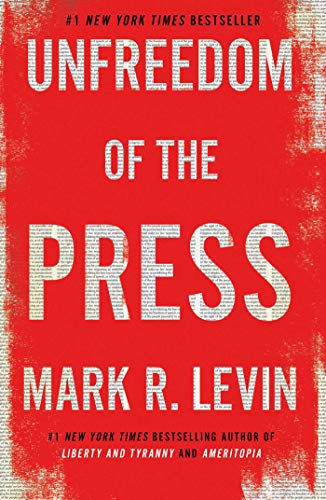
From six-time #1 New York Times bestselling author, FOX News star, and radio host Mark R. Levin comes a groundbreaking and enlightening book that shows how the great tradition of the American free press has degenerated into a standardless profession that has squandered the faith and trust of the American public, not through actions of government officials, but through its own abandonment of reportorial integrity and objective journalism.
Unfreedom of the Press is not just another book about the press. Levin shows how those entrusted with news reporting today are destroying freedom of the press from within: “not government oppression or suppression,” he writes, but self-censorship, group-think, bias by omission, and passing off opinion, propaganda, pseudo-events, and outright lies as news.
With the depth of historical background for which his books are renowned, Levin takes the reader on a journey through the early American patriot press, which proudly promoted the principles set forth in the Declaration of Independence and the Constitution, followed by the early decades of the Republic during which newspapers around the young country were open and transparent about their fierce allegiance to one political party or the other.
It was only at the start of the Progressive Era and the twentieth century that the supposed “objectivity of the press” first surfaced, leaving us where we are today: with a partisan party-press overwhelmingly aligned with a political ideology but hypocritically engaged in a massive untruth as to its real nature.
Die Inhaltsangabe kann sich auf eine andere Ausgabe dieses Titels beziehen.
Über die Autorin bzw. den Autor
Mark R. Levin, nationally syndicated talk radio host, host of LevinTV, chairman of Landmark Legal Foundation, and the host of the Fox News show Life, Liberty, & Levin, is the author of seven consecutive #1 New York Times bestsellers: Liberty and Tyranny, Ameritopia, The Liberty Amendments, Plunder and Deceit, Rediscovering Americanism, Unfreedom of the Press, and American Marxism. Liberty and Tyranny spent three months at #1 and sold more than 1.5 million copies. His books Men in Black and Rescuing Sprite were also New York Times bestsellers. Levin is an inductee of the National Radio Hall of Fame and was a top adviser to several members of President Ronald Reagan’s cabinet. He holds a BA from Temple University and a JD from Temple University Law School.
Auszug. © Genehmigter Nachdruck. Alle Rechte vorbehalten.
Unfreedom of the Press
ONE
NEWS AS POLITICAL AND IDEOLOGICAL ACTIVISM
WHAT DO WE mean by a “free press,” “press,” or “freedom of the press”?
What is the purpose of a free press? Is it to report information?
What kind of information? Is it to interpret or analyze information?
What is “the news”? How are decisions made about what is newsworthy and what is not?
What is a “news organization”? One person (a blogger), a group of people (a weekly newspaper), a corporate conglomerate (a television network)?
What is a “journalist”? What qualifies someone as a journalist? Experience, education, position, self-identification?
What is the job of a journalist? Is journalism a profession?
Are there standards?
Are journalists able to be “fair” or “objective”?
What is the purpose of reporting? To reinforce the founding and fundamental principles of the republic? To challenge public officials and authority? To give voice to certain individuals, groups, and causes? To influence politics and policy? To alter the status quo of a society? To promote “the common good” of the community?
What is the common good? Who decides?
What is the difference between freedom of the press and “free speech”? And does the current media revolution, spurred by technological advances such as the internet and social media, change any of this?
Do these questions even matter anymore to news outlets? The questions are rarely asked today let alone rationally discussed. They are infrequently the subject of open or public media circumspection or focused and sustained national debate. It seems “the media” are loath to investigate or explore “the media.” However, when the conduct of the media is questioned as biased, politically partisan, or otherwise irresponsible, they insist that they are of one mission: fidelity to the news and all that stems from it—protecting society from autocratic government, defending freedom of the press, and contributing to societal civility and justice. Moreover, they typically claim to pursue and report the news free from any personal or political agenda.
Is that true of the modern media?
More than seventy years ago, there was a serious self-examination of the media. The Commission on Freedom of the Press (also known as the Hutchins Commission) was organized in 1942 by Time and Life magazine publisher Henry Luce to explore whether freedom of the press was in danger and the proper function of the media in a modern democracy. Its report was issued in 1947 and concluded, in part, that freedom of the press was indeed in danger, and for three basic reasons: “First, the importance of the press to the people has greatly increased with the development of the press as an instrument of mass communication. At the same time the development of the press as an instrument of mass communication has greatly decreased the proportion of the people who can express their opinions and ideas through the press. Second, the few who are able to use the machinery of the press as an instrument of mass communication have not provided a service adequate to the needs of the society. Third, those who direct the machinery of the press have engaged from time to time in practices which the society condemns and which, if continued, it will inevitably undertake to regulate or control.”1
The commission warned: “The modern press itself is a new phenomenon. Its typical unit is the great agency of mass communication. These agencies can facilitate thought and discussion. They can stifle it. They can advance the progress of civilization or they can thwart it. They can debase and vulgarize mankind. They can endanger the peace of the world; they can do so accidentally, in a fit of absence of mind. They can play up or down the news and its significance, foster and feed emotions, create complacent fictions and blind spots, misuse the great words, and uphold empty slogans. Their scope and power are increasing every day as new instruments become available to them. These instruments can spread lies faster and farther than our forefathers dreamed when they enshrined the freedom of the press in the First Amendment to our Constitution.”2
The commission cautioned that “[w]ith the means of self-destruction that are now at their disposal, men must live, if they are to live at all, by self-restraint, moderation, and mutual understanding. They get their picture of one another through the press. The press can be inflammatory, sensational, and irresponsible. If it is, it and its freedom will go down in the universal catastrophe. On the other hand, the press can do its duty by the new world that is struggling to be born. It can help create a world community by giving men everywhere knowledge of the world and of one another, by promoting comprehension and appreciation of the goals of a free society that shall embrace all men.”3
Is this how the modern media conduct themselves? Self-restrained, measured, and temperate? Are the media providing knowledge and insight useful to the public and a free society, or are they obsessed with their own personal, political, and progressive predilections and piques? Have the media earned the respect and esteem of their readers, viewers, and listeners as fair and reliable purveyors of information, or are large numbers of the citizenry suspicious and distrustful of their reporting? Are the media on a trajectory of self-destruction, unofficially identifying with one political party (Democratic Party) over the other (Republican Party)?
In point of fact, most newsrooms and journalists have done a very poor job of upholding the tenets of their profession and, ultimately, have done severe damage to press freedom. Many millions of Americans do not respect them or trust them as credible, fair-minded, and unbiased news sources.
For example, on October 12, 2018, Gallup reported: “Republicans have typically placed less trust in the media than independents and especially Democrats, but the gap between Republicans and Democrats has grown. The current 55-percentage-point gap is among the largest to date, along with last year’s 58-point gap. President Donald Trump’s attacks on the ‘mainstream media’ are likely a factor in the increasingly polarized views of the media. Republicans agree with his assertions that the media unfairly cover his administration, while Democrats may see the media as the institution primarily checking the president’s power.”4
Furthermore, “Democrats’ trust surged last year and is now at 76%, the highest in Gallup’s trend by party, based on available data since 1997. Independents’ trust in the media is now at 42%, the highest for that group since 2005. Republicans continue to lag well behind the other party groups—just 21% trust the media—but that is up from 14% in 2016 and last year.”5 Another way to look at these statistics is that nearly 80 percent of Republicans distrust the media, while nearly 80 percent of Democrats trust the media. This would seem to underscore the close ideological and political association and tracking between Democrats and the press.
Lara...
„Über diesen Titel“ kann sich auf eine andere Ausgabe dieses Titels beziehen.
Suchergebnisse für Unfreedom of the Press

Beispielbild für diese ISBN
Unfreedom of the Press
Anbieter: World of Books (was SecondSale), Montgomery, IL, USA
Verkäuferbewertung 5 von 5 Sternen

Zustand: Good. Item in very good condition! Textbooks may not include supplemental items i.e. CDs, access codes etc. Artikel-Nr. 00076541317
Gebraucht kaufen
EUR 3,74
Versand gratis
Versand innerhalb von USA
Versand innerhalb von USA
Anzahl: 4 verfügbar
Beispielbild für diese ISBN
Unfreedom of the Press
Anbieter: World of Books (was SecondSale), Montgomery, IL, USA
Verkäuferbewertung 5 von 5 Sternen
Zustand: Good. Good condition ex-library book with usual library markings and stickers. Artikel-Nr. 00079632720
Gebraucht kaufen
EUR 3,74
Versand gratis
Versand innerhalb von USA
Versand innerhalb von USA
Anzahl: 2 verfügbar
Beispielbild für diese ISBN
Unfreedom of the Press
Anbieter: World of Books (was SecondSale), Montgomery, IL, USA
Verkäuferbewertung 5 von 5 Sternen
Zustand: Acceptable. Item in acceptable condition! Textbooks may not include supplemental items i.e. CDs, access codes etc. Artikel-Nr. 00081608593
Gebraucht kaufen
EUR 3,74
Versand gratis
Versand innerhalb von USA
Versand innerhalb von USA
Anzahl: 3 verfügbar
Beispielbild für diese ISBN
Unfreedom of the Press
Anbieter: World of Books (was SecondSale), Montgomery, IL, USA
Verkäuferbewertung 5 von 5 Sternen
Zustand: Good. Item in good condition and has highlighting/writing on text. Used texts may not contain supplemental items such as CDs, info-trac etc. Artikel-Nr. 00080440995
Gebraucht kaufen
EUR 3,74
Versand gratis
Versand innerhalb von USA
Versand innerhalb von USA
Anzahl: 3 verfügbar
Beispielbild für diese ISBN
Unfreedom of the Press
Anbieter: World of Books (was SecondSale), Montgomery, IL, USA
Verkäuferbewertung 5 von 5 Sternen
Zustand: Good. Item in good condition. Textbooks may not include supplemental items i.e. CDs, access codes etc. Artikel-Nr. 00062197318
Gebraucht kaufen
EUR 3,76
Versand gratis
Versand innerhalb von USA
Versand innerhalb von USA
Anzahl: Mehr als 20 verfügbar
Beispielbild für diese ISBN
Unfreedom of the Press
Anbieter: World of Books (was SecondSale), Montgomery, IL, USA
Verkäuferbewertung 5 von 5 Sternen
Zustand: Very Good. Item in very good condition! Textbooks may not include supplemental items i.e. CDs, access codes etc. Artikel-Nr. 00025699055
Gebraucht kaufen
EUR 3,76
Versand gratis
Versand innerhalb von USA
Versand innerhalb von USA
Anzahl: 1 verfügbar
Beispielbild für diese ISBN
Unfreedom of the Press
Anbieter: World of Books (was SecondSale), Montgomery, IL, USA
Verkäuferbewertung 5 von 5 Sternen
Zustand: Acceptable. Item in good condition. Textbooks may not include supplemental items i.e. CDs, access codes etc. Artikel-Nr. 00063790224
Gebraucht kaufen
EUR 3,76
Versand gratis
Versand innerhalb von USA
Versand innerhalb von USA
Anzahl: 3 verfügbar
Beispielbild für diese ISBN
Unfreedom of the Press
Verlag:
Threshold Editions (edition First Edition), 2019
ISBN 10: 1476773092
ISBN 13: 9781476773094
Gebraucht
Hardcover
Erstausgabe
Anbieter: BooksRun, Philadelphia, PA, USA
Verkäuferbewertung 5 von 5 Sternen
Hardcover. Zustand: Very Good. First Edition. It's a well-cared-for item that has seen limited use. The item may show minor signs of wear. All the text is legible, with all pages included. It may have slight markings and/or highlighting. Artikel-Nr. 1476773092-11-18
Gebraucht kaufen
EUR 5,09
Versand gratis
Versand innerhalb von USA
Versand innerhalb von USA
Anzahl: 1 verfügbar
Beispielbild für diese ISBN
Unfreedom of the Press
Verlag:
Threshold Editions (edition First Edition), 2019
ISBN 10: 1476773092
ISBN 13: 9781476773094
Gebraucht
Hardcover
Erstausgabe
Anbieter: BooksRun, Philadelphia, PA, USA
Verkäuferbewertung 5 von 5 Sternen
Hardcover. Zustand: Very Good. First Edition. With dust jacket. It's a well-cared-for item that has seen limited use. The item may show minor signs of wear. All the text is legible, with all pages included. It may have slight markings and/or highlighting. Artikel-Nr. 1476773092-11-1-29
Gebraucht kaufen
EUR 5,10
Versand gratis
Versand innerhalb von USA
Versand innerhalb von USA
Anzahl: 2 verfügbar
Beispielbild für diese ISBN
Unfreedom of the Press
Verlag:
Threshold Editions (edition First Edition), 2019
ISBN 10: 1476773092
ISBN 13: 9781476773094
Gebraucht
Hardcover
Erstausgabe
Anbieter: BooksRun, Philadelphia, PA, USA
Verkäuferbewertung 5 von 5 Sternen
Hardcover. Zustand: Very Good. First Edition. With dust jacket. It's a well-cared-for item that has seen limited use. The item may show minor signs of wear. All the text is legible, with all pages included. It may have slight markings and/or highlighting. Artikel-Nr. 1476773092-11-18-29
Gebraucht kaufen
EUR 5,41
Versand gratis
Versand innerhalb von USA
Versand innerhalb von USA
Anzahl: 3 verfügbar