
Verwandte Artikel zu Mating for Life: A Novel
Inhaltsangabe
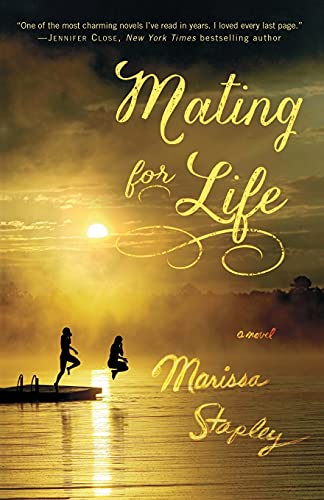
From the bestselling author of Lucky—a Reese Witherspoon Book Club pick—comes a captivating novel that explores marriage, motherhood, identity, and what it takes to love someone—family members, friends, or spouses—for life.
Former folk singer Helen Sear was a feminist wild child who proudly disdained monogamy, raising three daughters—each by a different father—largely on her own. Now in her sixties, Helen has fallen in love with a traditional man who desperately wants to marry her. And while she fears losing him, she’s equally afraid of abandoning everything she’s ever stood for if she goes through with it.
Meanwhile, Helen’s youngest daughter, Liane, is in the heady early days of a relationship with her soul mate. But he has an ex-wife and two kids, and her new role as a “step-something” doesn’t come with an instruction manual. Ilsa, an artist, has put her bohemian past behind her and is fervently hoping her second marriage will stick. Yet her world feels like it is slowly shrinking, and her painting is suffering as a result—and she realizes she may need to break free again, even if it means disrupting the lives of her two young children. And then there’s Fiona, the eldest sister, who has worked tirelessly to make her world pristine, yet who still doesn’t feel at peace. When she discovers her husband has been harboring a huge secret, Fiona loses her tenuous grip on happiness and is forced to face some truths about herself that she’d rather keep buried.
Interweaving the alternating perspectives of Helen, her daughters, and the women surrounding them, “each new chapter brings a wise and tender look at single life, dating rituals, and marital unease” (New York Times bestselling author Jennifer Close). In this “absolute feat of storytelling” (bestselling author Grace O'Connell), Marissa Stapley celebrates the many roles modern women play, and shows that even though happy endings aren’t one-size-fits-all, some loves really can last for life.
Die Inhaltsangabe kann sich auf eine andere Ausgabe dieses Titels beziehen.
Über die Autorin bzw. den Autor
Marissa Stapley is the New York Times bestselling author of the Reese’s Book Club pick Lucky, soon to be an Apple limited series starring Anya Taylor-Joy, The Lightning Bottles, The Last Resort, Things to Do When It’s Raining, and Mating for Life. Her journalism has appeared in newspapers and magazines across North America. She lives in Toronto with her family. Follow her on X and Instagram @MarissaStapley or like her page on Facebook (Facebook.com/MarissaStapleyAuthor) for updates and contests!
Auszug. © Genehmigter Nachdruck. Alle Rechte vorbehalten.
Mating for Life
1
Snapping Turtle (Chelydra serpentina)
Unlike other turtles, the common snapping turtle cannot hide in its shell because its body is too big. These turtles snap as a defense mechanism, but aren’t actually vicious. However, perhaps because of the misconception of aggression, snapping turtles are often targeted, and are endangered in North America. When mating, snapping turtles sometimes engage in an elaborate dancelike ritual in the water that involves eye contact but no touching. Snapping turtles have no defined mating season: they court and mate only when conditions are exactly right.
When Liane swam into the snapping turtle, she screamed. He didn’t bite her, but clearly he wanted to. Then he was gone, dipping first his head and then his shell underwater. (She didn’t know he was a he, but she assumed; there was something placidly male in his glare.)
She sensed the turtle was still there, somewhere below. She turned to float on her back, hearing her mother’s voice in her memory as she did. “If you ever feel scared, don’t panic. You’ll drown,” Helen had instructed from the edge of the floating dock while Liane paddled below. Liane’s eldest sister, Fiona, had already been front-crawling to the middle of the lake, where Helen had placed a DIVER DOWN sign. Ilsa had been lying on the floating dock, too, but then she rolled off and swam, dolphinlike, toward Liane, grabbing her sister’s ankle from beneath the waves. Liane had shouted and flailed. “Exactly! Thank you, Ilsa. That’s a perfect example of what you don’t do. Back float instead.” Liane remembered her mother’s red suit, brown skin, blond hair, and the way she talked to them as though they were already grown-ups. The swimming lessons were the one thing Helen insisted on during summers that spiraled out slowly, like the pucks of Bubble Tape gum they would buy at the marina for $1.25. The girls didn’t even have to unpack their bags if they didn’t want to. They were never asked to make their beds.
Now Liane looked up at the clouds and tried to fill her belly with air. But her breath was too shallow and she had to kick. Panic soon forced her to flip to her front and start to swim, fast, for the floating dock.
She wanted to go home, and it had only been one day.
Her plan: to swim and eat salads (mostly because she hated to cook, or couldn’t cook; it was a chicken/egg situation she didn’t care to analyze) and work on the final pages of her thesis. By the end of the week, when Liane’s mother and sisters arrived for their annual early summer cottage weekend, she would have finished it. Then Adam would stop asking her when she was going to finish it and she would stop feeling guilty for not responding in a more appropriately proactive way to his father’s offer of a job on the faculty at the university, as a teaching assistant, pending her thesis defense.
The other part of her plan, and one she hadn’t told anyone about, involved the hope that by coming here alone, by treating this as a regular cottage and normal lake—and not the site of one of her life’s greatest tragedies—she could erase the past and turn herself into a normal person. The kind of person Adam wanted her to be. The kind of person she didn’t think she could be but knew she should at least try to be.
Liane ducked her head underwater—eyes closed, testing herself—and resurfaced with a gasp. In addition to the big fears, her week-alone-at-the-cottage plan hadn’t accounted for her many small fears. (Turtles. Seaweed. Algae. Other things too embarrassing to mention. Like ants. Beetles. Walking into cobwebs.) All of these things seemed more frightening without company. (Currently: she could still sense the turtle near, perhaps now waiting at the base of the ladder to bite one of her toes.)
She went down again, and this time kept her eyes open. Then she surfaced, blinked the water from her eyes, and saw movement to her left. The turn of a page. There was a man sitting at the end of the dock at the cottage next door—it had been the Castersen place, but the Castersens had sold it, or were renting it out, or something. Liane couldn’t remember but knew Helen had explained it last year when the new dock had appeared and, next, a pair of kayaks had replaced the motorized pontoon boat Mr. Castersen had once called his “Party Boat.”
The unfamiliar man sitting on the dock reading looked up and Liane looked down, focusing again on her path through the water. But she should have waved. She was in cottage country. In cottage country, you were supposed to wave (even if you were swimming) and mouth, Hello, to people (regardless of whether you knew them). But she was too embarrassed. He had probably heard her screaming about the turtle. He had probably seen the awkward way she’d jumped off the dock, plugging her nose and splaying her legs. And either way, it was now too late because the man—who had copper-blond hair and a matching shadow of a beard—was reading his book again. She kept swimming and looked away from him, but looking away meant she had to look at the shed, so she closed her eyes and ducked under again.
“Why do you keep it?” she had asked Helen, years before, referring to the kayak that hulked in the shed just up from the water. “What am I going to do with it, throw it away?” Helen had asked. “I couldn’t live with the idea of it in a garbage dump somewhere until the end of time. And it seems wrong to sell it. So we’ll keep it. Maybe one day you’ll take it out.” “Never,” said Liane. What a macabre idea. Horrible. Sometimes she wondered if Helen meant to be so insensitive. She tried to love her mother as she was, did love her as she was, but she also wished Helen was more like other mothers. Other mothers would never have left that particular kayak in the shed or suggested Liane go out on the lake in it, for example.
Liane climbed the ladder of the floating dock, wincing and curling her toes against the algae on the steps. Then she sat, hugging her knees to her chest and wishing for a towel. She squinted. The spine of the man’s book was orange. A paperback. His head was bent and his shoulders were hunched and he was leaning forward a little. As though he wants to actually get onto the page, or into it. As though he isn’t just reading it but inhabiting it. Or maybe he was just nearsighted. Still, Liane found herself thinking about a book she had read as a child, about a boy (or was it a girl?) who found a tree with a door in the trunk and when he (she?) opened it, there was another world that had always been there. Liane still asked Helen about it. “Maybe you imagined it,” Helen said once. “You were very creative.” But Liane still believed this book existed somewhere. She was certain her father had given it to her and had written an inscription on the inside cover she could no longer remember the words of but longed to read again.
She straightened her legs, shimmied forward, and slid into the water. The new dock, the one at the Castersens’/Possibly Someone Else’s Place Now, was closer than the other Castersen dock had been, and bigger. Its blond wood planks stretched out, around, and out again.
Closer now. A few more strokes and she would have a clear view. At the perfect moment, the man leaned back to stretch, tilting the book. She saw white, yellow, black writing.
Junkie by William Burroughs. Disappointing. And slightly alarming. Liane gulped air and dove, thinking about how Burroughs had shot his wife in the head. Accidentally. Who could possibly shoot someone in the...
„Über diesen Titel“ kann sich auf eine andere Ausgabe dieses Titels beziehen.
Suchergebnisse für Mating for Life: A Novel

Beispielbild für diese ISBN
Mating for Life
Anbieter: World of Books (was SecondSale), Montgomery, IL, USA
Verkäuferbewertung 5 von 5 Sternen

Paperback. Zustand: Fair. From the bestselling author of Lucky--a Reese Witherspoon Book Club pick--comes a captivating novel that explores marriage, motherhood, identity, and what it takes to love someone--family members, friends, or spouses--for life. Former folk singer Helen Sear was a feminist wild child who proudly disdained monogamy, raising three daughters--each by a different father--largely on her own. Now in her sixties, Helen has fallen in love with a traditional man who desperately wants to marry her. And while she fears losing him, she's equally afraid of abandoning everything she's ever stood for if she goes through with it. Meanwhile, Helen's youngest daughter, Liane, is in the heady early days of a relationship with her soul mate. But he has an ex-wife and two kids, and her new role as a "step-something" doesn't come with an instruction manual. Ilsa, an artist, has put her bohemian past behind her and is fervently hoping her second marriage will stick. Yet her world feels like it is slowly shrinking, and her painting is suffering as a result--and she realizes she may need to break free again, even if it means disrupting the lives of her two young children. And then there's Fiona, the eldest sister, who has worked tirelessly to make her world pristine, yet who still doesn't feel at peace. When she discovers her husband has been harboring a huge secret, Fiona loses her tenuous grip on happiness and is forced to face some truths about herself that she'd rather keep buried. Interweaving the alternating perspectives of Helen, her daughters, and the women surrounding them, "each new chapter brings a wise and tender look at single life, dating rituals, and marital unease" (New York Times bestselling author Jennifer Close). In this "absolute feat of storytelling" (bestselling author Grace O'Connell), Marissa Stapley celebrates the many roles modern women play, and shows that even though happy endings aren't one-size-fits-all, some loves really can last for life. Artikel-Nr. 00042836801
Gebraucht kaufen
EUR 6,07
Versand gratis
Versand innerhalb von USA
Versand innerhalb von USA
Anzahl: 1 verfügbar
Beispielbild für diese ISBN
Mating for Life
Anbieter: ThriftBooks-Dallas, Dallas, TX, USA
Verkäuferbewertung 5 von 5 Sternen
Paperback. Zustand: As New. No Jacket. Pages are clean and are not marred by notes or folds of any kind. ~ ThriftBooks: Read More, Spend Less. Artikel-Nr. G1476762023I2N00
Gebraucht kaufen
EUR 6,17
Versand gratis
Versand innerhalb von USA
Versand innerhalb von USA
Anzahl: 1 verfügbar
Beispielbild für diese ISBN
Mating for Life
Anbieter: ThriftBooks-Atlanta, AUSTELL, GA, USA
Verkäuferbewertung 5 von 5 Sternen
Paperback. Zustand: Fair. No Jacket. Readable copy. Pages may have considerable notes/highlighting. ~ ThriftBooks: Read More, Spend Less. Artikel-Nr. G1476762023I5N00
Gebraucht kaufen
EUR 6,17
Versand gratis
Versand innerhalb von USA
Versand innerhalb von USA
Anzahl: 1 verfügbar
Beispielbild für diese ISBN
Mating for Life : A Novel
Verlag:
Washington Square Press, 2014
ISBN 10: 1476762023
ISBN 13: 9781476762029
Gebraucht
Softcover
Anbieter: Better World Books, Mishawaka, IN, USA
Verkäuferbewertung 5 von 5 Sternen
Zustand: Very Good. Former library copy. Pages intact with possible writing/highlighting. Binding strong with minor wear. Dust jackets/supplements may not be included. Includes library markings. Stock photo provided. Product includes identifying sticker. Better World Books: Buy Books. Do Good. Artikel-Nr. 8836808-6
Gebraucht kaufen
EUR 8,35
Versand gratis
Versand innerhalb von USA
Versand innerhalb von USA
Anzahl: 1 verfügbar
Beispielbild für diese ISBN
Mating for Life: A Novel
Verlag:
Washington Square Press, 2014
ISBN 10: 1476762023
ISBN 13: 9781476762029
Gebraucht
Softcover
Anbieter: Ammareal, Morangis, Frankreich
Verkäuferbewertung 5 von 5 Sternen
Softcover. Zustand: Bon. Petite(s) trace(s) de pliure sur la couverture. Légères traces d'usure sur la couverture. Ammareal reverse jusqu'à 15% du prix net de cet article à des organisations caritatives. ENGLISH DESCRIPTION Book Condition: Used, Good. Slightly creased cover. Slight signs of wear on the cover. Ammareal gives back up to 15% of this item's net price to charity organizations. Artikel-Nr. E-203-229
Gebraucht kaufen
EUR 3,50
EUR 16,50 Versand
Versand von Frankreich nach USA
Versand von Frankreich nach USA
Anzahl: 1 verfügbar
Beispielbild für diese ISBN
Mating for Life
Anbieter: Revaluation Books, Exeter, Vereinigtes Königreich
Verkäuferbewertung 5 von 5 Sternen
Paperback. Zustand: Brand New. 315 pages. 8.25x5.25x1.00 inches. In Stock. Artikel-Nr. x-1476762023
Neu kaufen
EUR 21,07
EUR 11,82 Versand
Versand von Vereinigtes Königreich nach USA
Versand von Vereinigtes Königreich nach USA
Anzahl: 2 verfügbar