
Verwandte Artikel zu We Are Not Ourselves: A Novel
Inhaltsangabe
New York Times 100 Notable Books of 2014 * Washington Post Top 50 Fiction List for 2014 * Entertainment Weekly Ten Best Fiction Books of 2014 * Esquire 5 Most Important Books of 2014 * Publishers Weekly Best Books of 2014 * One of Janet Maslin’s Ten Favorite Books of the Year in The New York Times
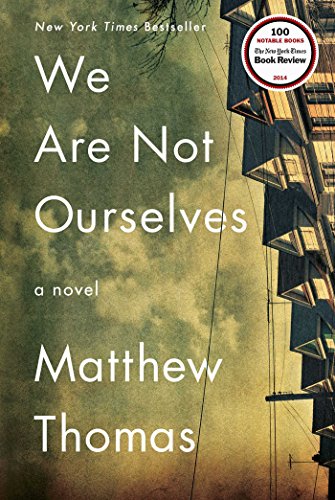
The instant New York Times bestseller the Washington Post calls a “stunning…superbly rendered” novel, and Entertainment Weekly describes as “a gripping family saga, maybe the best…since The Corrections.”
Born in 1941, Eileen Tumulty is raised by her Irish immigrant parents in Woodside, Queens, in an apartment where the mood swings between heartbreak and hilarity, depending on how much alcohol has been consumed. From an early age, Eileen wished that she lived somewhere else. She sets her sights on upper class Bronxville, New York, and an American Dream is born.
Driven by this longing, Eileen places her stock and love in Ed Leary, a handsome young scientist, and with him begins a family. Over the years Eileen encourages her husband to want more: a better job, better friends, a better house. It slowly becomes clear that his growing reluctance is part of a deeper, more incomprehensive psychological shift. An inescapable darkness enters their lives, and Eileen and Ed and their son Connell try desperately to hold together a semblance of the reality they have known, and to preserve, against long odds, an idea they have cherished of the future.
Described by The New York Times Book Review as “A long, gorgeous epic, full of love and caring…one of the best novels you’ll read this year,” We Are Not Ourselves is a testament to our greatest desires and our greatest frailties. Through the lives of these characters, Thomas charts the story of the American Century. The result is, “stunning…The joys of this book are the joys of any classic work of literature—for that is what this is destined to become—superbly rendered small moments that capture both an individual life and the universality of that person’s experience” (The Washington Post).
Die Inhaltsangabe kann sich auf eine andere Ausgabe dieses Titels beziehen.
Über die Autorin bzw. den Autor
Matthew Thomas was born in the Bronx and grew up in Queens. A graduate of the University of Chicago, he has an MA from the Writing Seminars at Johns Hopkins University and an MFA from the University of California, Irvine. His New York Times-bestselling novel We Are Not Ourselves has been shortlisted for the Flaherty-Dunnan First Novel Prize from the Center for Fiction and longlisted for the Guardian First Book Award. He lives with his wife and twin children in New Jersey.
Auszug. © Genehmigter Nachdruck. Alle Rechte vorbehalten.
We Are Not Ourselves
1
Instead of going to the priest, the men who gathered at Doherty’s Bar after work went to Eileen Tumulty’s father. Eileen was there to see it for herself, even though she was only in the fourth grade. When her father finished his delivery route, around four thirty, he picked her up at step dancing and walked her over to the bar. Practice went until six, but Eileen never minded leaving the rectory basement early. Mr. Hurley was always yelling at her to get the timing right or to keep her arms flush at her sides. Eileen was too lanky for the compact movements of a dance that evolved, according to Mr. Hurley, to disguise itself as standing still when the police passed by. She wanted to learn the jitterbug or Lindy Hop, anything she could throw her restless limbs into with abandon, but her mother signed her up for Irish dancing instead.
Her mother hadn’t let go of Ireland entirely. She wasn’t a citizen yet. Her father liked to tout that he’d applied for his citizenship on the first day he was eligible to. The framed Certificate of Citizenship, dated May 3, 1938, hung in the living room across from a watercolor painting of St. Patrick banishing the snakes, the only artwork in the apartment unless you counted the carved-wood Celtic cross in the kitchen. The little photo in the certificate bore an embossed seal, a tidy signature, and a face with an implacably fierce expression. Eileen looked into it for answers, but the tight-lipped younger version of her father never gave anything up.
• • •
When Eileen’s father filled the doorway with his body, holding his Stetson hat in front of him like a shield against small talk, Mr. Hurley stopped barking, and not just at Eileen. Men were always quieting down around her father. The recording played on and the girls finished the slip jig they were running. The fiddle music was lovely when Eileen didn’t have to worry about keeping her unruly body in line. At the end of the tune, Mr. Hurley didn’t waste time giving Eileen permission to leave. He just looked at the floor while she gathered her things. She was in such a hurry to get out of there and begin the wordless walk that she waited until she got to the street to change her shoes.
When they reached the block the bar was on, Eileen ran ahead to see if she could catch one of the men sitting on her father’s stool, which she’d never seen anyone else occupy, but all she found was them gathered in a half circle around it, as if anticipation of his presence had drawn them near.
The place was smoky and she was the only kid there, but she got to watch her father hold court. Before five, the patrons were laborers like him who drank their beers deliberately, contented in their exhaustion, well-being hanging about them like a mist. After five, the office workers drifted in, clicking their coins on the crowded bar as they waited to be served. They gulped their beers and signaled for another immediately, gripping the railing with two hands and leaning in to hurry the drink along. They watched her father as much as they did the bartender.
She sat at one of the creaky tables up front, in her pleated skirt and collared blouse, doing her homework but also training an ear on her father’s conversations. She didn’t have to strain to hear what they told him, because they felt no need to whisper, even when she was only a few feet away. There was something clarifying in her father’s authority; it absolved other men of embarrassment.
“It’s driving me nuts,” his friend Tom said, fumbling to speak. “I can’t sleep.”
“Out with it.”
“I stepped out on Sheila.”
Her father leaned in closer, his eyes pinning Tom to the barstool.
“How many times?”
“Just the once.”
“Don’t lie to me.”
“The second time I was too nervous to bring it off.”
“That’s twice, then.”
“It is.”
The bartender swept past to check the level of their drinks, slapped the bar towel over his shoulder, and moved along. Her father glanced at her and she pushed her pencil harder into her workbook, breaking off the point.
“Who’s the floozy?”
“A girl at the bank.”
“You’ll tell her the idiocy is over.”
“I will, Mike.”
“Are you going to be a goddamned idiot again? Tell me now.”
“No.”
A man came through the door, and her father and Tom nodded at him. A draft followed him in, chilling her bare legs and carrying the smell of spilled beer and floor cleaner to her.
“Reach into your pocket,” her father said. “Every penny you have stashed. Buy Sheila something nice.”
“Yes, that’s the thing. That’s the thing.”
“Every last penny.”
“I won’t hold out.”
“Swear before God that that’s the end of it.”
“I swear, Mike. I solemnly swear.”
“Don’t let me hear about you gallivanting around.”
“Those days are over.”
“And don’t go and do some fool thing like tell that poor woman what you’ve done. It’s enough for her to put up with you without knowing this.”
“Yes,” Tom said. “Yes.”
“You’re a damned fool.”
“I am.”
“That’s the last we’ll speak of it. Get us a couple of drinks.”
• • •
They laughed at everything he said, unless he was being serious, and then they put on grave faces. They held forth on the topic of his virtues as though he weren’t standing right there. Half of them he’d gotten jobs for off the boat—at Schaefer, at Macy’s, behind the bar, as supers or handymen.
Everybody called him Big Mike. He was reputed to be immune to pain. He had shoulders so broad that even in shirtsleeves he looked like he was wearing a suit jacket. His fists were the size of babies’ heads, and in the trunk he resembled one of the kegs of beer he carried in the crook of each elbow. He put no effort into his physique apart from his labor, and he wasn’t muscle-bound, just country strong. If you caught him in a moment of repose, he seemed to shrink to normal proportions. If you had something to hide, he grew before your eyes.
She wasn’t too young to understand that the ones who pleased him were the rare ones who didn’t drain the frothy brew of his myth in a quick quaff, but nosed around the brine of his humanity awhile, giving it skeptical sniffs.
• • •
She was only nine, but she’d figured a few things out. She knew why her father didn’t just swing by step dancing on the way home for dinner. To do so would have meant depriving the men in suits who arrived back from Manhattan toward the end of the hour of the little time he gave them every day. They loosened their ties around him, took their jackets off, huddled close, and started talking. He would’ve had to leave the bar by five thirty instead of a quarter to six, and the extra minutes made all the difference. She understood that it wasn’t only enjoyment for him, that part of what he was doing was making himself available to his men, and that his duty to her mother was just as important.
The three of them ate dinner together every night. Her mother...
„Über diesen Titel“ kann sich auf eine andere Ausgabe dieses Titels beziehen.
Suchergebnisse für We Are Not Ourselves: A Novel

Beispielbild für diese ISBN
We Are Not Ourselves A Novel
Anbieter: World of Books (was SecondSale), Montgomery, IL, USA
Verkäuferbewertung 5 von 5 Sternen

Zustand: Very Good. Item in very good condition! Textbooks may not include supplemental items i.e. CDs, access codes etc. Artikel-Nr. 00105648450
Gebraucht kaufen
EUR 4,00
Versand gratis
Versand innerhalb von USA
Versand innerhalb von USA
Anzahl: 5 verfügbar
Beispielbild für diese ISBN
We Are Not Ourselves A Novel
Anbieter: World of Books (was SecondSale), Montgomery, IL, USA
Verkäuferbewertung 5 von 5 Sternen
Zustand: Good. Item in good condition. Textbooks may not include supplemental items i.e. CDs, access codes etc. Artikel-Nr. 00081585262
Gebraucht kaufen
EUR 4,00
Versand gratis
Versand innerhalb von USA
Versand innerhalb von USA
Anzahl: 15 verfügbar
Beispielbild für diese ISBN
We Are Not Ourselves A Novel
Anbieter: World of Books (was SecondSale), Montgomery, IL, USA
Verkäuferbewertung 5 von 5 Sternen
Zustand: Acceptable. Item in acceptable condition! Textbooks may not include supplemental items i.e. CDs, access codes etc. Artikel-Nr. 00095560183
Gebraucht kaufen
EUR 4,00
Versand gratis
Versand innerhalb von USA
Versand innerhalb von USA
Anzahl: 4 verfügbar
Beispielbild für diese ISBN
We Are Not Ourselves: A Novel
Anbieter: ThriftBooks-Atlanta, AUSTELL, GA, USA
Verkäuferbewertung 5 von 5 Sternen
Hardcover. Zustand: Very Good. No Jacket. Former library book; May have limited writing in cover pages. Pages are unmarked. ~ ThriftBooks: Read More, Spend Less. Artikel-Nr. G147675666XI4N10
Gebraucht kaufen
EUR 6,19
Versand gratis
Versand innerhalb von USA
Versand innerhalb von USA
Anzahl: 1 verfügbar
Beispielbild für diese ISBN
We Are Not Ourselves: A Novel
Anbieter: ThriftBooks-Atlanta, AUSTELL, GA, USA
Verkäuferbewertung 5 von 5 Sternen
Hardcover. Zustand: Very Good. No Jacket. May have limited writing in cover pages. Pages are unmarked. ~ ThriftBooks: Read More, Spend Less. Artikel-Nr. G147675666XI4N00
Gebraucht kaufen
EUR 6,19
Versand gratis
Versand innerhalb von USA
Versand innerhalb von USA
Anzahl: 1 verfügbar
Beispielbild für diese ISBN
We Are Not Ourselves: A Novel
Anbieter: ThriftBooks-Dallas, Dallas, TX, USA
Verkäuferbewertung 5 von 5 Sternen
Hardcover. Zustand: Very Good. No Jacket. Missing dust jacket; May have limited writing in cover pages. Pages are unmarked. ~ ThriftBooks: Read More, Spend Less. Artikel-Nr. G147675666XI4N01
Gebraucht kaufen
EUR 6,19
Versand gratis
Versand innerhalb von USA
Versand innerhalb von USA
Anzahl: 1 verfügbar
Beispielbild für diese ISBN
We Are Not Ourselves: A Novel
Anbieter: Wonder Book, Frederick, MD, USA
Verkäuferbewertung 5 von 5 Sternen
Zustand: As New. Like New condition. Very Good dust jacket. A near perfect copy that may have very minor cosmetic defects. Artikel-Nr. D11B-03518
Gebraucht kaufen
EUR 6,55
Versand gratis
Versand innerhalb von USA
Versand innerhalb von USA
Anzahl: 2 verfügbar
Beispielbild für diese ISBN
We Are Not Ourselves: A Novel
Verlag:
Simon & Schuster, 2014
ISBN 10: 147675666X
ISBN 13: 9781476756660
Gebraucht
Hardcover
Signiert
Anbieter: Wonder Book, Frederick, MD, USA
Verkäuferbewertung 5 von 5 Sternen
Zustand: Very Good. Signed Copy . Like New dust jacket. In protective mylar cover. Signed by author on title page. Artikel-Nr. X00B-01978
Gebraucht kaufen
EUR 6,55
Versand gratis
Versand innerhalb von USA
Versand innerhalb von USA
Anzahl: 1 verfügbar
Beispielbild für diese ISBN
We Are Not Ourselves: A Novel
Anbieter: Wonder Book, Frederick, MD, USA
Verkäuferbewertung 5 von 5 Sternen
Zustand: As New. Like New condition. Like New dust jacket. A near perfect copy that may have very minor cosmetic defects. Artikel-Nr. M11L-01222
Gebraucht kaufen
EUR 6,55
Versand gratis
Versand innerhalb von USA
Versand innerhalb von USA
Anzahl: 3 verfügbar
Beispielbild für diese ISBN
We Are Not Ourselves: A Novel
Verlag:
Simon & Schuster (edition First Edition first Printing), 2014
ISBN 10: 147675666X
ISBN 13: 9781476756660
Gebraucht
Hardcover
Anbieter: BooksRun, Philadelphia, PA, USA
Verkäuferbewertung 5 von 5 Sternen
Hardcover. Zustand: Very Good. First Edition first Printing. It's a well-cared-for item that has seen limited use. The item may show minor signs of wear. All the text is legible, with all pages included. It may have slight markings and/or highlighting. Artikel-Nr. 147675666X-11-1
Gebraucht kaufen
EUR 6,65
Versand gratis
Versand innerhalb von USA
Versand innerhalb von USA
Anzahl: 1 verfügbar