
Verwandte Artikel zu The Mars Room: A Novel
Inhaltsangabe
TIME’S #1 FICTION TITLE OF THE YEAR • NEW YORK TIMES NOTABLE BOOK OF 2018
FINALIST for the MAN BOOKER PRIZE and the NATIONAL BOOK CRITICS CIRCLE AWARD
LONGLISTED for the ANDREW CARNEGIE MEDAL
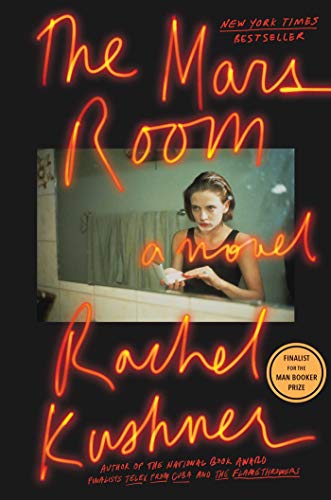
An instant New York Times bestseller from two-time National Book Award finalist Rachel Kushner, The Mars Room earned tweets from Margaret Atwood—“gritty, empathic, finely rendered, no sugar toppings, and a lot of punches, none of them pulled”—and from Stephen King—“The Mars Room is the real deal, jarring, horrible, compassionate, funny.”
It’s 2003 and Romy Hall is at the start of two consecutive life sentences at Stanville Women’s Correctional Facility, deep in California’s Central Valley. Outside is the world from which she has been severed: the San Francisco of her youth and her young son, Jackson. Inside is a new reality: thousands of women hustling for the bare essentials needed to survive; the bluffing and pageantry and casual acts of violence by guards and prisoners alike; and the deadpan absurdities of institutional living, which Kushner evokes with great humor and precision.
Stunning and unsentimental, The Mars Room demonstrates new levels of mastery and depth in Kushner’s work. It is audacious and tragic, propulsive and yet beautifully refined. As James Wood said in The New Yorker, her fiction “succeeds because it is so full of vibrantly different stories and histories, all of them particular, all of them brilliantly alive.”
Die Inhaltsangabe kann sich auf eine andere Ausgabe dieses Titels beziehen.
Über die Autorin bzw. den Autor
Rachel Kushner is the author of the New York Times bestseller Creation Lake, her latest novel; The Hard Crowd, her acclaimed essay collection; and the internationally bestselling novels The Mars Room, The Flamethrowers, and Telex from Cuba, as well as a book of short stories, The Strange Case of Rachel K. She has won the Prix Médicis and been a finalist for the National Book Critics Circle Award, the Folio Prize, and was twice a finalist for the Booker Prize and the National Book Award in Fiction. Creation Lake was also longlisted for the National Book Award. She is a Guggenheim Foundation Fellow and the recipient of the Harold D. Vursell Memorial Award from the American Academy of Arts and Letters. Her books have been translated into twenty-seven languages.
Auszug. © Genehmigter Nachdruck. Alle Rechte vorbehalten.
2
The trouble with San Francisco was that I could never have a future in that city, only a past.
The city to me was the Sunset District, fog-banked, treeless, and bleak, with endless unvaried houses built on sand dunes that stretched forty-eight blocks to the beach, houses that were occupied by middle- and lower-middle-class Chinese Americans and working-class Irish Catholics.
Fly Lie, we’d say, ordering lunch in middle school. Fried rice, which came in a paper carton. Tasted delicious but was never enough, especially if you were stoned. We called them gooks. We didn’t know that meant Vietnamese. The Chinese were our gooks. And the Laotians and Cambodians were FOBs, fresh off the boat. This was the 1980s and just think what these people went through, to arrive in the United States. But we didn’t know and didn’t know to care. They couldn’t speak English and they smelled to us of their alien food.
The Sunset was San Francisco, proudly, and yet an alternate one to what you might know: it was not about rainbow flags or Beat poetry or steep crooked streets but fog and Irish bars and liquor stores all the way to the Great Highway, where a sea of broken glass glittered along the endless parking strip of Ocean Beach. It was us girls in the back of someone’s primered Charger or Challenger riding those short, but long, forty-eight blocks to the beach, one boy shotgun with a stolen fire extinguisher, flocking people on street corners, randoms blasted white.
If you were visiting the city, or if you were a resident from the other, more admired parts of the city and you took a trip out to the beach, you might have seen, beyond the sea wall, our bonfires, which made the girls’ hair smell of smoke. If you were there in early January, you would see bigger bonfires, ones built of discarded Christmas trees, so dry and flammable they exploded on the high pyres. After each explosion you might have heard us cheer. When I say us I mean us WPODs. We loved life more than the future. “White Punks on Dope” is just some song; we didn’t even listen to it. The acronym was something else, not a gang but a grouping. An attitude, a way of dressing, living, being. Some changed our graffiti to White Powder on Donuts, and many of us were not even white, which becomes harder to explain, because the whole world of the Sunset WPODs was about white power, not powder, but these were the beliefs of not powerful kids who might end up passing through rehab centers and jails, unless they were the chosen few, the very few girls and boys, who, respectively, either enrolled in the Deloux School of Beauty, or got hired at John John Roofing on Ninth Avenue between Irving and Lincoln.
When I was little I saw a cover of an old magazine that showed the robes and feet of people who had drunk the Kool-Aid Jim Jones handed out in Guyana. My entire childhood I would think of that image and feel bad. I once told Jimmy Darling and he said it wasn’t actually Kool-Aid. It was Hi-C.
What kind of person would want to clarify such a thing?
A smart-ass is who. A person who is safe from that image in a way I was not. I was not likely to join a cult. That was not the danger I felt in glimpsing the feet of the dead, the bucket from which they drank. It was the proven fact, in the photographed feet, that you could drink death and join it.
--
When I was five or six years old I saw a paperback cover in the supermarket that was a drawing of a woman and her nude body had two knives coming out of it, blood pooling around her. The cover of the book said, “Killed Twice.” That was its title. I was away from my mother, who was shopping somewhere in the market. We were at Park and Shop on Irving and I felt I was not just a few aisles away but permanently sucked out to sea, to the engulfing world of Killed Twice. Coming home from the market, I was nauseous. I could not eat the dinner my mother prepared. She didn’t really cook. It was probably Top Ramen she prepared for me, and then attended to whichever of the men she was dating at the time.
For years, whenever I thought of that image on the cover of Killed Twice I felt sick. Now I can see that what I experienced was normal. You learn when you’re young that evil exists. You absorb the knowledge of it. When this happens for the first time, it does not go down easy. It goes down like a horse pill.
--
At age ten I fell under the spell of an older girl named Tyra. She had glassy eyes and olive skin and a husky, tough-girl voice. The night I met her I was in someone’s car, driving around drinking Löwenbräu lights. Lowie lights, green bottles with a baby-blue label. We picked up Tyra on Noriega, at a house that was an informal foster home for girls. The man who ran it, Russ, forced himself on the girls at night, unpredictably but predictably. If you stayed there, sooner or later you were going to be visited at night by Russ, who was old, and muscular, and mean. The girls complained about being raped by him as if it were a form of strictness, or rent. They were willing to endure it because they didn’t have other options. The rest of us did nothing about it because Russ bought us liquor and what were we to do, call the police? One of them was known for taking girls out to Point Lobos instead of to the police station on Taraval.
Tyra called shotgun in a menacing way and got in the front, put her feet on the dash. She was already buzzed, she told us, slur- ring her words in a way I found glamorous. She wore diamond earrings. They flashed from her little-girl ears as she drained a Lowie light and pitched her empty from the window of the car. Maybe Tyra’s earrings were fakes. It didn’t matter. Their effect was the same. For me she had the magic.
That year I’d had a chance to know a nice girl, with two parents, middle-class. She came to my house for a sleepover. The next week at school she told everyone that at my house we ate Hostess pies for dinner and threw the wrappers under the bed. I have no memory of that. I’m not saying it isn’t true. My mom let me eat what I wanted for dinner. She was usually with whatever guy she was seeing, someone who didn’t like children, so they’d be shut up in her bedroom with the door locked. We had an account at the corner market and I’d go down there and get goodies, chips, liters of soda, whatever I wanted. I didn’t know to pretend to live some other way to make an impression on another kid. It made me sad what this girl said about me and about our house. I was sad even as I stuck a pin in her ass as she got off the 6 Parnassus after school. Stood by the back doors, and as she exited I jabbed her, right through her pants. Everyone did that. We stole the pins from home economics. It was normal, but it made tears roll down your face if someone did it to you.
That diamonds are supposedly forever was something Jimmy Darling joked about. Every mineral here on earth is forever, he said. But they make it seem like diamonds are especially forever, in order to sell them, and it works.
A few days later Tyra called me and we made a plan to go to Golden Gate Park on a Sunday, to the bridge, where people roller-skate and hang out. Tyra came to my house, since I lived a few blocks from the bridge.
She said, “I need to beat this bitch’s face in.” I said okay and we went to the park.
The girl whose face Tyra had an appointment to beat in was already there, with two older brothers. They were not from the Sunset; later I learned they lived in the Haight. The brothers were adults, both mechanics at a garage on Cole Street. The girl, Tyra’s opponent, was tall and delicate-looking with a shiny black pony-...
„Über diesen Titel“ kann sich auf eine andere Ausgabe dieses Titels beziehen.
Suchergebnisse für The Mars Room: A Novel

Beispielbild für diese ISBN
The Mars Room
Anbieter: World of Books (was SecondSale), Montgomery, IL, USA
Verkäuferbewertung 5 von 5 Sternen

Hardback. Zustand: Good. NEW YORK TIMES BESTSELLER - TIME'S #1 FICTION TITLE OF THE YEAR - NEW YORK TIMES NOTABLE BOOK OF 2018 FINALIST for the MAN BOOKER PRIZE and LONGLISTED for the ANDREW CARNEGIE MEDAL Gritty, empathetic, finely rendered, no sugary toppings, and a lot of punches, none of them pulled. --Margaret Atwood via Twitter A page turner.one of those books that enrage you even as they break your heart. --The New York Times Book Review (cover review) Brilliant and devastating.a heartbreaking, true, and nearly flawless novel. --NPR With her richly textured third novel, Kushner certifies her place as one of the great American novelists of the twenty-first century. --Entertainment Weekly From twice National Book Award-nominated Rachel Kushner, whose Flamethrowers was called the best, most brazen, most interesting book of the year (Kathryn Schulz, New York magazine), comes a spectacularly compelling, heart-stopping novel about a life gone off the rails in contemporary America. It's 2003 and Romy Hall is at the start of two consecutive life sentences at Stanville Women's Correctional Facility, deep in California's Central Valley. Outside is the world from which she has been severed: the San Francisco of her youth and her young son, Jackson. Inside is a new reality: thousands of women hustling for the bare essentials needed to survive; the bluffing and pageantry and casual acts of violence by guards and prisoners alike; and the deadpan absurdities of institutional living, which Kushner evokes with great humor and precision. Stunning and unsentimental, The Mars Room demonstrates new levels of mastery and depth in Kushner's work. It is audacious and tragic, propulsive and yet beautifully refined. As James Wood said in The New Yorker, her fiction succeeds because it is so full of vibrantly different stories and histories, all of them particular, all of them brilliantly alive. Artikel-Nr. 00088363330
Gebraucht kaufen
EUR 3,83
Versand gratis
Versand innerhalb von USA
Versand innerhalb von USA
Anzahl: Mehr als 20 verfügbar
Foto des Verkäufers
The Mars Room: A Novel
Anbieter: Dream Books Co., Denver, CO, USA
Verkäuferbewertung 5 von 5 Sternen
Zustand: very_good. Pages are clean with no markings. May show minor signs of wear or cosmetic defects marks, cuts, bends, or scuffs on the cover, spine, pages, or dust jacket. May have remainder marks on edges. Artikel-Nr. DBV.1476756554.VG
Gebraucht kaufen
EUR 4,62
Versand gratis
Versand innerhalb von USA
Versand innerhalb von USA
Anzahl: 1 verfügbar
Beispielbild für diese ISBN
The Mars Room
Anbieter: ThriftBooks-Reno, Reno, NV, USA
Verkäuferbewertung 5 von 5 Sternen
Hardcover. Zustand: Very Good. No Jacket. May have limited writing in cover pages. Pages are unmarked. ~ ThriftBooks: Read More, Spend Less. Artikel-Nr. G1476756554I4N00
Gebraucht kaufen
EUR 5,96
Versand gratis
Versand innerhalb von USA
Versand innerhalb von USA
Anzahl: 1 verfügbar
Beispielbild für diese ISBN
The Mars Room
Anbieter: ThriftBooks-Phoenix, Phoenix, AZ, USA
Verkäuferbewertung 5 von 5 Sternen
Hardcover. Zustand: Good. No Jacket. Former library book; Pages can have notes/highlighting. Spine may show signs of wear. ~ ThriftBooks: Read More, Spend Less. Artikel-Nr. G1476756554I3N10
Gebraucht kaufen
EUR 5,96
Versand gratis
Versand innerhalb von USA
Versand innerhalb von USA
Anzahl: 1 verfügbar
Beispielbild für diese ISBN
The Mars Room
Anbieter: ThriftBooks-Dallas, Dallas, TX, USA
Verkäuferbewertung 5 von 5 Sternen
Hardcover. Zustand: Very Good. No Jacket. Former library book; May have limited writing in cover pages. Pages are unmarked. ~ ThriftBooks: Read More, Spend Less. Artikel-Nr. G1476756554I4N10
Gebraucht kaufen
EUR 5,96
Versand gratis
Versand innerhalb von USA
Versand innerhalb von USA
Anzahl: 1 verfügbar
Beispielbild für diese ISBN
The Mars Room
Anbieter: ThriftBooks-Atlanta, AUSTELL, GA, USA
Verkäuferbewertung 5 von 5 Sternen
Hardcover. Zustand: Good. No Jacket. Missing dust jacket; Pages can have notes/highlighting. Spine may show signs of wear. ~ ThriftBooks: Read More, Spend Less. Artikel-Nr. G1476756554I3N01
Gebraucht kaufen
EUR 5,96
Versand gratis
Versand innerhalb von USA
Versand innerhalb von USA
Anzahl: 1 verfügbar
Beispielbild für diese ISBN
The Mars Room
Anbieter: ThriftBooks-Dallas, Dallas, TX, USA
Verkäuferbewertung 5 von 5 Sternen
Hardcover. Zustand: Good. No Jacket. Pages can have notes/highlighting. Spine may show signs of wear. ~ ThriftBooks: Read More, Spend Less. Artikel-Nr. G1476756554I3N00
Gebraucht kaufen
EUR 5,96
Versand gratis
Versand innerhalb von USA
Versand innerhalb von USA
Anzahl: 1 verfügbar
Beispielbild für diese ISBN
The Mars Room
Anbieter: ThriftBooks-Atlanta, AUSTELL, GA, USA
Verkäuferbewertung 5 von 5 Sternen
Hardcover. Zustand: Good. No Jacket. Former library book; Pages can have notes/highlighting. Spine may show signs of wear. ~ ThriftBooks: Read More, Spend Less. Artikel-Nr. G1476756554I3N10
Gebraucht kaufen
EUR 5,96
Versand gratis
Versand innerhalb von USA
Versand innerhalb von USA
Anzahl: 1 verfügbar
Beispielbild für diese ISBN
The Mars Room
Anbieter: ThriftBooks-Reno, Reno, NV, USA
Verkäuferbewertung 5 von 5 Sternen
Hardcover. Zustand: Good. No Jacket. Former library book; Pages can have notes/highlighting. Spine may show signs of wear. ~ ThriftBooks: Read More, Spend Less. Artikel-Nr. G1476756554I3N10
Gebraucht kaufen
EUR 5,96
Versand gratis
Versand innerhalb von USA
Versand innerhalb von USA
Anzahl: 1 verfügbar
Beispielbild für diese ISBN
The Mars Room
Anbieter: ThriftBooks-Atlanta, AUSTELL, GA, USA
Verkäuferbewertung 5 von 5 Sternen
Hardcover. Zustand: Very Good. No Jacket. May have limited writing in cover pages. Pages are unmarked. ~ ThriftBooks: Read More, Spend Less. Artikel-Nr. G1476756554I4N00
Gebraucht kaufen
EUR 5,96
Versand gratis
Versand innerhalb von USA
Versand innerhalb von USA
Anzahl: 1 verfügbar