
Verwandte Artikel zu Generation Me - Revised and Updated: Why Today's...
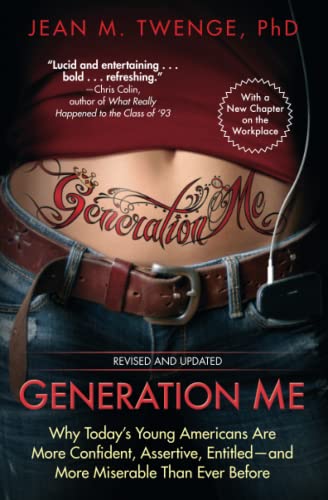
Generation Me - Revised and Updated: Why Today's Young Americans Are More Confident, Assertive, Entitled--and More Miserable Than Ever Before - Softcover
Inhaltsangabe
In this provocative and newly revised book, headline-making psychologist Dr. Jean Twenge explores why the young people she calls “Generation Me” are tolerant, confident, open-minded, and ambitious but also disengaged, narcissistic, distrustful, and anxious.
Born in the ’80s, and ’90s and called “The Entitlement Generation” or Millennials, they are reshaping schools, colleges, and businesses all over the country. The children of the Baby Boomers are not only feeling the effects of the recession and the changing job market—they are affecting change the world over. Now, in this new edition of Generation Me, Dr. Twenge incorporates the latest research, data, and statistics, as well as new stories and cultural references, to show how “Gen Me-ers” have shifted the American character, redefining what it means to be an individual in today’s society.
Dr. Twenge uses data from 11 million respondents to reveal shocking truths about this generation, including dramatic differences in sexual behavior and religious practice, and controversial predictions about what the future holds for them and society as a whole. Her often humorous, eyebrow-raising stories about real people vividly bring to life the hopes, disappointments, and challenges of Generation Me. Engaging, controversial, prescriptive, and funny, Generation Me gives Boomers and GenX’ers new and fascinating insights into their offspring, and helps those in their teens, twenties, and thirties find their road to happiness.
Die Inhaltsangabe kann sich auf eine andere Ausgabe dieses Titels beziehen.
Über die Autorin bzw. den Autor
Jean M. Twenge, PhD, a professor of psychology at San Diego State University, is the author of more than 190 scientific publications and several books based on her research, including Ten Rules for Raising Kids in a High-Tech World, Generations, iGen, and Generation Me. Her research has been covered in Time, The Atlantic, Newsweek, The New York Times, USA TODAY, and The Washington Post. She has also been featured on Today, Good Morning America, Fox and Friends, CBS This Morning, Real Time with Bill Maher, and NPR. She lives in San Diego with her husband and three daughters.
Auszug. © Genehmigter Nachdruck. Alle Rechte vorbehalten.
Generation Me - Revised and Updated 1 You Don’t Need Their Approval: The Decline of Social Rules
Getting dressed in the morning is a fundamentally different experience today than it was fifty years ago. For all of Generation Me’s lifetime, clothes have been a medium of self-expression, an individual choice in a range of alternatives and comfort. Contrast this to past decades, when men wore ties most of the time and women did not leave the house without crisp white gloves and a tight girdle. Pictures of crowds in the early 1960s show quaint sights such as men wearing three-piece suits at baseball games and ladies lined up in identical-length skirts. To GenMe, these images look like those of people on an alien planet—who wears a suit to a baseball game?
Even our shoes are different. Today’s casual footwear are called tennis shoes because people once wore them only to play tennis or basketball. Not even kids wore these types of shoes on the street—their shoes were made of stiff leather, just like adults’.
Now that’s all but forgotten. Except in the most formal of workplaces, few men wear suits to work, and virtually no one wears them to baseball games. Women have (thankfully) abandoned wearing tight girdles and white gloves everywhere they go (and many young women don’t even know what a girdle is, though some are devoted to Spanx, the GenMe version). The trend toward more informal dress has accelerated in the past ten years, with many companies opting for “business casual” and others going for just plain casual. The trend reached all the way to the top in July 2005, when about half the members of the Northwestern University women’s lacrosse team wore flip-flops during their White House visit, resulting in a picture of the president of the United States standing next to several young women wearing shoes that were once reserved for walking on sand or showering in scuzzy gymnasiums. Although most people still want to look good, we are a much more informal and accepting society than we once were. This is a perfect illustration of generational trends in attitudes, as the entire point in dressing up is to make a good impression on others and elicit their approval. You don’t dress to be relaxed, natural, and happy.
Holiday card, Minnesota, 1955. Not only are the clothes formal, but so is the posing and demeanor. The perfect family was proper and composed.
Holiday card, Massachusetts, mid-2000s. Formal clothing is no longer necessary to make a good impression. It is now more important to dress for yourself or for your comfort; if you really wanted to do things “your way” and just for yourself, you’d wear jeans to work. Many of us already do.
The strict rules of previous decades went far beyond appearance. Beneath the wool suits and tailored hats, yesterday’s men and women were bound by another type of conformity. Male or female, you were considered strange if you did not marry by age 25 and even stranger if you married outside your race or religion. It was expected that you would have children—it was not considered a choice. Your race and sex dictated your fate and behavior. When war came, you went to fight if you were male and able. Overall, duty and responsibility were held more important than individual needs and wants. You did certain things, you said certain things, and you didn’t talk about certain things. End of story.
Today, few of these rules apply. We are driven instead by our individual needs and desires. We are told to follow our dreams, to pursue happiness above all else. It’s okay to be different, and you should do what’s right for you. The phrase my needs was four times as common in American books in the 2000s compared to those in the 1960s. Young people today are only half as likely as those in the late 1980s to believe that children should learn obedience above all else. Baby boys in the 2010s (versus the 1950s) were three times less likely to receive one of the ten most popular names. These changes are not clearly good or clearly bad, but they do indicate a strong shift toward individualism.
The choices of the individual are now held so paramount that the most common advice given to teenagers is “Just be yourself.” (Not that long ago, it was more likely to be “Be polite.”) This started with Generation X: Filmmaker Kevin Smith says, “My generation believes we can do almost anything. My characters are free: no social mores keep them in check.” Or take Melissa, 20, who says, “I couldn’t care less how I am viewed by society. I live my life according to the morals, views, and standards that I create.”
This is the social trend—so strong it’s a revolution—that ties all of the generational changes together in a neat, tight bundle: do what makes you happy, and don’t worry about what other people think. It is enormously different from the cultural ethos of previous decades, and it is a philosophy that GenMe takes entirely for granted. “As long as I believe in myself, I really do not care what others think,” says Rachel, 21.
GENERATIONS AT THE CINEMA
The ethos of self-belief appears frequently in popular movies; my favorite examples involve what I call “the apparent time traveler.” The main character in these films is supposed to be a real person in the 1950s, but he or she actually represents the enlightened voice of the 21st century, which makes him (or her) the hero of the film. These movies were ubiquitous in the 2000s, when much of GenMe were forming their view of the world. In 2003’s Mona Lisa Smile, Julia Roberts plays a professor at Wellesley College in 1953. Soon after arriving, she rallies her students against the restrictions of early marriage and training for motherhood. When she critiques sexist advertising during a class, the modern audience knows exactly what she is doing, but few people in the 1950s would have seen it before—or even thought to do it. Roberts’s character has clearly taken the time-traveler shuttle to the future and absconded with a copy of the 1987 feminist antiadvertising film Still Killing Us Softly.
The Majestic, released in 2001, is an even worse movie. Jim Carrey’s character, a Hollywood screenwriter, gets blacklisted and takes refuge in a small town. After he is asked to testify, he convinces the entire town that McCarthyism is bad and that free speech is our most treasured right. The whole town unites behind the accused writer, and the main female character says, “It doesn’t really matter if you are a Communist or not—this is America and you can be one if you want to. It’s nobody’s business.” Uh, not really. Had this actually been the 1950s, an accused Communist would have been everybody’s business. This viewpoint was common even in the 1970s, when 48% of Americans believed Communists should not be allowed to give a speech, teach at a college, or have a book in a local library.
Movies that admit to time travel are somewhat more enjoyable. In Pleasantville, two modern teenagers help a 1950s town find passion and the freedom of ideas. Every character who discovers an individualistic freedom such as sex or intellectual questioning instantly turns from black and white into color. The film sinks into predictability once discrimination against the “colored” people begins. (Get it?)
Other movies travel across cultures rather than time, but they promote the same message. In 2002’s Bend It Like Beckham, an Indian girl living in London wants to play soccer. Her parents, already taken aback that their older daughter did not have an arranged marriage, want Jess to learn to cook and be a proper young lady....
„Über diesen Titel“ kann sich auf eine andere Ausgabe dieses Titels beziehen.
Suchergebnisse für Generation Me - Revised and Updated: Why Today's...

Beispielbild für diese ISBN
Generation Me: Why Today's Young Americans Are More Confident, Assertive, Entitled--And More Miserable Than Ever Before
Anbieter: World of Books (was SecondSale), Montgomery, IL, USA
Verkäuferbewertung 5 von 5 Sternen

Paperback. Zustand: Very Good. In this provocative and newly revised book, headline-making psychologist Dr. Jean Twenge explores why the young people she calls "Generation Me" are tolerant, confident, open-minded, and ambitious but also disengaged, narcissistic, distrustful, and anxious. Born in the '80s, and '90s and called "The Entitlement Generation" or Millennials, they are reshaping schools, colleges, and businesses all over the country. The children of the Baby Boomers are not only feeling the effects of the recession and the changing job market--they are affecting change the world over. Now, in this new edition of Generation Me, Dr. Twenge incorporates the latest research, data, and statistics, as well as new stories and cultural references, to show how "Gen Me-ers" have shifted the American character, redefining what it means to be an individual in today's society. Dr. Twenge uses data from 11 million respondents to reveal shocking truths about this generation, including dramatic differences in sexual behavior and religious practice, and controversial predictions about what the future holds for them and society as a whole. Her often humorous, eyebrow-raising stories about real people vividly bring to life the hopes, disappointments, and challenges of Generation Me. Engaging, controversial, prescriptive, and funny, Generation Me gives Boomers and GenX'ers new and fascinating insights into their offspring, and helps those in their teens, twenties, and thirties find their road to happiness. Artikel-Nr. 00099257525
Gebraucht kaufen
EUR 4,07
Versand gratis
Versand innerhalb von USA
Versand innerhalb von USA
Anzahl: 4 verfügbar
Beispielbild für diese ISBN
Generation Me: Why Today's Young Americans Are More Confident, Assertive, Entitled--And More Miserable Than Ever Before
Anbieter: World of Books (was SecondSale), Montgomery, IL, USA
Verkäuferbewertung 5 von 5 Sternen
Paperback. Zustand: Good. In this provocative and newly revised book, headline-making psychologist Dr. Jean Twenge explores why the young people she calls "Generation Me" are tolerant, confident, open-minded, and ambitious but also disengaged, narcissistic, distrustful, and anxious. Born in the '80s, and '90s and called "The Entitlement Generation" or Millennials, they are reshaping schools, colleges, and businesses all over the country. The children of the Baby Boomers are not only feeling the effects of the recession and the changing job market--they are affecting change the world over. Now, in this new edition of Generation Me, Dr. Twenge incorporates the latest research, data, and statistics, as well as new stories and cultural references, to show how "Gen Me-ers" have shifted the American character, redefining what it means to be an individual in today's society. Dr. Twenge uses data from 11 million respondents to reveal shocking truths about this generation, including dramatic differences in sexual behavior and religious practice, and controversial predictions about what the future holds for them and society as a whole. Her often humorous, eyebrow-raising stories about real people vividly bring to life the hopes, disappointments, and challenges of Generation Me. Engaging, controversial, prescriptive, and funny, Generation Me gives Boomers and GenX'ers new and fascinating insights into their offspring, and helps those in their teens, twenties, and thirties find their road to happiness. Artikel-Nr. 00096671017
Gebraucht kaufen
EUR 4,07
Versand gratis
Versand innerhalb von USA
Versand innerhalb von USA
Anzahl: 10 verfügbar
Beispielbild für diese ISBN
Generation Me: Why Today's Young Americans Are More Confident, Assertive, Entitled--And More Miserable Than Ever Before
Anbieter: World of Books (was SecondSale), Montgomery, IL, USA
Verkäuferbewertung 5 von 5 Sternen
Paperback. Zustand: Fair. In this provocative and newly revised book, headline-making psychologist Dr. Jean Twenge explores why the young people she calls "Generation Me" are tolerant, confident, open-minded, and ambitious but also disengaged, narcissistic, distrustful, and anxious. Born in the '80s, and '90s and called "The Entitlement Generation" or Millennials, they are reshaping schools, colleges, and businesses all over the country. The children of the Baby Boomers are not only feeling the effects of the recession and the changing job market--they are affecting change the world over. Now, in this new edition of Generation Me, Dr. Twenge incorporates the latest research, data, and statistics, as well as new stories and cultural references, to show how "Gen Me-ers" have shifted the American character, redefining what it means to be an individual in today's society. Dr. Twenge uses data from 11 million respondents to reveal shocking truths about this generation, including dramatic differences in sexual behavior and religious practice, and controversial predictions about what the future holds for them and society as a whole. Her often humorous, eyebrow-raising stories about real people vividly bring to life the hopes, disappointments, and challenges of Generation Me. Engaging, controversial, prescriptive, and funny, Generation Me gives Boomers and GenX'ers new and fascinating insights into their offspring, and helps those in their teens, twenties, and thirties find their road to happiness. Artikel-Nr. 00094207827
Gebraucht kaufen
EUR 4,07
Versand gratis
Versand innerhalb von USA
Versand innerhalb von USA
Anzahl: 2 verfügbar
Foto des Verkäufers
Generation Me - Revised and Updated: Why Today's Young Americans Are More Confident, Assertive, Entitled--and More Miserable Than Ever Before
Anbieter: Dream Books Co., Denver, CO, USA
Verkäuferbewertung 5 von 5 Sternen
Zustand: very_good. Pages are clean with no markings. May show minor signs of wear or cosmetic defects marks, cuts, bends, or scuffs on the cover, spine, pages, or dust jacket. May have remainder marks on edges. Artikel-Nr. DBV.1476755566.VG
Gebraucht kaufen
EUR 5,37
Versand gratis
Versand innerhalb von USA
Versand innerhalb von USA
Anzahl: 1 verfügbar
Beispielbild für diese ISBN
Generation Me - Revised and Updated: Why Today's Young Americans Are More Confident, Assertive, Entitled--and More Miserable Than Ever Before
Anbieter: Wonder Book, Frederick, MD, USA
Verkäuferbewertung 5 von 5 Sternen
Zustand: Very Good. Very Good condition. A copy that may have a few cosmetic defects. May also contain light spine creasing or a few markings such as an owner's name, short gifter's inscription or light stamp. Artikel-Nr. A12A-05879
Gebraucht kaufen
EUR 6,43
Versand gratis
Versand innerhalb von USA
Versand innerhalb von USA
Anzahl: 1 verfügbar
Foto des Verkäufers
Generation Me - Revised and Updated: Why Today's Young Americans Are More Confident, Assertive, Entitled--and More Miserable Than Ever Before
Anbieter: Dream Books Co., Denver, CO, USA
Verkäuferbewertung 5 von 5 Sternen
Zustand: good. Gently used with minimal wear on the corners and cover. A few pages may contain light highlighting or writing, but the text remains fully legible. Dust jacket may be missing, and supplemental materials like CDs or codes may not be included. May be ex-library with library markings. Ships promptly! Artikel-Nr. DBV.1476755566.G
Gebraucht kaufen
EUR 6,47
Versand gratis
Versand innerhalb von USA
Versand innerhalb von USA
Anzahl: 1 verfügbar
Beispielbild für diese ISBN
Generation Me: Why Today's Young Americans Are More Confident, Assertive, Entitled--And More Miserable Than Ever Before
Anbieter: ThriftBooks-Reno, Reno, NV, USA
Verkäuferbewertung 5 von 5 Sternen
Paperback. Zustand: Very Good. No Jacket. May have limited writing in cover pages. Pages are unmarked. ~ ThriftBooks: Read More, Spend Less. Artikel-Nr. G1476755566I4N00
Gebraucht kaufen
EUR 6,83
Versand gratis
Versand innerhalb von USA
Versand innerhalb von USA
Anzahl: 1 verfügbar
Beispielbild für diese ISBN
Generation Me: Why Today's Young Americans Are More Confident, Assertive, Entitled--And More Miserable Than Ever Before
Anbieter: ThriftBooks-Dallas, Dallas, TX, USA
Verkäuferbewertung 5 von 5 Sternen
Paperback. Zustand: Very Good. No Jacket. May have limited writing in cover pages. Pages are unmarked. ~ ThriftBooks: Read More, Spend Less. Artikel-Nr. G1476755566I4N00
Gebraucht kaufen
EUR 6,85
Versand gratis
Versand innerhalb von USA
Versand innerhalb von USA
Anzahl: 1 verfügbar
Beispielbild für diese ISBN
Generation Me: Why Today's Young Americans Are More Confident, Assertive, Entitled--And More Miserable Than Ever Before
Anbieter: ThriftBooks-Atlanta, AUSTELL, GA, USA
Verkäuferbewertung 5 von 5 Sternen
Paperback. Zustand: Very Good. No Jacket. May have limited writing in cover pages. Pages are unmarked. ~ ThriftBooks: Read More, Spend Less. Artikel-Nr. G1476755566I4N00
Gebraucht kaufen
EUR 6,85
Versand gratis
Versand innerhalb von USA
Versand innerhalb von USA
Anzahl: 1 verfügbar
Beispielbild für diese ISBN
Generation Me - Revised and Updated : Why Today's Young Americans Are More Confident, Assertive, Entitled--And More Miserable Than Ever Before
Anbieter: Better World Books, Mishawaka, IN, USA
Verkäuferbewertung 5 von 5 Sternen
Zustand: Good. Rev Upd. Pages intact with minimal writing/highlighting. The binding may be loose and creased. Dust jackets/supplements are not included. Stock photo provided. Product includes identifying sticker. Better World Books: Buy Books. Do Good. Artikel-Nr. 7955395-6
Gebraucht kaufen
EUR 7,02
Versand gratis
Versand innerhalb von USA
Versand innerhalb von USA
Anzahl: 2 verfügbar