
Verwandte Artikel zu How to Make Your Money Last: The Indispensable Retirement...
Inhaltsangabe
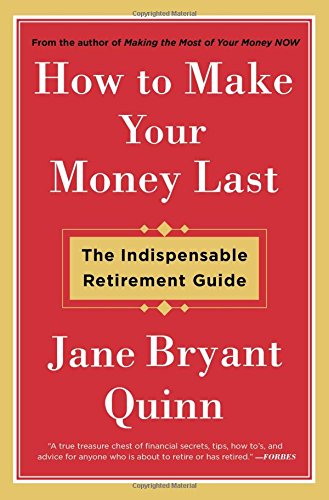
Turn your retirement savings into a steady paycheck that will last for life with Jane Bryant Quinn’s “‘how to’ book that covers every phase of retirement finance. Bottom line, anyone on the retirement track or in retirement should own this book” (Huffington Post).
Today, people worry that they’re going to run out of money in their older age. That won’t happen if you use a few tricks for squeezing higher payments from your assets—from your Social Security account (find the hidden values there), pension (monthly income or lump sum?), home equity (sell and invest the proceeds or take a reverse mortgage?), savings (should you buy a lifetime annuity?), and retirement accounts (how to invest and—critically—how much to withdraw from your savings each year?). The right moves will not only raise the amount you have to spend, they’ll stretch out your money over many more years. With this book, financial expert Jane Bryant Quinn, “America’s dean of personal finance” (Forbes), explains how to turn your retirement funds into a paycheck that will last for life.
She also shows how to look at your savings and investments in a new way. If you stick with super-safe choices the money might not last. You need safe money to help pay the bills in your early retirement years. But to ensure that you’ll still have spending money ten and twenty years from now, you have to invest for growth, today. Quinn shows you how. At a time when people are living longer, yet retiring with a smaller pot of savings than they’d hoped for, this book will become the essential guide—“a hugely valuable resource for readers, wherever they are on their personal financial timeline” (Publishers Weekly, starred review).
Die Inhaltsangabe kann sich auf eine andere Ausgabe dieses Titels beziehen.
Über die Autorin bzw. den Autor
Jane Bryant Quinn is a leading commentator on personal finance. She is author of the bestselling Making the Most of Your Money NOW, Smart and Simple Financial Strategies for Busy People, and Everyone’s Money Book. Quinn has written for Newsweek, The Washington Post, Bloomberg, Woman’s Day, and Good Housekeeping. An Emmy Award winner, Quinn’s own program ran on PBS. She has also been a regular correspondent for the CBS Morning and Evening News. Her personal finance column currently appears in the AARP Bulletin. She lives in New York City and blogs at JaneBryantQuinn.com.
Auszug. © Genehmigter Nachdruck. Alle Rechte vorbehalten.
How to Make Your Money Last
1
The Joy and Challenge of Life After Work
Now that you can do whatever you want, what do you want to do?
Retirement challenges us like nothing else. We have to reinvent our lives. One day we’re part of the vast American workforce—living by the clock, attacking new projects, and focusing our minds and skills. The next day we can sleep until noon if it pleases us. Then we bound out of bed, free at last, ready for coffee and lunch and . . . what?
Successful retirement—whenever it occurs—turns out to be work of another kind. The future is almost as blank a slate as it was when you were 18 and wondering what was going to happen to you. Fifty years later, you’re fortified with knowledge and experience but with no place to take it. You might have a partner in life, children, grandchildren, status in your community, and a dog that loves you. Still, you have seven days a week and 52 weeks a year to fill. No sane human being can watch that much television or play that much golf. Maybe you’ll be able to stay at work well past normal retirement age. Even so, you might shorten your hours. The last day of work can’t be held off forever. You need an action plan to transition into this new phase of your life.
You also need a financial plan to make the most of the income and savings that you have available. That’s what most of this book is about. “Money can’t buy happiness,” they say, but it sure can buy food, shelter, heat, phone service, streaming movies on TV, and gas for the car. A little extra buys plane tickets, ball games, concerts, and long-term peace of mind. It’s hard to be happy if you’re always worried about the bills. Learning how to stretch your available income and rightsize your life are the first steps toward retiring well. Even if retirement seems far away, steps you take now—to save and invest—can greatly improve your standard of living when your paycheck eventually stops.
But before I talk money, I’d like to talk about the nonfinancial challenges of life after full-time work. They’re huge and, for most people, unexpected. We fling ourselves into leisure as if a grand vacation lay ahead. But permanent vacations can get pretty boring. When we were working, we had a sense of accomplishment and a place in the world, even if—at the end—we couldn’t wait to quit. Now, having shut that door, we need another place. What are we retiring to?
Eventually, when you look back on your transition from work to retirement, you’ll think of it as perhaps the most creative period of your life. Most of us still need an active sense of social worth. But instead of getting it from a workplace, ready-made, we have to make it ourselves. The challenge is to discover new interests, new places, and new friends. Your weeks should fill up again with projects, meetings, entertainments, and events—activities you chose yourself, to gladden your days and give purpose to your life. You’ll probably take on these projects at a leisurely pace. I’m not suggesting that you’ll want to be busy all the time. But neither will you want to look at a daily calendar that’s blank.
It takes time to move from the worker role to the role of engaged, individual citizen. How long the transition takes will depend on your personal initiative and will. The faster you can bury the old “workplace you” and rise to a new “liberated you,” the more content you’re going to be.
Not everyone moves into retirement willingly. You might lose your job and spend some unhappy weeks or months rehashing that stressful time. Your health (or your spouse’s health) might be dicey, which, for now, completely occupies your mind. The departure from work might have been so sudden that you had no time to prepare emotionally.
Widows, widowers, and the divorced face similar problems. They’ve been forcibly “retired” from married life and now face their own blank slate.
No matter how you get there, you (and your partner, if you have one) will have to figure out how to build another life. The questions will be the same for everyone.
Who are you, anyway?
For so much of our lives, we identify ourselves with our jobs. “I’m a lawyer.” “I’m a teacher.” “I’m an operations manager.” “I work for IBM.” Those who have young children might also say “I’m a mother” or “I’m a father.” Our jobs and family responsibilities give us status and meaning. When we quit, or the children grow up, there’s an instant loss of status that few of us are truly prepared for. We’re in a new role—that of citizen-retiree. It’s an empty vessel until we fill it up.
What are you going to do with the rest of your life?
A 3G retirement (golf, gossip, and grandchildren) isn’t always enough, cute as the grandchildren are. Most retirees today are vigorous, mentally alert, and eager to jump into something active and interesting. We have skills, smarts, and dreams. At work, we were accomplishing stuff, even if we got tired of it. As parents, we had the critical job of raising responsible adults. But what are we accomplishing now? Loss of meaning and purpose throws some retirees into depression, even those who thought they couldn’t wait to start a leisured life. If you spend your hours in front of a TV set, you’re likely to—quite literally—bore yourself to death. You’ll need all your imagination and energy to discover a new role.
Where will you find friends?
When you worked, you made social contact simply by doing your job every day. You had people to chat with or complain about, customers to call on, and lunches with colleagues. When your job ends, however, your workaday friends are likely to fall away. You need to get out of the house and do things, not just for fun and intellectual interest but for the social companionship, too. Women are better at this than men but it can be a challenge for both.
THE FIVE STAGES OF RETIREMENT
The gerontology researcher Robert Atchley studied the transition from working life to leisure. Retirement, he says, is a process, not an event. Some people hustle through the stages. Others take months, even years, to reach serenity. The better you manage the first stage, the faster your progress is likely to be.
Stage 1: Preretirement. You gradually disengage from work. You’re still doing your job but your imagination moves ahead. You talk with friends about their own plans for life after work and ask retired friends what they’re up to now. You put together a budget to see if, and when, you can afford to leave your paycheck behind. If you’re married, you have many talks with your spouse about how you each expect retirement to work—your hopes and fears, where you’ll live, what you’ll do with your time, whether you’ll both retire at the same time and, if not, what the expectations will be. You think about what you might do next. If you hope for part-time work, now’s the time to start making the contacts. There might be a project you can do for your current employer or others in your business. If you’re being laid off, do your best to think about your next life, not your past one. You’re not “unemployed” (bad place), you’re “semiretired” (better place). Forward is your only choice.
Stage 2: The Honeymoon....
„Über diesen Titel“ kann sich auf eine andere Ausgabe dieses Titels beziehen.
Suchergebnisse für How to Make Your Money Last: The Indispensable Retirement...

Beispielbild für diese ISBN
How to Make Your Money Last: The Indispensable Retirement Guide
Anbieter: World of Books (was SecondSale), Montgomery, IL, USA
Verkäuferbewertung 5 von 5 Sternen

Paperback. Zustand: Good. Turn your retirement savings into a steady paycheck that will last for life with Jane Bryant Quinn's 'how to' book that covers every phase of retirement finance. Bottom line, anyone on the retirement track or in retirement should own this book (Huffington Post). Today, people worry that they're going to run out of money in their older age. That won't happen if you use a few tricks for squeezing higher payments from your assets--from your Social Security account (find the hidden values there), pension (monthly income or lump sum?), home equity (sell and invest the proceeds or take a reverse mortgage?), savings (should you buy a lifetime annuity?), and retirement accounts (how to invest and--critically--how much to withdraw from your savings each year?). The right moves will not only raise the amount you have to spend, they'll stretch out your money over many more years. With this book, financial expert Jane Bryant Quinn, America's dean of personal finance (Forbes), explains how to turn your retirement funds into a paycheck that will last for life. She also shows how to look at your savings and investments in a new way. If you stick with super-safe choices the money might not last. You need safe money to help pay the bills in your early retirement years. But to ensure that you'll still have spending money ten and twenty years from now, you have to invest for growth, today. Quinn shows you how. At a time when people are living longer, yet retiring with a smaller pot of savings than they'd hoped for, this book will become the essential guide--a hugely valuable resource for readers, wherever they are on their personal financial timeline (Publishers Weekly, starred review). Artikel-Nr. 00096298046
Gebraucht kaufen
EUR 3,66
Versand gratis
Versand innerhalb von USA
Versand innerhalb von USA
Anzahl: 9 verfügbar
Beispielbild für diese ISBN
How to Make Your Money Last: The Indispensable Retirement Guide
Verlag:
Simon & Schuster (edition Reprint), 2017
ISBN 10: 1476743770
ISBN 13: 9781476743776
Gebraucht
Paperback
Anbieter: BooksRun, Philadelphia, PA, USA
Verkäuferbewertung 5 von 5 Sternen
Paperback. Zustand: Very Good. Reprint. It's a well-cared-for item that has seen limited use. The item may show minor signs of wear. All the text is legible, with all pages included. It may have slight markings and/or highlighting. Artikel-Nr. 1476743770-11-1
Gebraucht kaufen
EUR 4,41
Versand gratis
Versand innerhalb von USA
Versand innerhalb von USA
Anzahl: 1 verfügbar
Beispielbild für diese ISBN
How to Make Your Money Last: The Indispensable Retirement Guide
Verlag:
Simon & Schuster (edition Reprint), 2017
ISBN 10: 1476743770
ISBN 13: 9781476743776
Gebraucht
Paperback
Anbieter: BooksRun, Philadelphia, PA, USA
Verkäuferbewertung 5 von 5 Sternen
Paperback. Zustand: Fair. Reprint. The item might be beaten up but readable. May contain markings or highlighting, as well as stains, bent corners, or any other major defect, but the text is not obscured in any way. Artikel-Nr. 1476743770-7-1
Gebraucht kaufen
EUR 4,58
Versand gratis
Versand innerhalb von USA
Versand innerhalb von USA
Anzahl: 2 verfügbar
Beispielbild für diese ISBN
How to Make Your Money Last : The Indispensable Retirement Guide
Anbieter: Better World Books: West, Reno, NV, USA
Verkäuferbewertung 5 von 5 Sternen
Zustand: Very Good. Reprint. Pages intact with possible writing/highlighting. Binding strong with minor wear. Dust jackets/supplements may not be included. Stock photo provided. Product includes identifying sticker. Better World Books: Buy Books. Do Good. Artikel-Nr. 13255600-6
Gebraucht kaufen
EUR 6,08
Versand gratis
Versand innerhalb von USA
Versand innerhalb von USA
Anzahl: 1 verfügbar
Beispielbild für diese ISBN
How to Make Your Money Last : The Indispensable Retirement Guide
Anbieter: Better World Books, Mishawaka, IN, USA
Verkäuferbewertung 5 von 5 Sternen
Zustand: Good. Reprint. Pages intact with minimal writing/highlighting. The binding may be loose and creased. Dust jackets/supplements are not included. Stock photo provided. Product includes identifying sticker. Better World Books: Buy Books. Do Good. Artikel-Nr. 12879898-6
Gebraucht kaufen
EUR 6,08
Versand gratis
Versand innerhalb von USA
Versand innerhalb von USA
Anzahl: 2 verfügbar
Beispielbild für diese ISBN
How to Make Your Money Last: The Indispensable Retirement Guide
Anbieter: Wonder Book, Frederick, MD, USA
Verkäuferbewertung 5 von 5 Sternen
Zustand: Good. Good condition. A copy that has been read but remains intact. May contain markings such as bookplates, stamps, limited notes and highlighting, or a few light stains. Artikel-Nr. F23A-03399
Gebraucht kaufen
EUR 6,32
Versand gratis
Versand innerhalb von USA
Versand innerhalb von USA
Anzahl: 1 verfügbar
Beispielbild für diese ISBN
How to Make Your Money Last: The Indispensable Retirement Guide
Anbieter: Wonder Book, Frederick, MD, USA
Verkäuferbewertung 5 von 5 Sternen
Zustand: Very Good. Very Good condition. A copy that may have a few cosmetic defects. May also contain light spine creasing or a few markings such as an owner's name, short gifter's inscription or light stamp. Artikel-Nr. K09B-05030
Gebraucht kaufen
EUR 6,32
Versand gratis
Versand innerhalb von USA
Versand innerhalb von USA
Anzahl: 3 verfügbar
Beispielbild für diese ISBN
How to Make Your Money Last: The Indispensable Retirement Guide
Anbieter: ThriftBooks-Atlanta, AUSTELL, GA, USA
Verkäuferbewertung 5 von 5 Sternen
Paperback. Zustand: As New. No Jacket. Pages are clean and are not marred by notes or folds of any kind. ~ ThriftBooks: Read More, Spend Less. Artikel-Nr. G1476743770I2N00
Gebraucht kaufen
EUR 6,36
Versand gratis
Versand innerhalb von USA
Versand innerhalb von USA
Anzahl: 1 verfügbar
Beispielbild für diese ISBN
How to Make Your Money Last: The Indispensable Retirement Guide
Anbieter: ThriftBooks-Atlanta, AUSTELL, GA, USA
Verkäuferbewertung 5 von 5 Sternen
Paperback. Zustand: Very Good. No Jacket. May have limited writing in cover pages. Pages are unmarked. ~ ThriftBooks: Read More, Spend Less. Artikel-Nr. G1476743770I4N00
Gebraucht kaufen
EUR 6,36
Versand gratis
Versand innerhalb von USA
Versand innerhalb von USA
Anzahl: 1 verfügbar
Beispielbild für diese ISBN
How to Make Your Money Last: The Indispensable Retirement Guide
Anbieter: ThriftBooks-Dallas, Dallas, TX, USA
Verkäuferbewertung 5 von 5 Sternen
Paperback. Zustand: As New. No Jacket. Pages are clean and are not marred by notes or folds of any kind. ~ ThriftBooks: Read More, Spend Less. Artikel-Nr. G1476743770I2N00
Gebraucht kaufen
EUR 6,36
Versand gratis
Versand innerhalb von USA
Versand innerhalb von USA
Anzahl: 1 verfügbar