
Verwandte Artikel zu Why Did the Chicken Cross the World?: The Epic Saga...
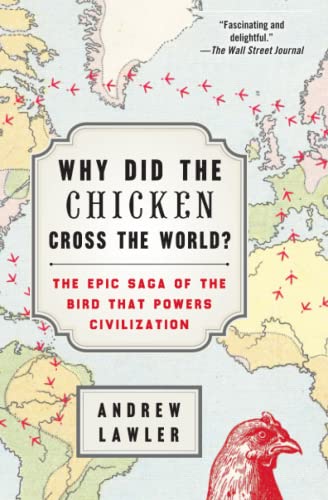
Why Did the Chicken Cross the World?: The Epic Saga of the Bird that Powers Civilization - Softcover
Inhaltsangabe
Veteran journalist Andrew Lawler delivers a “fascinating and delightful…globetrotting tour” (Wall Street Journal) with the animal that has been most crucial to the spread of civilization—the chicken.
In a masterful combination of historical sleuthing and journalistic adventure, veteran reporter Andrew Lawler “opens a window on civilization, evolution, capitalism, and ethics” (New York) with a fascinating account of the most successful of all cross-species relationships—the partnership between human and chicken. This “splendid book full of obsessive travel and research in history” (Kirkus Reviews) explores how people through the ages embraced the chicken as a messenger of the gods, an all-purpose medicine, an emblem of resurrection, a powerful sex symbol, a gambling aid, a handy research tool, an inspiration for bravery, the epitome of evil, and, of course, the star of the world’s most famous joke.
Queen Victoria was obsessed with the chicken. Socrates’s last words embraced it. Charles Darwin and Louis Pasteur used it for scientific breakthroughs. Religious leaders of all stripes have praised it. Now neuroscientists are uncovering signs of a deep intelligence that offers insights into human behavior.
Trekking from the jungles of southeast Asia through the Middle East and beyond, Lawler discovers the secrets behind the fowl’s transformation from a shy, wild bird into an animal of astonishing versatility, capable of serving our species’ changing needs more than the horse, cow, or dog. The natural history of the chicken, and its role in entertainment, food history, and food politics, as well as the debate raging over animal welfare, comes to light in this “witty, conversational” (Booklist) volume.
Die Inhaltsangabe kann sich auf eine andere Ausgabe dieses Titels beziehen.
Über die Autorin bzw. den Autor
Andrew Lawler is the author of more than a thousand newspaper and magazine articles on subjects ranging from asteroids to zebrafish. He is a contributing writer for Science magazine and a contributing editor for Archaeology magazine. He has written for National Geographic, Smithsonian, Discover, Slate, Columbia Journalism Review, The New York Times, and several European newspapers, among others. See more at AndrewLawler.com.
Auszug. © Genehmigter Nachdruck. Alle Rechte vorbehalten.
Why Did the Chicken Cross the World?
1.
Nature’s Mr. Potato Head
Probably the Eskimo is the only branch of the human family which has been unable to profit from this domestic creature.
—William Beebe, A Monograph of the Pheasants
On a chilly dawn in a damp upland forest of northern Burma in 1911, thirty-four-year-old biologist William Beebe crouched in the soggy undergrowth as a village rooster crowed in the distance. In a clearing just beyond his hiding place, men and mules carrying rice and ammunition prepared to leave for the nearby border with China, which was then convulsed with famine and revolution. As the caravan moved off into the morning light and the thin tinkle of the harness bells faded away, wild pigs, vultures, doves, and local chickens entered the abandoned camp to scavenge for leftovers.
A few minutes later, a colorful bird with a sleek and slender body and long black spurs sauntered into the clearing. Peering through binoculars, Beebe watched transfixed as the rising sun pierced the woods and hit the bird’s feathers. “Just for a moment he was agleam, the sun reflecting metallic red, green, and purple from his plumage,” he writes. The domestic hens and roosters stopped to observe the stately newcomer pass. “They recognized him as something alien, perhaps as superior, certainly to be respected, for they took no liberties with him,” Beebe adds. The wild bird feigned not to notice the other animals, pausing only to snatch a bite and eye a village hen, before vanishing with a regal strut into the woods.
Beebe followed, sliding his lanky body quietly across the wet ground. At the bottom of a gully he spotted the male bird in a clump of bamboo with a female, which clucked happily and scratched the soil for worms as the wild cock “allowed no fall of leaf or twig to escape him, and it was interesting to watch how, every second or two, he systematically swept the sky and the woods all about.” Never, he notes, was the bird off its guard, and he seemed to possess an almost eerie extrasensory perception. A distant yowling cat brought them both to attention; then a squirrel stirred nearby and the pair quickly darted into the dense forest.
This experience left an indelible impression on Beebe, who would go on to become one of America’s first celebrity scientists. The bird, a red jungle fowl, carried itself like “an untamable leopard; low-hung tail, slightly bent legs; head low, always intent, listening, watching; almost never motionless.” Beebe, an adventurous ornithologist who had traveled from Mexico to Malaysia, was awed by this singular creature that is the ancestor of the modern chicken. “Once the real fowl of the deep jungle is seen,” he writes, “it will not be forgotten.”
If the chicken is so common that it is concealed in plain sight, the wild bird from which it springs is surprisingly mysterious. Few biologists have observed the red jungle fowl in its native habitat of South Asia, and most of our knowledge of it comes from studies conducted in zoos on specimens that look like the bird observed by Beebe but act more like their tame barnyard brethren. Since the chicken and red jungle fowl are the same species—both bear the Latin name Gallus gallus—they can breed with each other. The number of chickens that can mate with their sibling and ancestor soared with the increase in the human population from India to Vietnam in the succeeding decades, diluting the wild gene pool. Beebe’s observations give us an invaluable glimpse of the wild bird that would become the chicken.
How this shy and sly creature transformed into the epitome of domesticity has long puzzled biologists. “Those birds which have been pointed out as the most probable ancestors of the Domestic Fowl, do not appear to be more tamable than the Partridge or the Golden Pheasant,” notes a perplexed Edmund Saul Dixon, an English pastor who served as Darwin’s poultry muse, in 1848.
Like all domesticated animals, the chicken began as a wild creature that gradually was drawn into the human orbit. The wolf that became the dog came to us in its search of scraps of discarded food, which we provided in exchange for protection. Wildcats fed on the mice that ate our grain stores in the ancient Near East, so both felines and humans tolerated one another. Pigs, sheep, goats, and cows began as our prey and eventually were corralled into herds. The chicken’s story is more enigmatic. Did the fowl come to us, did we go to it, or did we, over time, grow used to each other’s presence?
The word domestication comes from the Latin term meaning “belonging to the house,” and it suggests that, like a servant or slave, a domesticated animal does our bidding in exchange for shelter, food, and protection. Biologists today, however, see domestication as a long-term and mutual relationship, with bonds that can never fully be dissolved. Even feral pigs, Australian dingoes, and the mustangs of the American West retain genetic traits inculcated over thousands of years of living with people.
Few animals bond with us. Out of twenty-five thousand species of fish, the goldfish and carp can be considered domesticates. A couple dozen of more than five thousand mammals are domesticated, and out of nearly ten thousand bird species, only about ten are at home in our households or barnyards. Elephants can be trained to carry logs, cheetahs taught to walk on a leash, and zebras harnessed to pull a carriage, but they are only temporarily tamed, reluctant visitors rather than full-fledged members of the extended human household. Individuals from these species must be tamed anew with each generation. The red jungle fowl, distrustful of humans and ill-suited for captivity, seems an unlikely candidate for launching our species’ most important animal partnership. That is why Beebe’s minute scrutiny of the wild bird in its native habitat is the starting place for charting the chicken’s journey across oceans and continents.
His visit to Burma on the eve of World War I had nothing to do with chicken history, however. It was part of an urgent mission by conservationists to study and record pheasants that faced extermination thanks to women’s hats and rubber tires. Hundreds of thousands of acres of prime pheasant habitat were then being cleared across South Asia to make way for vast rubber plantations to supply the burgeoning bicycle and auto industries. Meanwhile, the feathers of exotic birds were a popular fashion statement for hundreds of thousands of Americans and Europeans, and egrets, warblers, terns, and herons across the United States were decimated as a result. A small protest movement that began in Boston when two socialites met for tea and founded the National Audubon Society grew into a potent political force that led Congress to ban sales of native bird plumes.
The large millinery industry promptly turned to the jungles of South Asia, home to all but two of the world’s forty-nine pheasant species, including the red jungle fowl. This family of birds has elaborate and brilliant plumage unmatched by other avian species. Bird lovers feared that entire pheasant species would vanish before they could even be cataloged. “Members of this most beautiful and remarkable group are rapidly becoming extinct,” warned Henry Fairfield Osborn, the president of the New York Zoological Society. “The record of their habits and surroundings, which is important to the understanding of their structure and evolution, will soon be lost for ever.” Osborn and other worried New Yorkers turned to Beebe, the wunderkind of ornithology.
Beebe had dropped out of Columbia University to work at the recently opened New...
„Über diesen Titel“ kann sich auf eine andere Ausgabe dieses Titels beziehen.
Suchergebnisse für Why Did the Chicken Cross the World?: The Epic Saga...

Beispielbild für diese ISBN
Why Did the Chicken Cross the World?: The Epic Saga of the Bird that Powers Civilization
Verlag:
Atria (edition Reprint), 2016
ISBN 10: 1476729905
ISBN 13: 9781476729909
Gebraucht
Paperback
Anbieter: BooksRun, Philadelphia, PA, USA
Verkäuferbewertung 5 von 5 Sternen

Paperback. Zustand: Fair. Reprint. The item might be beaten up but readable. May contain markings or highlighting, as well as stains, bent corners, or any other major defect, but the text is not obscured in any way. Artikel-Nr. 1476729905-7-1
Gebraucht kaufen
EUR 4,17
Versand gratis
Versand innerhalb von USA
Versand innerhalb von USA
Anzahl: 1 verfügbar
Beispielbild für diese ISBN
Why Did the Chicken Cross the World?: The Epic Saga of the Bird That Powers Civilization
Anbieter: ThriftBooks-Atlanta, AUSTELL, GA, USA
Verkäuferbewertung 5 von 5 Sternen
Paperback. Zustand: Fair. No Jacket. Readable copy. Pages may have considerable notes/highlighting. ~ ThriftBooks: Read More, Spend Less. Artikel-Nr. G1476729905I5N00
Gebraucht kaufen
EUR 5,97
Versand gratis
Versand innerhalb von USA
Versand innerhalb von USA
Anzahl: 1 verfügbar
Beispielbild für diese ISBN
Why Did the Chicken Cross the World?: The Epic Saga of the Bird That Powers Civilization
Anbieter: ThriftBooks-Reno, Reno, NV, USA
Verkäuferbewertung 5 von 5 Sternen
Paperback. Zustand: Good. No Jacket. Pages can have notes/highlighting. Spine may show signs of wear. ~ ThriftBooks: Read More, Spend Less. Artikel-Nr. G1476729905I3N00
Gebraucht kaufen
EUR 5,97
Versand gratis
Versand innerhalb von USA
Versand innerhalb von USA
Anzahl: 1 verfügbar
Beispielbild für diese ISBN
Why Did the Chicken Cross the World?: The Epic Saga of the Bird That Powers Civilization
Anbieter: ThriftBooks-Atlanta, AUSTELL, GA, USA
Verkäuferbewertung 5 von 5 Sternen
Paperback. Zustand: Good. No Jacket. Pages can have notes/highlighting. Spine may show signs of wear. ~ ThriftBooks: Read More, Spend Less. Artikel-Nr. G1476729905I3N00
Gebraucht kaufen
EUR 5,97
Versand gratis
Versand innerhalb von USA
Versand innerhalb von USA
Anzahl: 1 verfügbar
Beispielbild für diese ISBN
Why Did the Chicken Cross the World?: The Epic Saga of the Bird That Powers Civilization
Anbieter: ThriftBooks-Dallas, Dallas, TX, USA
Verkäuferbewertung 5 von 5 Sternen
Paperback. Zustand: Very Good. No Jacket. May have limited writing in cover pages. Pages are unmarked. ~ ThriftBooks: Read More, Spend Less. Artikel-Nr. G1476729905I4N00
Gebraucht kaufen
EUR 5,97
Versand gratis
Versand innerhalb von USA
Versand innerhalb von USA
Anzahl: 1 verfügbar
Beispielbild für diese ISBN
Why Did the Chicken Cross the World?: The Epic Saga of the Bird That Powers Civilization
Anbieter: ThriftBooks-Dallas, Dallas, TX, USA
Verkäuferbewertung 5 von 5 Sternen
Paperback. Zustand: Good. No Jacket. Pages can have notes/highlighting. Spine may show signs of wear. ~ ThriftBooks: Read More, Spend Less. Artikel-Nr. G1476729905I3N00
Gebraucht kaufen
EUR 5,97
Versand gratis
Versand innerhalb von USA
Versand innerhalb von USA
Anzahl: 1 verfügbar
Beispielbild für diese ISBN
Why Did the Chicken Cross the World? : The Epic Saga of the Bird That Powers Civilization
Anbieter: Better World Books, Mishawaka, IN, USA
Verkäuferbewertung 5 von 5 Sternen
Zustand: Good. Former library copy. Pages intact with minimal writing/highlighting. The binding may be loose and creased. Dust jackets/supplements are not included. Includes library markings. Stock photo provided. Product includes identifying sticker. Better World Books: Buy Books. Do Good. Artikel-Nr. 38587533-6
Gebraucht kaufen
EUR 5,97
Versand gratis
Versand innerhalb von USA
Versand innerhalb von USA
Anzahl: 1 verfügbar
Beispielbild für diese ISBN
Why Did the Chicken Cross the World? : The Epic Saga of the Bird That Powers Civilization
Anbieter: Better World Books: West, Reno, NV, USA
Verkäuferbewertung 5 von 5 Sternen
Zustand: Very Good. Pages intact with possible writing/highlighting. Binding strong with minor wear. Dust jackets/supplements may not be included. Stock photo provided. Product includes identifying sticker. Better World Books: Buy Books. Do Good. Artikel-Nr. 18404601-6
Gebraucht kaufen
EUR 5,97
Versand gratis
Versand innerhalb von USA
Versand innerhalb von USA
Anzahl: 1 verfügbar
Beispielbild für diese ISBN
Why Did the Chicken Cross the World? : The Epic Saga of the Bird That Powers Civilization
Anbieter: Better World Books, Mishawaka, IN, USA
Verkäuferbewertung 5 von 5 Sternen
Zustand: Very Good. Former library copy. Pages intact with possible writing/highlighting. Binding strong with minor wear. Dust jackets/supplements may not be included. Includes library markings. Stock photo provided. Product includes identifying sticker. Better World Books: Buy Books. Do Good. Artikel-Nr. 18530316-6
Gebraucht kaufen
EUR 5,97
Versand gratis
Versand innerhalb von USA
Versand innerhalb von USA
Anzahl: 2 verfügbar
Beispielbild für diese ISBN
Why Did the Chicken Cross the World?: The Epic Saga of the Bird that Powers Civilization
Anbieter: Books From California, Simi Valley, CA, USA
Verkäuferbewertung 4 von 5 Sternen

paperback. Zustand: Fine. Artikel-Nr. mon0004096986
Gebraucht kaufen
EUR 8,01
EUR 4,30 Versand
Versand innerhalb von USA
Versand innerhalb von USA
Anzahl: 1 verfügbar