
Verwandte Artikel zu Why Did the Chicken Cross the World?: The Epic Saga...
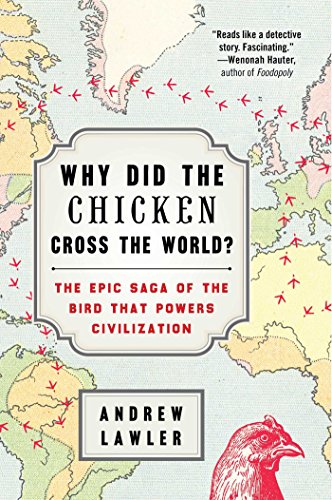
Why Did the Chicken Cross the World?: The Epic Saga of the Bird that Powers Civilization - Hardcover
Inhaltsangabe
From ancient empires to modern economics, veteran journalist Andrew Lawler delivers a sweeping history of the animal that has been most crucial to the spread of civilization across the globe—the chicken.
Queen Victoria was obsessed with it. Socrates’ last words were about it. Charles Darwin and Louis Pasteur made their scientific breakthroughs using it. Catholic popes, African shamans, Chinese philosophers, and Muslim mystics praised it. Throughout the history of civilization, humans have embraced it in every form imaginable—as a messenger of the gods, powerful sex symbol, gambling aid, emblem of resurrection, all-purpose medicine, handy research tool, inspiration for bravery, epitome of evil, and, of course, as the star of the world’s most famous joke.
In Why Did the Chicken Cross the World?, science writer Andrew Lawler takes us on an adventure from prehistory to the modern era with a fascinating account of the partnership between human and chicken (the most successful of all cross-species relationships). Beginning with the recent discovery in Montana that the chicken’s unlikely ancestor is T. rex, this book builds on Lawler’s popular Smithsonian cover article, “How the Chicken Conquered the World” to track the chicken from its original domestication in the jungles of Southeast Asia some 10,000 years ago to postwar America, where it became the most engineered of animals, to the uncertain future of what is now humanity’s single most important source of protein.
In a masterful combination of historical sleuthing and journalistic exploration on four continents, Lawler reframes the way we feel and think about our most important animal partner—and, by extension, all domesticated animals, and even nature itself.
Lawler’s narrative reveals the secrets behind the chicken’s transformation from a shy jungle bird into an animal of astonishing versatility, capable of serving our species’ changing needs. For no other siren has called humans to rise, shine, and prosper quite like the rooster’s cry: “cock-a-doodle-doo!”
Die Inhaltsangabe kann sich auf eine andere Ausgabe dieses Titels beziehen.
Über die Autorin bzw. den Autor
Andrew Lawler is the author of more than a thousand newspaper and magazine articles on subjects ranging from asteroids to zebrafish. He is a contributing writer for Science magazine and a contributing editor for Archaeology magazine. He has written for National Geographic, Smithsonian, Discover, Slate, Columbia Journalism Review, The New York Times, and several European newspapers, among others. See more at AndrewLawler.com.
Auszug. © Genehmigter Nachdruck. Alle Rechte vorbehalten.
Why Did the Chicken Cross the World?
INTRODUCTION
Follow the chicken and find the world.
—Donna J. Haraway, When Species Meet
Add up the world’s cats, dogs, pigs, and cows and there would still be more chickens. Toss in every rat on earth and the bird still dominates. The domestic fowl is the world’s most ubiquitous bird and most common barnyard animal. More than 20 billion chickens live on our planet at any given moment, three for every human. The nearest avian competitor is the red-billed quelea, a little African finch numbering a mere 2 billion or so.
Only one country and one continent are fowl-free. Pope Francis I regularly dines on skinless breast bought in the markets of Rome since there is no room for a coop in the tiny state of Vatican City. In Antarctica, chickens are taboo. Grilled wings are a staple at the annual New Year’s celebration at the South Pole’s Amundsen-Scott Station, but the international treaty governing the southern continent forbids import of live or raw poultry to protect penguins from disease. Even so, most emperor penguin chicks have been exposed to common chicken viruses.
These exceptions prove the rule. From Siberia to the South Atlantic’s South Sandwich Islands, the chicken is universal, and NASA has studied whether it could survive the trip to Mars. The bird that began in the thickets of South Asian jungles is now our single most important source of protein, and we are unlikely to leave the planet without it. As our cities and appetites grow, so does the population of, and our dependence on, the common fowl. “Both the jayhawk and the man eat chickens,” wrote the American economist Henry George in 1879, “but the more jayhawks, the fewer chickens, while the more men, the more chickens.”
Until recently I never thought to ask why this creature, out of fifteen thousand species of mammals and birds, emerged as our most important animal companion. My reporting took me to archaeology digs in the Middle East, Central Asia, and East Asia as I pursued the question of why and how our species abandoned the quiet hunter-gatherer life in favor of bustling cities, global empires, world wars, and social media. This mysterious and radical shift to urban life that began in the Middle East six millennia ago continues to transform the earth. Only in the past decade, for the first time in history, have more people lived in cities than the country.
When I heard that excavators working on an Arabian beach had evidence that Indian traders had mastered the monsoon to sail across the open ocean more than four thousand years ago, I pitched the story to a magazine. These adventurous Bronze Age sailors inaugurated international trade and helped spark the first global economy, carrying Himalayan timber and Afghan lapis lazuli to the great Mesopotamian cities as Egyptian masons put the finishing touches on the Giza pyramids. In my pitch, I mentioned to the editor that along with remains of ancient Indian trade goods, archaeologists had uncovered a chicken bone that might mark the bird’s arrival in the West.
“That’s interesting,” the editor said. “Follow the bird. Where did it come from? Why do we eat so much of it? What is a chicken, anyway?” I agreed, reluctantly, and a few weeks later I arrived in a seaside Omani village as the Italian archaeology team working at the beach site was returning from an afternoon swim in the Arabian Sea. The chicken bone? “Oh,” said the dig director, toweling his damp locks. “We think it was misidentified. It probably came from one of our workmen’s lunches.”
Since chickens didn’t pull Babylonian war chariots or carry silks from China, archaeologists and historians have not given the bird much thought, and anthropologists prefer watching people hunt boar than feed fowl. Poultry scientists are fixated on converting grain to meat as efficiently as possible, not in tracing the bird’s spread around the world. Even scientists who appreciate the importance of animals in the making of human societies tend to overlook the fowl. Jared Diamond, author of the bestseller Guns, Germs, and Steel, relegates the chicken to a category of “small domestic mammals and domestic birds and insects” that are useful but not worthy of the attention due, say, the ox.
Underdogs and unsung heroes are journalistic red meat. The chicken is so underestimated that it is legally invisible. Although its meat and eggs power our urban and industrial lives, it is not considered livestock—or even an animal—under American law if raised for food. “Chickens do not always enjoy an honorable position among city-bred people,” E. B. White noted. If they thought of chickens at all, it was “as a comic prop straight out of vaudeville.” Though Susan Orlean declared the chicken the “it” bird in a 2009 New Yorker article devoted to the popular backyard chicken movement, the dog and cat retain their joint title as most beloved pet.
If all canines and felines vanished tomorrow, along with the odd parakeet and gerbil, there would be much mourning but minimal impact on the global economy or international politics. A suddenly chickenless world, however, would spell immediate disaster. In 2012, as the cost of eggs shot up in Mexico City after millions of birds were culled due to disease, demonstrators took to the streets, rattling the new government. It was dubbed “The Great Egg Crisis,” and no wonder, since Mexicans eat more eggs per capita than any other people. The same year in Cairo, high-priced poultry helped inspire Egypt’s revolution as protestors rallied to the cry: “They are eating pigeon and chicken, but we eat beans every day!” When poultry prices tripled in Iran recently, the nation’s police chief warned television producers not to broadcast images of people eating the popular meat to avoid inciting violence among those who could not afford grilled kebabs.
The chicken has, quietly but inexorably, become essential. Though it can barely fly, the fowl has become the world’s most migratory bird through international imports and exports. The various parts of a single bird may end up at opposite ends of the globe. Chinese get the feet, Russians the legs, Spaniards the wings, Turks the intestines, Dutch soup makers the bones, and the breasts go to the United States and Britain. This globalized business extends to Kansan corn that plumps Brazilian birds, European antibiotics to stave off illness in American flocks, and Indian-made cages housing South African poultry.
“A commodity appears at first sight an extremely obvious, trivial thing,” Karl Marx wrote. But analyze it and the commodity turns into “a very strange thing, abounding in metaphysical subtleties and theological niceties.” As I pursued the chicken’s trail around the world, I found it full of surprising metaphysical and theological implications. Emerging from the Asian jungle as a magical creature, it spread around the globe, performing as a celebrity in royal menageries, playing an important role as a guide to the future, and transforming into a holy messenger of light and resurrection. It entertained us as it fought to the death in the cockpit, served as an all-purpose medicine chest, and inspired warriors, lovers, and mothers. In traditions from Bali to Brooklyn, it still takes on our sins as it has done for millennia. No other animal has attracted so many legends, superstitions, and beliefs across so many societies and eras.
The chicken crossed the world because we took it...
„Über diesen Titel“ kann sich auf eine andere Ausgabe dieses Titels beziehen.
Suchergebnisse für Why Did the Chicken Cross the World?: The Epic Saga...

Beispielbild für diese ISBN
Why Did the Chicken Cross the
Anbieter: World of Books (was SecondSale), Montgomery, IL, USA
Verkäuferbewertung 5 von 5 Sternen

Zustand: Good. Item in good condition. Textbooks may not include supplemental items i.e. CDs, access codes etc. Artikel-Nr. 00107045961
Gebraucht kaufen
EUR 4,43
Versand gratis
Versand innerhalb von USA
Versand innerhalb von USA
Anzahl: 4 verfügbar
Beispielbild für diese ISBN
Why Did the Chicken Cross the
Anbieter: World of Books (was SecondSale), Montgomery, IL, USA
Verkäuferbewertung 5 von 5 Sternen
Zustand: Very Good. Item in very good condition! Textbooks may not include supplemental items i.e. CDs, access codes etc. Artikel-Nr. 00108015761
Gebraucht kaufen
EUR 4,43
Versand gratis
Versand innerhalb von USA
Versand innerhalb von USA
Anzahl: 1 verfügbar
Beispielbild für diese ISBN
Why Did the Chicken Cross the
Anbieter: World of Books (was SecondSale), Montgomery, IL, USA
Verkäuferbewertung 5 von 5 Sternen
Zustand: Good. Good condition ex-library book with usual library markings and stickers. Artikel-Nr. 00106928625
Gebraucht kaufen
EUR 4,66
Versand gratis
Versand innerhalb von USA
Versand innerhalb von USA
Anzahl: 1 verfügbar
Beispielbild für diese ISBN
Why Did the Chicken Cross the World?: The Epic Saga of the Bird that Powers Civilization
Verlag:
Atria Books (edition First Edition), 2014
ISBN 10: 1476729891
ISBN 13: 9781476729893
Gebraucht
Hardcover
Erstausgabe
Anbieter: BooksRun, Philadelphia, PA, USA
Verkäuferbewertung 5 von 5 Sternen
Hardcover. Zustand: Very Good. First Edition. With dust jacket. It's a well-cared-for item that has seen limited use. The item may show minor signs of wear. All the text is legible, with all pages included. It may have slight markings and/or highlighting. Artikel-Nr. 1476729891-11-1-29
Gebraucht kaufen
EUR 5,07
Versand gratis
Versand innerhalb von USA
Versand innerhalb von USA
Anzahl: 1 verfügbar
Beispielbild für diese ISBN
Why Did the Chicken Cross the World?: The Epic Saga of the Bird that Powers Civilization
Anbieter: ThriftBooks-Dallas, Dallas, TX, USA
Verkäuferbewertung 5 von 5 Sternen
Hardcover. Zustand: Good. No Jacket. Pages can have notes/highlighting. Spine may show signs of wear. ~ ThriftBooks: Read More, Spend Less. Artikel-Nr. G1476729891I3N00
Gebraucht kaufen
EUR 5,90
Versand gratis
Versand innerhalb von USA
Versand innerhalb von USA
Anzahl: 1 verfügbar
Beispielbild für diese ISBN
Why Did the Chicken Cross the World?: The Epic Saga of the Bird that Powers Civilization
Anbieter: ThriftBooks-Dallas, Dallas, TX, USA
Verkäuferbewertung 5 von 5 Sternen
Hardcover. Zustand: Very Good. No Jacket. Former library book; May have limited writing in cover pages. Pages are unmarked. ~ ThriftBooks: Read More, Spend Less. Artikel-Nr. G1476729891I4N10
Gebraucht kaufen
EUR 5,90
Versand gratis
Versand innerhalb von USA
Versand innerhalb von USA
Anzahl: 1 verfügbar
Beispielbild für diese ISBN
Why Did the Chicken Cross the World? : The Epic Saga of the Bird That Powers Civilization
Anbieter: Better World Books, Mishawaka, IN, USA
Verkäuferbewertung 5 von 5 Sternen
Zustand: Very Good. Former library copy. Pages intact with possible writing/highlighting. Binding strong with minor wear. Dust jackets/supplements may not be included. Includes library markings. Stock photo provided. Product includes identifying sticker. Better World Books: Buy Books. Do Good. Artikel-Nr. 8694639-75
Gebraucht kaufen
EUR 6,21
Versand gratis
Versand innerhalb von USA
Versand innerhalb von USA
Anzahl: 1 verfügbar
Beispielbild für diese ISBN
Why Did the Chicken Cross the World? : The Epic Saga of the Bird That Powers Civilization
Anbieter: Better World Books, Mishawaka, IN, USA
Verkäuferbewertung 5 von 5 Sternen
Zustand: Good. Former library copy. Pages intact with minimal writing/highlighting. The binding may be loose and creased. Dust jackets/supplements are not included. Includes library markings. Stock photo provided. Product includes identifying sticker. Better World Books: Buy Books. Do Good. Artikel-Nr. 4699505-20
Gebraucht kaufen
EUR 6,21
Versand gratis
Versand innerhalb von USA
Versand innerhalb von USA
Anzahl: 2 verfügbar
Beispielbild für diese ISBN
Why Did the Chicken Cross the World?: The Epic Saga of the Bird that Powers Civilization
Anbieter: Wonder Book, Frederick, MD, USA
Verkäuferbewertung 5 von 5 Sternen
Zustand: Good. Good condition. Good dust jacket. A copy that has been read but remains intact. May contain markings such as bookplates, stamps, limited notes and highlighting, or a few light stains. Artikel-Nr. J04A-05607
Gebraucht kaufen
EUR 6,28
Versand gratis
Versand innerhalb von USA
Versand innerhalb von USA
Anzahl: 1 verfügbar
Beispielbild für diese ISBN
Why Did the Chicken Cross the World?: The Epic Saga of the Bird that Powers Civilization
Anbieter: ThriftBooks-Phoenix, Phoenix, AZ, USA
Verkäuferbewertung 5 von 5 Sternen
Hardcover. Zustand: Very Good. No Jacket. Former library book; May have limited writing in cover pages. Pages are unmarked. ~ ThriftBooks: Read More, Spend Less. Artikel-Nr. G1476729891I4N10
Gebraucht kaufen
EUR 7,01
Versand gratis
Versand innerhalb von USA
Versand innerhalb von USA
Anzahl: 1 verfügbar