
Verwandte Artikel zu Enchanted Objects: Innovation, Design, and the Future...
Inhaltsangabe
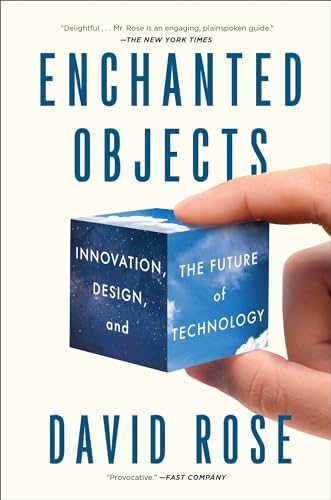
In the tradition of Who Owns the Future, an MIT Media Lab scientist imagines how everyday objects can intuit our needs, improve our lives, and form “an ethereal interconnection of gadgets and human desires that...will pervade our lives in the very near future” (The Wall Street Journal).
We are now standing at the precipice of the next transformative development, a world in which technology becomes more human. Soon, connected technology will be embedded in hundreds of everyday objects we already use: our cars, wallets, watches, umbrellas, even our trash cans. These objects will respond to our needs, come to know us, and even learn to think ahead on our behalf. David Rose calls these devices—which are just beginning to creep into the marketplace—Enchanted Objects.
In Rose’s vision of the future, technology atomizes, combining itself with the objects that make up the very fabric of daily living. Such innovations will be woven into the background of our environment, enhancing human relationships, channeling desires for omniscience, long life, and creative expression. The enchanted objects of fairy tales and science fiction will enter real life.
Groundbreaking, timely, and provocative, Enchanted Objects is a “delightful” (The New York Times) blueprint for a better future, where efficient solutions come hand in hand with technology that delights our senses. It is essential reading for designers, technologists, entrepreneurs, business leaders, and anyone who wishes to take a glimpse into the future.
Die Inhaltsangabe kann sich auf eine andere Ausgabe dieses Titels beziehen.
Über die Autorin bzw. den Autor
David Rose is an award-winning entrepreneur and instructor at the MIT Media Lab, specializing in how digital information interfaces with the physical environment. A former CEO at Vitality, he founded Ambient Devices, which pioneered technology to embed Internet information in everyday objects like lamps, mirrors, and umbrellas. CEO of Ditto Labs, Rose has been featured in The New York Times and parodied on The Colbert Report. A frequent speaker at conferences and for corporations, he lives in Brookline, Massachusetts, with his wife and two children. Enchanted Objects is his first book.
Auszug. © Genehmigter Nachdruck. Alle Rechte vorbehalten.
PROLOGUE
MY NIGHTMARE
I HAVE A recurring nightmare. It is years into the future. All the wonderful everyday objects we once treasured have disappeared, gobbled up by an unstoppable interface: a slim slab of black glass. Books, calculators, clocks, compasses, maps, musical instruments, pencils, and paintbrushes, all are gone. The artifacts, tools, toys, and appliances we love and rely on today have converged into this slice of shiny glass, its face filled with tiny, inscrutable icons that now define and control our lives. In my nightmare the landscape beyond the slab is barren. Desks are decluttered and paperless. Pens are nowhere to be found. We no longer carry wallets or keys or wear watches. Heirloom objects have been digitized and then atomized. Framed photos, sports trophies, lovely cameras with leather straps, creased maps, spinning globes and compasses, even binoculars and books—the signifiers of our past and triggers of our memory—have been consumed by the cold glass interface and blinking search field. Future life looks like a Dwell magazine photo shoot. Rectilinear spaces, devoid of people. No furniture. No objects. Just hard, intersecting planes—Corbusier’s Utopia. The lack of objects has had an icy effect on us. Human relationships, too, have become more transactional, sharply punctuated, thin and curt. Less nostalgic. Fewer objects exist to trigger storytelling—no old photo albums or clumsy watercolors made while traveling someplace in the Caribbean.
In my nightmare, the cold, black slab has re-architected everything—our living and working spaces, our schools, airports, even bars and restaurants. We interact with screens 90 percent of our waking hours. The result is a colder, more isolated, less humane world. Perhaps it is more efficient, but we are less happy.
Marc Andreessen, the inventor of the Netscape browser, said, “Software is eating the world.” Smartphones are the pixelated plates where software dines.
Often when I awake from this nightmare, I think of my grandfather Otto and know the future doesn’t have to be dominated by the slab. Grandfather was a meticulous architect and woodworker. His basement workshop had many more tools than a typical iPad has apps. He owned power tools: table saw, lathe, band saw, drill press, belt sander, circular sander, jigsaw, router. And hand tools: hundreds of hammers, screwdrivers, wrenches, pliers, chisels, planes, files, rasps. Clamps hung from every rafter. Strewn around his architectural drawings were T squares, transparent triangles, hundreds of pencils and pens, stencils for complex curves, compasses, and protractors of every size.
The diversity of wood-working tools in my grandfather’s workshop, or utensils in a kitchen, or shoes in your closet, prove our presence for specialization. This debunks the myth of technology convergence.
I don’t recall my grandfather ever complaining about having too many tools. Or dreaming of tool convergence—wishing some singular mother-of-all-tools would come along to replace them. Redundancy abounded. Specialization was prized. When carving, he would lay out a line of chisels that, to my untrained eye, looked pretty much the same. He would switch rapidly from tool to tool, this one for a smaller-radius cut, this one to take out more material, this one for a V-shaped cut. As a five-year-old, my job was to brush the wonderful-smelling wood shavings off the worktable and sweep sawdust into piles on the floor.
Just as important as the suitability of the tool to the job was its relationship to the worker. The way it fit the hand, responded to leverage and force, aligned with my grandfather’s thought process, reminded him of past projects or how he had inherited a particular tool from his own father, a cabinetmaker. Tools were practical, but they also told stories. They each possessed a lineage. They stirred emotions. Hanging from the rafters were hundreds of specialized jigs he had made to hold a particular part of a clock as it passed through the table saw or to route dovetail joints. As tools summoned memories, he would glance up from his work. “You know that rocking chair that sits on the porch, David?” Yes, I would nod. “Remember the legs and how they have a nice smooth bend to them?” Yes, of course. He would point to the bow in his hand. “This is what I used to form the curve.”
Grandfather’s tools were constructed and used with a respect for human capabilities and preferences. They fit human bodies and minds. They were a pleasure to work with and to display. They made us feel powerful, more skilled and capable than we were without them. They hung or nestled quietly, each in its place, and never made us feel stupid or overwhelmed. They were, in a word, enchanting.
WE HAVE ALREADY IMAGINED THE FUTURE OF TECHNOLOGY
I want the future of our relationship with digital technology to look less like the cold slab of glass of my nightmare and more like my grandfather’s basement workshop—chock-full of beloved tools and artifacts imbued with stories. I want the computer-human interface to be an empowering and positive experience—to minimize the interruption, annoyance, and distraction of our so-called smartphones and glass-faced tablets.
Over millennia, as humans worked with textiles, wood, and metal to craft clothing, furniture, homes, and cathedrals, we developed specialized tools for specific jobs. But, in today’s world, characterized by the convergence of everything into smartphones, we have become close-minded, obsessed with apps, app stores, and icons. Few innovators are daring to ask, “What other kinds of future interfaces might rival the dominance of the black slab?”
Some people, however, are imagining interfaces outside the current norm. I admire the thinking of David Merrill, my MIT colleague and founder of the inventive toy company Sifteo. He and I share a view of the needs and opportunities for human-technology interaction that are not currently being answered by the smartphone and its kin.
For one, we need to connect the billions of legacy objects that already make up our infrastructure—thermostats, doorknobs and locks, buses and bridges and electric power meters. We also need devices that can manipulate real material, such as 3-D printers that can translate electronic designs into physical objects, into food, and, eventually, into aromas. And we need tangible interfaces that make the human body smarter. Technology can enhance our five senses and optimize our physical abilities by accommodating and responding to the way we already operate in the world: with natural gestures, expressions, movements, and sounds.
What if screens atomize into a smaller, tangible, and more siftable material like sand? This is the vision of the innovative game company Sifteo. Each of these blocks is a screen that knows its orientation to the others.
These are just a few of the hundreds, thousands, possibly millions of possibilities for objects to interact with us in ways that glass slabs cannot. This book will uncover, analyze, and celebrate those objects and new forms of interaction. Technology, I believe, should help make human beings, and the world we live in, more captivating and more enchanting. You and I can help illuminate the way toward that future.
FALLING FOR ENCHANTED OBJECTS
I grew up in...
„Über diesen Titel“ kann sich auf eine andere Ausgabe dieses Titels beziehen.
Suchergebnisse für Enchanted Objects: Innovation, Design, and the Future...

Beispielbild für diese ISBN
Enchanted Objects: Innovation, Design, and the Future of Technology
Anbieter: World of Books (was SecondSale), Montgomery, IL, USA
Verkäuferbewertung 5 von 5 Sternen

Zustand: Good. Item in good condition. Textbooks may not include supplemental items i.e. CDs, access codes etc. Artikel-Nr. 00098597891
Gebraucht kaufen
EUR 3,96
Versand gratis
Versand innerhalb von USA
Versand innerhalb von USA
Anzahl: 3 verfügbar
Beispielbild für diese ISBN
Enchanted Objects: Innovation, Design, and the Future of Technology
Verlag:
Scribner (edition Reprint), 2015
ISBN 10: 1476725640
ISBN 13: 9781476725642
Gebraucht
Paperback
Anbieter: BooksRun, Philadelphia, PA, USA
Verkäuferbewertung 5 von 5 Sternen
Paperback. Zustand: Very Good. Reprint. It's a well-cared-for item that has seen limited use. The item may show minor signs of wear. All the text is legible, with all pages included. It may have slight markings and/or highlighting. Artikel-Nr. 1476725640-11-1
Gebraucht kaufen
EUR 5,11
Versand gratis
Versand innerhalb von USA
Versand innerhalb von USA
Anzahl: 1 verfügbar
Beispielbild für diese ISBN
Enchanted Objects : Innovation, Design, and the Future of Technology
Anbieter: Better World Books, Mishawaka, IN, USA
Verkäuferbewertung 5 von 5 Sternen
Zustand: Good. Reprint. Pages intact with minimal writing/highlighting. The binding may be loose and creased. Dust jackets/supplements are not included. Stock photo provided. Product includes identifying sticker. Better World Books: Buy Books. Do Good. Artikel-Nr. 8683102-6
Gebraucht kaufen
EUR 6,04
Versand gratis
Versand innerhalb von USA
Versand innerhalb von USA
Anzahl: 1 verfügbar
Beispielbild für diese ISBN
Enchanted Objects : Innovation, Design, and the Future of Technology
Anbieter: Better World Books: West, Reno, NV, USA
Verkäuferbewertung 5 von 5 Sternen
Zustand: Very Good. Reprint. Pages intact with possible writing/highlighting. Binding strong with minor wear. Dust jackets/supplements may not be included. Stock photo provided. Product includes identifying sticker. Better World Books: Buy Books. Do Good. Artikel-Nr. GRP98759255
Gebraucht kaufen
EUR 6,04
Versand gratis
Versand innerhalb von USA
Versand innerhalb von USA
Anzahl: 1 verfügbar
Beispielbild für diese ISBN
Enchanted Objects : Innovation, Design, and the Future of Technology
Anbieter: Better World Books, Mishawaka, IN, USA
Verkäuferbewertung 5 von 5 Sternen
Zustand: Very Good. Reprint. Pages intact with possible writing/highlighting. Binding strong with minor wear. Dust jackets/supplements may not be included. Stock photo provided. Product includes identifying sticker. Better World Books: Buy Books. Do Good. Artikel-Nr. GRP98759255
Gebraucht kaufen
EUR 6,04
Versand gratis
Versand innerhalb von USA
Versand innerhalb von USA
Anzahl: 1 verfügbar
Beispielbild für diese ISBN
Enchanted Objects: Innovation, Design, and the Future of Technology
Anbieter: Wonder Book, Frederick, MD, USA
Verkäuferbewertung 5 von 5 Sternen
Zustand: Good. Good condition. A copy that has been read but remains intact. May contain markings such as bookplates, stamps, limited notes and highlighting, or a few light stains. Artikel-Nr. N02B-04771
Gebraucht kaufen
EUR 6,27
Versand gratis
Versand innerhalb von USA
Versand innerhalb von USA
Anzahl: 1 verfügbar
Beispielbild für diese ISBN
Enchanted Objects
Anbieter: ThriftBooks-Dallas, Dallas, TX, USA
Verkäuferbewertung 5 von 5 Sternen
Paperback. Zustand: Very Good. No Jacket. May have limited writing in cover pages. Pages are unmarked. ~ ThriftBooks: Read More, Spend Less. Artikel-Nr. G1476725640I4N00
Gebraucht kaufen
EUR 6,92
Versand gratis
Versand innerhalb von USA
Versand innerhalb von USA
Anzahl: 1 verfügbar
Beispielbild für diese ISBN
Enchanted Objects
Anbieter: ThriftBooks-Atlanta, AUSTELL, GA, USA
Verkäuferbewertung 5 von 5 Sternen
Paperback. Zustand: Very Good. No Jacket. May have limited writing in cover pages. Pages are unmarked. ~ ThriftBooks: Read More, Spend Less. Artikel-Nr. G1476725640I4N00
Gebraucht kaufen
EUR 6,92
Versand gratis
Versand innerhalb von USA
Versand innerhalb von USA
Anzahl: 1 verfügbar
Beispielbild für diese ISBN
Enchanted Objects: Innovation, Design, and the Future of Technology
Anbieter: WorldofBooks, Goring-By-Sea, WS, Vereinigtes Königreich
Verkäuferbewertung 5 von 5 Sternen
Paperback. Zustand: Very Good. The book has been read, but is in excellent condition. Pages are intact and not marred by notes or highlighting. The spine remains undamaged. Artikel-Nr. GOR007290949
Gebraucht kaufen
EUR 2,90
EUR 6,53 Versand
Versand von Vereinigtes Königreich nach USA
Versand von Vereinigtes Königreich nach USA
Anzahl: 4 verfügbar
Foto des Verkäufers
Enchanted Objects: Innovation, Design, and the Future of Technology
Anbieter: WeBuyBooks, Rossendale, LANCS, Vereinigtes Königreich
Verkäuferbewertung 5 von 5 Sternen
paperback. Zustand: Very Good. Most items will be dispatched the same or the next working day. A copy that has been read, but is in excellent condition. Pages are intact and not marred by notes or highlighting. The spine remains undamaged. Artikel-Nr. rev3119314932
Gebraucht kaufen
EUR 3,32
EUR 6,92 Versand
Versand von Vereinigtes Königreich nach USA
Versand von Vereinigtes Königreich nach USA
Anzahl: 1 verfügbar