
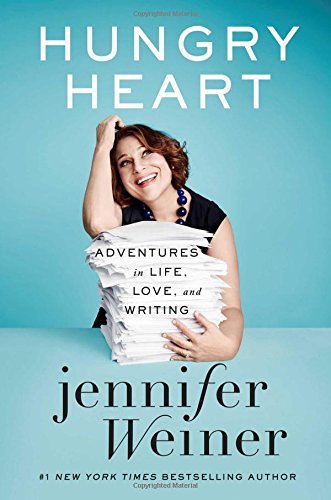
Inhaltsangabe
"Generous and entertaining." —Publishers Weekly (starred review)
Finalist for the PEN/Diamonstein-Spielvogel Award for the Art of the Essay * Nominated for “Best Memoir & Autobiography” by Goodreads Choice Awards 2016 * Named a “Best Book of the Year” by New York Post
"You'll laugh, you'll cry, you'll want to read it again." —TheSkimm
“I'm mad Jennifer's Weiner's first book of essays is as wonderful as her fiction. You will love this book and wish she was your friend." —Mindy Kaling, author of Why Not Me?
"Fiercely funny, powerfully smart, and remarkably brave." —Cheryl Strayed, author of Wild
Jennifer Weiner is many things: a bestselling author, a Twitter phenomenon, and an “unlikely feminist enforcer” (The New Yorker). She’s also a mom, a daughter, and a sister, a clumsy yogini, and a reality-TV devotee. In this “unflinching look at her own experiences” (Entertainment Weekly), Jennifer fashions tales of modern-day womanhood as uproariously funny and moving as the best of Nora Ephron and Tina Fey.
No subject is off-limits in these intimate and honest essays: sex, weight, envy, money, her mother’s coming out of the closet, her estranged father’s death. From lonely adolescence to hearing her six-year-old daughter say the F word—fat—for the first time, Jen dives into the heart of female experience, with the wit and candor that have endeared her to readers all over the world.
Die Inhaltsangabe kann sich auf eine andere Ausgabe dieses Titels beziehen.
Über die Autorin bzw. den Autor
Jennifer Weiner is the #1 New York Times bestselling author of eighteen books, including Good in Bed, That Summer, and an essay collection, Hungry Heart: Adventures in Life, Love, and Writing. A graduate of Princeton University and a frequent contributor to the New York Times Opinion section, Jennifer lives with her family in Philadelphia. Visit her online at JenniferWeiner.com.
Auszug. © Genehmigter Nachdruck. Alle Rechte vorbehalten.
Hungry Heart
Hungry Heart
The other day, I was walking from the hair salon to pick up my eight-year-old after school. It was a beautiful February afternoon, unseasonably sunny and springlike, with a sweet breeze rummaging in the tree branches that were just starting to bud.
Also, my hair looked spectacular.
I was feeling really good. I’d put in a solid morning writing; then I’d done a spinning class, where, according to the computerized rankings that I obsessively checked, I hadn’t finished last. I was wearing my favorite jeans, which are dark-rinsed, straight-legged, stretchy and forgiving, and the Eileen Fisher cashmere sweater that I’d snagged for 70 percent off at the cash-only sale. With my UGG boots on my feet and my purse, with its furry purse-charm, slung over my shoulder, I strode confidently down Lombard Street, feeling like I was on top of things, like this was a day when I had it all figured out.
And then I fell.
My toe must have caught a crack in the pavement as I hurried to cross Twenty-Fifth Street before the light changed. I felt myself leave the ground, saw my arms flailing, then heard myself shout in pain after I smacked down on the pavement, landing on my knees and the heels of my hands. This was not a cute stumble, not the dainty little stutter-step you’d see in a ZZ Top video right before the band launched into a paean to the high-heel-wearing, miniskirted heroine’s legs. This was a full-on pratfall, a wind-knocked-out-of-you, flat-out, oh-my-God, people-running-over-to-see-if-you’re-okay face-plant.
I think I lay there whimpering for a minute before I hauled myself to my feet, assured my fellow pedestrians that I was fine, staggered through the school gate, and inspected the damage. There was dirt and grit and gravel ground into my palms. My jeans were torn. Both of my knees were bruised and bleeding.
“Mommy, are you okay?” asked Phoebe moments later when she came out of the classroom and found me holding a paper napkin to my knee.
“Yeah, I’ll be fine,” I muttered. I limped outside, where we waited for an Uber—no way was I walking home in this condition—and I realized that this was not just a trip, not just a stumble; it was a metaphor for my life, maybe for every woman’s life.
You fall, you get hurt, you get up again.
• • •
Last summer, the New York Times wrote a profile of the author Judy Blume, in which she described herself and her work. “I’m a storyteller—you know what I mean—an inventor of people,” Blume said. “And their relationships. It’s not that I love the words—that’s not the kind of writer I am. So I’m not”—she made a furious scribbling motion with her right hand—“I’m not a great writer. But maybe I’m a really good storyteller.”
I don’t think I’ve ever identified so completely with a description, or the way it plays into the seemingly endless debate over what qualifies as literature. I, too, am a storyteller; I, too, eschew the furious-scribbling-motion kind of writing. I care about language and structure and pace, but I care about plot and characters more. I know I’m not the kind of writer who wins prizes and a place on the ninth-grade summer reading list, the kind of writer who gets called “great.” And, lucky me, if I was ever in danger of forgetting precisely where on the literary food chain I reside, there are people lined up on the Internet to remind me.
But “great writer” was never my ambition . . . and I suspect was never within the realm of possibility. I believe that, through education and inclination, through temperament and history, all authors grow up to be a particular kind of writer, to tell a specific type of story. We could no more change the kind of work we do—the voice in which we write, the characters that call to us—than we could our own blood type.
I am the proud and happy writer of popular fiction, and I would never argue that it matters as much as the award-winning, breathtaking, life-changing meditations on love and humanity and the Way We Live Now. I would also note that critics still stumble over the gender divide, where a man’s dissection of a marriage or a family is seen as important and literary, whereas a woman’s book about the same topic is dismissed as precious and jewel-like, domestic and small. Double standards persist, and in general, men’s books are still perceived as more meaningful, more important, more desirable. Last summer, a writer for the feminist website Jezebel revealed that querying six literary agents under a male name netted her five responses (including three requests to see the manuscript) within twenty-four hours, while the exact same letter, sent fifty times under her own name, had gotten a total of just two invitations to send her manuscript. “The judgments about my work that had seemed as solid as the walls of my house had turned out to be meaningless,” she wrote. “My novel wasn’t the problem, it was me—Catherine.”
Clearly, there is progress to be made in terms of how we regard women’s work . . . and being the one who points out the problem does not earn you the Miss Congeniality sash. Particularly when your insistence on fair play and a level playing field is interpreted as a form of delusion about the kind of books you write and the kind of attention you deserve.
She thinks she’s as good as Jonathan Franzen, my critics sneer. She thinks her stuff belongs in the New Yorker. Not true! As a lifelong reader of both literary and popular fiction, I am completely equipped to tell the difference, and I know what belongs where. What I believe is that popular fiction by and for women deserves the same regard as popular fiction by and for men. I believe that if the New York Times is going to review mysteries and thrillers and science fiction, it should also review romance—which remains by far the bestselling genre of all literature—and everything that comes under the catch-all umbrella of “commercial women’s fiction.” Maybe books like mine won’t win the National Book Award, but that doesn’t mean they don’t matter at all. Nor does it mean that the women who read them deserve to be ignored or erased. Women’s stories matter, the stories we write, the stories we read—the big-deal winners of literary prizes, and Harlequin romances, and documentaries, and soap operas, and PBS investigations, and Lifetime movies of the week. Women’s stories matter. They tell us who we are, they give us places to explore our problems, to try on identities and imagine happy endings. They entertain us, they divert us, they comfort us when we’re lonely or alone. Women’s stories matter. And women matter, too.
• • •
You fall down. You get hurt. You get up again.
In my own life, I can trace the ups and downs, the things that have gone spectacularly wrong, and the things that have gone right beyond any imagining. There has been heartache. There has been embarrassment. There was that time I had to read about my father’s scrotum in the newspaper. (Fear not; we’ll get there.)
But I’ve realized my childhood dream of becoming a published author and a contributing writer for the New York Times. I have a beautiful home in a city I love, and friends who’ve stood by me, and a wonderful, loving, crazy family that’s come with me for the...
„Über diesen Titel“ kann sich auf eine andere Ausgabe dieses Titels beziehen.
Weitere beliebte Ausgaben desselben Titels

Suchergebnisse für Hungry Heart: Adventures in Life, Love, and Writing

Beispielbild für diese ISBN
Its All Material
Anbieter: World of Books (was SecondSale), Montgomery, IL, USA
Verkäuferbewertung 5 von 5 Sternen

Zustand: Good. Item in good condition. Textbooks may not include supplemental items i.e. CDs, access codes etc. Artikel-Nr. 00060492058
Gebraucht kaufen
EUR 3,17
Versand gratis
Versand innerhalb von USA
Versand innerhalb von USA
Anzahl: 3 verfügbar
Beispielbild für diese ISBN
Hungry Heart: Adventures in Life, Love, and Writing
Anbieter: World of Books (was SecondSale), Montgomery, IL, USA
Verkäuferbewertung 5 von 5 Sternen
Zustand: Very Good. Item in very good condition! Textbooks may not include supplemental items i.e. CDs, access codes etc. Artikel-Nr. 00084306580
Gebraucht kaufen
EUR 3,76
Versand gratis
Versand innerhalb von USA
Versand innerhalb von USA
Anzahl: 7 verfügbar
Beispielbild für diese ISBN
Hungry Heart: Adventures in Life, Love, and Writing
Anbieter: World of Books (was SecondSale), Montgomery, IL, USA
Verkäuferbewertung 5 von 5 Sternen
Zustand: Good. Item in good condition. Textbooks may not include supplemental items i.e. CDs, access codes etc. Artikel-Nr. 00086216988
Gebraucht kaufen
EUR 3,76
Versand gratis
Versand innerhalb von USA
Versand innerhalb von USA
Anzahl: 7 verfügbar
Beispielbild für diese ISBN
Hungry Heart: Adventures in Life, Love, and Writing
Verlag:
Atria Books (edition First Edition), 2016
ISBN 10: 1476723400
ISBN 13: 9781476723402
Gebraucht
Hardcover
Erstausgabe
Anbieter: BooksRun, Philadelphia, PA, USA
Verkäuferbewertung 5 von 5 Sternen
Hardcover. Zustand: Very Good. First Edition. With dust jacket. It's a well-cared-for item that has seen limited use. The item may show minor signs of wear. All the text is legible, with all pages included. It may have slight markings and/or highlighting. Artikel-Nr. 1476723400-11-6-29
Gebraucht kaufen
EUR 5,57
Versand gratis
Versand innerhalb von USA
Versand innerhalb von USA
Anzahl: 1 verfügbar
Beispielbild für diese ISBN
Hungry Heart: Adventures in Life, Love, and Writing
Verlag:
Atria Books (edition First Edition), 2016
ISBN 10: 1476723400
ISBN 13: 9781476723402
Gebraucht
Hardcover
Erstausgabe
Anbieter: BooksRun, Philadelphia, PA, USA
Verkäuferbewertung 5 von 5 Sternen
Hardcover. Zustand: Very Good. First Edition. With dust jacket. It's a well-cared-for item that has seen limited use. The item may show minor signs of wear. All the text is legible, with all pages included. It may have slight markings and/or highlighting. Artikel-Nr. 1476723400-11-18-29
Gebraucht kaufen
EUR 5,63
Versand gratis
Versand innerhalb von USA
Versand innerhalb von USA
Anzahl: 1 verfügbar
Beispielbild für diese ISBN
Hungry Heart: Adventures in Life, Love, and Writing
Anbieter: ThriftBooks-Reno, Reno, NV, USA
Verkäuferbewertung 5 von 5 Sternen
Hardcover. Zustand: Very Good. No Jacket. May have limited writing in cover pages. Pages are unmarked. ~ ThriftBooks: Read More, Spend Less. Artikel-Nr. G1476723400I4N00
Gebraucht kaufen
EUR 5,87
Versand gratis
Versand innerhalb von USA
Versand innerhalb von USA
Anzahl: 1 verfügbar
Beispielbild für diese ISBN
Hungry Heart: Adventures in Life, Love, and Writing
Anbieter: ThriftBooks-Atlanta, AUSTELL, GA, USA
Verkäuferbewertung 5 von 5 Sternen
Hardcover. Zustand: Very Good. No Jacket. May have limited writing in cover pages. Pages are unmarked. ~ ThriftBooks: Read More, Spend Less. Artikel-Nr. G1476723400I4N00
Gebraucht kaufen
EUR 5,87
Versand gratis
Versand innerhalb von USA
Versand innerhalb von USA
Anzahl: 1 verfügbar
Beispielbild für diese ISBN
Hungry Heart: Adventures in Life, Love, and Writing
Anbieter: ThriftBooks-Atlanta, AUSTELL, GA, USA
Verkäuferbewertung 5 von 5 Sternen
Hardcover. Zustand: Very Good. No Jacket. Former library book; May have limited writing in cover pages. Pages are unmarked. ~ ThriftBooks: Read More, Spend Less. Artikel-Nr. G1476723400I4N10
Gebraucht kaufen
EUR 5,87
Versand gratis
Versand innerhalb von USA
Versand innerhalb von USA
Anzahl: 1 verfügbar
Beispielbild für diese ISBN
Hungry Heart: Adventures in Life, Love, and Writing
Anbieter: ThriftBooks-Dallas, Dallas, TX, USA
Verkäuferbewertung 5 von 5 Sternen
Hardcover. Zustand: Very Good. No Jacket. May have limited writing in cover pages. Pages are unmarked. ~ ThriftBooks: Read More, Spend Less. Artikel-Nr. G1476723400I4N00
Gebraucht kaufen
EUR 5,87
Versand gratis
Versand innerhalb von USA
Versand innerhalb von USA
Anzahl: 1 verfügbar
Beispielbild für diese ISBN
Hungry Heart: Adventures in Life, Love, and Writing
Verlag:
Atria Books (edition First Edition), 2016
ISBN 10: 1476723400
ISBN 13: 9781476723402
Gebraucht
Hardcover
Erstausgabe
Anbieter: BooksRun, Philadelphia, PA, USA
Verkäuferbewertung 5 von 5 Sternen
Hardcover. Zustand: Fair. First Edition. The item might be beaten up but readable. May contain markings or highlighting, as well as stains, bent corners, or any other major defect, but the text is not obscured in any way. Artikel-Nr. 1476723400-7-18
Gebraucht kaufen
EUR 6,09
Versand gratis
Versand innerhalb von USA
Versand innerhalb von USA
Anzahl: 1 verfügbar