
Verwandte Artikel zu All the Single Ladies: Unmarried Women and the Rise...
Inhaltsangabe
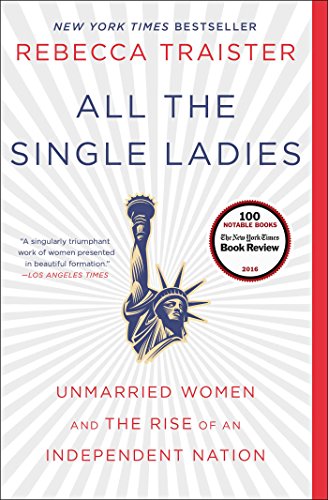
The New York Times bestselling investigation into the sexual, economic, and emotional lives of women is “an informative and thought-provoking book for anyone—not just the single ladies—who want to gain a greater understanding of this pivotal moment in the history of the United States” (The New York Times Book Review).
In 2009, award-winning journalist Rebecca Traister started All the Single Ladies about the twenty-first century phenomenon of the American single woman. It was the year the proportion of American women who were married dropped below fifty percent; and the median age of first marriages, which had remained between twenty and twenty-two years old for nearly a century (1890–1980), had risen dramatically to twenty-seven.
But over the course of her vast research and more than a hundred interviews with academics and social scientists and prominent single women, Traister discovered a startling truth: the phenomenon of the single woman in America is not a new one. And historically, when women were given options beyond early heterosexual marriage, the results were massive social change—temperance, abolition, secondary education, and more. Today, only twenty percent of Americans are married by age twenty-nine, compared to nearly sixty percent in 1960.
“An informative and thought-provoking book for anyone—not just single ladies” (The New York Times Book Review), All the Single Ladies is a remarkable portrait of contemporary American life and how we got here, through the lens of the unmarried American woman. Covering class, race, sexual orientation, and filled with vivid anecdotes from fascinating contemporary and historical figures, “we’re better off reading Rebecca Traister on women, politics, and America than pretty much anyone else” (The Boston Globe).
Die Inhaltsangabe kann sich auf eine andere Ausgabe dieses Titels beziehen.
Über die Autorin bzw. den Autor
Rebecca Traister is writer at large for New York magazine and a contributing editor at Elle. A National Magazine Award finalist, she has written about women in politics, media, and entertainment from a feminist perspective for The New Republic and Salon and has also contributed to The Nation, The New York Observer, The New York Times, The Washington Post, Vogue, Glamour, and Marie Claire. She is the author of Good and Mad, All the Single Ladies and the award-winning Big Girls Don’t Cry. She lives in New York with her family.
Von der hinteren Coverseite
The New York Times bestselling investigation into the sexual, economic, and emotional lives of women is “an informative and thought-provoking book for anyone—not just the single ladies—who want to gain a greater understanding of this pivotal moment in the history of the United States” (The New York Times Book Review).
In 2009, award-winning journalist Rebecca Traister started All the Single Ladies about the twenty-first century phenomenon of the American single woman. It was the year the proportion of American women who were married dropped below fifty percent; and the median age of first marriages, which had remained between twenty and twenty-two years old for nearly a century (1890–1980), had risen dramatically to twenty-seven.
But over the course of her vast research and more than a hundred interviews with academics and social scientists and prominent single women, Traister discovered a startling truth: the phenomenon of the single woman in America is not a new one. And historically, when women were given options beyond early heterosexual marriage, the results were massive social change—temperance, abolition, secondary education, and more. Today, only twenty percent of Americans are married by age twenty-nine, compared to nearly sixty percent in 1960.
“An informative and thought-provoking book for anyone—not just single ladies” (The New York Times Book Review), All the Single Ladies is a remarkable portrait of contemporary American life and how we got here, through the lens of the unmarried American woman. Covering class, race, sexual orientation, and filled with vivid anecdotes from fascinating contemporary and historical figures, “we’re better off reading Rebecca Traister on women, politics, and America than pretty much anyone else” (The Boston Globe).
Auszug. © Genehmigter Nachdruck. Alle Rechte vorbehalten.
All the Single Ladies CHAPTER ONE Watch Out for That Woman: The Political and Social Power of an Unmarried Nation
The contemporary wave of single women was building in the very same years that I was heading off to college, though I hadn’t realized it. The early 1990s was the period in which reverberations of the social and political revolutions of my mother’s generation were manifesting as swiftly changing marriage and reproductive patterns, which, in turn, would create a current of political possibility for independent women in America.
On October 11, 1991, a thirty-five-year-old law professor, Anita Faye Hill, appeared before the Senate Judiciary Committee to testify about the sexual harassment she’d experienced while working for Clarence Thomas, a D.C. Circuit Judge nominated by President George H. W. Bush to fill the Supreme Court seat of the retiring civil rights hero, Thurgood Marshall. A native of rural Lone Tree, Oklahoma, Hill was the youngest of thirteen children raised by Baptist farmers; her grandfather and great-grandparents had been slaves in Arkansas. She was valedictorian of her high-school class and attended Yale Law School, worked for Thomas at both the Department of Education and the Equal Employment Opportunity Commission, and taught contract law at the University of Oklahoma. She was not married.
As cameras recorded every second, broadcasting to a rapt and tense nation, Hill sat before the all-white, all-male Senate Judiciary Panel and told them in a careful, clear voice of the sexually crude ways in which Thomas had spoken to her during the years she worked for him; she detailed her former boss’s references to pornographic movie stars, penis size, and pubic hair in professional contexts. In turn, she was pilloried by the conservative press, spoken to with skepticism and insult by many on the committee, and portrayed by other witnesses as irrational, sexually loose, and perhaps a sufferer of erotomania,1 a rare psychological disorder that causes women to fantasize sexual relationships with powerful men.
Wyoming Senator Alan Simpson questioned Hill’s “proclivities” (a term that the conservative columnist William Safire suggested was “a code word for homosexuality”2). One pundit, David Brock, called Hill “a little bit nutty and a little bit slutty.” Called in front of the committee after her testimony, John Doggett, a former classmate of Thomas’s and an acquaintance of Hill’s, described Hill as “somewhat unstable” and surmised that she had “fantasized about my being interested in her romantically.” He guessed, based on their brief social interactions, “that she was having a problem with being rejected by men she was attracted to;” at another point, Doggett noted that Hill “seemed to be lonely in this town.”
As Hill would later write of her experience, “Much was made in the press of the fact that I was single, though the relevance of my marital status to the question of sexual harassment was never articulated.”3
The relevance of her single status was how it distinguished her from established expectations of femininity. Hill had no husband to vouch for her virtue, no children to affirm her worth, as women’s worth had been historically understood. Her singleness, Hill felt at the time, allowed her detractors to place her “as far outside the norms of proper behavior as they could.” Members of the Judiciary, she wrote, “could not understand why I was not attached to certain institutions, notably marriage,” and were thus left to surmise that she was single “because I was unmarriageable or opposed to marriage, the fantasizing spinster or the man-hater.”
The lingering assumption—born of the same expectations that I had chafed at as a kid, reading novels—was that the natural state of adult womanhood involved being legally bound to a man. Perhaps especially in the comparatively new world of female professional achievement, in which a woman might be in a position, as an equivalently educated professional peer of a judicial nominee to the Supreme Court, to offer testimony that could imperil his career, marriage remained the familiar institution that might comfortably balance out this new kind of parity, and would offer the official male validation and abrogate her questioners’ ability to depict her as a spinster fantasist.
In raising questions about her marital status and her mental stability, Hill wrote, senators were “attempting to establish a relationship between marriage, values, and credibility” and prompt people to wonder “why I, a thirty-five-year-old Black woman, had chosen to pursue a career and to remain single—an irrelevant shift of focus that contributed to the conclusion that I was not to be believed.”
Indeed, Hill’s testimony was not believed by the members of the committee, at least not enough to make an impact on their decision. Clarence Thomas was confirmed to the Supreme Court days after her appearance before the Judiciary.
But Hill was not some contemporary Hester Prynne, doomed to a life in exile. Instead, her appearance had a lasting impact on the country and its power structures. The term sexual harassment entered the lexicon and the American consciousness, allowing women, married and single, to make sense of and lodge objections to workplace harassment; it offered us a view of how behavior long viewed as harmless was actually a form of discrimination and subjugation that hurt women as a class.
Just as long-lasting was the impact that the vision of Hill’s being grilled by a panel of white men had on America’s representative politics. In 1991, there had been only two women serving in the United States Senate, an embarrassing circumstance that the hearings put in stark national relief. A photograph published by the New York Times showed a group of Congress’s few female representatives, including Patricia Schroeder and Eleanor Holmes Norton, running up the Capitol steps to stop the proceedings to demand that Hill be allowed to testify.
The spectacle of Hill’s treatment by the committee spurred a reckoning with the nation’s monochromatic and male representative body. The year after her testimony, an unprecedented number of women ran for the Senate. Four of them won. One, Washington’s Patty Murray, has repeatedly explained that the Thomas hearings had helped spur her to political action; “I just kept looking at this committee, going ‘God, who’s saying what I would say if I was there,’?” she’s said. “I mean, all men, not saying what I would say. I just felt so disoriented.”4 Another, Carole Moseley Braun of Illinois, became the first (and, so far, only) African-American woman elected to the Senate. They called 1992 “The Year of the Woman.”
Though Hill’s life and career were certainly upended by the attention (as well as by the death and rape threats) that came in the wake of her testimony, they were not cut short or ended. She was not permanently ostracized, professionally or personally. Today, she teaches law at Brandeis and lives in Boston with her partner of more than a decade.
Part of the reason that Hill was not wholly written off as a social aberration was because by the early 1990s, she wasn’t. A generation of women was, like Hill, living, working, and occupying public space on its own. The percentage of women between the ages of thirty-five and forty-four who were married had fallen from about 87 percent in 1960 and 1970 to 73 percent in 1990.5
“Women began, in the nineties, to embrace their own sexuality and sexual expression in a different way,” Hill...
„Über diesen Titel“ kann sich auf eine andere Ausgabe dieses Titels beziehen.
Suchergebnisse für All the Single Ladies: Unmarried Women and the Rise...

Beispielbild für diese ISBN
All the Single Ladies: Unmarried Women and the Rise of an Independent Nation
Anbieter: World of Books (was SecondSale), Montgomery, IL, USA
Verkäuferbewertung 5 von 5 Sternen

Paperback. Zustand: Good. Synopsis coming soon. Artikel-Nr. 00086051935
Gebraucht kaufen
EUR 4,06
Versand gratis
Versand innerhalb von USA
Versand innerhalb von USA
Anzahl: 17 verfügbar
Beispielbild für diese ISBN
All the Single Ladies: Unmarried Women and the Rise of an Independent Nation
Anbieter: World of Books (was SecondSale), Montgomery, IL, USA
Verkäuferbewertung 5 von 5 Sternen
Paperback. Zustand: Fair. Synopsis coming soon. Artikel-Nr. 00083709802
Gebraucht kaufen
EUR 4,06
Versand gratis
Versand innerhalb von USA
Versand innerhalb von USA
Anzahl: 3 verfügbar
Beispielbild für diese ISBN
All the Single Ladies: Unmarried Women and the Rise of an Independent Nation
Anbieter: World of Books (was SecondSale), Montgomery, IL, USA
Verkäuferbewertung 5 von 5 Sternen
Paperback. Zustand: Very Good. Synopsis coming soon. Artikel-Nr. 00106547671
Gebraucht kaufen
EUR 4,06
Versand gratis
Versand innerhalb von USA
Versand innerhalb von USA
Anzahl: 1 verfügbar
Beispielbild für diese ISBN
All the Single Ladies: Unmarried Women and the Rise of an Independent Nation
Verlag:
S&S/ Marysue Rucci Books (edition Reprint), 2016
ISBN 10: 1476716579
ISBN 13: 9781476716572
Gebraucht
Paperback
Anbieter: BooksRun, Philadelphia, PA, USA
Verkäuferbewertung 5 von 5 Sternen
Paperback. Zustand: Very Good. Reprint. It's a well-cared-for item that has seen limited use. The item may show minor signs of wear. All the text is legible, with all pages included. It may have slight markings and/or highlighting. Artikel-Nr. 1476716579-11-1
Gebraucht kaufen
EUR 4,98
Versand gratis
Versand innerhalb von USA
Versand innerhalb von USA
Anzahl: 1 verfügbar
Beispielbild für diese ISBN
All the Single Ladies : Unmarried Women and the Rise of an Independent Nation
Anbieter: Better World Books, Mishawaka, IN, USA
Verkäuferbewertung 5 von 5 Sternen
Zustand: Very Good. Reprint. Pages intact with possible writing/highlighting. Binding strong with minor wear. Dust jackets/supplements may not be included. Stock photo provided. Product includes identifying sticker. Better World Books: Buy Books. Do Good. Artikel-Nr. 11977002-6
Gebraucht kaufen
EUR 6,23
Versand gratis
Versand innerhalb von USA
Versand innerhalb von USA
Anzahl: 1 verfügbar
Beispielbild für diese ISBN
All the Single Ladies : Unmarried Women and the Rise of an Independent Nation
Anbieter: Better World Books, Mishawaka, IN, USA
Verkäuferbewertung 5 von 5 Sternen
Zustand: Good. Reprint. Former library copy. Pages intact with minimal writing/highlighting. The binding may be loose and creased. Dust jackets/supplements are not included. Includes library markings. Stock photo provided. Product includes identifying sticker. Better World Books: Buy Books. Do Good. Artikel-Nr. 11940343-75
Gebraucht kaufen
EUR 6,23
Versand gratis
Versand innerhalb von USA
Versand innerhalb von USA
Anzahl: 2 verfügbar
Beispielbild für diese ISBN
All the Single Ladies : Unmarried Women and the Rise of an Independent Nation
Anbieter: Better World Books, Mishawaka, IN, USA
Verkäuferbewertung 5 von 5 Sternen
Zustand: Good. Reprint. Pages intact with minimal writing/highlighting. The binding may be loose and creased. Dust jackets/supplements are not included. Stock photo provided. Product includes identifying sticker. Better World Books: Buy Books. Do Good. Artikel-Nr. 14660386-6
Gebraucht kaufen
EUR 6,23
Versand gratis
Versand innerhalb von USA
Versand innerhalb von USA
Anzahl: 1 verfügbar
Beispielbild für diese ISBN
All the Single Ladies: Unmarried Women and the Rise of an Independent Nation
Anbieter: Wonder Book, Frederick, MD, USA
Verkäuferbewertung 5 von 5 Sternen
Zustand: Very Good. Very Good condition. A copy that may have a few cosmetic defects. May also contain light spine creasing or a few markings such as an owner's name, short gifter's inscription or light stamp. Bundled media such as CDs, DVDs, floppy disks or access codes may not be included. Artikel-Nr. E03J-01393
Gebraucht kaufen
EUR 6,47
Versand gratis
Versand innerhalb von USA
Versand innerhalb von USA
Anzahl: 1 verfügbar
Beispielbild für diese ISBN
All the Single Ladies: Unmarried Women and the Rise of an Independent Nation
Anbieter: ThriftBooks-Phoenix, Phoenix, AZ, USA
Verkäuferbewertung 5 von 5 Sternen
Paperback. Zustand: Very Good. No Jacket. May have limited writing in cover pages. Pages are unmarked. ~ ThriftBooks: Read More, Spend Less. Artikel-Nr. G1476716579I4N00
Gebraucht kaufen
EUR 6,75
Versand gratis
Versand innerhalb von USA
Versand innerhalb von USA
Anzahl: 1 verfügbar
Beispielbild für diese ISBN
All the Single Ladies: Unmarried Women and the Rise of an Independent Nation
Anbieter: ThriftBooks-Phoenix, Phoenix, AZ, USA
Verkäuferbewertung 5 von 5 Sternen
Paperback. Zustand: Good. No Jacket. Pages can have notes/highlighting. Spine may show signs of wear. ~ ThriftBooks: Read More, Spend Less. Artikel-Nr. G1476716579I3N00
Gebraucht kaufen
EUR 6,75
Versand gratis
Versand innerhalb von USA
Versand innerhalb von USA
Anzahl: 1 verfügbar