
Verwandte Artikel zu Under Your Skin: A Novel
Inhaltsangabe
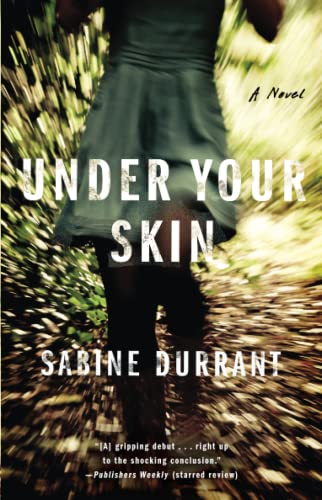
If you loved Gone Girl, then make this page-turning debut next on your reading list: “Sabine Durrant offers more twists than a rollercoaster in her thriller Under Your Skin, which proves you can trust no one” (Good Housekeeping).
Gaby Mortimer is the woman who has it all. But everything changes when she finds a body near her home. She’s shaken and haunted by the image of the lifeless young woman, and frightened that the killer, still at large, could strike again.
Before long, the police have a lead. The evidence points to a very clear suspect. One Gaby never saw coming…
Full of brilliant twists and turns, Under Your Skin is a dark and suspenseful psychological thriller that will make you second guess everything. Because you can never be too sure about anything, especially when it comes to murder.
Die Inhaltsangabe kann sich auf eine andere Ausgabe dieses Titels beziehen.
Über die Autorin bzw. den Autor
Sabine Durrant is a former assistant editor of The Guardian and a former literary editor at The Sunday Times whose feature writing has appeared in numerous British national newspapers and magazines. She is currently a magazine profile writer for The Sunday Telegraph and a contributor to The Guardian’s family section. She is the author of several books, including Remember Me This Way, Take Me In, and Finders, Keepers. She lives in south London with her partner, sportswriter Giles Smith, and their three children.
Auszug. © Genehmigter Nachdruck. Alle Rechte vorbehalten.
Under Your Skin
FRIDAY
I left the house earlier than usual this morning and, though it isn’t exactly dark, it isn’t yet light. The common is full of ghosts and shadows; the trees still ironclad, unyielding figures to the early gauze of spring; the bushes and brambles along the railway line knotted and clumped: a mugger’s paradise, though I try not to think about that.
I take my usual route—over the bridge and round the soccer fields, pitches, churned into clods like a choppy sea. It’s darkest where the path hits the corner, and there is an uncomfortable moment where you are hemmed in, rail cutting on one side, the adventure playground on the other. A blue anorak, sodden and draped, gives a creepily human form to a post, and my pace quickens until the path channels across the open grass toward the main road. The headlights of cars—commuters who need to be at work earlier than me, if such a thing were possible—rake the pavement. A shape comes toward me almost silently, another runner, a flash of headphone and Lycra, gone in a breath, a whiff of warmth and sweat. You are never alone in London, not in the dead of night, or even in the bone-cold chill of a predawn March morning. There is always the possibility of someone watching, following, seeing what you’re up to. I’m not sure I like it.
It helps to run. The pace, the rhythm, the sensation of regular movement in my limbs help give order to my thoughts. I didn’t sleep well last night. Even in the short snatches of unconsciousness I dreamed I was awake and anxious. In the end, I had to get up. I focus on my breath. In and out. In and out. I will run, try and sort things in my mind, and then once home, I will shower. Steve will be there to drive me to the studio at 7:00 AM. Kiss good-bye to Millie—Marta will give her breakfast. (Try to like Marta more.) Will I see Philip? Probably not. Already now it is—what, 5:15 AM?—he is showering, shaving, shaking off Nobu and the Dorchester (I smelled the cigars when he stumbled in at 3:00 AM), elbowing into all that spandex and peddling off on his brand-new carbon bike for Mayfair, Tokyo, Bloomberg. We used to run together. (Matching running tops, his and hers Asics. Is it pitiable to say I loved that?) But we haven’t since last summer. With the city as it is, he says, he needs serious muscle feedback. He needs powerful resistance. Running, he says, doesn’t come near reducing his stress.
My breath is ragged. I can feel it, hot, in my chest. It’s all wrong; I’m not doing it right. I’m hopeless; I’m a person who can’t even run properly. I turn up the central path, past the heartrending bench where someone ties a wreath (“MUM”) at Christmas. It might help to filter out the facts first. Philip’s parents: want an answer about Sunday lunch. Millie’s pretend birthday: beg Philip not to miss this one. (How could he have not turned up on Tuesday?) The weekend in Brighton . . . Something horrible happens in my stomach when I think about this. He says he’s too busy. “No biggie,” I said, but I didn’t mean it. It’s not even the kind of phrase I use. It was as if I were pretending to be someone younger, sassier: India, that girl at work with the orthodontically perfected smile, Stan Kennedy’s protégée, pretty and clever enough to have her eye on my job. No biggie? Did Philip look at me oddly when I said that? Did I sound as if I was trying to be cool? No biggie. All this little stuff is big; that’s the problem. What’s trivial? What’s serious? Sunday lunch with Philip’s parents, fancy undies in a suite in Brighton, a younger woman’s pearly teeth, an eight-year-old blowing out her candles. It’s what life is made of. It’s all about love in the end.
Up to the bridge and over. It’s busier out here now. I spot two other runners across the grass, a large dog nosing toward the pond. Three geese fly up, flapping, cackling. Somewhere behind lowering gunmetal clouds, a sun is rising, creating blank trickles of light that seem to flatten the common, leach it of contrast and color. By the children’s playground, a toddler’s red shoe is stuck upside down on one of the gray railings. A wet, spotted ladybug hat hangs from a silvery branch. All these abandoned possessions, these bits of people left behind. Once, out running, I saw a pair of men’s pants in the undergrowth. How? It’s not like Clapham Common. It’s Wandsworth. We’re all Labradoodles and Rusty Racquets here, not cabinet ministers in compromising positions.
At the café, I make a split-second decision and turn off, keen on a quick jog round the bowling green. But when I reach the hut by the tennis courts, something draws me into the wilderness of the wooded copse beyond. I don’t usually run there. It’s only a small triangle of denser trees, tall and narrow, that edge the soccer field, but you’re out of sight of the main drag. It feels too dodgy, too risky. Why did I do it? The gathering light? A desire to outrun the day? The manicure of the bowling green, and the sedateness of my pace? My hopeless failure to sort? I don’t know. Afterward, I might say it was a sudden yearning to feel fresh vegetation beneath my feet, to push the pathetic and tame boundaries of the common, to be, for a few seconds, on my own.
I can’t tell you.
I’m not scared—because I’m running quite quickly, maybe—but it’s harder going than I expected. The ground is uneven, shifts to trip you up. Tree limbs poke at eye level; tangles of grass lunge at ankle. And then, through a crisscross of branches, I see it.
At first, I think of blow-up dolls. Or fish. Once, on holiday in the Isle of Wight, we came across a dead porpoise high up on the sands—unsettlingly pale and fleshy, a disturbing incongruity. Then, walking along the canal at Oxford years ago, when I was a student, I stumbled on a dead swan, stretched out across the embankment. It was shocking, not so much because it was dead—though there was a sense of savagery in the wasted beauty, all that whiteness—but because it was just there, because no one had cleared it up, I suppose, before me.
I push a little farther into the undergrowth, pressing back the pale limbs of the silver birch saplings, to a place where someone or something has worn the foliage flat, to where the muddle of object is.
She is lying on her side, her bare white arms outstretched above her head, her back arched. Hair the color of mahogany is away from her face, as though someone had pulled it. Her eyes are open, but they are glazed, as if covered in plastic wrap. She has long, thick eyelashes—I wonder if they might be fake—and a thin face. Her teeth are small and her tongue swollen. It looks to be pushing out of her mouth against her bottom lip. She is wearing tight khaki-colored trousers—Topshop perhaps—with pockets on the thighs and little zips on the ankles. Her feet are bare. Her toenails are polished, almost black. Her fingernails, in contrast, are ragged and torn. A triangle of black thong shows where her pink cap-sleeved T-shirt has ridden up in back. The skin on her face, neck, and some of her chest is bluish white, but there are marks, blood, cuts and scratches, tiny dots and dark horizontal lines, all over. I can hardly bear to look at her neck.
I haven’t screamed. I haven’t made any sound at all. Isn’t that odd? But I’m suddenly aware of my own breathing; it sounds like...
„Über diesen Titel“ kann sich auf eine andere Ausgabe dieses Titels beziehen.
Suchergebnisse für Under Your Skin: A Novel

Beispielbild für diese ISBN
Under Your Skin
Anbieter: World of Books (was SecondSale), Montgomery, IL, USA
Verkäuferbewertung 5 von 5 Sternen

Paperback. Zustand: Fair. If you loved Gone Girl, then make this page-turning debut next on your reading list: Sabine Durrant offers more twists than a rollercoaster in her thriller Under Your Skin, which proves you can trust no one (Good Housekeeping). Gaby Mortimer is the woman who has it all. But everything changes when she finds a body near her home. She's shaken and haunted by the image of the lifeless young woman, and frightened that the killer, still at large, could strike again. Before long, the police have a lead. The evidence points to a very clear suspect. One Gaby never saw coming. Full of brilliant twists and turns, Under Your Skin is a dark and suspenseful psychological thriller that will make you second guess everything. Because you can never be too sure about anything, especially when it comes to murder. Artikel-Nr. 00066966679
Gebraucht kaufen
EUR 5,10
Versand gratis
Versand innerhalb von USA
Versand innerhalb von USA
Anzahl: 1 verfügbar
Beispielbild für diese ISBN
Under Your Skin: A Novel
Verlag:
Atria/Emily Bestler Books (edition Reprint), 2015
ISBN 10: 1476716285
ISBN 13: 9781476716282
Gebraucht
Paperback
Anbieter: BooksRun, Philadelphia, PA, USA
Verkäuferbewertung 5 von 5 Sternen
Paperback. Zustand: Very Good. Reprint. It's a well-cared-for item that has seen limited use. The item may show minor signs of wear. All the text is legible, with all pages included. It may have slight markings and/or highlighting. Artikel-Nr. 1476716285-11-1
Gebraucht kaufen
EUR 5,11
Versand gratis
Versand innerhalb von USA
Versand innerhalb von USA
Anzahl: 1 verfügbar
Beispielbild für diese ISBN
Under Your Skin : A Novel
Verlag:
Atria/Emily Bestler Books, 2015
ISBN 10: 1476716285
ISBN 13: 9781476716282
Gebraucht
Softcover
Anbieter: Better World Books, Mishawaka, IN, USA
Verkäuferbewertung 5 von 5 Sternen
Zustand: Very Good. Reprint. Pages intact with possible writing/highlighting. Binding strong with minor wear. Dust jackets/supplements may not be included. Stock photo provided. Product includes identifying sticker. Better World Books: Buy Books. Do Good. Artikel-Nr. 12964100-6
Gebraucht kaufen
EUR 6,23
Versand gratis
Versand innerhalb von USA
Versand innerhalb von USA
Anzahl: 1 verfügbar
Beispielbild für diese ISBN
Under Your Skin : A Novel
Verlag:
Atria/Emily Bestler Books, 2015
ISBN 10: 1476716285
ISBN 13: 9781476716282
Gebraucht
Softcover
Anbieter: Better World Books, Mishawaka, IN, USA
Verkäuferbewertung 5 von 5 Sternen
Zustand: Good. Reprint. Pages intact with minimal writing/highlighting. The binding may be loose and creased. Dust jackets/supplements are not included. Stock photo provided. Product includes identifying sticker. Better World Books: Buy Books. Do Good. Artikel-Nr. 5485987-6
Gebraucht kaufen
EUR 6,23
Versand gratis
Versand innerhalb von USA
Versand innerhalb von USA
Anzahl: 1 verfügbar
Beispielbild für diese ISBN
Under Your Skin
Anbieter: ThriftBooks-Atlanta, AUSTELL, GA, USA
Verkäuferbewertung 5 von 5 Sternen
Paperback. Zustand: Fair. No Jacket. Readable copy. Pages may have considerable notes/highlighting. ~ ThriftBooks: Read More, Spend Less. Artikel-Nr. G1476716285I5N00
Gebraucht kaufen
EUR 6,82
Versand gratis
Versand innerhalb von USA
Versand innerhalb von USA
Anzahl: 1 verfügbar
Beispielbild für diese ISBN
Under Your Skin
Anbieter: ThriftBooks-Dallas, Dallas, TX, USA
Verkäuferbewertung 5 von 5 Sternen
Paperback. Zustand: Very Good. No Jacket. May have limited writing in cover pages. Pages are unmarked. ~ ThriftBooks: Read More, Spend Less. Artikel-Nr. G1476716285I4N00
Gebraucht kaufen
EUR 6,82
Versand gratis
Versand innerhalb von USA
Versand innerhalb von USA
Anzahl: 1 verfügbar
Beispielbild für diese ISBN
Under Your Skin
Anbieter: ThriftBooks-Atlanta, AUSTELL, GA, USA
Verkäuferbewertung 5 von 5 Sternen
Paperback. Zustand: Very Good. No Jacket. May have limited writing in cover pages. Pages are unmarked. ~ ThriftBooks: Read More, Spend Less. Artikel-Nr. G1476716285I4N00
Gebraucht kaufen
EUR 6,82
Versand gratis
Versand innerhalb von USA
Versand innerhalb von USA
Anzahl: 1 verfügbar
Beispielbild für diese ISBN
Under Your Skin : A Novel
Verlag:
Atria/Emily Bestler Books, 2015
ISBN 10: 1476716285
ISBN 13: 9781476716282
Gebraucht
Softcover
Anbieter: Better World Books Ltd, Dunfermline, Vereinigtes Königreich
Verkäuferbewertung 5 von 5 Sternen
Zustand: Good. Reprint. Former library copy. Pages intact with minimal writing/highlighting. The binding may be loose and creased. Dust jackets/supplements are not included. Includes library markings. Stock photo provided. Product includes identifying sticker. Better World Books: Buy Books. Do Good. Artikel-Nr. 13505872-6
Gebraucht kaufen
EUR 8,33
EUR 5,98 Versand
Versand von Vereinigtes Königreich nach USA
Versand von Vereinigtes Königreich nach USA
Anzahl: 1 verfügbar
Beispielbild für diese ISBN
Under Your Skin
Anbieter: Revaluation Books, Exeter, Vereinigtes Königreich
Verkäuferbewertung 5 von 5 Sternen
Paperback. Zustand: Brand New. reprint edition. 304 pages. 8.25x5.25x0.75 inches. In Stock. Artikel-Nr. x-1476716285
Neu kaufen
EUR 17,82
EUR 11,96 Versand
Versand von Vereinigtes Königreich nach USA
Versand von Vereinigtes Königreich nach USA
Anzahl: 2 verfügbar
Beispielbild für diese ISBN
Under Your Skin
Anbieter: Kennys Bookstore, Olney, MD, USA
Verkäuferbewertung 5 von 5 Sternen
Zustand: New. 2015. Reprint. paperback. . . . . . Books ship from the US and Ireland. Artikel-Nr. V9781476716282
Neu kaufen
EUR 22,15
EUR 9,44 Versand
Versand innerhalb von USA
Versand innerhalb von USA
Anzahl: Mehr als 20 verfügbar