
Verwandte Artikel zu The King Arthur Trilogy Book Two: Warrior of the West...
The King Arthur Trilogy Book Two: Warrior of the West (Volume 2) - Softcover
Buch 2 von 3: The King Arthur Trilogy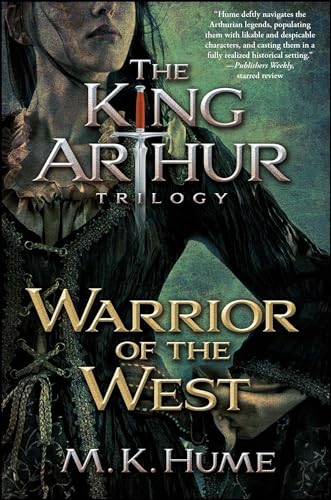
Inhaltsangabe
Could all that King Arthur fought for be lost? From the author of The Merlin Prophecy, a trilogy that Kirkus Reviews proclaimed, will “appeal to those who thrill to Game of Thrones,” the second installment in the action-packed historical trilogy is the epic tale of Arthur’s efforts to save the heart of his kingdom.
Warrior of the West – King Arthur’s Journey Continues.
Twelve years have passed since Arthur was crowned High King. Against all odds, he has united Celtic Britain and banished the Saxons. Although he’s succeeded in defeating all external threats and his kingdom is at its zenith, it is now being undermined from within.
Arthur has chosen evil Wenhaver as his queen and second wife. Wenhaver will always love what she cannot have and have what she cannot love, and her bitterness threatens to bring down all those around her.
Arthur is betrayed by his wife and also learns of appalling perversion at the heart of his kingdom. With his guide and master tactician, Myrddion, gone, Arthur must decide how to proceed if he wishes to see Britain stand strong. The fate of a kingdom rests on his shoulders and his selflessness is put to the test.
Could all that Arthur has bought for be lost forever?
Die Inhaltsangabe kann sich auf eine andere Ausgabe dieses Titels beziehen.
Über die Autorin bzw. den Autor
M. K. Hume is a retired academic. She received her MA and PhD in Arthurian literature and is the author of The Merlin Prophecy, a historical trilogy about the legend of Merlin. She lives in Australia with her husband and two sons.
Auszug. © Genehmigter Nachdruck. Alle Rechte vorbehalten.
King Arthur Trilogy Book Two: Warrior of the West
Chapter I
BLOOD GUILT
Then all the councillors, together with that proud tyrant Vortigern, the British king, were so blinded, that, as a protection to their country, they sealed its doom by inviting in among them (like wolves into the sheepfold), the fierce and impious Saxons, a race hateful both to God and men, to repel the invasions of the northern nations.
—GILDAS
Artor stood on the summit of the imposing earthworks of Cadbury Tor and stared down at his domain. Below him, like the peeled skin of an apple, the ramparts and cobbled roadways leading to the flagged fortress curled around the tor. Regular redoubts guarded heavy log gates that could be closed and barred to seal any enemy between its walls of wood and stone. If any fortress could be considered impregnable, then Cadbury was one such, for in its long history it had never fallen.
As he stared down at what he had rebuilt, Artor recalled his first, crucial campaign against the western Saxons twelve years earlier.
Older Celts still remembered, and resented, the foolishness of King Vortigern, who had been so lost to reason that when the strong, golden legs of Rowena, his Saxon queen, were wrapped round his waist, he was prepared to accede to her every request. While in her thrall, Vortigern permitted the Saxons to settle in the lands of the Demetae, and for generations Celts and Saxons had dwelt together uneasily, until the Saxons had eventually sought to extend their power by forming an alliance with Katigern Oakheart in the east.
Cadbury and Environs
Glastonbury and Environs
But early in his reign, Artor had ridden north out of Cadbury and defeated the invaders at a time when he was still untried, both as a king and as a leader. For the first time, and in bloody attrition, Artor had used his cavalry against that most fearsome of barbarian tactics, the Saxon shield wall.
A double line of Saxons wedged their circular wooden, bull hide, and bronze shields together in unconscious imitation of the old Roman tortoise. But the Saxons stood well over six feet in height, unlike the Romans, who were rarely taller than five and a half feet. The second row protected the heads of the front row with their shields, and once the shield wall was engaged, the warriors refused to retreat, holding the line until every last man was dead. Like the ancient Spartans, the Saxons worshipped individual heroism and prowess in battle, but without the leaven of Spartan iron discipline. Wild for glory, Saxon warriors courted death and heroism, while the Romans had always been pragmatic, professional, and sanguine fighters.
Artor had viewed the shield wall from a convenient rise in the ground above the forked Roman road near Magnis. He had sighed, anticipating the slaughter that it presaged. The Saxons were accustomed to absorbing the shock of fiercely attacking men, but Artor had changed the rules of engagement. The High King ordered his cavalry to pound the wall in wave after thundering wave of charging horseflesh. No man, no matter how large, can absorb the shock of a galloping horse. As the cavalry disengaged, Celtic spears were used to deadly effect to slaughter fallen men. Inevitably, many horses perished as the berserk Saxons risked everything to gut the animals, but the wall was weakened and eventually broke. The remaining Saxons fled into the inhospitable mountains. Through inexperience, Artor had mercifully permitted them to escape.
“You’ll have to crush them sooner or later,” Targo, his old sword master, had grunted as he cut the throat of a horse whose leg dangled at an unnatural, painful angle.
“True,” Artor replied philosophically, and stepped to one side to avoid the jet of arterial blood as the horse kicked convulsively, and then died. “But I must soon face a larger Saxon force in the east, and I don’t have the men to deal with enemies on two fronts. These curs will keep till a later time.”
“You’ll not succeed with cavalry so easily again,” Targo warned softly. “Still, I suppose there’s many ways to trap a rabbit, as my old sergeant used to say. They’ll continue to breed until they become a problem once again.”
“Give over, Targo!” Artor snapped, his eyes momentarily cold. Then he laughed ruefully. “I still lack the stomach for carnage.”
“You’ll learn,” Targo replied without a trace of humor or rancor in his cracked old voice.
Half starved and ill equipped, the Saxons had squabbled and skirmished on the rocky hills of Dyfed like parasites until an emerging new leader had bludgeoned them into a fragile unity, linked only by their old hatred for all things Celt—and for King Artor. Intolerant and obdurate, these warriors were born and bred as Saxons, not as Britons, regardless of their mixed bloodlines. They swore that they would never again retreat from their enemy.
After that first successful campaign, the war with the Saxons and the traitorous Celtic kings had raged for twelve long years. Now, all the Celtic tribes south of the great Roman Wall were united against a shared barbarian threat. Now, at Cadbury, Artor waited.
“So many dead warriors, and all good men,” Artor sighed. “Why was so much violence necessary? Reason and compromise could have saved hundreds—nay, thousands of lives. But compromise is another word for cowardice in the Saxon vocabulary.”
“Talking to yourself again, Artor?” Targo muttered, leaning upon a heavy staff. “When an ancient like me can sneak up on you, then you’re dead.”
“Why do our conversations always hark back to my mortality?” Artor smiled as he spoke. “How goes your day, Targo?”
“Slowly, slowly. As it does for you, my lord. You still await news of your proposed truce from our envoys?”
“The waiting tries my patience, Targo.”
“Your attempts at peacemaking won’t work, my boy. You’ll receive your ambassadors back in little pieces, and the Saxons will believe that you’re growing soft and are too frightened to engage them in battle. I told you in times gone by that they’d breed to cause you trouble.”
Artor sighed with resignation. “Yes.”
The single word fell like a stone into a deep and very empty well.
Targo peered up into the younger man’s set face. Artor was no longer a beautiful young man, and the light of excitement and pleasure had left his eyes. Something harder, more bitter, and wounded had taken its place and Targo regretted the loss of the boy whom he had loved so well.
“I imagine that it’s difficult to send good men to certain death. I wouldn’t fancy it, so I always served in the ranks. No responsibility—no guilt.”
“I will not permit the latest of these Saxon thanes to endanger the west, and I’ll no longer ignore King Lot’s treason when he gives aid to the enemy. He’ll see sense and draw back behind the Roman Wall, or I’ll slaughter every warrior and camp follower that praises the Saxon might.”
“Even King Lot?”
...
„Über diesen Titel“ kann sich auf eine andere Ausgabe dieses Titels beziehen.
Suchergebnisse für The King Arthur Trilogy Book Two: Warrior of the West...

Beispielbild für diese ISBN
The King Arthur Trilogy Book Two: Warrior of the West
Anbieter: World of Books (was SecondSale), Montgomery, IL, USA
Verkäuferbewertung 5 von 5 Sternen

Paperback. Zustand: Good. Could all that King Arthur fought for be lost? From the author of The Merlin Prophecy, a trilogy that Kirkus Reviews proclaimed, will "appeal to those who thrill to Game of Thrones," the second installment in the action-packed historical trilogy is the epic tale of Arthur's efforts to save the heart of his kingdom. Warrior of the West - King Arthur's Journey Continues. Twelve years have passed since Arthur was crowned High King. Against all odds, he has united Celtic Britain and banished the Saxons. Although he's succeeded in defeating all external threats and his kingdom is at its zenith, it is now being undermined from within. Arthur has chosen evil Wenhaver as his queen and second wife. Wenhaver will always love what she cannot have and have what she cannot love, and her bitterness threatens to bring down all those around her. Arthur is betrayed by his wife and also learns of appalling perversion at the heart of his kingdom. With his guide and master tactician, Myrddion, gone, Arthur must decide how to proceed if he wishes to see Britain stand strong. The fate of a kingdom rests on his shoulders and his selflessness is put to the test. Could all that Arthur has bought for be lost forever? Artikel-Nr. 00108390989
Gebraucht kaufen
EUR 3,85
Versand gratis
Versand innerhalb von USA
Versand innerhalb von USA
Anzahl: 1 verfügbar
Beispielbild für diese ISBN
The King Arthur Trilogy Book Two: Warrior of the West
Anbieter: World of Books (was SecondSale), Montgomery, IL, USA
Verkäuferbewertung 5 von 5 Sternen
Paperback. Zustand: Very Good. Could all that King Arthur fought for be lost? From the author of The Merlin Prophecy, a trilogy that Kirkus Reviews proclaimed, will "appeal to those who thrill to Game of Thrones," the second installment in the action-packed historical trilogy is the epic tale of Arthur's efforts to save the heart of his kingdom. Warrior of the West - King Arthur's Journey Continues. Twelve years have passed since Arthur was crowned High King. Against all odds, he has united Celtic Britain and banished the Saxons. Although he's succeeded in defeating all external threats and his kingdom is at its zenith, it is now being undermined from within. Arthur has chosen evil Wenhaver as his queen and second wife. Wenhaver will always love what she cannot have and have what she cannot love, and her bitterness threatens to bring down all those around her. Arthur is betrayed by his wife and also learns of appalling perversion at the heart of his kingdom. With his guide and master tactician, Myrddion, gone, Arthur must decide how to proceed if he wishes to see Britain stand strong. The fate of a kingdom rests on his shoulders and his selflessness is put to the test. Could all that Arthur has bought for be lost forever? Artikel-Nr. 00108789383
Gebraucht kaufen
EUR 5,11
Versand gratis
Versand innerhalb von USA
Versand innerhalb von USA
Anzahl: 1 verfügbar
Beispielbild für diese ISBN
The King Arthur Trilogy Book Two: Warrior of the West
Anbieter: ThriftBooks-Atlanta, AUSTELL, GA, USA
Verkäuferbewertung 5 von 5 Sternen
Paperback. Zustand: Good. No Jacket. Pages can have notes/highlighting. Spine may show signs of wear. ~ ThriftBooks: Read More, Spend Less. Artikel-Nr. G1476715203I3N00
Gebraucht kaufen
EUR 7,52
Versand gratis
Versand innerhalb von USA
Versand innerhalb von USA
Anzahl: 1 verfügbar
Beispielbild für diese ISBN
The King Arthur Trilogy Book Two: Warrior of the West
Anbieter: ThriftBooks-Atlanta, AUSTELL, GA, USA
Verkäuferbewertung 5 von 5 Sternen
Paperback. Zustand: Good. No Jacket. Former library book; Pages can have notes/highlighting. Spine may show signs of wear. ~ ThriftBooks: Read More, Spend Less. Artikel-Nr. G1476715203I3N10
Gebraucht kaufen
EUR 7,52
Versand gratis
Versand innerhalb von USA
Versand innerhalb von USA
Anzahl: 1 verfügbar
Beispielbild für diese ISBN
The King Arthur Trilogy Book Two: Warrior of the West (2)
Anbieter: Wonder Book, Frederick, MD, USA
Verkäuferbewertung 5 von 5 Sternen
Zustand: Good. Good condition. Book 2. (historical fiction, King Arthur). Artikel-Nr. SB09D-01342
Gebraucht kaufen
EUR 7,79
Versand gratis
Versand innerhalb von USA
Versand innerhalb von USA
Anzahl: 1 verfügbar
Beispielbild für diese ISBN
The King Arthur Trilogy Book Two: Warrior of the West
Anbieter: Better World Books: West, Reno, NV, USA
Verkäuferbewertung 5 von 5 Sternen
Zustand: Good. Reprint. Pages intact with minimal writing/highlighting. The binding may be loose and creased. Dust jackets/supplements are not included. Stock photo provided. Product includes identifying sticker. Better World Books: Buy Books. Do Good. Artikel-Nr. 4915227-6
Gebraucht kaufen
EUR 8,59
Versand gratis
Versand innerhalb von USA
Versand innerhalb von USA
Anzahl: 1 verfügbar
Beispielbild für diese ISBN
The King Arthur Trilogy Book Two: Warrior of the West
Anbieter: Better World Books: West, Reno, NV, USA
Verkäuferbewertung 5 von 5 Sternen
Zustand: Good. Reprint. Former library copy. Pages intact with minimal writing/highlighting. The binding may be loose and creased. Dust jackets/supplements are not included. Includes library markings. Stock photo provided. Product includes identifying sticker. Better World Books: Buy Books. Do Good. Artikel-Nr. 5145250-6
Gebraucht kaufen
EUR 8,59
Versand gratis
Versand innerhalb von USA
Versand innerhalb von USA
Anzahl: 1 verfügbar
Beispielbild für diese ISBN
The King Arthur Trilogy Book Two: Warrior of the West
Anbieter: Better World Books: West, Reno, NV, USA
Verkäuferbewertung 5 von 5 Sternen
Zustand: Very Good. Reprint. Former library copy. Pages intact with possible writing/highlighting. Binding strong with minor wear. Dust jackets/supplements may not be included. Includes library markings. Stock photo provided. Product includes identifying sticker. Better World Books: Buy Books. Do Good. Artikel-Nr. 5687999-6
Gebraucht kaufen
EUR 8,59
Versand gratis
Versand innerhalb von USA
Versand innerhalb von USA
Anzahl: 1 verfügbar
Beispielbild für diese ISBN
The King Arthur Trilogy Book Two: Warrior of the West: Volume 2
Anbieter: WorldofBooks, Goring-By-Sea, WS, Vereinigtes Königreich
Verkäuferbewertung 5 von 5 Sternen
Paperback. Zustand: Very Good. The book has been read, but is in excellent condition. Pages are intact and not marred by notes or highlighting. The spine remains undamaged. Artikel-Nr. GOR007779243
Gebraucht kaufen
EUR 24,51
EUR 6,69 Versand
Versand von Vereinigtes Königreich nach USA
Versand von Vereinigtes Königreich nach USA
Anzahl: 1 verfügbar
Beispielbild für diese ISBN
Warrior of the West
Anbieter: Revaluation Books, Exeter, Vereinigtes Königreich
Verkäuferbewertung 5 von 5 Sternen
Paperback. Zustand: Brand New. original edition. 512 pages. 9.00x6.00x1.25 inches. In Stock. Artikel-Nr. x-1476715203
Neu kaufen
EUR 37,15
EUR 14,93 Versand
Versand von Vereinigtes Königreich nach USA
Versand von Vereinigtes Königreich nach USA
Anzahl: 2 verfügbar