
Verwandte Artikel zu Beyond Addiction: How Science and Kindness Help People...
Inhaltsangabe
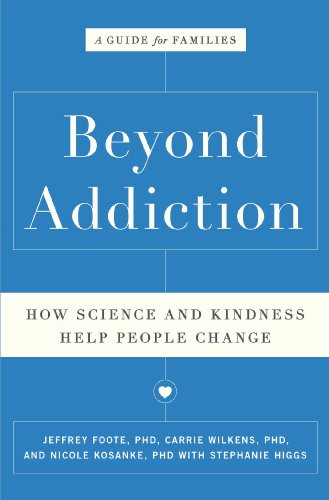
The most innovative leaders in progressive addiction treatment in the US offer a groundbreaking, science-based guide to helping loved ones overcome addiction problems and compulsive behaviors.
The most innovative leaders in progressive addiction treatment in the US offer a groundbreaking, science-based guide to helping loved ones overcome addiction problems and compulsive behaviors.
Beyond Addiction eschews the theatrics of interventions and tough love to show family and friends how they can use kindness, positive reinforcement, and motivational and behavioral strategies to help their loved ones change. Drawing on forty collective years of research and decades of clinical experience, the authors present the best practical advice science has to offer.
Delivered with warmth, optimism, and humor, Beyond Addiction defines a new, empowered role for friends and family and a paradigm shift for the field. Learn how to tap the transformative power of relationships for positive change, guided by exercises and examples. Practice what really works in therapy and in everyday life, and discover many different treatment options along with tips for navigating the system.
And have hope: this guide is designed not only to help someone change, but to help someone want to change.
Die Inhaltsangabe kann sich auf eine andere Ausgabe dieses Titels beziehen.
Über die Autorin bzw. den Autor
Jeffrey Foote, PhD, is co-founder and executive director of CMC and psychologist for the New York Mets. He has been a leader in the science and humanity of change for twenty-five years.
Carrie Wilkens, PhD, is co-founder and clinical director of CMC and a dedicated practitioner and researcher of the most effective treatments for substance use problems and compulsive behaviors. Her expertise is regularly sought by the CBS Early Show; Fox News; Newsweek; O, The Oprah Magazine; and Psychology Today.
Nicole Kosanke, PhD, is director of evaluation and family services at CMC. In 2008 Dr. Kosanke was featured in an O, The Oprah Magazine article about her client’s experience in treatment at CMC, which was later published in O’s Big Book of Happiness: The Best of O.
Stephanie Higgs is an editor and writer dedicated to bridging the gap between helpful ideas and people who could use the help.
Auszug. © Genehmigter Nachdruck. Alle Rechte vorbehalten.
Beyond Addiction
INTRODUCTION
Hope in Hell
To accept the things you cannot change . . . to change the things you can . . . to know the difference.
—Adapted from the AA motto
This book is different.
You may have picked up this book in desperation, you may be afraid nothing will help, but we are optimistic we can change that.
Maybe your husband’s drinking increased after the kids went to college and you worry it’s only going to get worse. Maybe your grown son doesn’t return calls anymore, seems uninterested in working, and smokes a lot of pot. Maybe your daughter has stopped eating, or maybe she can’t seem to stop. Maybe your elderly mom sounds slurry every time you call her in the evening, but never remembers it the next day. Maybe your brother is back in treatment, again, for methamphetamine abuse. Substance and compulsive behavior problemsIcan take endless shapes and vary in terms of severity, scariness, and heartbreak.
Families come to our program every day with these and many other serious problems. Still we are optimistic. We don’t mean that maybe you’ll be lucky or that it’s no big deal. We are optimistic because we know change is possible. If your own optimism has gotten shaky in recent months or years, we invite you to borrow ours for now. Take this book like a steadying hand. And know that you can make a difference.
As researchers and clinicians, we’ve seen the evidence over the past forty years that families and friends make a difference in helping someone who struggles with drinking, drugs, eating, or other compulsive behaviors. Often, it is the critical difference.
We also know that people get better, and there are many reasons to be hopeful. However, you’re probably more familiar with the popular notions of intractable character defects and progressive, chronic disease. There’s widespread pessimism about the possibility of real change. Addiction can be terrible—at times life-threatening. But change is possible, and there are clear paths leading to it.
This is why, ten years ago, we created a new treatment program, the Center for Motivation and Change (CMC), in New York City, where we are part of a revolution in addiction treatment based on evidence and on a new model for change.
We built our practice on optimism, not because it made us feel good, though it does, but because it works. We base our optimism, our clinical practice, and now this book on forty years of well-documented research on how substances and other compulsive behaviors affect people, why people use them, and how and why people stop self-destructive behavior and start on paths toward health and happiness. In turn, our experiences with thousands of clients bear out the research findings.
There is in fact a science of change.
Every day at CMC we see clients put it into practice, using the knowledge, attitudes, and skills you’ll find in this book. It takes time, and it is not usually a straight or smooth path. But it is a better way. Things can and do change. The process already started when you picked up this book.
The Science of Change
It’s been five hundred years since the scientific revolution, and we’ve had modern medicine for at least a century. Yet shockingly, the understanding and treatment of substance use in the United States has been exempt from scientific standards and separate from mainstream healthcare until quite recently.
Researchers in America only began to collect evidence in earnest in the 1970s. The National Institute on Alcohol Abuse and Alcoholism (NIAAA) was established in 1970, followed by the National Institute on Drug Abuse (NIDA) in 1974. Finally, after years of folk wisdom running the gamut from truly helpful to ineffective to harmful, federal money flowed toward scientific studies of what works, including what family and friends like you can do to help. The increasing number of controlled studies, including our own, over these forty-odd years, has created a mountain of evidence—scientists have separated the wheat from the chaff, revealing that certain approaches and treatment strategies are more successful than others. That’s good news, and we hope that it will help you find your own optimism.
Most people equate treatment with intensive, residential “rehab” and believe rehab is the starting point of all change. In fact, there are many treatment options and substantial evidence that outpatient treatment is at least as effective in most cases and often a better place to start. Since 1996, the American Society of Addiction Medicine recommends starting with the least intensive treatment that is safe. Dr. Mark Willenbring, former director of the Treatment and Recovery Research Division of NIAAA, describes how the vast majority of people who could benefit from help don’t get it, in part because the system is designed to treat the most severe problems, while the culture dictates waiting until someone “hits bottom”—in other words, waiting until problems become severe. Family members and friends are left with few options other than to stand by and watch things get worse, then get their loved one into rehab if they can. This despite strong evidence that reaching people early, when their problems are less severe and more treatable, leads to better outcomes. Thankfully, the treatment system is starting to change.
The evidence supports many ways to address substance use disorders, as many ways as there are reasons people have them. Treatment is not always necessary; it turns out that many people get better without ever seeking professional help. There is also clear evidence that certain treatment approaches consistently outperform others. Cognitive-behavioral and motivational approaches, for example, which treat substance abuse like any other human behavior, are significantly more effective than confrontational approaches aimed to challenge a person’s “denial” about his “disease.”
Research has demonstrated that the popular belief that if someone “just stops” using a substance, then the rest of his problems will take care of themselves is simplistic and untrue. Substance problems are complex and multidetermined, often driven by underlying psychiatric disorders such as depression, anxiety, bipolar disorder, or attention deficit disorders that require specialized attention over and beyond just treating the substance problem. In other words, good treatment often includes psychiatric care, which has historically been overlooked or even discouraged in some drug and alcohol treatment settings.
Science has also given us a better understanding of the brain’s role in substance use and compulsive behaviors. With that science, there are new medications that reduce cravings and compulsivity, block drug effects, ease withdrawal, and treat underlying issues. Neuroimaging research provides new insights into the effects of substances on the brain; and recent discoveries in neuroscience have shown the power of neuroplasticity in the brain’s healing itself.
And science has revealed that teenagers are not simply grown-ups who text a lot; they are neurologically, psychologically, socially, and legally different from adults, and they have different treatment needs. Until about fifteen years ago, most of the services available for adolescents were barely modified adult treatments. Clinical trials have shown us that teenagers respond well to appropriate treatment and just as with adults, some treatments are considerably more effective than others. You might be surprised to learn that they all involve parents as...
„Über diesen Titel“ kann sich auf eine andere Ausgabe dieses Titels beziehen.
Suchergebnisse für Beyond Addiction: How Science and Kindness Help People...

Beispielbild für diese ISBN
Beyond Addiction : How Science and Kindness Help People Change
Anbieter: Better World Books, Mishawaka, IN, USA
Verkäuferbewertung 5 von 5 Sternen

Zustand: Good. First Edition. Former library copy. Pages intact with minimal writing/highlighting. The binding may be loose and creased. Dust jackets/supplements are not included. Includes library markings. Stock photo provided. Product includes identifying sticker. Better World Books: Buy Books. Do Good. Artikel-Nr. 8969465-6
Gebraucht kaufen
EUR 11,34
Versand gratis
Versand innerhalb von USA
Versand innerhalb von USA
Anzahl: 1 verfügbar
Beispielbild für diese ISBN
Beyond Addiction : How Science and Kindness Help People Change
Anbieter: Better World Books, Mishawaka, IN, USA
Verkäuferbewertung 5 von 5 Sternen
Zustand: Good. First Edition. Pages intact with minimal writing/highlighting. The binding may be loose and creased. Dust jackets/supplements are not included. Stock photo provided. Product includes identifying sticker. Better World Books: Buy Books. Do Good. Artikel-Nr. 4439646-6
Gebraucht kaufen
EUR 11,34
Versand gratis
Versand innerhalb von USA
Versand innerhalb von USA
Anzahl: 1 verfügbar
Beispielbild für diese ISBN
Beyond Addiction: How Science and Kindness Help People Change
Anbieter: Housing Works Online Bookstore, New York, NY, USA
Verkäuferbewertung 5 von 5 Sternen
Hardcover. Zustand: Very Good. First Edition. Minimal wear to cover. Pages clean and binding tight. shelf wear. bumped edges. Hardcover. Artikel-Nr. BC5-02410-IN
Gebraucht kaufen
EUR 8,58
EUR 3,50 Versand
Versand innerhalb von USA
Versand innerhalb von USA
Anzahl: 1 verfügbar
Beispielbild für diese ISBN
Beyond Addiction: How Science and Kindness Help People Change
Anbieter: World of Books (was SecondSale), Montgomery, IL, USA
Verkäuferbewertung 5 von 5 Sternen
Hardback. Zustand: Good. Artikel-Nr. 00109050150
Gebraucht kaufen
EUR 13,21
Versand gratis
Versand innerhalb von USA
Versand innerhalb von USA
Anzahl: 2 verfügbar
Beispielbild für diese ISBN
Beyond Addiction: How Science and Kindness Help People Change - A Guide for Families
Anbieter: Revaluation Books, Exeter, Vereinigtes Königreich
Verkäuferbewertung 5 von 5 Sternen
Hardcover. Zustand: Brand New. 320 pages. 9.00x6.25x1.50 inches. In Stock. Artikel-Nr. 1476709475
Neu kaufen
EUR 73,08
EUR 11,66 Versand
Versand von Vereinigtes Königreich nach USA
Versand von Vereinigtes Königreich nach USA
Anzahl: 1 verfügbar