
Verwandte Artikel zu Slums on Screen: World Cinema and the Planet of Slums...
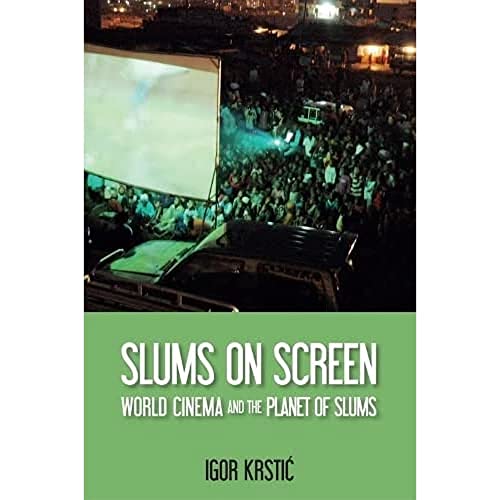
Slums on Screen: World Cinema and the Planet of Slums (Edinburgh Companions to the Gothic) - Softcover
Inhaltsangabe
A polycentric approach to the representation of slums in world cinema
Die Inhaltsangabe kann sich auf eine andere Ausgabe dieses Titels beziehen.
Über die Autorinnen und Autoren
Postdoctoral Fellow at the University of Reading.
Igor Krstic is Lecturer in American Studies at the University of Stuttgart and in the Centre for Cultural and General Studies (ZAK) at the Karlsruhe Institute of Technology (KIT). He has published on national, world and transnational cinema, documentary film and film philosophy. He is the author of Slums on Screen: World Cinema and the Planet of Slums (Edinburgh University Press, 2016).
Von der hinteren Coverseite
‘This lucid and necessary study offers a breathtaking coverage of more than a hundred years of slums in film. Igor Krstic undertakes an in-depth scrutiny of handpicked examples of the various phases of slums on screen worldwide, in the light of a rigorous, polycentric and cross-mediatic methodology. Fearlessly confronting the debates around the ethics of representing the underprivileged, Igor Krstic rises, with this book, to the forefront of film studies today.’Lúcia Nagib, Professor of Film, University of ReadingNear to one billion people call slums their home, making it a reasonable claim to describe our world as a ‘planet of slums’. But how has this hard and unyielding way of life been depicted on screen? How have filmmakers engaged historically and across the globe with the social conditions of what is often perceived as the world’s most miserable habitats?Combining approaches from cultural, globalisation and film studies, Igor Krstic outlines a transnational history of films that either document or fictionalise the favelas, shantytowns, barrios populares or chawls of our ‘planet of slums’, exploring the way accelerated urbanisation has intersected with an increasingly interconnected global film culture. From Jacob Riis’ How The Other Half Lives (1890) to Danny Boyle’s Slumdog Millionaire (2008), the volume provides a number of close readings of films from different historical periods and regions to outline how contemporary film and media practices relate to their past predecessors – demonstrating the way various filmmakers, both north and south of the equator, have repeatedly grappled with, rejected or continuously modified documentary and realist modes to convey life in our ‘planet of slums’.Igor Krstic is a postdoctoral researcher in the Department of Film, Theatre and Television at the University of Reading.
„Über diesen Titel“ kann sich auf eine andere Ausgabe dieses Titels beziehen.
Suchergebnisse für Slums on Screen: World Cinema and the Planet of Slums...

Beispielbild für diese ISBN
Slums on Screen
Anbieter: PBShop.store US, Wood Dale, IL, USA
Verkäuferbewertung 5 von 5 Sternen

PAP. Zustand: New. New Book. Shipped from UK. Established seller since 2000. Artikel-Nr. FV-9781474425933
Beispielbild für diese ISBN
Slums on Screen
Anbieter: PBShop.store UK, Fairford, GLOS, Vereinigtes Königreich
Verkäuferbewertung 5 von 5 Sternen
PAP. Zustand: New. New Book. Shipped from UK. Established seller since 2000. Artikel-Nr. FV-9781474425933
Neu kaufen
EUR 35,42
EUR 4,84 Versand
Versand von Vereinigtes Königreich nach USA
Versand von Vereinigtes Königreich nach USA
Anzahl: 10 verfügbar
Beispielbild für diese ISBN
Slums on Screen: World Cinema and the Planet of Slums (Edinburgh Companions to the Gothic)
Anbieter: Majestic Books, Hounslow, Vereinigtes Königreich
Verkäuferbewertung 4 von 5 Sternen

Zustand: New. Artikel-Nr. 370439813
Neu kaufen
EUR 38,35
EUR 7,56 Versand
Versand von Vereinigtes Königreich nach USA
Versand von Vereinigtes Königreich nach USA
Anzahl: 3 verfügbar
Beispielbild für diese ISBN
Slums on Screen: World Cinema and the Planet of Slums
Anbieter: Kennys Bookstore, Olney, MD, USA
Verkäuferbewertung 5 von 5 Sternen
Zustand: New. From Jacob Riis' How The Other Half Lives (1890) to Danny Boyle's Slumdog Millionaire (2008), Igor Krstic outlines a transnational history of films that either document or fictionalise the favelas, shantytowns, barrios poulares or chawls of our 'planet of slums'. BIC Classification: APFA; JFSG. Category: (G) General (US: Trade). . . 2017. Reprint. Paperback. . . . . Books ship from the US and Ireland. Artikel-Nr. V9781474425933
Neu kaufen
EUR 52,11
EUR 9,23 Versand
Versand innerhalb von USA
Versand innerhalb von USA
Anzahl: Mehr als 20 verfügbar
Foto des Verkäufers
Slums on Screen : World Cinema and the Planet of Slums
Verlag:
Edinburgh University Press Aug 2017, 2017
ISBN 10: 1474425933
ISBN 13: 9781474425933
Neu
Taschenbuch
Anbieter: AHA-BUCH GmbH, Einbeck, Deutschland
Verkäuferbewertung 5 von 5 Sternen
Taschenbuch. Zustand: Neu. Neuware - A polycentric approach to the representation of slums in world cinemaNear to one billion people call slums their home, making it a reasonable claim to describe our world as a 'planet of slums.' But how has this hard and unyielding way of life been depicted on screen How have filmmakers engaged historically and across the globe with the social conditions of what is often perceived as the world's most miserable habitats Combining approaches from cultural, globalisation and film studies, Igor Krstic outlines a transnational history of films that either document or fictionalise the favelas, shantytowns, barrios poulares or chawls of our 'planet of slums', exploring the way accelerated urbanisation has intersected with an increasingly interconnected global film culture. From Jacob Riis' How The Other Half Lives (1890) to Danny Boyle's Slumdog Millionaire (2008), the volume provides a number of close readings of films from different historical periods and regions to outline how contemporary film and media practices relate to their past predecessors, demonstrating the way various filmmakers, both north and south of the equator, have repeatedly grappled with, rejected or continuously modified documentary and realist modes to convey life in our 'planet of slums'.- Read the introduction to Slums on Screen for free (pdf)Key Features- Traces the global flows of film culture through emphasising the transnational impact of important film movements- Focuses on two important 'cinematic megacities' (Rio de Janeiro and Mumbai) to outline how global film cultural currents become modified according to a specific local context- Combines approaches from cultural, globalisation and film studies to reconstruct world cinema's 'planet of slums'- Adds a new perspective on cultural (world cinema) and social (cityward migration) globalisation processes. Artikel-Nr. 9781474425933
Neu kaufen
EUR 52,83
EUR 35,00 Versand
Versand von Deutschland nach USA
Versand von Deutschland nach USA
Anzahl: 2 verfügbar
Foto des Verkäufers
Slums on Screen: World Cinema and the Planet of Slums
Anbieter: moluna, Greven, Deutschland
Verkäuferbewertung 5 von 5 Sternen
Zustand: New. Combining approaches from cultural, globalisation and film studies, Igor Krstic outlines a transnational history of films that either document or fictionalise the favelas, shantytowns, barrios populares or chawls of our `planet of slums .Über d. Artikel-Nr. 595998671
Neu kaufen
EUR 41,19
EUR 48,99 Versand
Versand von Deutschland nach USA
Versand von Deutschland nach USA
Anzahl: Mehr als 20 verfügbar