
Verwandte Artikel zu Teaching on Solid Ground: Knowledge Foundations for...
Inhaltsangabe
To be successful, teachers of English in grades 6–12 need more than basic content knowledge and classroom management skills. They need a deep understanding of the goals and principles of teaching literature, writing, oral discourse, and language in order to make sound instructional decisions. This engaging book explores the pedagogical foundations of the discipline and gives novice and future teachers specific guidance for creating effective, interesting learning experiences. The authors consider such questions as what makes a literary text worth studying, what students gain from literary analysis, how to make writing meaningful, and how to weave listening and speaking into every class meeting. Professional learning and course use are facilitated by end-of-chapter reflection questions, text boxes, and appendices showcasing exemplary learning activities.
Die Inhaltsangabe kann sich auf eine andere Ausgabe dieses Titels beziehen.
Über die Autorinnen und Autoren
Thomas M. McCann, PhD, is Professor of English at Northern Illinois University, where he contributes to the teacher licensure program. He taught English in high schools for 25 years, including 7 years working in an alternative high school. The author or coauthor of numerous books, Dr. McCann has served on the Secondary Section Steering Committee of the National Council of Teachers of English (NCTE) and on the Executive Committee of NCTE’s Conference on English Education, from whom he received the Richard A. Meade Award. Dr. McCann has provided inservice professional development to schools and districts in the Chicago area and nationally.
John V. Knapp, PhD, is Professor Emeritus of English at Northern Illinois University. He is the author or editor of several books and over 50 articles and reviews on literature, family systems psychology, literary criticism, and literature instruction. Since 2007, he has been editor of the literary journal Style. As an English teacher and later a professor, Dr. Knapp has educated students at every level, from middle school to doctoral seminars.
John V. Knapp, PhD, is Professor Emeritus of English at Northern Illinois University. He is the author or editor of several books and over 50 articles and reviews on literature, family systems psychology, literary criticism, and literature instruction. Since 2007, he has been editor of the literary journal Style. As an English teacher and later a professor, Dr. Knapp has educated students at every level, from middle school to doctoral seminars.
Thomas M. McCann, PhD, is Professor of English at Northern Illinois University, where he contributes to the teacher licensure program. He taught English in high schools for 25 years, including 7 years working in an alternative high school. The author or coauthor of numerous books, Dr. McCann has served on the Secondary Section Steering Committee of the National Council of Teachers of English (NCTE) and on the Executive Committee of NCTE’s Conference on English Education, from whom he received the Richard A. Meade Award. Dr. McCann has provided inservice professional development to schools and districts in the Chicago area and nationally.
John V. Knapp, PhD, is Professor Emeritus of English at Northern Illinois University. He is the author or editor of several books and over 50 articles and reviews on literature, family systems psychology, literary criticism, and literature instruction. Since 2007, he has been editor of the literary journal Style. As an English teacher and later a professor, Dr. Knapp has educated students at every level, from middle school to doctoral seminars.
Auszug. © Genehmigter Nachdruck. Alle Rechte vorbehalten.
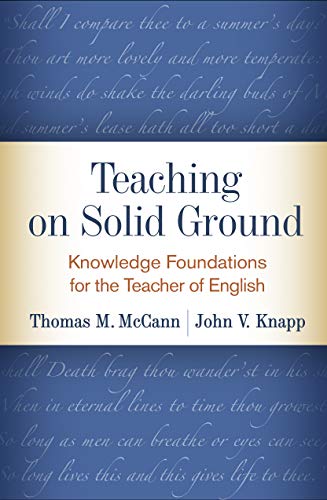
Teaching on Solid Ground
Knowledge Foundations for the Teacher of English
By Thomas M. McCann, John V. KnappThe Guilford Press
Copyright © 2019 The Guilford Press
All rights reserved.
ISBN: 978-1-4625-3762-4All rights reserved.
Contents
Introduction: The Importance of Pedagogical, 1,
1 Knowing the Territory of Literature, 13,
2 Teaching in the Territory of Literature, 36,
3 The Territory of Writing: What Makes, 60,
4 The Territory of Writing: How Can We, 79,
5 The Territory of Oral Discourse, 101,
6 The Territory of Language: What Do We Teach, 124,
7 What English Teachers Should Know, 145,
Appendix A. What Is the "Business" of Teaching English?: Profiles of English Teachers in Action, 159,
Appendix B. Knowledge about Mode and Form: What Is a Tragedy?, 163,
Appendix C. Practice with Rules of Notice and Rules of Significance: Character Dynamism in Harry Potter and the Sorcerer's Stone, 169,
Appendix D. Applying Rules of Notice and Signification, 173,
Appendix E. Discovering Rules of Configuration, 183,
Appendix F. A Case for Discussion and Written Response, 189,
Appendix G. Drawing on Knowledge about Drama: Reading a Shakespeare Play as Performance, 198,
Appendix H. Using Language Analysis to "Open" a Novel, 203,
References, 207,
Index, 221,
CHAPTER 1
Knowing the Territory of Literature
At the university where we teach, posted on the bulletin board for students in the teacher licensure program is a "Strongly Recommended Reading List." An introduction emphasizes the teacher candidate's need to build substantial knowledge of significant literary texts before entering into the methods courses, and exhorts the candidates to read the recommended texts and track progress toward completing the list. The list includes the following titles: The Odyssey, The Iliad, the Old Testament, The Aeneid, The Metamorphoses of Ovid, selected plays by Aristophanes and Sophocles, Plato's Republic and Meno, Aristotle's Poetics, and translations of The Divine Comedy and Beowulf. A major implication of the list is that teaching literature requires a developing level of expertise, one that begins at minimum with a basic understanding of the building blocks, the texts of the discipline, constituting such expert knowledge and practice. Consequently, the authors of "the list" assumed that novice teachers of English in middle schools and high schools should be familiar with classic literature, even if they never engage their own students with these texts.
As two professors in the same teacher preparation program, we have disagreed about the list — both the specific titles and the idea of a list of "strongly recommended" texts. In fact, we disagree about several issues about preparing candidates, although we converge about some core principles. As we share our disagreements and convergences on these pages, we invite readers to reflect on their own positions, perhaps taking the opportunity to refine thinking about what English teachers need to know in order to teach English in a principled way in middle school and high school.
According to John, the thinking behind the recommended reading is consistent for those who consider the teaching of literature as an acquired expertise, one that begins early in life with the pleasures of reading stories and then, over time, also includes noticing that story patterns develop in the ways tales are both told and received. Some readers appear naturally to gravitate toward stories that reflect their own time, situations in life, and familiar people, while others prefer literary experiences that take them out of their own world and into domains and lives very different from their own. The central issue confronting all teachers of literature is to achieve a balance between these two tendencies: encourage those students looking primarily for confirmation about the already familiar to explore other times, cultures, and varieties of characters, human or otherwise. David Lowenthal insists, "The past remains integral to us all, individually and collectively. We must concede the ancients their place. ... But their place is not simply back there, in a separate and foreign country; it is assimilated in ourselves and resurrected into an ever-changing present" (p. 412; quoted in Santirocco, 2016, p. 5). Conversely, some teachers urge those who want primarily imaginative versions of unknown people and places to look more closely at what they believe to be seemingly familiar. In a diverse classroom, selecting texts that convince some reluctant readers to expand their reading is a real challenge for many teachers.
One way to attack the problems just mentioned is prescriptive, and a well-known example may be seen with Hirsch's argument for cultural literacy. In his influential text, Hirsch (1988) reviews research literature about reading and accurately notes that a reader's prior reading experience will influence, and perhaps facilitate, the current reading experience. As a general precept, the more one has read, the easier it is to read other texts for understanding and appreciation: prior learning influences current learning. Few educators disagree with this part of Hirsch's argument, but he has had his critics for other reasons. Part of the controversy focuses on Hirsch's prescription for what constitutes appropriate background knowledge in a diverse cultural context; critics claim that his text choices come from a literary tradition that is primarily white and Western, and that they are too narrow to represent a "shared" cultural experience. Those refuting Hirsch's lists argue that every student brings a fund of knowledge to the variety of literacy experiences required in schools, although that knowledge base may not align with the texts that Hirsch values. And what was arguable in 1988 — the presumption of a monolithic and stable social culture — has been settled in the face of an undeniably diverse population in the 21st century. If our culture were stable — à la British literature of the later 19th century — it would be considerably easier to catalog what one should have read as a teacher prepared to introduce other learners to the world of quality literature. John argues, however, that cultural diversity is only one part of the problem even though some have made it the central issue in literary education.
Over the years we have heard preservice teachers complain about the expectations that they should be familiar with the works appearing on the "Strongly Recommended" list. In some instances, the teacher candidates recall that their early enthusiasm for reading, especially for reading popular fiction and various series targeting adolescent readers, influenced their decision to pursue a license to teach English. These reading enthusiasts rarely recall having read anything on the "Strongly Recommended" list, making it difficult for them to see the necessity for an English teacher to be familiar with these texts from a traditional literature canon: they had never met these texts along their path to the university and saw no imperative to introduce younger readers to them. Other skeptics among the prospective teachers are those who have experienced clinical placements in middle schools where they have encountered some readers reading at a third- or fourth-grade level. The preservice teachers question how their familiarity with Dante, Homer, Aeschylus, or even Shakespeare will help them as they work with reluctant and struggling readers.
While...
„Über diesen Titel“ kann sich auf eine andere Ausgabe dieses Titels beziehen.
Suchergebnisse für Teaching on Solid Ground: Knowledge Foundations for...

Beispielbild für diese ISBN
Teaching on Solid Ground
Anbieter: PBShop.store UK, Fairford, GLOS, Vereinigtes Königreich
Verkäuferbewertung 5 von 5 Sternen

PAP. Zustand: New. New Book. Shipped from UK. Established seller since 2000. Artikel-Nr. FT-9781462537624
Neu kaufen
EUR 38,76
EUR 4,92 Versand
Versand von Vereinigtes Königreich nach USA
Versand von Vereinigtes Königreich nach USA
Anzahl: 15 verfügbar
Beispielbild für diese ISBN
Teaching on Solid Ground: Knowledge Foundations for the Teacher of English
Anbieter: Majestic Books, Hounslow, Vereinigtes Königreich
Verkäuferbewertung 4 von 5 Sternen

Zustand: New. pp. 226. Artikel-Nr. 379725328
Neu kaufen
EUR 41,27
EUR 7,69 Versand
Versand von Vereinigtes Königreich nach USA
Versand von Vereinigtes Königreich nach USA
Anzahl: 3 verfügbar
Beispielbild für diese ISBN
Teaching on Solid Ground: Knowledge Foundations for the Teacher of English
Anbieter: Revaluation Books, Exeter, Vereinigtes Königreich
Verkäuferbewertung 5 von 5 Sternen
Paperback. Zustand: Brand New. 232 pages. 9.00x6.00x0.50 inches. In Stock. Artikel-Nr. __1462537626
Neu kaufen
EUR 45,20
EUR 11,84 Versand
Versand von Vereinigtes Königreich nach USA
Versand von Vereinigtes Königreich nach USA
Anzahl: 1 verfügbar
Foto des Verkäufers
Teaching on Solid Ground: Knowledge Foundations for the Teacher of English
Anbieter: moluna, Greven, Deutschland
Verkäuferbewertung 5 von 5 Sternen
Zustand: New. Thomas M. McCann, PhD, is Professor of English at Northern Illinois University, where he contributes to the teacher licensure program. He taught English in high schools for 25 years, including 7 years working in an alternative high school. The author or . Artikel-Nr. 257113309
Neu kaufen
EUR 44,12
EUR 48,99 Versand
Versand von Deutschland nach USA
Versand von Deutschland nach USA
Anzahl: Mehr als 20 verfügbar
Foto des Verkäufers
Teaching on Solid Ground : Knowledge Foundations for the Teacher of English
Verlag:
Guilford Publications Jan 2019, 2019
ISBN 10: 1462537626
ISBN 13: 9781462537624
Neu
Taschenbuch
Anbieter: AHA-BUCH GmbH, Einbeck, Deutschland
Verkäuferbewertung 5 von 5 Sternen
Taschenbuch. Zustand: Neu. Neuware - To be successful, teachers of English in grades 6-12 need more than basic content knowledge and classroom management skills. They need a deep understanding of the goals and principles of teaching literature, writing, oral discourse, and language in order to make sound instructional decisions. This engaging book explores the pedagogical foundations of the discipline and gives novice and future teachers specific guidance for creating effective, interesting learning experiences. The authors consider such questions as what makes a literary text worth studying, what students gain from literary analysis, how to make writing meaningful, and how to weave listening and speaking into every class meeting. Professional learning and course use are facilitated by end-of-chapter reflection questions, text boxes, and appendices showcasing exemplary learning activities. Artikel-Nr. 9781462537624
Neu kaufen
EUR 63,05
EUR 35,00 Versand
Versand von Deutschland nach USA
Versand von Deutschland nach USA
Anzahl: 2 verfügbar