
Verwandte Artikel zu Invisible Chains: Overcoming Coercive Control in Your...
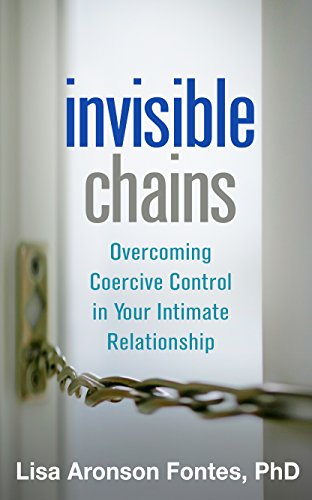
Inhaltsangabe
When you are showered with attention, it can feel incredibly romantic and can blind you to hints of problems ahead. But what happens when attentiveness becomes domination? In some relationships, the desire to control leads to jealousy, gaslighting, threats, micromanaging--even physical violence. If you or someone you care about are trapped in a web of coercive control, this book provides answers, hope, and a way out. Lisa Aronson Fontes draws on both professional expertise and personal experience to help you:
*Recognize controlling behaviors of all kinds.
*Understand why this destructive pattern occurs.
*Determine whether you are in danger and if your partner can change.
*Protect yourself and your kids.
*Find the support and resources you need.
*Take action to improve or end your relationship.
*Regain your freedom and independence.
*Recognize controlling behaviors of all kinds.
*Understand why this destructive pattern occurs.
*Determine whether you are in danger and if your partner can change.
*Protect yourself and your kids.
*Find the support and resources you need.
*Take action to improve or end your relationship.
*Regain your freedom and independence.
Die Inhaltsangabe kann sich auf eine andere Ausgabe dieses Titels beziehen.
Über die Autorinnen und Autoren
Lisa Aronson Fontes, PhD, has a doctorate in counseling psychology and has worked in the areas of child abuse, violence against women, and challenging family issues for over 25 years. A professor, researcher, and popular conference speaker, she teaches at the University of Massachusetts Amherst. She survived a relationship that included coercive control and stalking.
Lisa Aronson Fontes, PhD, has a doctorate in counseling psychology and has worked in the areas of child abuse, violence against women, challenging family issues, and cross-cultural research for over 25 years. A professor, researcher, and popular conference speaker, she teaches at the University of Massachusetts Amherst. Dr. Fontes is the author of Invisible Chains: Overcoming Coercive Control in Your Intimate Relationship as well as the professional resources Child Abuse and Culture and Interviewing across Cultures.
Auszug. © Genehmigter Nachdruck. Alle Rechte vorbehalten.
Invisible Chains
Overcoming Coercive Control in Your Intimate Relationship
By Lisa Aronson FontesThe Guilford Press
Copyright © 2015 The Guilford Press
All rights reserved.
ISBN: 978-1-4625-2024-4All rights reserved.
Contents
Cover,
Praise for Invisible Chains,
Also by Lisa Aronson Fontes,
Title Page,
Copyright Page,
Dedication Page,
About This Book,
PART I. WHAT IS COERCIVE CONTROL?,
1. Introduction to Coercive Control,
2. Controlling Behaviors,
PART II. WHY COERCIVE CONTROL HAPPENS,
3. Why Some Men Control Their Partners in This Way,
4. Why Some Women Get and Stay Involved,
PART III. COERCIVE CONTROL IN SPECIFIC POPULATIONS,
5. Different Gender Arrangements and Coercive Control,
6. Teenage Victims of Coercive Control,
PART IV. ENDING COERCIVE CONTROL,
7. Are You Being Victimized?,
8. Are You Staying? Expecting Change?,
9. Ending the Relationship,
10. Feeling Like Yourself Again: Recovering from Coercive Control,
11. If Someone You Care About Is Being Victimized by Coercive Control,
12. Conclusion,
Resources,
References,
Index,
Acknowledgments,
About the Author,
About Guilford Press,
Discover Related Guilford Books,
CHAPTER 1
Introduction to Coercive Control
When 23-year-old Lily's boyfriend, Dave, started quizzing her about where she had been and she caught him examining her phone, she decided Dave was "a jerk" and broke up with him immediately. Dave texted her several times a day for a couple of weeks, and once she saw him sitting in his car outside her workplace. But that was the end of it.
Mandy, age 35, did not see her situation so clearly. After the whirlwind courtship in which Tom showered her with cards and flowers, Mandy married him. Then he started asking Mandy for details about how she had spent her day, with whom she had spoken and for how long. Tom complained about how much time Mandy talked on the phone with her mother and sister. They had their first real fight when Mandy arrived home with short hair, and Tom was angry that she had cut it without asking for his opinion. She promised to grow it long again. It seemed as if nothing she did pleased him. Over time, Mandy noticed fewer loving moments and felt increasingly anxious about Tom catching her doing "something wrong." With two children at home and feeling worse and worse about herself, Mandy felt trapped.
Lily and Mandy were not simply unlucky in love; they were victims of coercive control. Coercive control strips away victims' independence, sense of self, and basic rights, such as the right to make decisions about their own time, friends, and appearance.
Coercive control shows up in a variety of relationships. This book focuses on the most common situation: where a man uses coercive control against a woman who is his partner in an intimate relationship. Chapter 5 discusses coercive control in same-sex relationships and in heterosexual relationships where the woman dominates the man.
Many men who use coercive control also abuse their wives and girlfriends physically or sexually, sometimes causing severe or even fatal injuries. Others limit themselves to slapping, pushing, grabbing, and other types of force that might look mild to outsiders who don't see how frequently they occur and the fear they cause over time. Violence is one among many tactics of a strategy of coercive control. Some men use coercive control without physical violence.
Coercive control can sometimes be found outside romantic and sexual relationships. Coworkers and supervisors sometimes use coercive control at the workplace. And we find a similar dynamic in cults and other organizations, on sports teams, and in the military, especially during basic training. However, intimate relationships are especially ensnaring. The controller may have access to the victim around the clock and knows her daily routine. He may also know things about her that she has shared with no one else, such as her secret hopes and fears. She may have told him about experiences that she does not want to become public. He uses these secrets to control and hurt her.
Outsiders may not be able to see the signs of coercive control in a couple. The men who use it often make a good impression in other settings. Much of society still thinks men's control over women is just the way things are, and that what happens in couples is their private business. All this adds to a woman's sense of being imprisoned by her partner.
Victims of coercive control often feel like hostages. Over time, being grilled, criticized, and shamed may come to seem routine. Victims often blame themselves as they feel despairing and disoriented. It can be hard for them to figure out exactly what's wrong. Isolated and humiliated, some women lose confidence and accept their partner's view of reality. They may have trouble deciding whether their partners are doing and saying hurtful things out of love and concern—as claimed—or out of cruelty. They may feel confused as they are told again and again that they themselves have triggered their partner's behaviors by doing something wrong. At the same time, to keep the peace in their relationship, victims may detach from family and friends, contacting them less and less often until they lose touch with many of the people they care about most. Unfortunately, the victims typically do not see the connection between their partner's control and their own isolation until time has passed. Losing self-confidence and close relationships at the same time can be paralyzing.
Women who get caught in the web of a controlling man are no different from other women. They just had the bad luck to become involved romantically with a controlling person at a time when they were especially vulnerable. Once a controlling man has caught a woman in his web, he will do everything he can to prolong the relationship.
Victims of coercive control come from all racial, ethnic, and religious backgrounds. They live in mansions, trailer parks, city apartments, and suburban and rural homes. Often victims of coercive control keep up a happy front because they feel ashamed or because their partner demands it. Sometimes other people sense that something is wrong, but are not sure what. The woman may appear unusually shy, lonely, meek, or even disturbed. It may be obvious to other people that she is being controlled, or the control may remain perfectly hidden.
People who exert control often look charming on the surface. To outsiders, they may even seem like ideal partners when they take over all crucial decisions. Some abusers appear eager to help others, friendly, romantic, and outgoing, while others seem mean and let their possessiveness show. There is no easy way to spot a person who will someday begin to exercise coercive control over his partner.
When he first meets a woman he likes, a controlling man will often say he wants to support and help her. He may buy her gifts, listen to her stories, and offer her advice about her work and family. He may do chores for her. He may look at her with admiration and think of her success as an extension of his own. If she is with a man like this, a woman initially benefits from his caring and concern. Family and friends may comment about the positive aspects of the relationship, saying, "You are so lucky to have found this man. You will never find another man like him!"
A part of her may feel uneasy, wondering, "What will happen if I don't want to follow his...
„Über diesen Titel“ kann sich auf eine andere Ausgabe dieses Titels beziehen.
Suchergebnisse für Invisible Chains: Overcoming Coercive Control in Your...

Beispielbild für diese ISBN
Invisible Chains: Overcoming Coercive Control in Your Intimate Relationship
Anbieter: World of Books (was SecondSale), Montgomery, IL, USA
Verkäuferbewertung 5 von 5 Sternen

Zustand: Very Good. Item in very good condition! Textbooks may not include supplemental items i.e. CDs, access codes etc. Artikel-Nr. 00108677471
Gebraucht kaufen
EUR 5,50
Versand gratis
Versand innerhalb von USA
Versand innerhalb von USA
Anzahl: 7 verfügbar
Beispielbild für diese ISBN
Invisible Chains: Overcoming Coercive Control in Your Intimate Relationship
Anbieter: ThriftBooks-Dallas, Dallas, TX, USA
Verkäuferbewertung 5 von 5 Sternen
Paperback. Zustand: Good. No Jacket. Former library book; Pages can have notes/highlighting. Spine may show signs of wear. ~ ThriftBooks: Read More, Spend Less. Artikel-Nr. G1462520243I3N10
Gebraucht kaufen
EUR 6,94
Versand gratis
Versand innerhalb von USA
Versand innerhalb von USA
Anzahl: 1 verfügbar
Beispielbild für diese ISBN
Invisible Chains : Overcoming Coercive Control in Your Intimate Relationship
Verlag:
Guilford Publications, 2015
ISBN 10: 1462520243
ISBN 13: 9781462520244
Gebraucht
Softcover
Erstausgabe
Anbieter: Better World Books, Mishawaka, IN, USA
Verkäuferbewertung 5 von 5 Sternen
Zustand: Good. 1st Edition. Former library copy. Pages intact with minimal writing/highlighting. The binding may be loose and creased. Dust jackets/supplements are not included. Includes library markings. Stock photo provided. Product includes identifying sticker. Better World Books: Buy Books. Do Good. Artikel-Nr. 14304085-6
Gebraucht kaufen
EUR 9,87
Versand gratis
Versand innerhalb von USA
Versand innerhalb von USA
Anzahl: 1 verfügbar
Beispielbild für diese ISBN
Invisible Chains: Overcoming Coercive Control in Your Intimate Relationship
Anbieter: Books From California, Simi Valley, CA, USA
Verkäuferbewertung 4 von 5 Sternen

Paperback. Zustand: Very Good. Artikel-Nr. mon0003668344
Gebraucht kaufen
EUR 6,87
EUR 4,35 Versand
Versand innerhalb von USA
Versand innerhalb von USA
Anzahl: 4 verfügbar
Beispielbild für diese ISBN
Invisible Chains: Overcoming Coercive Control in Your Intimate Relationship
Anbieter: Books From California, Simi Valley, CA, USA
Verkäuferbewertung 4 von 5 Sternen
Paperback. Zustand: Fine. Artikel-Nr. mon0003670486
Gebraucht kaufen
EUR 6,92
EUR 4,35 Versand
Versand innerhalb von USA
Versand innerhalb von USA
Anzahl: 1 verfügbar
Beispielbild für diese ISBN
Invisible Chains: Overcoming Coercive Control in Your Intimate Relationship
Verlag:
Guilford Publications, United States, New York, 2015
ISBN 10: 1462520243
ISBN 13: 9781462520244
Gebraucht
Paperback
Anbieter: WorldofBooks, Goring-By-Sea, WS, Vereinigtes Königreich
Verkäuferbewertung 5 von 5 Sternen
Paperback. Zustand: Very Good. When you are showered with attention, it can feel incredibly romantic and can blind you to hints of problems ahead. But what happens when attentiveness becomes domination? In some relationships, the desire to control leads to jealousy, gaslighting, threats, micromanaging--even physical violence. If you or someone you care about are trapped in a web of coercive control, this book provides answers, hope, and a way out. Lisa Aronson Fontes draws on both professional expertise and personal experience to help you: *Recognize controlling behaviors of all kinds. *Understand why this destructive pattern occurs. *Determine whether you are in danger and if your partner can change. *Protect yourself and your kids. *Find the support and resources you need. *Take action to improve or end your relationship. *Regain your freedom and independence. The book has been read, but is in excellent condition. Pages are intact and not marred by notes or highlighting. The spine remains undamaged. Artikel-Nr. GOR007472049
Gebraucht kaufen
EUR 9,64
EUR 6,53 Versand
Versand von Vereinigtes Königreich nach USA
Versand von Vereinigtes Königreich nach USA
Anzahl: 1 verfügbar
Beispielbild für diese ISBN
Invisible Chains: Overcoming Coercive Control in Your Intimate Relationship
Anbieter: Revaluation Books, Exeter, Vereinigtes Königreich
Verkäuferbewertung 5 von 5 Sternen
Paperback. Zustand: Brand New. 226 pages. 8.25x5.50x0.75 inches. In Stock. Artikel-Nr. xr1462520243
Neu kaufen
EUR 16,19
EUR 11,66 Versand
Versand von Vereinigtes Königreich nach USA
Versand von Vereinigtes Königreich nach USA
Anzahl: 2 verfügbar
Beispielbild für diese ISBN
Invisible Chains: Overcoming Coercive Control in Your Intimate Relationship
Verlag:
Guilford Publications, Incorporated, 2015
ISBN 10: 1462520243
ISBN 13: 9781462520244
Neu
Softcover
Anbieter: Majestic Books, Hounslow, Vereinigtes Königreich
Verkäuferbewertung 4 von 5 Sternen
Zustand: New. 226. Artikel-Nr. 374867609
Neu kaufen
EUR 21,00
EUR 7,58 Versand
Versand von Vereinigtes Königreich nach USA
Versand von Vereinigtes Königreich nach USA
Anzahl: 3 verfügbar
Beispielbild für diese ISBN
Invisible Chains: Overcoming Coercive Control in Your Intimate Relationship
Anbieter: Kennys Bookstore, Olney, MD, USA
Verkäuferbewertung 5 von 5 Sternen
Zustand: New. Num Pages: 226 pages. BIC Classification: VFJ; VFVG; VSP. Category: (G) General (US: Trade); (U) Tertiary Education (US: College). Dimension: 211 x 141 x 23. Weight in Grams: 264. . 2015. 1st Edition. Paperback. . . . . Books ship from the US and Ireland. Artikel-Nr. V9781462520244
Neu kaufen
EUR 22,05
EUR 9,15 Versand
Versand innerhalb von USA
Versand innerhalb von USA
Anzahl: Mehr als 20 verfügbar
Beispielbild für diese ISBN
Invisible Chains: Overcoming Coercive Control in Your Intimate Relationship
Anbieter: Ria Christie Collections, Uxbridge, Vereinigtes Königreich
Verkäuferbewertung 5 von 5 Sternen
Zustand: New. In English. Artikel-Nr. ria9781462520244_new
Neu kaufen
EUR 21,66
EUR 10,93 Versand
Versand von Vereinigtes Königreich nach USA
Versand von Vereinigtes Königreich nach USA
Anzahl: 4 verfügbar