
Verwandte Artikel zu Your Defiant Teen: 10 Steps to Resolve Conflict and...
Inhaltsangabe
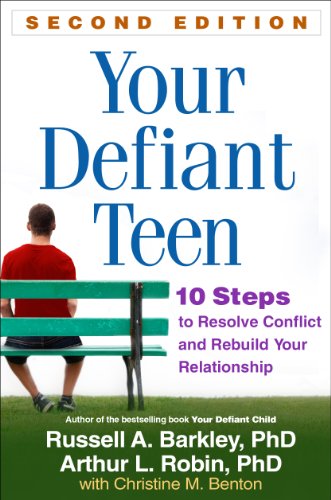
If life with your teen has become a battleground, it's time to take action. This empathic book shows how. Trusted psychologists who have worked with thousands of families give you the tools you need to overcome defiance and get teen behavior back on track. By following the authors' clinically proven 10-step program, learn how you can:
*Reestablish your authority while building trust.
*Identify and enforce nonnegotiable rules.
*Use rewards and incentives that work.
*Communicate and problem-solve effectively--even in the heat of the moment.
*Restore positive feelings in your relationship.
*Develop your teen's skills for becoming a successful adult.
Vivid stories and answers to frequently asked questions help you put the techniques into action. The updated second edition incorporates new scientific research on why some teens have more problems with self-control than others. Practical forms and worksheets can be downloaded and printed in a convenient 8 1/2" x 11" size.
Mental health professionals, see also the authors' Defiant Teens, Second Edition: A Clinician's Manual for Assessment and Family Intervention. For a focus on younger children, see also Dr. Barkley's Defiant Children, Third Edition (for professionals), and Your Defiant Child, Second Edition (for parents).
*Reestablish your authority while building trust.
*Identify and enforce nonnegotiable rules.
*Use rewards and incentives that work.
*Communicate and problem-solve effectively--even in the heat of the moment.
*Restore positive feelings in your relationship.
*Develop your teen's skills for becoming a successful adult.
Vivid stories and answers to frequently asked questions help you put the techniques into action. The updated second edition incorporates new scientific research on why some teens have more problems with self-control than others. Practical forms and worksheets can be downloaded and printed in a convenient 8 1/2" x 11" size.
Mental health professionals, see also the authors' Defiant Teens, Second Edition: A Clinician's Manual for Assessment and Family Intervention. For a focus on younger children, see also Dr. Barkley's Defiant Children, Third Edition (for professionals), and Your Defiant Child, Second Edition (for parents).
Die Inhaltsangabe kann sich auf eine andere Ausgabe dieses Titels beziehen.
Über die Autorinnen und Autoren
Russell A. Barkley, PhD, ABPP, ABCN, before retiring in 2021, served on the faculties of the University of Massachusetts Medical Center, the Medical University of South Carolina, and Virginia Commonwealth University. Dr. Barkley has worked with children, adolescents, and families since the 1970s and is the author of numerous bestselling books for both professionals and the public, including Taking Charge of ADHD and Your Defiant Child. He has also published six assessment scales and more than 300 scientific articles and book chapters on attention-deficit/hyperactivity disorder, executive functioning, and childhood defiance. A frequent conference presenter and speaker who is widely cited in the national media, Dr. Barkley is past president of the Section on Clinical Child Psychology (the former Division 12) of the American Psychological Association (APA), and of the International Society for Research in Child and Adolescent Psychopathology. He is a recipient of awards from the American Academy of Pediatrics and the APA, among other honors. His website is www.russellbarkley.org.
Arthur L. Robin, PhD, is Director of Psychology Training at Children's Hospital of Michigan and Professor of Psychiatry and Behavioral Neurosciences at Wayne State University. Dr. Robin is a practicing psychologist with more than 40 years of clinical experience.
Christine M. Benton is a Chicago-based writer and editor.
Arthur L. Robin, PhD, is Director of Psychology Training at Children's Hospital of Michigan and Professor of Psychiatry and Behavioral Neurosciences at Wayne State University. Dr. Robin is a practicing psychologist with more than 40 years of clinical experience.
Christine M. Benton is a Chicago-based writer and editor.
Russell A. Barkley, PhD, ABPP, ABCN, is Clinical Professor of Psychiatry at the Virginia Commonwealth University School of Medicine. Dr. Barkley has worked with children, adolescents, and families since the 1970s and is the author of numerous bestselling books for both professionals and the public, including Taking Charge of ADHD and Your Defiant Child. He has also published six assessment scales and more than 280 scientific articles and book chapters on attention-deficit/hyperactivity disorder, executive functioning, and childhood defiance, and is editor of the newsletter The ADHD Report. A frequent conference presenter and speaker who is widely cited in the national media, Dr. Barkley is past president of the Section on Clinical Child Psychology (the former Division 12) of the American Psychological Association (APA), and of the International Society for Research in Child and Adolescent Psychopathology. He is a recipient of awards from the American Academy of Pediatrics and the APA, among other honors. His website is www.russellbarkley.org.
Arthur L. Robin, PhD, is Director of Psychology Training at Children's Hospital of Michigan and Professor of Psychiatry and Behavioral Neurosciences at Wayne State University. Dr. Robin is a practicing psychologist with more than 40 years of clinical experience.
Christine M. Benton is a Chicago-based writer and editor.
Auszug. © Genehmigter Nachdruck. Alle Rechte vorbehalten.
Your Defiant Teen
10 Steps to Resolve Conflict and Rebuild Your Relationship
By Russell A. Barkley, Arthur L. Robin, Christine M. BentonThe Guilford Press
Copyright © 2014 The Guilford Press
All rights reserved.
ISBN: 978-1-4625-1166-2All rights reserved.
Contents
Cover,
Praise for Your Defiant Teen,
Selected Works from Russell A. Barkley and Arthur L. Robin,
Title Page,
Copyright Page,
Dedication Page,
Acknowledgments,
Introduction,
I. You and Your Defiant Teen,
1. What Defiance Is—and What You Should Do about It,
2. How Defiance Develops,
3. What Does Adolescence Have to Do with It?,
4. Is It Just Your Teen's Personality?,
5. Where Do You Come In?,
6. How to Find a Way Out,
II. 10 Steps to a Better Relationship with Your Teen—and a Better Future for Your Teen,
7. Getting Ready,
8. Step 1. Making Positive One-on-One Time a Habit,
9. Step 2. A New Way to Manage Behavior,
10. Step 3. Contracts and Point Systems: How Teens Can Earn Privileges,
11. Step 4. Making the Punishment Really Fit the Crime,
12. Step 5. Tackling Additional Issues with Rewards and Penalties,
13. Step 6. Addressing Defiant Behavior in School and Conflicts over Homework,
14. Step 7. Using Problem-Solving Skills,
15. Step 8. Learning and Practicing Communication Skills,
16. Step 9. Dealing with Unreasonable Beliefs and Expectations,
17. Step 10. Keeping It Together,
APPENDIX A. Problem-Solving Worksheets,
APPENDIX B. How to Find a Therapist,
Resources,
Index,
About the Authors,
About Guilford Press,
Discover Related Guilford Books,
CHAPTER 1
What Defiance Is—and What You Should Do about It
Seventeen-year-old Mark (mentioned in the Introduction) usually doesn't show up at home on weekdays until dinnertime, if then. So when he made a rare appearance at 3:00 one Friday, his mother, Sandy, looked at him suspiciously when he entered the kitchen, pointedly looked at her watch, and said sarcastically, "To what do I owe this honor?"
Mark just sneered and opened the refrigerator.
As she watched him pawing through the food on the shelves, Sandy became more and more irritated. She didn't want to start a fight. It had already been a long week. But she couldn't keep her silence.
"Mark, did you actually go to school today? Doesn't the last class end at 3:00?"
"Relax, Ma. My last class was canceled. Besides, what the hell do you care? You haven't asked me about school since, like, Christmas."
"Watch your mouth, young man," Sandy snapped. "If you miss much more school, you're not even going to graduate!"
"Oh, yeah, like that matters." Mark grabbed sandwich fixings from the refrigerator and plopped down at the kitchen table, where he started making three huge sandwiches.
"What do you need all that food for?" his mother demanded. "You get lunch money every week."
"Yeah, well, I spent it on cigarettes," Mark shot back, then leaned back in his chair and aimed an insolent grin at his mother. "Besides, I'm gonna be out for a while; I'm taking this with me."
Sandy spun around from the sink. "You're not going anywhere till you mow the lawn, like I asked you last Saturday—and the Saturday before, and the Saturday before that."
"It's Friday, and I'm going out. You want the grass cut so bad, you do it! All you ever do is sit around here anyway."
"Don't you talk to me that way! And don't you even think about leaving here without cutting the grass!"
"OK, I won't think about it," Mark said slyly. Then he stood up, went back to the refrigerator, grabbed a six-pack of beer, and walked out the front door so fast he didn't hear his mother yelling: "You get back here, Mark! Don't expect to waltz back in here whenever you feel like showing up! Everybody has to pitch in around here, you know!" Mark was thinking about his plans for the weekend and had already tuned his mother out.
This scene or one a lot like it has been replayed in this household dozens of times over the last year. When Mark started to act as if his parents' rules were negligible and their requests optional, his parents said nothing, hoping the phase would pass. When it didn't, they tried threats and removal of privileges. Mark just laughed at them. Now he comes and goes as he pleases and treats them with more and more disdain. Periodically he erupts into cursing and threats of his own. Frankly, both of his parents are a little bit afraid of him.
HOW WE DEFINE DEFIANCE
Pull this interaction apart, and you'll have before you all the elements by which we define defiance:
1. Failure to comply with an adult's request within a reasonable time. Believe it or not, a mere minute or so is considered a reasonable time within which to comply with an adult's request—that's about the same window in which you'd expect an adult to do something you've asked, and it's fair to expect a teen to do the same. Yes, if a teen is already busy with another project, then a longer time to comply is reasonable, but in those cases the teen should at least acknowledge the request and an intention to comply with it within a minute or so. Mark not only didn't mow the lawn when his mother asked him, he's totally ignored her request for 3 weeks!
2. Failure to keep doing what has been requested until the task is finished. Maybe this seems like it goes without saying. But many teenagers start out doing what they're asked to do and then don't follow through. They pay lip service—they do half the job and then switch to something they want to do, they do a sloppy job, or they drag out the task for so long that it doesn't get done when you need it done. Mark, obviously, never even got started. Of course in some circumstances it's clear that compliance with an adult instruction is not expected immediately. But in those cases it's up to you to state explicitly when compliance should begin.
3. Failure to follow previously taught rules of conduct. Mark has racked up quite a score on this one: His parents expect him to attend school; let them know where he is; come home when expected; speak to them respectfully and listen attentively; and spend the money they give him as they intended, not for cigarettes and beer. He defies them on every count.
Although we'll use the term defiance throughout this book, it's important to understand that we mean both noncompliance (passively not doing what is asked or expected or not completing it) and more active verbal or physical resistance such as Mark's arguing, swearing, challenging, and threatening. It may very well be the latter that has brought you to this book, although 14-year-old Lauren (mentioned in the Introduction) has driven her mother to seek help just by quietly breaking all the rules and generally making herself scarce.
WHY YOU NEED TO KNOW MORE ABOUT YOUR TEEN'S DEFIANCE
If your teen resembles Mark or Lauren or the other two adolescents depicted in the Introduction, you already know enough to justify trying the straightforward steps in Part II. You may not know enough, however, to get everything you possibly can from the program. First you need to know whether this self-help program is really what you need and whether it's all you need.
Is Your Teen's Defiance a Behavior or a Trait?
If we asked you to tell us what you mean by "defiance," you'd probably be quick to define it as resistance, opposition, and disobedience—complete disregard for whatever you request, demand, or instruct your teenager to do. You may even liken it to Groucho Marx's refrain in the movie Horsefeathers: "Whatever it is, I'm against it!"
Of course you might look at it that way only on good days, when you can summon up a sense of humor about the issue. On most days your teenager's defiance is no laughing matter. Dealing with someone who always seems to want to resist or to fight, and constantly displays contempt or aversion, wears you down and beats you up. You want to "get this kid in line" and get your lives back to normal.
The trouble is, your lives may never get back to normal if you view the problem as something your teen is instead of something he or she does. As you can see from our definition of defiance, it's measured by specific acts. Yet when those acts add up to what feels like endless grief for you, defiance in a teen can begin to seem like a personality trait instead of a behavior. Personality traits generally can't be changed very much, but behavior can be changed. If you view your teenager as just being defiant, you're sort of stuck with the condition, aren't you? It's this perspective that leads to finger-pointing of the "You always ..." and "Why can't you ever ...?" variety. It puts you at loggerheads and keeps you there.
Yet if you look closely at the way your teenager acts, you'll probably see that she isn't defiant as "constantly" as you may feel; she may not be defiant everywhere, with everyone, all the time, and in exactly the same way. Some kids are so defiant at home that their parents can't believe they don't act the same way at school—but they don't. Others are much more defiant with certain people than with everyone else or when faced with certain demands. Defiance is often demonstrated to different degrees, but it all begins to run together and seem like one big rebellion to parents who are expecting it. When you become aware of these nuances, you gain information about what goes wrong and what goes right—and consequently where to address the problem first and how to capitalize on the positives.
Remember, behavior can be changed. Looking more closely at your teen's defiance will reveal the cracks in the behavior and help you see where you can wiggle your way in and make a difference.
Is It Just Normal Adolescent Behavior or More Serious Problems?
Your lives may also never get back to normal if you put the emphasis on "back." Taking a closer look at the history of your teen's defiance and training a magnifying glass on the current behavior will help you see how easy it can be to confuse normal adolescent striving for autonomy with out-of-control rebellion. We'll get into this important topic more in the chapters that follow, but, for now, try to keep in mind that there is a line. It's just that it gets pretty blurry in the heated battle of wills, and we all take a little time to adjust to these new creatures who are so eager to be shed of our supervision and care. If you can begin to see the difference between "normal" assertions of growing independence—the way kids typically behave when they hit the teen years—and how what we call "defiance" departs from that pattern, you won't make the mistake of trying to "correct" behavior that is just fine as it is (as trying as it can be).
Remember What You Stand to Gain
When your patience has been pushed so far past its limits that you don't remember what calm feels like, it's hard not to view defiance as a one-way street. Your teenager defies you (the cause), and conflict erupts (the effect). Look more closely, though, and you'll be reminded that defiance is not just an action; it's a reaction—to the person being defied or to a situation deemed intolerable. Technically, it's an interaction. Your teen cannot defy your instruction if no instruction is given or break a rule if one has not been laid down previously and you do not react with anger or frustration at everything your teen does. Defiance doesn't occur in a vacuum or when a person is alone. "It takes two to tango," as they say. This may be hard to believe considering that teens often express defiance through their absence. You tell your 15-year-old to do the dishes and then hit the books, and instead he hits the pavement—running. You've set a weeknight curfew of 10:00 P.M., and your daughter responds to your edict by staying out till midnight. Whether the teen is present or not, every act of defiance is a response to something you or some other authority figure has said. Defiance makes the interaction a conflict. It pits you and your teen against each other; it pulls you farther and farther apart over time. When you look closely at your teen's defiance, you'll see the damage it's doing to the parent–child relationship. We hope this realization will motivate you to keep at the program even when it's tough because you have so much to gain. And we hope you'll remember that, if you're part of the interactions where defiance occurs, it means you have a lot of power to make a difference. Fairly simple changes in your behavior may lead to big changes in your teen's behavior.
In the Introduction we said that if you answered "Yes" to any of the following questions, you probably need to address your teen's defiance.
1. Is your teen's defiant behavior much worse than it is for most other adolescents?
2. Is your teen's defiant behavior making it hard for him or her to function as expected, or does it risk eliciting serious consequences from others?
3. Is your teen's defiant behavior causing a lot of emotional distress or harm?
The rest of this chapter will help you examine the nature of your teen's defiant behavior so you know how to answer these questions. You'll have a chance to enter all the information you've gathered on a Decision-Making Worksheet to help you determine whether you need help, and, if so, whether self-help is likely to be enough or you need professional help.
WHAT DOES YOUR TEEN'S DEFIANCE LOOK LIKE?
Defiance takes all kinds of forms in teenagers. Just to get an overview of what you've been dealing with, check off the behaviors in the Defiant Behaviors list that you've been noticing recently. Feel free to copy the list for later use or download it from www.guilford.com/barkley16-forms.
Notice the four categories of defiant behavior: Verbal (V), Physical (P), Aggressive (A), and Passive Noncompliance (PN) . How many behaviors in each category did you check off? Keep this in mind as we proceed through the rest of the book. We'll be suggesting different techniques to deal with different categories of defiant behavior. In Chapter 15 you'll learn to use communication skills to deal with verbal defiance. In Chapters 10, 11, and 12 you'll learn to use contracts, point systems, and punishments to deal with physical and aggressive defiance. In Chapter 14 you'll learn to use problem solving to deal with passive defiance as well as elements of the other types of defiance. If you checked off any of the last five symptoms in the Aggressive category, be sure to read the section "Do You Need Professional Help?" later in this chapter.
IS YOUR TEEN'S DEFIANCE MUCH WORSE THAN DEFIANCE IN OTHER TEENS?
Is your teen's defiant behavior much worse than it is for most other teens? To answer this question, we need a standard for other teens to which you can compare your teen. First, circle the word below that represents how frequently your teen exhibits the following three behaviors:
Fails to comply with an adult's request within a reasonable time
never sometimes often very often
Fails to keep doing what has been requested until the task is finished
never sometimes often very often
Fails to follow previously taught rules of conduct
never sometimes often very often
Second, fill out the Conflict Behavior Questionnaire for Parents, developed by Dr. Robin. Feel free to copy the questionnaire or download it from www.guilford.com/barkley16-forms for later uses. Save your frequency ratings above and your scores on the Conflict Behavior Questionnaire for Parents to use in the Decision-Making Worksheet that appears later in this chapter.
IS YOUR TEEN'S BEHAVIOR CREATING IMPAIRMENT?
Is your teen's defiant behavior making it hard for him or her to function as expected at home, in school, or in the community? To help you answer this question, we have listed the major settings where defiant behavior may be a problem. Consider all the oppositional behaviors that you rated sometimes, often, or very often on the previous checklist. Taking all these behaviors into account, circle the ratings on the Impairment Rating Form that represent how much these behaviors interfere with your teen's ability to function in each life activity. Feel free to copy or download the form from www.guilford.com/barkley16-forms for later uses.
Even if you circled often or very often only once, your teenager's defiant behavior is interfering significantly with his or her ability to function in a major life activity. As with your frequency ratings, keep your results handy so you can use them in the Decision-Making Worksheet.
IS YOUR TEENAGER'S BEHAVIOR CAUSING A LOT OF EMOTIONAL DISTRESS?
Emotional distress comes in many different forms. Maybe your teenager's defiant behavior is making you or others in your family feel angry, frustrated, upset, depressed, and/or hopeless. This is a difficult experience to measure because each person experiences emotional distress differently, so your ratings in the Emotional Distress Rating Form below are bound to be inexact, which is fine. Just try to rate the overall degree of emotional distress you and other family members experience on a typical day because your teen engages in the defiant behaviors that you've reported on our earlier rating scales. Feel free to copy or download the form from www.guilford.com/barkley16-forms for later uses.
If one or more of the people in your family are experiencing at least moderate degrees of emotional distress because of your teen's oppositional behavior, you need to think seriously about trying the program outlined in this book or seeing a therapist.
(Continues...)
Excerpted from Your Defiant Teen by Russell A. Barkley, Arthur L. Robin, Christine M. Benton. Copyright © 2014 The Guilford Press. Excerpted by permission of The Guilford Press.
All rights reserved. No part of this excerpt may be reproduced or reprinted without permission in writing from the publisher.
Excerpts are provided by Dial-A-Book Inc. solely for the personal use of visitors to this web site.
„Über diesen Titel“ kann sich auf eine andere Ausgabe dieses Titels beziehen.
Suchergebnisse für Your Defiant Teen: 10 Steps to Resolve Conflict and...

Beispielbild für diese ISBN
Your Defiant Teen, Second Edition: 10 Steps to Resolve Conflict and Rebuild Your Relationship
Anbieter: World of Books (was SecondSale), Montgomery, IL, USA
Verkäuferbewertung 5 von 5 Sternen

Paperback. Zustand: Good. If life with your teen has become a battleground, it's time to take action. This empathic book shows how. Trusted psychologists who have worked with thousands of families give you the tools you need to overcome defiance and get teen behavior back on track. By following the authors' clinically proven 10-step program, learn how you can: Â *Reestablish your authority while building trust. *Identify and enforce nonnegotiable rules. *Use rewards and incentives that work. *Communicate and problem-solve effectively--even in the heat of the moment. *Restore positive feelings in your relationship. *Develop your teen's skills for becoming a successful adult. Â Vivid stories and answers to frequently asked questions help you put the techniques into action. The updated second edition incorporates new scientific research on why some teens have more problems with self-control than others. Practical forms and worksheets can be downloaded and printed in a convenient 8 1/2 x 11 size. Mental health professionals, see also the authors' Defiant Teens, Second Edition: A Clinician's Manual for Assessment and Family Intervention. For a focus on younger children, see also Dr. Barkley's Defiant Children, Third Edition (for professionals), and Your Defiant Child, Second Edition (for parents). Artikel-Nr. 00105714895
Gebraucht kaufen
EUR 5,45
Versand gratis
Versand innerhalb von USA
Versand innerhalb von USA
Anzahl: 7 verfügbar
Foto des Verkäufers
Your Defiant Teen: 10 Steps to Resolve Conflict and Rebuild Your Relationship
Anbieter: Dream Books Co., Denver, CO, USA
Verkäuferbewertung 5 von 5 Sternen
Zustand: acceptable. This copy has clearly been enjoyedâ"expect noticeable shelf wear and some minor creases to the cover. Binding is strong, and all pages are legible. May contain previous library markings or stamps. Artikel-Nr. 4EKTGN0034YL_ns
Gebraucht kaufen
EUR 5,45
Versand gratis
Versand innerhalb von USA
Versand innerhalb von USA
Anzahl: 1 verfügbar
Beispielbild für diese ISBN
Your Defiant Teen: 10 Steps to Resolve Conflict and Rebuild Your Relationship
Anbieter: ThriftBooks-Reno, Reno, NV, USA
Verkäuferbewertung 5 von 5 Sternen
Paperback. Zustand: Good. No Jacket. Pages can have notes/highlighting. Spine may show signs of wear. ~ ThriftBooks: Read More, Spend Less. Artikel-Nr. G146251166XI3N00
Gebraucht kaufen
EUR 6,28
Versand gratis
Versand innerhalb von USA
Versand innerhalb von USA
Anzahl: 1 verfügbar
Beispielbild für diese ISBN
Your Defiant Teen: 10 Steps to Resolve Conflict and Rebuild Your Relationship
Anbieter: ThriftBooks-Atlanta, AUSTELL, GA, USA
Verkäuferbewertung 5 von 5 Sternen
Paperback. Zustand: Good. No Jacket. Pages can have notes/highlighting. Spine may show signs of wear. ~ ThriftBooks: Read More, Spend Less. Artikel-Nr. G146251166XI3N00
Gebraucht kaufen
EUR 6,28
Versand gratis
Versand innerhalb von USA
Versand innerhalb von USA
Anzahl: 1 verfügbar
Beispielbild für diese ISBN
Your Defiant Teen: 10 Steps to Resolve Conflict and Rebuild Your Relationship
Anbieter: ThriftBooks-Dallas, Dallas, TX, USA
Verkäuferbewertung 5 von 5 Sternen
Paperback. Zustand: Good. No Jacket. Pages can have notes/highlighting. Spine may show signs of wear. ~ ThriftBooks: Read More, Spend Less. Artikel-Nr. G146251166XI3N00
Gebraucht kaufen
EUR 6,28
Versand gratis
Versand innerhalb von USA
Versand innerhalb von USA
Anzahl: 1 verfügbar
Beispielbild für diese ISBN
Your Defiant Teen : 10 Steps to Resolve Conflict and Rebuild Your Relationship
Anbieter: Better World Books: West, Reno, NV, USA
Verkäuferbewertung 5 von 5 Sternen
Zustand: Good. Former library copy. Pages intact with minimal writing/highlighting. The binding may be loose and creased. Dust jackets/supplements are not included. Includes library markings. Stock photo provided. Product includes identifying sticker. Better World Books: Buy Books. Do Good. Artikel-Nr. 7850499-6
Gebraucht kaufen
EUR 6,35
Versand gratis
Versand innerhalb von USA
Versand innerhalb von USA
Anzahl: 1 verfügbar
Beispielbild für diese ISBN
Your Defiant Teen : 10 Steps to Resolve Conflict and Rebuild Your Relationship
Anbieter: Better World Books, Mishawaka, IN, USA
Verkäuferbewertung 5 von 5 Sternen
Zustand: Good. Former library copy. Pages intact with minimal writing/highlighting. The binding may be loose and creased. Dust jackets/supplements are not included. Includes library markings. Stock photo provided. Product includes identifying sticker. Better World Books: Buy Books. Do Good. Artikel-Nr. 7850499-6
Gebraucht kaufen
EUR 6,35
Versand gratis
Versand innerhalb von USA
Versand innerhalb von USA
Anzahl: 2 verfügbar
Beispielbild für diese ISBN
Your Defiant Teen, Second Edition: 10 Steps to Resolve Conflict and Rebuild Your Relationship
Anbieter: Books From California, Simi Valley, CA, USA
Verkäuferbewertung 4 von 5 Sternen

Paperback. Zustand: Fine. Artikel-Nr. mon0003375984
Gebraucht kaufen
EUR 6,57
EUR 4,45 Versand
Versand innerhalb von USA
Versand innerhalb von USA
Anzahl: 5 verfügbar
Beispielbild für diese ISBN
Your Defiant Teen, Second Edition: 10 Steps to Resolve Conflict and Rebuild Your Relationship
Anbieter: Books From California, Simi Valley, CA, USA
Verkäuferbewertung 4 von 5 Sternen
Paperback. Zustand: Very Good. Artikel-Nr. mon0003740343
Gebraucht kaufen
EUR 9,94
EUR 4,45 Versand
Versand innerhalb von USA
Versand innerhalb von USA
Anzahl: 1 verfügbar
Foto des Verkäufers
Your Defiant Teen - Second Edition
Anbieter: Bookbot, Prague, Tschechien
Verkäuferbewertung 5 von 5 Sternen
Softcover. Zustand: Fair. Verschmutzung; Leichte Kratzer / Abnutzungen / Druckstellen. If life with your teen has become a battleground, it's time to take action. This empathic book shows how. Trusted psychologists who have worked with thousands of families give you the tools you need to overcome defiance and get teen behavior back on track. By following the authors' clinically proven 10-step program, learn how you can: *Reestablish your authority while building trust. *Identify and enforce nonnegotiable rules. *Use rewards and incentives that work. *Communicate and problem-solve effectively--even in the heat of the moment. *Restore positive feelings in your relationship. *Develop your teen's skills for becoming a successful adult. Vivid stories and answers to frequently asked questions help you put the techniques into action. The updated second edition incorporates new scientific research on why some teens have more problems with self-control than others. Practical forms and worksheets can be downloaded and printed in a convenient 8 1/2" x 11" size. Mental health professionals, see also the authors' Defiant Teens, Second Edition: A Clinician's Manual for Assessment and Family Intervention. For a focus on younger children, see also Dr. Barkley's Defiant Children, Third Edition (for professionals), and Your Defiant Child, Second Edition (for parents). Artikel-Nr. 15d99acb-c263-445f-84c3-9afab6cf77a5
Gebraucht kaufen
EUR 5,09
EUR 18,99 Versand
Versand von Tschechien nach USA
Versand von Tschechien nach USA
Anzahl: 1 verfügbar