
Verwandte Artikel zu Controlling Your Drinking: Tools to Make Moderation...
Inhaltsangabe
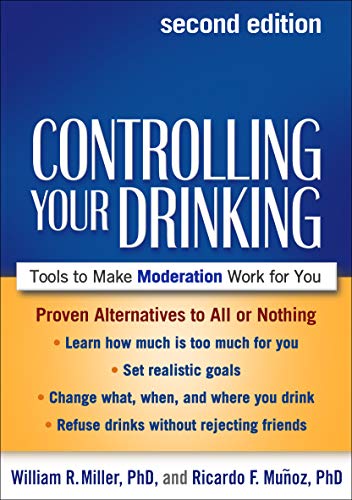
Interested in cutting down on your drinking without giving it up altogether? This encouraging, science-based book can help make that goal a reality. Distinguished clinician-researchers William R. Miller and Ricardo F. Muñoz have spent more than 40 years studying whether moderation works, who it works (and doesn't work) for, and how to achieve it. They give you tools to evaluate your alcohol consumption, decide what changes you want to make, and create a doable plan of action. Learn new ways to enjoy social events, defuse tension and stress, and cope with difficult emotions--with or without a glass in hand. The updated second edition incorporates the latest scientific data and features a new chapter on mindfulness. Helpful forms and worksheets can be downloaded and printed in a convenient 8 1/2" x 11" size.
Die Inhaltsangabe kann sich auf eine andere Ausgabe dieses Titels beziehen.
Über die Autorin bzw. den Autor
William R. Miller, PhD, is Emeritus Distinguished Professor of Psychology and Psychiatry at the University of New Mexico. He has published over 400 scientific articles and chapters and more than 40 books, including the groundbreaking work for professionals Motivational Interviewing. Fundamentally interested in the psychology of change, Dr. Miller has focused particularly on developing and testing more effective treatments for people with alcohol and drug problems. The Institute for Scientific Information lists him as one of the world's most cited scientists.
Ricardo F. Muñoz, PhD, is Distinguished Professor of Clinical Psychology at Palo Alto University and Emeritus Professor of Psychology at the University of California, San Francisco. His major areas of expertise include addictive behavior, the prevention and treatment of depression, and how depression affects substance use. He has published over 100 scientific articles and chapters and several books, including Control Your Depression and The Prevention of Depression.
Ricardo F. Muñoz, PhD, is Distinguished Professor of Clinical Psychology at Palo Alto University and Emeritus Professor of Psychology at the University of California, San Francisco. His major areas of expertise include addictive behavior, the prevention and treatment of depression, and how depression affects substance use. He has published over 100 scientific articles and chapters and several books, including Control Your Depression and The Prevention of Depression.
Auszug. © Genehmigter Nachdruck. Alle Rechte vorbehalten.
Controlling Your Drinking
Tools to Make Moderation Work for You
By William R. Miller, Ricardo F. MuñozThe Guilford Press
Copyright © 2013 The Guilford Press
All rights reserved.
ISBN: 978-1-4625-0759-7All rights reserved.
Contents
Cover,
Praise for Controlling Your Drinking,
Other Titles from William R. Miller,
Title Page,
Copyright Page,
Dedication Page,
Preface,
Acknowledgments,
PART I Introduction,
1 Thinking about Drinking,
2 Why Change?,
3 Is Moderation for You?,
PART II When You Drink,
4 Getting Started,
5 Keeping Track,
6 Taking Charge,
7 Slowing Down,
8 Refusing Drinks,
9 Affirming Your Progress,
10 Moving Along,
PART III Before You Drink,
11 Discovering Your Triggers,
12 Places,
13 People,
14 Days and Times,
15 Feelings,
16 Other Triggers,
17 Summary: Before You Drink,
PART IV Instead of Drinking,
18 Relaxing,
19 Self-Talk,
20 Pleasant Activities without Alcohol,
21 Coping with Negative Moods and Depression,
22 Self-Concept,
23 Sleeping Well,
24 Mindfulness,
25 Managing Anxiety and Fear,
26 Being Assertive,
27 Relating to Others,
28 Living "As If",
PART V How Are You Doing?,
29 If Moderation Isn't Working for You,
30 Sources of Help,
Appendix A The Wrath of Grapes: Reasons for Concern,
Appendix B An Inventory of Alcohol-Related Problems,
Appendix C Tables for Estimating Blood Alcohol Concentration (BAC),
Going Further: Recommended Resources,
Notes,
Bibliography,
Index,
About the Authors,
About Guilford Press,
Discover Related Guilford Books,
CHAPTER 1
Thinking about Drinking
Many people drink alcohol, and most of them never experience serious harm or problems from doing it. Many others, however, do find at some point in their lives that their drinking is becoming risky or creating problems, and so they decide to cut down or quit. Some find that they need help to do so and seek professional consultation or attend mutual-help groups such as Alcoholics Anonymous. Many others cut down or quit drinking on their own.
Perhaps you're reading this book because you wonder whether you're drinking too much and ought to cut back. Problems related to drinking rarely spring up overnight, but rather build up gradually over a period of months or years. Often family members or others become concerned well before the drinker him- or herself does. Judging from our four decades of research, if you (or a loved one) are wondering whether you might be drinking too much, there is probably good reason for concern.
This book provides step-by-step guidance for deciding how much you will drink and then for reaching your chosen goal. The research-tested methods that we offer here are the best we know to help you moderate your drinking. We also offer suggestions for how to proceed if you find you have difficulty maintaining moderation, including the option of not consuming alcohol at all.
OVERDRINKING, DUMB DRINKING, HARMFUL DRINKING, AND DEPENDENT DRINKING
Why is it that it can take so long for people to realize they're drinking too much and to do something about it? One obstacle, we believe, has been the label "alcoholic." When this term came into prominence a century ago, the belief emerged that either you are an alcoholic or you aren't: if you are, then there's nothing you can do about it except to stop drinking; and if you aren't, then you have nothing to worry about and can drink as much as you please. Furthermore, because "alcoholic" is a sticky label that carries a lot of social stigma. People tend to resent it and often endure many harsh consequences of overdrinking rather than accepting the label. Consequently, they take no action until their situation becomes very serious indeed.
This was pretty much the public view of alcoholism when the ideas in this book first saw print in 1976. Within that understanding, there would be no one to use a book like this: If you are alcoholic, then it's too late for moderation. If you're not alcoholic, then you don't need it. Or so popular thinking went at the time.
A lot more is known now about the many ways in which overdrinking can harm your physical, psychological, spiritual, and family health. If you're interested, Appendix A briefly summarizes current scientific reasons to be careful about alcohol. It is also clearer now just how many people are experiencing personal harm from their drinking. Those who fit the common stereotype of alcoholism account for only a small minority of alcohol-related health and social problems. They are but the tip of an immense iceberg.
In any event, we're not focused on labels here. We offer no slick test to tell you whether you "are" or "aren't." Instead, we want to help you think objectively about your drinking and how it may affect you.
Overdrinking
Perhaps the most common question is simply whether you drink too much. At relatively low levels of use, alcohol has no harmful effects for most people and may even offer some health benefits. Drinking above these safe limits, however, results in a rather steep increase in the rates and risk of a host of health and social problems. If your drinking exceeds safe limits, it may be termed "risky" or "hazardous," even if you have not yet experienced any significant negative consequences. We prefer the term "overdrinking" for its parallel to the term "overeating." "Overdrinking" applies only to the level or amount of drinking and does not imply the presence of any harm, problems, or dependence. It applies equally to a man who most days has a six pack of "light" beer between work and bedtime, a woman who drinks a bottle of wine once or twice a week, and the person whose daily fare is a fifth of scotch.
So how much is too much? The U.S. National Institutes of Health have recommended limits of one drink per day for women and two drinks per day for men. (We will define what "one drink" means in Chapter 4.) A further general recommendation is not to drink every day but to give your body a rest from alcohol on at least one or two days a week.
Wow! Only one or two drinks a day? You may view that as an incredibly small amount of alcohol. Yet there are good reasons for these medically recommended limits. For most of the health problems described in Appendix A, risk levels are no different at zero, one, or two drinks per day. Above that level, however, risks for cancers, hypertension, stroke, and heart disease climb significantly: the more drinks per day, the higher the risk of serious health problems.
These are just averages, of course. Most people who gamble do lose money, and a very few win big. That is why gambling establishments are so profitable. In the same way, the more you overdrink, the more likely you are to "lose" by developing significant physical, emotional, or social problems. A few people are fortunate and become that uncle or aunt, hero or grandparent who drank like a parched horse (or smoked two packs of cigarettes a day, or ate bacon cheeseburgers and butter-fried eggs all the time) for decades and still died at a ripe old age. It happens. As any life insurance actuary knows, however, mortality prediction statistics are dauntingly accurate for all of us collectively, even though it's more difficult to predict the longevity of any one particular person. Like smoking or overeating, overdrinking shortens life...
„Über diesen Titel“ kann sich auf eine andere Ausgabe dieses Titels beziehen.
Suchergebnisse für Controlling Your Drinking: Tools to Make Moderation...

Beispielbild für diese ISBN
Controlling Your Drinking, Second Edition: Tools to Make Moderation Work for You
Anbieter: World of Books (was SecondSale), Montgomery, IL, USA
Verkäuferbewertung 5 von 5 Sternen

Paperback. Zustand: Good. Interested in cutting down on your drinking without giving it up altogether? This encouraging, science-based book can help make that goal a reality. Distinguished clinician-researchers William R. Miller and Ricardo F. Muñoz have spent more than 40 years studying whether moderation works, who it works (and doesn't work) for, and how to achieve it. They give you tools to evaluate your alcohol consumption, decide what changes you want to make, and create a doable plan of action. Learn new ways to enjoy social events, defuse tension and stress, and cope with difficult emotions--with or without a glass in hand. The updated second edition incorporates the latest scientific data and features a new chapter on mindfulness. Helpful forms and worksheets can be downloaded and printed in a convenient 8 1/2 x 11 size. Artikel-Nr. 00109449277
Gebraucht kaufen
EUR 3,47
Versand gratis
Versand innerhalb von USA
Versand innerhalb von USA
Anzahl: 4 verfügbar
Beispielbild für diese ISBN
Controlling Your Drinking : Tools to Make Moderation Work for You
Anbieter: Better World Books, Mishawaka, IN, USA
Verkäuferbewertung 5 von 5 Sternen
Zustand: Very Good. Former library copy. Pages intact with possible writing/highlighting. Binding strong with minor wear. Dust jackets/supplements may not be included. Includes library markings. Stock photo provided. Product includes identifying sticker. Better World Books: Buy Books. Do Good. Artikel-Nr. 1385949-6
Gebraucht kaufen
EUR 6,35
Versand gratis
Versand innerhalb von USA
Versand innerhalb von USA
Anzahl: 1 verfügbar
Beispielbild für diese ISBN
Controlling Your Drinking : Tools to Make Moderation Work for You
Anbieter: Better World Books, Mishawaka, IN, USA
Verkäuferbewertung 5 von 5 Sternen
Zustand: Good. Former library copy. Pages intact with minimal writing/highlighting. The binding may be loose and creased. Dust jackets/supplements are not included. Includes library markings. Stock photo provided. Product includes identifying sticker. Better World Books: Buy Books. Do Good. Artikel-Nr. 4867435-6
Gebraucht kaufen
EUR 6,35
Versand gratis
Versand innerhalb von USA
Versand innerhalb von USA
Anzahl: 2 verfügbar
Beispielbild für diese ISBN
Controlling Your Drinking: Tools to Make Moderation Work for You
Anbieter: ThriftBooks-Reno, Reno, NV, USA
Verkäuferbewertung 5 von 5 Sternen
Paperback. Zustand: Good. No Jacket. Pages can have notes/highlighting. Spine may show signs of wear. ~ ThriftBooks: Read More, Spend Less. Artikel-Nr. G146250759XI3N00
Gebraucht kaufen
EUR 6,40
Versand gratis
Versand innerhalb von USA
Versand innerhalb von USA
Anzahl: 1 verfügbar
Beispielbild für diese ISBN
Controlling Your Drinking: Tools to Make Moderation Work for You
Anbieter: ThriftBooks-Phoenix, Phoenix, AZ, USA
Verkäuferbewertung 5 von 5 Sternen
Paperback. Zustand: Good. No Jacket. Pages can have notes/highlighting. Spine may show signs of wear. ~ ThriftBooks: Read More, Spend Less. Artikel-Nr. G146250759XI3N00
Gebraucht kaufen
EUR 6,40
Versand gratis
Versand innerhalb von USA
Versand innerhalb von USA
Anzahl: 1 verfügbar
Beispielbild für diese ISBN
Controlling Your Drinking: Tools to Make Moderation Work for You
Anbieter: ThriftBooks-Dallas, Dallas, TX, USA
Verkäuferbewertung 5 von 5 Sternen
Paperback. Zustand: Very Good. No Jacket. May have limited writing in cover pages. Pages are unmarked. ~ ThriftBooks: Read More, Spend Less. Artikel-Nr. G146250759XI4N00
Gebraucht kaufen
EUR 6,42
Versand gratis
Versand innerhalb von USA
Versand innerhalb von USA
Anzahl: 1 verfügbar
Beispielbild für diese ISBN
Controlling Your Drinking: Tools to Make Moderation Work for You
Anbieter: ThriftBooks-Dallas, Dallas, TX, USA
Verkäuferbewertung 5 von 5 Sternen
Paperback. Zustand: Fair. No Jacket. Readable copy. Pages may have considerable notes/highlighting. ~ ThriftBooks: Read More, Spend Less. Artikel-Nr. G146250759XI5N00
Gebraucht kaufen
EUR 6,42
Versand gratis
Versand innerhalb von USA
Versand innerhalb von USA
Anzahl: 1 verfügbar
Beispielbild für diese ISBN
Controlling Your Drinking: Tools to Make Moderation Work for You
Anbieter: ThriftBooks-Dallas, Dallas, TX, USA
Verkäuferbewertung 5 von 5 Sternen
Paperback. Zustand: Good. No Jacket. Pages can have notes/highlighting. Spine may show signs of wear. ~ ThriftBooks: Read More, Spend Less. Artikel-Nr. G146250759XI3N00
Gebraucht kaufen
EUR 6,42
Versand gratis
Versand innerhalb von USA
Versand innerhalb von USA
Anzahl: 1 verfügbar
Beispielbild für diese ISBN
Controlling Your Drinking: Tools to Make Moderation Work for You
Anbieter: ThriftBooks-Atlanta, AUSTELL, GA, USA
Verkäuferbewertung 5 von 5 Sternen
Paperback. Zustand: Good. No Jacket. Pages can have notes/highlighting. Spine may show signs of wear. ~ ThriftBooks: Read More, Spend Less. Artikel-Nr. G146250759XI3N00
Gebraucht kaufen
EUR 6,42
Versand gratis
Versand innerhalb von USA
Versand innerhalb von USA
Anzahl: 2 verfügbar
Beispielbild für diese ISBN
Controlling Your Drinking, Second Edition: Tools to Make Moderation Work for You
Anbieter: WorldofBooks, Goring-By-Sea, WS, Vereinigtes Königreich
Verkäuferbewertung 5 von 5 Sternen
Paperback. Zustand: Very Good. The book has been read, but is in excellent condition. Pages are intact and not marred by notes or highlighting. The spine remains undamaged. Artikel-Nr. GOR007921682
Gebraucht kaufen
EUR 3,79
EUR 6,62 Versand
Versand von Vereinigtes Königreich nach USA
Versand von Vereinigtes Königreich nach USA
Anzahl: 3 verfügbar