
Verwandte Artikel zu Creating Wealth With A Small Business: Strategies and...
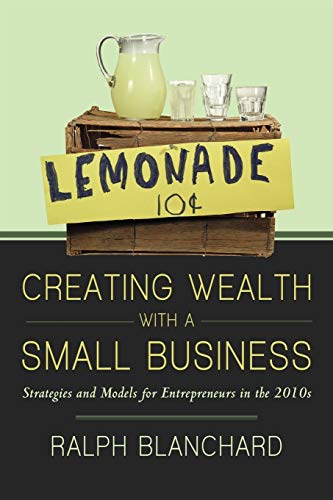
Creating Wealth With A Small Business: Strategies and Models for Entrepreneurs in the 2010S - Softcover
Inhaltsangabe
A 'must-read' book . . . filled with practical information and numerous case studies on what aspiring entrepreneurs and business owners need to know to run a profitable business . . . the author reminds the reader not to confuse the excitement and enthusiasm of starting a business and being a business owner with the skills required to be successful and avoid becoming one of the 80% of businesses that will eventually fail. A major contribution of this book is its continuous emphasis on the importance of having a business model as a critical requirement to start and manage a profitable business -Edgar Ortiz, CEO of Strategic Analytic Solutions and business columnist for the Atlanta Journal-Constitution Ralph Blanchard, a successful entrepreneur with a background in economics, provides a detailed analysis of what it is really like to buy, start, operate, and eventually sell a small business. Topics covered include: why most businesses fail ten management skills found in successful small business owners strategies to transition from self-employment to entrepreneurship advantages that small business owners have over larger competitors tips to develop profitable pricing strategies innovative ideas to help develop a sound business model
Die Inhaltsangabe kann sich auf eine andere Ausgabe dieses Titels beziehen.
Auszug. © Genehmigter Nachdruck. Alle Rechte vorbehalten.
Creating Wealth with a Small Business
Strategies and Models for Entrepreneurs in the 2010'sBy Ralph BlanchardiUniverse, Inc.
Copyright © 2011 Ralph BlanchardAll right reserved.
ISBN: 978-1-4620-2921-1
Contents
Foreword to the 2010's Edition..........................................................................................................xiChapter One: Why Some Small Businesses Succeed..........................................................................................1Chapter Two: Ten Management Skills Found in Successful Small Business Owners............................................................49Chapter Three: The Self-Employment Trap.................................................................................................110Chapter Four: Small is Beautiful........................................................................................................129Chapter Five: Small Business Models.....................................................................................................192Addendum to Chapter Five: - Small Business Models A Case Study of the Bostrom Company: A Small Business That Failed.....................261Chapter Six: Pricing Strategies for Products and Services...............................................................................323Chapter Seven: A Pricing Strategy for Selling Your Business.............................................................................418Chapter Eight: Small Business Opportunities after the Great Recession...................................................................456Appendix: Cash Flow and Accounting During the Start-Up Phase............................................................................500
Chapter One
Why Some Small Businesses Succeed
America leads the world in the creation of individual wealth. One reason for this is that America also leads the world in the formation of new businesses. Contrary to what we might expect, it appears that the number of new businesses being formed in the U.S. has not decreased during the recent economic slowdown. Business failure rates are extremely high, however, and so there is substantial personal risk involved in becoming an entrepreneur. What causes businesses to fail and what motivates entrepreneurs to take risks? What can entrepreneurs do to improve their chances of success in a weak economy? To answer these questions entrepreneurs need to begin by rethinking much of the conventional wisdom that has traditionally guided small business owners. In addition, it is also important for entrepreneurs to develop Core Values and General Principles as a basis for strategic planning and management decisions in a rapidly changing business environment. Chapter One explores these issues and also presents a case study of a small business that failed during the Great Recession that began in 2008. Did it fail because of the recession or were there other problems that led to the collapse? Understanding why businesses fail can help entrepreneurs understand why some small businesses succeed.
At the end of 2009, approximately 10 million individuals in the world had cash (liquid) assets of one million dollars or more. This was the most millionaires since 2007 and reflects the improving finances of HNWIs (High Net Worth Individuals) now that the Great Recession is officially over. Aggregate global GDP (Gross Domestic Product, a standard measurement of economic activity) actually contracted 2% in 2009, but HNWI financial assets grew 18.9% to $39 trillion. This represents about 35.5% of total global wealth. The U.S. had the largest number of HNWIs (2,860,000 or 28.6% of the global HNMI population). They had assets of about $10.7 trillion. Despite the slow recovery from the recession, the number of HNWIs in the U.S. increased by 406,000 in 2009. (By comparison, China, with a population six times greater than the U.S., had about 1.1 million millionaires at the end of 2010.) America has continued to generate great wealth even during the worst economic downturn since the 1930's.
How do HNWIs accumulate their wealth? Globally, approximately 14% are full-time investors with financial portfolios and real estate holdings, 16% receive inheritances, and 23% hold down a job, usually as a high-end executive or skilled professional. The rest, 47% of the total HNMI population, own private businesses. In the U.S. the percentage of business owners is even higher, approximately 66%. Add to that number those who inherit wealth or accumulate it from investments and you soon realize that only a small number of Americans become millionaires working for someone else. Most of them own businesses.
Who Wants to be a Millionaire?
Is it important to have $1M? Most Americans today probably think so although this has not always been the case. In the 1950's a popular TV drama called The Millionaire conveyed the message that having $1M was not necessarily a good thing. The show was fictional but bore a strong resemblance to present-day reality TV. Each week a philanthropist named John Beresford Tipton, Jr., selected individuals seemingly at random and gave them a cashier's check for $1M. There were no obligations and no strings attached. There weren't even any taxes due (Mr. Tipton paid them in advance). The lucky recipients were free to do as they pleased with the money. Not surprisingly, things often went badly as wealth proved to be a mixed blessing. The weekly lesson for Mr. Tipton (and the TV audience) was that coping with great wealth can change people. It undermines their sense of self-worth, destroys friendships, causes them to lose the respect of their peers and sometimes even costs them their lives. The Millionaire struck a responsive chord in American culture, airing for five years (1955-1960) and lasting two decades in syndicated re-runs.
Fast-forward to today and we would probably consider the sudden gift of $1M unbelievably good luck. One of the most popular TV game shows in recent years is Who Wants to be a Millionaire? It offers contestants a chance to win up to $1M by correctly answering a complex series of questions. Neither the audience nor the lucky winners have any misgivings about somebody becoming a millionaire. Moreover, Americans are not the only fans of wealth. "Millionaire fever" has gripped global audiences and Who Wants to be a Millionaire? has franchises in over 100 countries. In 2008 the movie Slumdog Millionaire was based on the fictional life of a contestant in the Indian version of Who Wants to be a Millionaire? As the contestant (a young boy from an unimaginably poor background) gets closer to winning the top prize, he is accused by the authorities of cheating simply because he is doing so well on the show. They cannot believe that someone of his lowly upbringing is answering the questions correctly and stands to win such a large sum of money. Of course the movie audience sides with the "slumdog," who they realize would never have the chance to lead a normal life (to say nothing of becoming a HNWI) unless he wins the top prize. The moral of the story is that everyone has it within himself to be a millionaire (even if the only way to become one is to win the top prize on a game show). Written by an Indian author and filmed in the slums of Mumbai, the movie was a huge hit globally and won eight Academy Awards in the U.S.
It is clear that attitudes toward wealth have changed since the 1950's. The cautionary tales of The Millionaire have given way to legions...
„Über diesen Titel“ kann sich auf eine andere Ausgabe dieses Titels beziehen.
Weitere beliebte Ausgaben desselben Titels

Suchergebnisse für Creating Wealth With A Small Business: Strategies and...

Beispielbild für diese ISBN
Creating Wealth With A Small Business: Strategies and Models for Entrepreneurs in the 2010S
Anbieter: Ria Christie Collections, Uxbridge, Vereinigtes Königreich
Verkäuferbewertung 5 von 5 Sternen

Zustand: New. In. Artikel-Nr. ria9781462029211_new
Neu kaufen
EUR 32,76
EUR 14,00 Versand
Versand von Vereinigtes Königreich nach USA
Versand von Vereinigtes Königreich nach USA
Anzahl: Mehr als 20 verfügbar