
Verwandte Artikel zu Real Options and Strategic Technology Venturing: A...
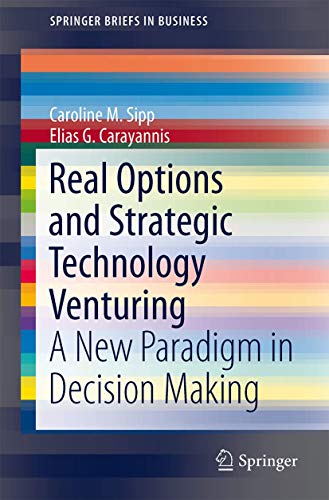
Real Options and Strategic Technology Venturing: A New Paradigm in Decision Making (SpringerBriefs in Business, Band 31) - Softcover
Inhaltsangabe
This book seeks to answer "why, when and how are real options used in strategic technology venturing" This work tests for the role of real options in decision making involving three types of firms in decreasing order of technology-dependence - technology-driven (TD) (where the profit is fully dependent on new technology creation and leveraging), technology-based (TB) (where the profit is enabled and supported by technology) and technology-neutral (TN) (where the profit is almost independent of technology). It also deals with strategic and non-strategic types of decisions driven by real options. This analysis shows that an environment presenting co-opetitive (simultaneous competition and collaboration) conditions triggers the use of real options (why), that serve to transform the position, posture and propensity of businesses to innovate and thus they co-evolve (when) into more effective and efficient forms of businesses (co-specialization) (how). The authors demonstrate that embracing risk and uncertainty can increase levels and probability of new venture formation. However, their simulation also shows that it should be adapted to the risk profile of the firm and that timing is also a factor to be considered. Although engaging the concepts of real options, this analysis does not focus on a specific investment valuation methodology, but highlights the relationship between knowledge and risk and rather addresses the management of mindsets, as moving towards a systematic conceptualization of real options represents a different paradigm in decision making.
Die Inhaltsangabe kann sich auf eine andere Ausgabe dieses Titels beziehen.
Von der hinteren Coverseite
This book seeks to answer “why, when and how are real options used in strategic technology venturing?” This work tests for the role of real options in decision making involving three types of firms in decreasing order of technology-dependence – technology-driven (TD) (where the profit is fully dependent on new technology creation and leveraging), technology-based (TB) (where the profit is enabled and supported by technology) and technology-neutral (TN) (where the profit is almost independent of technology). It also deals with strategic and non-strategic types of decisions driven by real options.
This analysis shows that an environment presenting co-opetitive (simultaneous competition and collaboration) conditions triggers the use of real options (why), that serve to transform the position, posture and propensity of businesses to innovate and thus they co-evolve (when) into more effective and efficient forms of businesses (co-specialization) (how). The authors demonstrate that embracing risk and uncertainty can increase levels and probability of new venture formation. However, their simulation also shows that it should be adapted to the risk profile of the firm and that timing is also a factor to be considered. Although engaging the concepts of real options, this analysis does not focus on a specific investment valuation methodology, but highlights the relationship between knowledge and risk and rather addresses the management of mindsets, as moving towards a systematic conceptualization of real options represents a different paradigm in decision making.
„Über diesen Titel“ kann sich auf eine andere Ausgabe dieses Titels beziehen.
Suchergebnisse für Real Options and Strategic Technology Venturing: A...

Beispielbild für diese ISBN
Real Options and Strategic Technology Venturing: A New Paradigm in Decision Making (SpringerBriefs in Business, 31)
Anbieter: Ria Christie Collections, Uxbridge, Vereinigtes Königreich
Verkäuferbewertung 5 von 5 Sternen

Zustand: New. In English. Artikel-Nr. ria9781461458135_new
Neu kaufen
EUR 66,14
EUR 11,07 Versand
Versand von Vereinigtes Königreich nach USA
Versand von Vereinigtes Königreich nach USA
Anzahl: Mehr als 20 verfügbar
Beispielbild für diese ISBN
Real Options and Strategic Technology Venturing: A New Paradigm in Decision Making
Anbieter: Revaluation Books, Exeter, Vereinigtes Königreich
Verkäuferbewertung 5 von 5 Sternen
Paperback. Zustand: Brand New. 2013 edition. 137 pages. 9.25x0.33x6.10 inches. In Stock. Artikel-Nr. x-1461458137
Neu kaufen
EUR 71,95
EUR 11,81 Versand
Versand von Vereinigtes Königreich nach USA
Versand von Vereinigtes Königreich nach USA
Anzahl: 2 verfügbar
Foto des Verkäufers
Real Options and Strategic Technology Venturing
Verlag:
Springer New York, 2012
ISBN 10: 1461458137
ISBN 13: 9781461458135
Neu
Kartoniert / Broschiert
Anbieter: moluna, Greven, Deutschland
Verkäuferbewertung 5 von 5 Sternen
Kartoniert / Broschiert. Zustand: New. Artikel-Nr. 4198867
Neu kaufen
EUR 48,33
EUR 48,99 Versand
Versand von Deutschland nach USA
Versand von Deutschland nach USA
Anzahl: Mehr als 20 verfügbar
Foto des Verkäufers
Real Options and Strategic Technology Venturing : A New Paradigm in Decision Making
Anbieter: AHA-BUCH GmbH, Einbeck, Deutschland
Verkäuferbewertung 5 von 5 Sternen
Taschenbuch. Zustand: Neu. Druck auf Anfrage Neuware - Printed after ordering - This book seeks to answer 'why, when and how are real options used in strategic technology venturing ' This work tests for the role of real options in decision making involving three types of firms in decreasing order of technology-dependence - technology-driven (TD) (where the profit is fully dependent on new technology creation and leveraging), technology-based (TB) (where the profit is enabled and supported by technology) and technology-neutral (TN) (where the profit is almost independent of technology). It also deals with strategic and non-strategic types of decisions driven by real options.This analysis shows that an environment presenting co-opetitive (simultaneous competition and collaboration) conditions triggers the use of real options (why), that serve to transform the position, posture and propensity of businesses to innovate and thus they co-evolve (when) into more effective and efficient forms of businesses (co-specialization) (how). The authors demonstrate that embracing risk and uncertainty can increase levels and probability of new venture formation. However, their simulation also shows that it should be adapted to the risk profile of the firm and that timing is also a factor to be considered. Although engaging the concepts of real options, this analysis does not focus on a specific investment valuation methodology, but highlights the relationship between knowledge and risk and rather addresses the management of mindsets, as moving towards a systematic conceptualization of real options represents a different paradigm in decision making. Artikel-Nr. 9781461458135
Neu kaufen
EUR 64,43
EUR 35,00 Versand
Versand von Deutschland nach USA
Versand von Deutschland nach USA
Anzahl: 1 verfügbar