
Verwandte Artikel zu Multidimensional Processing of Video Signals (The Springer...
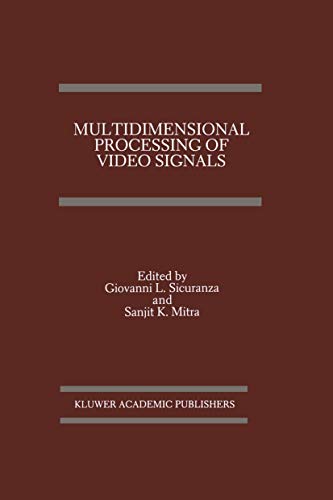
Multidimensional Processing of Video Signals (The Springer International Series in Engineering and Computer Science, Band 171) - Softcover
Inhaltsangabe
A color time-varying image can be described as a three-dimensional vector (representing the colors in an appropriate color space) defined on a three-dimensional spatiotemporal space. In conventional analog television a one-dimensional signal suitable for transmission over a communication channel is obtained by sampling the scene in the vertical and tem poral directions and by frequency-multiplexing the luminance and chrominance informa tion. In digital processing and transmission systems, sampling is applied in the horizontal direction, too, on a signal which has been already scanned in the vertical and temporal directions or directly in three dimensions when using some solid-state sensor. As a conse quence, in recent years it has been considered quite natural to assess the potential advan tages arising from an entire multidimensional approach to the processing of video signals. As a simple but significant example, a composite color video signal, such as the conven tional PAL or NTSC signal, possesses a three-dimensional spectrum which, by using suitable three-dimensional filters, permits horizontal sampling at a rate which is less than that re quired for correctly sampling the equivalent one-dimensional signal. More recently it has been widely recognized that the improvement of the picture quality in current and advanced television systems requires well-chosen signal processing algorithms which are multidimen sional in nature within the demanding constraints of a real-time implementation.
Die Inhaltsangabe kann sich auf eine andere Ausgabe dieses Titels beziehen.
Suchergebnisse für Multidimensional Processing of Video Signals (The Springer...

Beispielbild für diese ISBN
Multidimensional Processing of Video Signals (The Springer International Series in Engineering and Computer Science, 171)
Anbieter: Ria Christie Collections, Uxbridge, Vereinigtes Königreich
Verkäuferbewertung 5 von 5 Sternen

Zustand: New. In English. Artikel-Nr. ria9781461366072_new
Neu kaufen
EUR 181,81
EUR 10,89 Versand
Versand von Vereinigtes Königreich nach USA
Versand von Vereinigtes Königreich nach USA
Anzahl: Mehr als 20 verfügbar
Foto des Verkäufers
Multidimensional Processing of Video Signals
Anbieter: moluna, Greven, Deutschland
Verkäuferbewertung 5 von 5 Sternen
Zustand: New. A color time-varying image can be described as a three-dimensional vector (representing the colors in an appropriate color space) defined on a three-dimensional spatiotemporal space. In conventional analog television a one-dimensional signal suitable for tr. Artikel-Nr. 4194778
Neu kaufen
EUR 178,14
EUR 48,99 Versand
Versand von Deutschland nach USA
Versand von Deutschland nach USA
Anzahl: Mehr als 20 verfügbar
Beispielbild für diese ISBN
Multidimensional Processing of Video Signals (The Springer International Series in Engineering and Computer Science)
Anbieter: Revaluation Books, Exeter, Vereinigtes Königreich
Verkäuferbewertung 5 von 5 Sternen
Paperback. Zustand: Brand New. 189 pages. 9.45x6.30x0.45 inches. In Stock. Artikel-Nr. x-1461366070
Neu kaufen
EUR 235,76
EUR 11,63 Versand
Versand von Vereinigtes Königreich nach USA
Versand von Vereinigtes Königreich nach USA
Anzahl: 2 verfügbar
Foto des Verkäufers
Multidimensional Processing of Video Signals
Anbieter: AHA-BUCH GmbH, Einbeck, Deutschland
Verkäuferbewertung 5 von 5 Sternen
Taschenbuch. Zustand: Neu. Neuware - A color time-varying image can be described as a three-dimensional vector (representing the colors in an appropriate color space) defined on a three-dimensional spatiotemporal space. In conventional analog television a one-dimensional signal suitable for transmission over a communication channel is obtained by sampling the scene in the vertical and tem poral directions and by frequency-multiplexing the luminance and chrominance informa tion. In digital processing and transmission systems, sampling is applied in the horizontal direction, too, on a signal which has been already scanned in the vertical and temporal directions or directly in three dimensions when using some solid-state sensor. As a conse quence, in recent years it has been considered quite natural to assess the potential advan tages arising from an entire multidimensional approach to the processing of video signals. As a simple but significant example, a composite color video signal, such as the conven tional PAL or NTSC signal, possesses a three-dimensional spectrum which, by using suitable three-dimensional filters, permits horizontal sampling at a rate which is less than that re quired for correctly sampling the equivalent one-dimensional signal. More recently it has been widely recognized that the improvement of the picture quality in current and advanced television systems requires well-chosen signal processing algorithms which are multidimen sional in nature within the demanding constraints of a real-time implementation. Artikel-Nr. 9781461366072
Neu kaufen
EUR 247,94
EUR 35,00 Versand
Versand von Deutschland nach USA
Versand von Deutschland nach USA
Anzahl: 2 verfügbar