
Verwandte Artikel zu Stranded: Alaska's Worst Maritime Disaster Nearly...
Inhaltsangabe
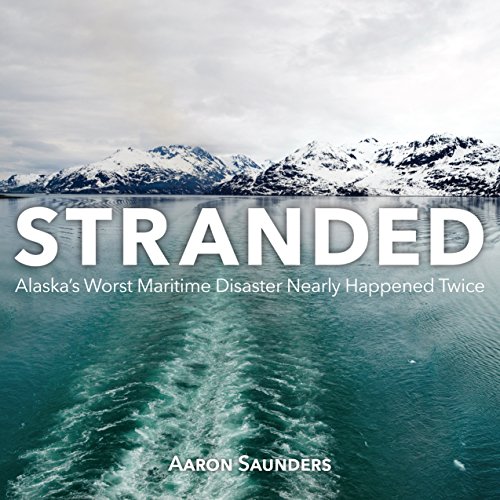
The sinking of the Canadian Pacific steamship Princess Sophia was Alaska’s worst maritime disaster — until it nearly happened again.
In 1918, the Canadian Pacific steamship Princess Sophia left Skagway, Alaska, on her last trip of the season to Vancouver. She never made it. Battered by a raging snowstorm and sent dangerously off course, she ran aground on Vanderbilt Reef, a rocky shoal in Lynn Canal, North America’s deepest and longest fjord. She would spend two days high and dry on the reef, with rescue ships standing by, unable to help, before she finally slid to her watery grave.
Seventy-six years later, another ship — the modern Star Princess — finds herself off course in Lynn Canal, and history nearly repeats itself. Weaving together events past and present, Aaron Saunders tells the story of two very different ships that set sail from Skagway at opposite ends of the century. Their common bond — the unassuming and often treacherous stretch of water known as Lynn Canal.
Die Inhaltsangabe kann sich auf eine andere Ausgabe dieses Titels beziehen.
Über die Autorin bzw. den Autor
Aaron Saunders writes about cruises and maritime history for The Province, Canadian Traveller, Cruise & Travel Lifestyles, Shippax CFI, and many others. He is the founder of the website From the Deck Chair. When not at sea, he calls Vancouver home.
Auszug. © Genehmigter Nachdruck. Alle Rechte vorbehalten.
IntroductionO, I have suffered with those that I saw suffer! A brave vessel (Who had no doubt some noble creature in her) Dashed all to pieces! O, the cry did knock against my very heart! Poor souls, they perished!— William Shakespeare, The TempestIn the course of writing this book, it occurred to me that I can’t really remember the first time I learned of the wreck of the Princess Sophia. I do, however, remember where I was when I thought it would be a good idea to write a book juxtaposing her accident with the 1995 grounding of the cruise vessel Star Princess: in a little pub in Juneau known as the Triangle Club Bar, where I sat, nursing a pint of Alaskan Amber Ale while in port on a cruise through Alaska. I’d come into the bar because I’d heard there was free Wi-Fi internet access with purchase — and there was. But instead of checking emails and filing articles, I found myself staring at a wall covered in photos of famous Alaskan shipwrecks, one of which was the unmistakable silhouette of the Princess Sophia, stranded up on Vanderbilt Reef. The first step in what would become a multi-year journey occurred when I literally walked across the street to Hearthside Books and purchased a copy of Ken Coates and Bill Morrison’s masterwork, The Sinking of the Princess Sophia. In Alaska, everything you need seems to be close at hand. I read the book as we made our way up to Skagway, and when I disembarked I stood in the middle of Broadway Street and tried to imagine the scene that would have greeted travellers in October 1918. I found it both easy and difficult; easy because of the cruise ship passengers like myself who swarmed the dock apron and clogged the streets. Difficult because Skagway today is a bit of a parody of itself; there’s re-enactments of shootouts and fake brothels designed to entertain families. Have you ever heard a father trying to explain to his son what a brothel is? You will, if you visit Skagway in the summer.The real tragedy, however, is not that it’s difficult to visualize the world of 1918, but that the story of the Princess Sophia has been largely forgotten. Even the grounding of the Star Princess, which occurred in modern times, wasn’t given the media-circus frenzy that has accompanied similar accidents in recent memory. It wasn’t until I was one of the hundreds of people queuing up to get back on my massive floating palace in Skagway that it hit me: absolutely no one who comes to Skagway by ship knows the sad, storied events that have played out right in the very waters on which they sail.Now, you could argue cruise lines don’t really want to talk about shipwrecks — it’s a bit like showing Alive on an airplane. That’s fair. But the more I read about both accidents, the more utterly fascinated I became by the parallels between them. The Princess Sophia is the Titanic of the west coast; yet her journey into obscurity was greatly accelerated by the end of the Great War; the war that, people hoped, would be the War to End All Wars. Our knowledge of what happened onboard during those two grim days Princess Sophia spent stranded on Vanderbilt Reef comes from the passengers aboard her, and from those who had the most fleeting encounters with her crew. These included her would-be rescuers who kept their ships nearby in absolutely atrocious weather, sometimes at great risk to their own vessels and personal safety. Passengers wrote letters, some of which were discovered when the ship foundered. Wireless conversations, recorded in Juneau and preserved for all time, also provide brief glimpses into what life was like onboard. Many books about the Princess Sophia focus on the trial and the aftermath of the sinking. We don’t know every detail of what happened onboard, but there’s enough witness testimony to put together a substantial part of the puzzle. From there it’s possible to fill in the blanks to surmise what exactly happened onboard during those two awful days stranded upon Vanderbilt Reef. On the second evening she slipped silently and suddenly into the churning ocean that had been trying to claim her, hidden by a raging snowstorm that only seemed to intensify during her greatest hour of need. She took 343 passengers and crew down with her that night.At least, we think she did. The official court documents and accident proceedings — which wouldn’t be finalized until over a decade after the accident occurred and are contested to this day — continuously pegged the number of souls onboard at 343, despite the passenger and crew lists being fraught with errors. Additional crewmembers were brought onboard in Skagway to cover for crew who had fallen ill with influenza. They are not recorded on the official list. Many of the Chinese crewmembers who worked aboard the Princess Sophia on her final voyage were posthumously (and, today, insensitively) lumped into a single category: “12 Chinamen in steward’s department.” Either way it’s likely there were at least 350 souls onboard that final voyage — and that the exact final number will never be known.If the lists of souls onboard could best be described as inaccurate, deciphering a timeline of events in the sinking of the Princess Sophia is almost an exercise in pure torture. Alaskan Standard Time is one hour behind Pacific Standard Time that Victoria and Vancouver use. To complicate matters, despite the fact that she spent the majority of her time in Alaskan waters, Princess Sophia’s clocks were continually set one hour ahead, on Pacific Standard Time.1 To help keep things organized, I’ve standardized all times to Alaskan Standard and not Pacific Standard. In most cases, times given are based on either eyewitness accounts, inquiry testimony, or wireless message records. In a few instances, they’re close approximations that I’ve come to by averaging out the different sources of information. In retelling the events that took place both onboard and ashore, I’ve tried to keep things in chronological order. Establishing this order was, once again, a bit of a jigsaw thanks to differences in time and conflicting witness testimony. The Star Princess proved to be a much easier beast to research — though even then, with a full accident report issued in 1997 by the National Transportation Safety Board, questions still remain, and answers are elusive. Twenty years have passed since that incident occurred, and many of the key players have either retired or passed on during that time. Besides the books and the accident reports and the hundreds upon hundreds of pages of testimony and legal wrangling that went on in courts on both sides of the border for both incidents, seeing really is believing. I’d taken six separate voyages to Alaska in the past decade, but it was only on my seventh voyage that I managed to finally glimpse Vanderbilt Reef. When the ship I was travelling on passed it in the early hours of the morning the sky was still dark. The reef now has a small tower with a beacon on it. According to the Juneau Empire, it’s apparently a great place to catch halibut.2In all honesty, I have a hard time picturing the Princess Sophia sitting on that impossibly small outcrop of rocks. We sailed straight past it, safely, just like every modern cruise ship that travels between Juneau and Skagway during the busy summer Alaska cruise season. I watched from my balcony on the ship as the reef disappeared from view. It was like seeing a ghost. Somewhere, beneath that murky black sea, her remains still lie. What isn’t difficult to picture is the storm. The weather in Alaska changes in a heartbeat, and the winds that whip down Lynn Canal can be ferocious. I’ve seen many a cruise passenger lose their hat upon departure from Skagway. Even a sunny July departure can drive people back into the warmth of the...
„Über diesen Titel“ kann sich auf eine andere Ausgabe dieses Titels beziehen.
Suchergebnisse für Stranded: Alaska's Worst Maritime Disaster Nearly...

Beispielbild für diese ISBN
Stranded : Alaska's Worst Maritime Disaster Nearly Happened Twice
Anbieter: Better World Books: West, Reno, NV, USA
Verkäuferbewertung 5 von 5 Sternen

Zustand: Very Good. Pages intact with possible writing/highlighting. Binding strong with minor wear. Dust jackets/supplements may not be included. Stock photo provided. Product includes identifying sticker. Better World Books: Buy Books. Do Good. Artikel-Nr. 53962545-75
Gebraucht kaufen
EUR 12,18
Versand gratis
Versand innerhalb von USA
Versand innerhalb von USA
Anzahl: 1 verfügbar
Beispielbild für diese ISBN
Stranded: Alaska's Worst Maritime Disaster Nearly Happened Twice
Anbieter: ThriftBooks-Atlanta, AUSTELL, GA, USA
Verkäuferbewertung 5 von 5 Sternen
Paperback. Zustand: Good. No Jacket. Former library book; Pages can have notes/highlighting. Spine may show signs of wear. ~ ThriftBooks: Read More, Spend Less. Artikel-Nr. G1459731549I3N10
Gebraucht kaufen
EUR 12,34
Versand gratis
Versand innerhalb von USA
Versand innerhalb von USA
Anzahl: 1 verfügbar
Beispielbild für diese ISBN
Stranded: Alaska's Worst Maritime Disaster Nearly Happened Twice
Anbieter: Revaluation Books, Exeter, Vereinigtes Königreich
Verkäuferbewertung 5 von 5 Sternen
Paperback. Zustand: Brand New. 176 pages. 8.50x8.50x1.00 inches. In Stock. Artikel-Nr. x-1459731549
Neu kaufen
EUR 22,64
EUR 11,66 Versand
Versand von Vereinigtes Königreich nach USA
Versand von Vereinigtes Königreich nach USA
Anzahl: 2 verfügbar
Foto des Verkäufers
Stranded : Alaska's Worst Maritime Disaster Nearly Happened Twice
Anbieter: AHA-BUCH GmbH, Einbeck, Deutschland
Verkäuferbewertung 5 von 5 Sternen
Taschenbuch. Zustand: Neu. Neuware - The sinking of the Canadian Pacific steamship Princess Sophia was Alaska's worst maritime disaster - until it nearly happened again.In 1918, the Canadian Pacific steamship Princess Sophia left Skagway, Alaska, on her last trip of the season to Vancouver. She never made it. Battered by a raging snowstorm and sent dangerously off course, she ran aground on Vanderbilt Reef, a rocky shoal in Lynn Canal, North America's deepest and longest fjord. She would spend two days high and dry on the reef, with rescue ships standing by, unable to help, before she finally slid to her watery grave.Seventy-six years later, another ship - the modern Star Princess - finds herself off course in Lynn Canal, and history nearly repeats itself. Weaving together events past and present, Aaron Saunders tells the story of two very different ships that set sail from Skagway at opposite ends of the century. Their common bond - the unassuming and often treacherous stretch of water known as Lynn Canal. Artikel-Nr. 9781459731547
Neu kaufen
EUR 35,53
EUR 30,50 Versand
Versand von Deutschland nach USA
Versand von Deutschland nach USA
Anzahl: 2 verfügbar
Foto des Verkäufers
STRANDED
Anbieter: moluna, Greven, Deutschland
Verkäuferbewertung 5 von 5 Sternen
Zustand: New. Über den AutorrnrnAaron Saunders writes about cruises and maritime history for The Province, Canadian Traveller, Cruise & Travel Lifestyles, Shippax CFI, and many others. He is the founder of the website From the. Artikel-Nr. 902901448
Neu kaufen
EUR 20,55
EUR 48,99 Versand
Versand von Deutschland nach USA
Versand von Deutschland nach USA
Anzahl: Mehr als 20 verfügbar