
Verwandte Artikel zu On the Brink: Inside the Race to Stop the Collapse...
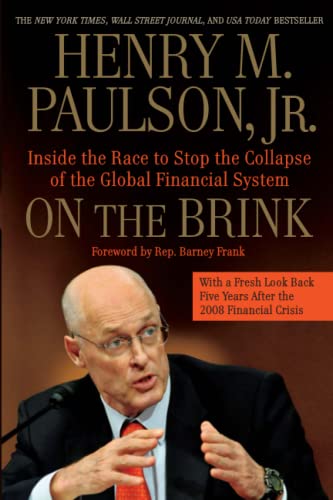
On the Brink: Inside the Race to Stop the Collapse of the Global Financial System -- With Original New Material on the Five Year Anniversary of the Financial Crisis - Softcover
Inhaltsangabe
Former Secretary of the Treasury Hank Paulson -- who was at the very epicenter of the crashing financial markets -- provides a startling, first- person account of what really happened during this time of global financial crisis - and this revised edition features fresh and original material from Paulson on the five-year-anniversary of the 2008 financial crisis.
From the man who was in the very middle of this perfect economic storm, Paulson puts the reader in the room for all the intense moments as he addressed urgent market conditions, weighed critical decisions, and debated policy and economic considerations with of all the notable players-including the CEOs of top Wall Street firms as well as Ben Bernanke, Timothy Geithner, Sheila Bair, Nancy Pelosi, Barney Frank, presidential candidates Barack Obama and John McCain, and then-President George W. Bush.
More than an account about numbers and credit risks gone bad, On the Brink is an extraordinary story about people and politics-all brought together during the world's impending financial Armageddon.
Die Inhaltsangabe kann sich auf eine andere Ausgabe dieses Titels beziehen.
Über die Autorin bzw. den Autor
As the CEO of Goldman Sachs from 1999-2006 and then as the Treasury Secretary of the United States from 2006-2009, Hank Paulson has sat across the bargaining table from countless Chinese politicians as both a banker and a statesman. Since leaving Washington, the former Treasury Secretary has worked on bridging the gap between East and West through The Paulson Institute, which he describes not as a think tank but as a "think and do" tank.
Auszug. © Genehmigter Nachdruck. Alle Rechte vorbehalten.
On the Brink
Inside the Race to Stop the Collapse of the Global Financial System -- With Original New Material on the Five Year Anniversary of the Financial Crisis
By Henry M. PaulsonGrand Central Publishing
Copyright © 2013 Henry M. Paulson
All rights reserved.
ISBN: 978-1-4555-5190-3All rights reserved.
CHAPTER 1
Thursday, September 4, 2008
Do they know it's coming, Hank?" President Bush asked me.
"Mr. President," I said, "we're going to move quickly and take them by surprise.The first sound they'll hear is their heads hitting the floor."
It was Thursday morning, September 4, 2008, and we were in the Oval Office ofthe White House discussing the fate of Fannie Mae and Freddie Mac, the troubledhousing finance giants. For the good of the country, I had proposed that weseize control of the companies, fire their bosses, and prepare to provide up to$100 billion of capital support for each. If we did not act immediately, Fannieand Freddie would, I feared, take down the financial system, and the globaleconomy, with them.
I'm a straightforward person. I like to be direct with people. But I knew thatwe had to ambush Fannie and Freddie. We could give them no room to maneuver. Wecouldn't very well go to Daniel Mudd at Fannie Mae or Richard Syron at FreddieMac and say: "Here's our idea for how to save you. Why don't we just take youover and throw you out of your jobs, and do it in a way that protects thetaxpayer to the disadvantage of your shareholders?" The news would leak, andthey'd fight. They'd go to their many powerful friends on Capitol Hill or to thecourts, and the resulting delays would cause panic in the markets. We'd triggerthe very disaster we were trying to avoid.
I had come alone to the White House from an 8:00 a.m. meeting at Treasury withBen Bernanke, the chairman of the Federal Reserve Board, who shared my concerns,and Jim Lockhart, head of the Federal Housing Finance Agency (FHFA), the mainregulator for Fannie and Freddie. Many of our staffers had been up allnight—we had all been putting in 18-hour days during the summer andthrough the preceding Labor Day holiday weekend—to hammer out the languageand documents that would allow us to make the move. We weren't quite there yet,but it was time to get the president's official approval. We wanted to placeFannie and Freddie into conservatorship over the weekend and make sure thateverything was wrapped up before the Asian markets opened Sunday night.
The mood was somber as I laid out our plans to the president and his topadvisers, who included White House chief of staff Josh Bolten; deputy chief ofstaff Joel Kaplan; Ed Lazear, chairman of the Council of Economic Advisers;Keith Hennessey, director of the National Economic Council (NEC); and JimNussle, director of the Office of Management and Budget. The night before,Alaska governor Sarah Palin had electrified the Republican National Conventionin St. Paul, Minnesota, with her speech accepting the nomination as the party'svice presidential candidate, but there was no mention of that in the OvalOffice. St. Paul might as well have been on another planet.
The president and his advisers were well informed of the seriousness of thesituation. Less than two weeks before, I had gotten on a secure videoconferenceline in the West Wing to brief the president at his ranch in Crawford, Texas,and explained my thinking. Like him, I am a firm believer in free markets, and Icertainly hadn't come to Washington planning to do anything to inject thegovernment into the private sector. But Fannie and Freddie were congressionallychartered companies that already relied heavily on implicit government support,and in August, along with Bernanke, I'd come to the conclusion that taking themover was the best way to avert a meltdown, keep mortgage financing available,stabilize markets, and protect the taxpayer. The president had agreed.
It is hard to exaggerate how central Fannie and Freddie were to U.S. markets.Between them they owned or guaranteed more than $5 trillion in residentialmortgages and mortgage-backed securities—about half of all those in thecountry. To finance operations, they were among the biggest issuers of debt inthe world: a total of about $1.7 trillion for the pair. They were in the marketsconstantly, borrowing more than $20 billion a week at times.
But investors were losing faith in them—for good reason. Combined, theyalready had $5.5 billion in net losses for the year to date. Their common shareprices had plunged—to $7.32 for Fannie the day before from $66 one yearearlier. The previous month, Standard & Poor's, the rating agency, had twicedowngraded the preferred stock of both companies. Investors were shying awayfrom their auctions, raising the cost of their borrowings and making existingdebt holders increasingly nervous. By the end of August, neither could raiseequity capital from private investors or in the public markets.
Moreover, the financial system was increasingly shaky. Commercial and investmentbank stocks were under pressure, and we were nervously monitoring the health ofseveral ailing institutions, including Wachovia Corporation, Washington Mutual,and Lehman Brothers. We had seen what happened in March when Bear Stearns'scounterparties—the other banks and investment houses that lent it money orbought its securities—abruptly turned away. We had survived that, but thecollapse of Fannie and Freddie would be catastrophic. Seemingly everyone in theworld—little banks, big banks, foreign central banks, money marketfunds—owned their paper or was a counterparty. Investors would lose tensof billions; foreigners would lose confidence in the U.S. It might cause a runon the dollar.
The president, in suit coat and tie as always, was all business, engaged andfocused on our tactics. He leaned forward in his blue-and-yellow-stripedarmchair. I sat in the armchair to his right; the others were crowded on facingsofas.
I told the president we planned to summon the top management of Fannie andFreddie to meet with Bernanke, Lockhart, and me the following afternoon. We'dlay out our decision and then present it to their boards on Saturday: we wouldput $100 billion of capital behind each, with hundreds of billions of dollarsmore available beyond that, and assure both companies of ample credit lines fromthe government. Obviously we preferred that they voluntarily acquiesce. But ifthey did not, we would seize them.
I explained that we had teams of lawyers, bank examiners, computer specialists,and others on standby, ready to roll into the companies' offices and securetheir premises, trading floors, books and records, and so forth. We had alreadypicked replacement chief executives. David Moffett, a former chief financialofficer from U.S. Bancorp, one of the few nearly pristine big banks in thecountry, was on board for Freddie Mac. For Fannie Mae we'd selected former TIAA-CREF chief executive and chairman Herb Allison. (He was vacationing in theCaribbean, and when I reached him later and twisted his arm to come toWashington the next day, he'd initially protested: "Hank, I'm in my flip-flops.I don't even have a suit down here." But he'd agreed to come.)
White House staff had been shocked when we first suggested conservatorship forFannie and Freddie, which had the reputation of being the toughest streetfighters in Washington. But they liked the boldness of the idea, as did thepresident. He had a deep disdain for entities like Fannie and Freddie, which hesaw as part of a permanent Washington elite, detached from the heartland, withformer government officials and lobbyists cycling through their ranks...
„Über diesen Titel“ kann sich auf eine andere Ausgabe dieses Titels beziehen.
Suchergebnisse für On the Brink: Inside the Race to Stop the Collapse...

Beispielbild für diese ISBN
On the Brink: Inside the Race to Stop the Collapse of the Global Financial System -- With Original New Material on the Five Year Anniversary of the Financial Crisis
Anbieter: World of Books (was SecondSale), Montgomery, IL, USA
Verkäuferbewertung 5 von 5 Sternen

Zustand: Very Good. Item in very good condition! Textbooks may not include supplemental items i.e. CDs, access codes etc. Artikel-Nr. 00107068866
Gebraucht kaufen
EUR 5,26
Versand gratis
Versand innerhalb von USA
Versand innerhalb von USA
Anzahl: 1 verfügbar
Beispielbild für diese ISBN
On the Brink: Inside the Race to Stop the Collapse of the Global Financial System -- With Original New Material on the Five Year Anniversary of the Financial Crisis
Anbieter: World of Books (was SecondSale), Montgomery, IL, USA
Verkäuferbewertung 5 von 5 Sternen
Zustand: Acceptable. Item in acceptable condition! Textbooks may not include supplemental items i.e. CDs, access codes etc. Artikel-Nr. 00106352095
Gebraucht kaufen
EUR 5,26
Versand gratis
Versand innerhalb von USA
Versand innerhalb von USA
Anzahl: 1 verfügbar
Beispielbild für diese ISBN
On the Brink: Inside the Race to Stop the Collapse of the Global Financial System -- With Original New Material on the Five Year Anniversary of the Financial Crisis
Anbieter: World of Books (was SecondSale), Montgomery, IL, USA
Verkäuferbewertung 5 von 5 Sternen
Zustand: Good. Item in good condition. Textbooks may not include supplemental items i.e. CDs, access codes etc. Artikel-Nr. 00104630615
Gebraucht kaufen
EUR 5,26
Versand gratis
Versand innerhalb von USA
Versand innerhalb von USA
Anzahl: 2 verfügbar
Beispielbild für diese ISBN
On the Brink: Inside the Race to Stop the Collapse of the Global Financial System -- With Original New Material on the Five Year Anniversary of the Financial Crisis
Verlag:
Business Plus (edition Reprint,Updated), 2013
ISBN 10: 1455551902
ISBN 13: 9781455551903
Gebraucht
Paperback
Anbieter: BooksRun, Philadelphia, PA, USA
Verkäuferbewertung 5 von 5 Sternen
Paperback. Zustand: Very Good. Reprint,Updated. It's a well-cared-for item that has seen limited use. The item may show minor signs of wear. All the text is legible, with all pages included. It may have slight markings and/or highlighting. Artikel-Nr. 1455551902-11-1
Gebraucht kaufen
EUR 5,76
Versand gratis
Versand innerhalb von USA
Versand innerhalb von USA
Anzahl: 1 verfügbar
Beispielbild für diese ISBN
On the Brink: Inside the Race to Stop the Collapse of the Global Financial System
Anbieter: ThriftBooks-Atlanta, AUSTELL, GA, USA
Verkäuferbewertung 5 von 5 Sternen
Paperback. Zustand: Very Good. No Jacket. May have limited writing in cover pages. Pages are unmarked. ~ ThriftBooks: Read More, Spend Less. Artikel-Nr. G1455551902I4N00
Gebraucht kaufen
EUR 5,99
Versand gratis
Versand innerhalb von USA
Versand innerhalb von USA
Anzahl: 1 verfügbar
Beispielbild für diese ISBN
On the Brink: Inside the Race to Stop the Collapse of the Global Financial System
Anbieter: ThriftBooks-Dallas, Dallas, TX, USA
Verkäuferbewertung 5 von 5 Sternen
Paperback. Zustand: Very Good. No Jacket. May have limited writing in cover pages. Pages are unmarked. ~ ThriftBooks: Read More, Spend Less. Artikel-Nr. G1455551902I4N00
Gebraucht kaufen
EUR 5,99
Versand gratis
Versand innerhalb von USA
Versand innerhalb von USA
Anzahl: 1 verfügbar
Beispielbild für diese ISBN
On the Brink: Inside the Race to Stop the Collapse of the Global Financial System
Anbieter: ThriftBooks-Phoenix, Phoenix, AZ, USA
Verkäuferbewertung 5 von 5 Sternen
Paperback. Zustand: Good. No Jacket. Pages can have notes/highlighting. Spine may show signs of wear. ~ ThriftBooks: Read More, Spend Less. Artikel-Nr. G1455551902I3N00
Gebraucht kaufen
EUR 5,99
Versand gratis
Versand innerhalb von USA
Versand innerhalb von USA
Anzahl: 1 verfügbar
Beispielbild für diese ISBN
On the Brink: Inside the Race to Stop the Collapse of the Global Financial System
Anbieter: ThriftBooks-Reno, Reno, NV, USA
Verkäuferbewertung 5 von 5 Sternen
Paperback. Zustand: Good. No Jacket. Pages can have notes/highlighting. Spine may show signs of wear. ~ ThriftBooks: Read More, Spend Less. Artikel-Nr. G1455551902I3N00
Gebraucht kaufen
EUR 5,99
Versand gratis
Versand innerhalb von USA
Versand innerhalb von USA
Anzahl: 1 verfügbar
Beispielbild für diese ISBN
On the Brink: Inside the Race to Stop the Collapse of the Global Financial System
Anbieter: ThriftBooks-Atlanta, AUSTELL, GA, USA
Verkäuferbewertung 5 von 5 Sternen
Paperback. Zustand: Good. No Jacket. Pages can have notes/highlighting. Spine may show signs of wear. ~ ThriftBooks: Read More, Spend Less. Artikel-Nr. G1455551902I3N00
Gebraucht kaufen
EUR 5,99
Versand gratis
Versand innerhalb von USA
Versand innerhalb von USA
Anzahl: 1 verfügbar
Beispielbild für diese ISBN
On the Brink: Inside the Race to Stop the Collapse of the Global Financial System
Anbieter: ThriftBooks-Dallas, Dallas, TX, USA
Verkäuferbewertung 5 von 5 Sternen
Paperback. Zustand: Good. No Jacket. Pages can have notes/highlighting. Spine may show signs of wear. ~ ThriftBooks: Read More, Spend Less. Artikel-Nr. G1455551902I3N00
Gebraucht kaufen
EUR 5,99
Versand gratis
Versand innerhalb von USA
Versand innerhalb von USA
Anzahl: 1 verfügbar