
Verwandte Artikel zu Empowerment Evaluation: Knowledge and Tools for Self-Assessm...
Empowerment Evaluation: Knowledge and Tools for Self-Assessment, Evaluation Capacity Building, and Accountability - Softcover
Inhaltsangabe
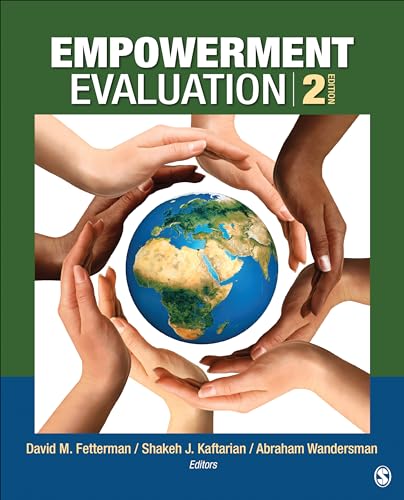
This Second Edition celebrates 21 years of the practice of empowerment evaluation, a term first coined by David Fetterman during his presidential address for the American Evaluation Association. Since that time, this approach has altered the landscape of evaluation and has spread to a wide range of settings in more than 16 countries. In this Second Edition of Empowerment Evaluation: Knowledge and Tools for Self-Assessment, Evaluation Capacity Building, and Accountability, an outstanding group of evaluators from academia, government, nonprofits, and foundations assess how empowerment evaluation has been used in practice since the publication of the landmark 1996 edition. The book includes 10 empowerment evaluation principles, a number of models and tools to help put empowerment evaluation into practice, reflections on the history and future of the approach, and illustrative case studies from a number of different projects in a variety of diverse settings. The Second Edition offers readers the most current insights into the practice of this stakeholder-involvement approach to evaluation.
“One of the greatest evaluation innovations of the past two decades has been the development of a professional and systematic approach to self-evaluation called empowerment evaluation. This book offers you the latest, cutting-edge understanding of this powerful innovation and evaluation approach. May you be inspired and empowered as you adventure through the chapters in this outstanding volume!” —Stewart I. Donaldson, President-elect, American Evaluation Association, Claremont Graduate University
“This twenty year follow-up to the original provides even better and richer stories about the versatility and utility of empowerment work in most social contexts. It expands our understanding of how empowerment evaluation is foundational to any effort to improve and measure growth in any community/social environment.” —Robert Schumer, University of Minnesota
“This text brings empowerment evaluation to life, and in doing so it offers all evaluators a large body of relevant concepts and tools for designing, implementing, and assessing evaluation efforts that engage, democratize, and strengthen stakeholder’s self-determination.” —Gary J. Skolits, The University of Tennessee, Knoxville
Die Inhaltsangabe kann sich auf eine andere Ausgabe dieses Titels beziehen.
Über die Autorinnen und Autoren
David M. Fetterman is the President and CEO of Fetterman & Associates, an international ethnographic and evaluation consultation firm. He works in a wide range of settings, ranging from townships in South Africa to Google in Silicon Valley. Clients and sponsors include: the U.S. Department of Education, W. K. Kellogg Foundation, Hewlett Foundation, Hewlett Packard Philanthropy, John S. and James L. Knight Foundation, and Arkansas Department of Education. David has also provided consultation services for the: Ministry of Education in Japan, Ministry of Health in Brazil, Ministry of Health in Ethiopia, and Te Puni Kokiri (Ministry of Māori Development) in New Zealand.
He concurrently serves as a member of the faculty at Pacifica Graduate Institute and the University of Charleston. Dr. Fetterman has over 25 years of experience at Stanford University. He was a Consulting Professor of Education in the School of Education and the Director of Evaluation in the School of Medicine at Stanford University. Formerly, he served as a Professor and Research Director at the California Institute of Integral Studies, Principal Research Scientist at the American Institutes for Research, and a Senior Associate and Project Director at RMC Research Corporation. He received his PhD from Stanford University in educational and medical anthropology.
David is a past-president of the American Anthropological Association's Council on Anthropology and Education and the American Evaluation Association. He is a Fellow of the American Anthropological Association and the Society for Applied Anthropology. David received the Top Anthropologist of the Year 2019 Award; George and Louise Spindler Award, for outstanding contributions to educational anthropology; and the Ethnographic Evaluation Award. He also received the Paul Lazarsfeld Award for Outstanding Contributions to Evaluation Theory and the Myrdal Award for Cumulative Contributions to Evaluation Practice--the American Evaluation Association's highest honors.
Fetterman has contributed to a variety of encyclopedias and is the author of Ethnography: Step by Step; Excellence and Equality: A Qualitatively Different Perspective on Gifted and Talented Education; and Empowerment Evaluation in the Digital Villages: Hewlett-Packard's $15 Million Race Toward Social Justice. Dr. Fetterman is the editor of: Ethnography in Educational Evaluation; Educational Evaluation: Ethnography in Theory, Practice, and Politics; Speaking the Language of Power: Communication, Collaboration, and Advocacy (translating ethnography into action); Qualitative Approaches to Evaluation in Education: The Silent Scientific Revolution; Empowerment Evaluation: Knowledge and Tools for Self-assessment, Evaluation Capacity Building, and Accountability; Empowerment Evaluation Principles in Practice; and Foundations of Empowerment. (Details of the projects are available at http: //www.drdavidfetterman.com.).
Shakeh Kaftarian is President and CEO of Kaftarian & Associates, a consulting firm offering empowerment evaluation services to national and international organizations. Her interests include community coalition building, substance abuse prevention programming, and women's health research. She has held positions as a research and evaluation scientist at the National Institutes of Health; Substance Abuse and Mental Health Administration; and Agency for Healthcare Research and Quality of the U.S. Department of Health and Human Services. She has served as Senior Advisor at the White House Office of National Drug Control Policy, and Adjunct Research Professor at the Uniformed Services University of the Health Sciences. She is the co-editor of the first edition of Empowerment Evaluation: Knowledge and Tools for Self-Assessment and Accountability (SAGE, 1996), and has authored a number of peer-reviewed articles and Federal evaluation research reports. She has also served as guest editor for the Journal of Primary Prevention; Prevention Science; Evaluation and Program Planning; and Journal of Community Psychology.
Abraham Wandersman is a Professor of Psychology at the University of South Carolina-Columbia. Dr. Wandersman performs research and program evaluation on citizen participation in community organizations and coalitions and on interagency collaboration. He is a co-editor of three books on empowerment evaluation, and a co-author of several Getting To Outcomes accountability books (how-to manuals for planning, implementation, and evaluation to achieve results). Abraham collaborated with CDC to develop the Interactive Systems Framework for Dissemination and Implementation--the subject of two special issues of a peer-reviewed journal (2008, 2012). In 1998, he received the Myrdal Award for Evaluation Practice from the American Evaluation Association. In 2000, he was elected President of the Society for Community Research and Action (SCRA). In 2005, he was awarded the Distinguished Theory and Research Contributions Award by SCRA. In 2008, Getting To Outcomes won the American Evaluation Association's Outstanding Publication Award. In 2013, he was a Visiting Scholar at the Center for Injury Prevention of the Centers for Disease Control and Prevention.
Von der hinteren Coverseite
This Second Edition celebrates 21 years of the practice of empowerment evaluation, a term first coined by David Fetterman during his presidential address for the American Evaluation Association. Since
„Über diesen Titel“ kann sich auf eine andere Ausgabe dieses Titels beziehen.
Suchergebnisse für Empowerment Evaluation: Knowledge and Tools for Self-Assessm...

Beispielbild für diese ISBN
Empowerment Evaluation: Knowledge and Tools for Self-Assessment, Evaluation Capacity Building, and Accountability
Anbieter: World of Books (was SecondSale), Montgomery, IL, USA
Verkäuferbewertung 5 von 5 Sternen

Paperback. Zustand: Good. In this volume, evaluators from a wide range of backgrounds assess how empowerment evaluation has been used in practice since the publication of the first edition in 1996, looking at theories and concepts, as well as evaluation principles. Artikel-Nr. CIN1452299536G
Gebraucht kaufen
EUR 9,68
Versand gratis
Versand innerhalb von USA
Versand innerhalb von USA
Anzahl: 1 verfügbar
Beispielbild für diese ISBN
Empowerment Evaluation: Knowledge and Tools for Self-Assessment, Evaluation Capacity Building, and Accountability
Verlag:
SAGE Publications, Inc (edition Second), 2014
ISBN 10: 1452299536
ISBN 13: 9781452299532
Gebraucht
Paperback
Anbieter: BooksRun, Philadelphia, PA, USA
Verkäuferbewertung 5 von 5 Sternen
Paperback. Zustand: Fair. Second. The item might be beaten up but readable. May contain markings or highlighting, as well as stains, bent corners, or any other major defect, but the text is not obscured in any way. Artikel-Nr. 1452299536-7-1-13
Gebraucht kaufen
EUR 11,28
Versand gratis
Versand innerhalb von USA
Versand innerhalb von USA
Anzahl: 1 verfügbar
Beispielbild für diese ISBN
Empowerment Evaluation: Knowledge and Tools for Self-assessment, Evaluation Capacity Building, and Accountability
Anbieter: Revaluation Books, Exeter, Vereinigtes Königreich
Verkäuferbewertung 5 von 5 Sternen
Paperback. Zustand: Brand New. 2nd edition. 336 pages. 9.00x7.25x1.00 inches. In Stock. Artikel-Nr. x-1452299536
Neu kaufen
EUR 197,86
EUR 14,93 Versand
Versand von Vereinigtes Königreich nach USA
Versand von Vereinigtes Königreich nach USA
Anzahl: 2 verfügbar
Beispielbild für diese ISBN
Empowerment Evaluation: Knowledge and Tools for Self-Assessment, Evaluation Capacity Building, and Accountability
Anbieter: Kennys Bookstore, Olney, MD, USA
Verkäuferbewertung 5 von 5 Sternen
Zustand: New. In this volume, evaluators from a wide range of backgrounds assess how empowerment evaluation has been used in practice since the publication of the first edition in 1996, looking at theories and concepts, as well as evaluation principles. Editor(s): Fetterman, David M.; Kaftarian, Shakeh J.; Wandersman, Abraham H. Num Pages: 392 pages, black & white tables, figures. BIC Classification: GPS. Category: (U) Tertiary Education (US: College). Dimension: 232 x 191 x 16. Weight in Grams: 646. . 2014. 2nd Edition. Paperback. . . . . Books ship from the US and Ireland. Artikel-Nr. V9781452299532
Neu kaufen
EUR 216,95
EUR 9,40 Versand
Versand innerhalb von USA
Versand innerhalb von USA
Anzahl: Mehr als 20 verfügbar