
Verwandte Artikel zu How to Do Things: A Timeless Guide to a Simpler Life
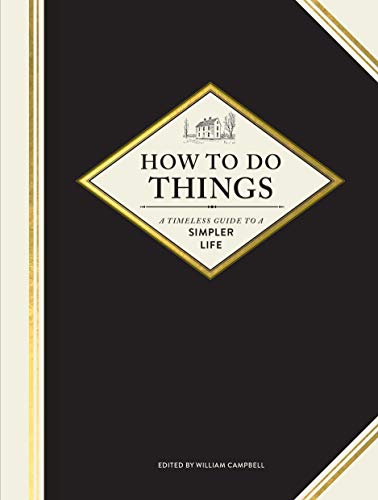
Inhaltsangabe
An ode to self-reliance brimming with wit, wisdom, and nostalgia.
Sometimes doing things the "old-fashioned way" is still the best way: For anyone who wants to learn how to catch a runaway pig, mend a fence post, milk a cow, or throw an unforgettable barn party, this engaging volume delivers timeless advice on accomplishing tasks big and small around the house, garden, and farm. Written by farmers and craftsmen and featuring original text and illustrations from the 1919 first edition, the 100th-anniversary volume of How to Do Things presents a new generation of readers with expert guidance on every facet of homesteading in a very handsomely crafted package.
- With projects that range from practical (ridding a yard of poison ivy) to downright bemusing (organizing a potato peeling contest), this delightful book is equal parts useful and entertaining.
- Originally published by the editors of Farm Journal a century ago, How to Do Things still contains relevant information for today's world.
- With the handwriting – and doodles – of the test taker, readers will have flashbacks of anxiously sitting over a test paper chewing on the end of a pencil.
An ode to self-reliance and an invitation to reconnect with life's simple pleasures.
- A must-have for anyone who enjoys doing things with their own two hands.
- Beautifully packaged, How to Do Things makes a great gift for farmers, city dwellers and everyone in between.
Die Inhaltsangabe kann sich auf eine andere Ausgabe dieses Titels beziehen.
Über die Autorin bzw. den Autor
Brian Barth is a contributing editor at Landscape Architecture Magazine and writer at large at Modern Farmer. He lives in Toronto.
William Campbell is an editor and writer. He lives an idyllic pastoral life in Brooklyn.
William Campbell is an editor and writer. He lives an idyllic pastoral life in Brooklyn.
Von der hinteren Coverseite
For anyone who wants to learn how to catch a runaway pig, mend a fence post, milk a cow, or throw an unforgettable barn party, this engaging volume delivers timeless advice on accomplishing tasks big and small around the house, garden, and farm. Featuring original text and illustrations from the 1919 first edition, this 100th-anniversary volume presents a new generation of readers with expert guidance on every facet of homesteading in a very handsomely crafted package. With projects that range from practical (ridding a yard of poison ivy) to downright bemusing (organizing a potato peeling contest), this delightful book is equal parts useful and entertaining. An ode to self-reliance brimming with wit, wisdom, and nostalgia, this is a must-have for anyone who enjoys doing things with their own two hands.
Auszug. © Genehmigter Nachdruck. Alle Rechte vorbehalten.
How To Do Things
By William CampbellChronicle Books LLC
Copyright © 2019 Maria Ribas Literary, LLC
All rights reserved.
ISBN: 978-1-4521-7167-8All rights reserved.
Contents
FOREWORD PRACTICAL, not fancy, LIVING, 10,
INTRODUCTION INTERESTING and IMPORTANT MATTERS, 14,
PART I DOWN on the FARM, 17,
PART II AROUND the YARD, 43,
PART III In the KITCHEN, 87,
PART IV AROUND the HOUSE, 125,
PART V OUT in the WORKSHOP, 221,
INDEX, 254,
ACKNOWLEDGMENTS, 262,
AUTHORS, 263,
CHAPTER 1
MAILING LISTSthatMAKE MONEY
Almost every farm can use mailing lists to advantage. In buying, the lists help locate the cheapest and the most suitable article at once. In selling, they drum up trade, add new customers, and help obtain the highest market prices.
SELLING SEED CORN
A farmer who had made a hobby of growing sweet corn — cultivating it for years until he had developed a superior strain — found that the local stores were glad to handle his seed but offered a low price. He compiled a list of nineteen seedsmen operating in his territory, securing the names from farm paper and newspaper advertisements and from personal knowledge. Some of them sold seeds by mail, some through retail stores, and others were city wholesalers.
Using a typewriter, the farmer wrote a businesslike letter to all nineteen seedsmen, telling them what he had to offer and forwarding samples. His results were typical of mailing-list work. Eight businesses did not reply at all, and seven answered that they had adequate supplies arranged for. Four firms offered $1 a bushel more than the grower had been offered at home.
SELLING NUTS
Another farmer with a big crop of hickory nuts used a list of entirely different character. During a trip to town he borrowed several city directories and wrote down the names of professionals, manufacturers, and others chat he believed had better-than-average buying power. These were classified in the directories and were easily copied. To every one of the several hundred families on his list, he mailed a printed catalog, with 1-cent postage, describing the superior sort of produce he had to offer and quoting prices in bulk lots. The prices were somewhat below what the city fruit stores were charging. He easily sold his entire crop in this way and had a fine beginning toward a parcel-post trade in other farm products.
SELLING WOOD
A third farmer obtained a list of pulpwood buyers and secured a price 50 cents a cord better than that which he was about to accept for his wood.
Purchasing agents of corporations send form letters to every business manufacturing articles they are in the market for, giving specifications and asking for samples and prices. Farmers who are making purchases of considerable size can follow the same plan. From the local farm newspapers a list of businesses can be readily complied. It is well to get prices from the local dealer, too. Whether the articles to be bought are fence posts or farm implements, it pays to feel out the market thoroughly, and the mailing list is a cheap, effective way of going about it. The fellow who buys without comparison is often the disappointed one.
Mailing lists for most farm purposes can be compiled at home. There are businesses that make a specialty of furnishing lists, their charges running from about $2 for every thousand names with a guarantee of accuracy. If the list written to is a long one, it is oftentimes good business to use a printed form letter. With smaller lists, a typewriter will do. The typewriter lessens the labor in correspondence, and every farmer who does a great deal of writing should have one.
LEADINGtheBULL SAFELY
Where a bull is kept on the farm great care must be taken that he has no chance to do any one an injury. No chances should be taken. A rope attached to a ring in the nose serves as an extra hitching arrangement in the stall, but the bull should not be led by this alone. He can charge on the one leading him at will. Put an extra ring in the rope near his nose and have a stick with a snap in the end, and then the bull can be led anywhere in safety, the rope and the stick being taken together in the hand.
STOP CHICKEN EATING
Here is a cure for that old hog that eats up all the chickens. Use a piece of stiff leather wide enough to cover the hog's face within an inch or so of the snout, and secure it with a hog ring to the lower edge of the ears. An old bootleg will do.
ANOTHER HEN DISCOURAGER
Hiram Hogg: "At last my owner has solved the hen problem to my entire satisfaction by hinging the door to my sty so that :t will always swing shut. When I leave my house to roam in the alfalfa I push it open with my snout and need not worry about any fussy old hen and a host of chirping chickens scratching in my nest. Nor will I again waken from my afternoon nap to find that same fussy old hen hovering her brood on my back."
HOMEMADE HOG SCRATCHER
Here is a device that will take the lice off the farmer's hogs as they are sound asleep. Drive a stake in the ground, wrap an old rope around the stake, and tack with shingle nails. Saturate the rope with equal parts of coal oil and lard once a week, or use one of the commercial coal-tar dips. Drive the stake near the hogs' sleeping quarters. This is so effectual that the hogs will stand in line waiting their turn to rub against this homemade hog scratcher.
SIMPLEST KINDofMILK STRAINER
Good butter making begins as far back as the milking, if not further. The process of milking must be clean if sweet butter is to be made. Fit a funnel, with strainer in the bottom, to the milk pail and milk into this. This will keep out much floating dust and will also assist in keeping the milk closed to odors while it has to remain in the stable.
RAISING GUINEA PIGS
The guinea pig is a native of Brazil and comes in three different colors — white, black, and fawn. Some of the white ones have red eyes.
Before starting in the business of raising guinea pigs, you should carefully consider several things:
If you have hay, apples, and similar feed on the home place, it is all right; if not, it may be a mistake to start in the guinea pigs business, as these feeds cost too much. Grain must be purchased, but that is a small expense compared with the other feed.
Then there must be a good place to keep the little animals. They won't thrive down in the cellar, nor out in the shed, nor up in the garret. They must have a place where a fire can be kept in cold weather.
They must be attended to as regularly as other farm animals. They must be watered once daily, fed two or three times, and have their hutches cleaned out every day.
When you get two hundred or three hundred guinea pigs, which would be necessary to have a steady income, you will find it work — not hard labor, but work you cannot shirk.
SCIENTIFIC HAND MILKING
ITS IMPORTANCE OFTEN OVERLOOKED
Too little attention is paid to the subject of scientific hand milking. A poor milker may easily do enough harm in a herd of cows in one year to equal in loss the amount of his wages. In other words, it would pay to hand him his year's salary in a lump sum and buy him off instead of allowing him to milk poorly ten or twelve cows each night and morning. Such a milker, if he is rough, cross, noisy, unclean, irregular, or imperfect in his milking, may quickly or gradually dry...
„Über diesen Titel“ kann sich auf eine andere Ausgabe dieses Titels beziehen.
Suchergebnisse für How to Do Things: A Timeless Guide to a Simpler Life

Beispielbild für diese ISBN
How to Do Things: A Timeless Guide to a Simpler Life
Anbieter: World of Books (was SecondSale), Montgomery, IL, USA
Verkäuferbewertung 5 von 5 Sternen

Hardback. Zustand: Good. For anyone who wants to learn how to catch a runaway pig, mend a fence post, milk a cow, or throw an unforgettable barn party, this engaging volume delivers timeless advice on accomplishing tasks big and small around the house, garden, and farm. Featuring original text and illustrations from the 1919 first edition, this 100th-anniversary volume presents a new generation of readers with expert guidance on every facet of homesteading in a very handsomely crafted package. With projects that range from practical (ridding a yard of poison ivy) to downright bemusing (organizing a potato peeling contest), this delightful book is equal parts useful and entertaining. An ode to self-reliance brimming with wit, wisdom, and nostalgia, this is a must-have for anyone who enjoys doing things with their own two hands. Artikel-Nr. 00094283844
Gebraucht kaufen
EUR 3,99
Versand gratis
Versand innerhalb von USA
Versand innerhalb von USA
Anzahl: 3 verfügbar
Beispielbild für diese ISBN
How to Do Things: A Timeless Guide to a Simpler Life
Anbieter: ThriftBooks-Atlanta, AUSTELL, GA, USA
Verkäuferbewertung 5 von 5 Sternen
Hardcover. Zustand: Very Good. No Jacket. Former library book; May have limited writing in cover pages. Pages are unmarked. ~ ThriftBooks: Read More, Spend Less. Artikel-Nr. G145217167XI4N10
Gebraucht kaufen
EUR 6,98
Versand gratis
Versand innerhalb von USA
Versand innerhalb von USA
Anzahl: 1 verfügbar
Beispielbild für diese ISBN
How to Do Things: A Timeless Guide to a Simpler Life
Anbieter: ThriftBooks-Dallas, Dallas, TX, USA
Verkäuferbewertung 5 von 5 Sternen
Hardcover. Zustand: Very Good. No Jacket. Missing dust jacket; May have limited writing in cover pages. Pages are unmarked. ~ ThriftBooks: Read More, Spend Less. Artikel-Nr. G145217167XI4N01
Gebraucht kaufen
EUR 6,98
Versand gratis
Versand innerhalb von USA
Versand innerhalb von USA
Anzahl: 1 verfügbar
Beispielbild für diese ISBN
How to Do Things: A Timeless Guide to a Simpler Life
Anbieter: Housing Works Online Bookstore, New York, NY, USA
Verkäuferbewertung 5 von 5 Sternen
Hardcover. Zustand: Very Good. Illustrated. Minimal wear to cover. Pages clean and binding tight. shelf wear. bumped edges. Hardcover. Artikel-Nr. GK3-01078-IN
Gebraucht kaufen
EUR 5,30
EUR 3,49 Versand
Versand innerhalb von USA
Versand innerhalb von USA
Anzahl: 1 verfügbar
Beispielbild für diese ISBN
How to Do Things : A Timeless Guide to a Simpler Life
Anbieter: Better World Books, Mishawaka, IN, USA
Verkäuferbewertung 5 von 5 Sternen
Zustand: Good. Pages intact with minimal writing/highlighting. The binding may be loose and creased. Dust jackets/supplements are not included. Stock photo provided. Product includes identifying sticker. Better World Books: Buy Books. Do Good. Artikel-Nr. 17992228-6
Gebraucht kaufen
EUR 10,21
Versand gratis
Versand innerhalb von USA
Versand innerhalb von USA
Anzahl: 1 verfügbar
Beispielbild für diese ISBN
How to Do Things : A Timeless Guide to a Simpler Life
Anbieter: Better World Books, Mishawaka, IN, USA
Verkäuferbewertung 5 von 5 Sternen
Zustand: Very Good. Pages intact with possible writing/highlighting. Binding strong with minor wear. Dust jackets/supplements may not be included. Stock photo provided. Product includes identifying sticker. Better World Books: Buy Books. Do Good. Artikel-Nr. 39817763-6
Gebraucht kaufen
EUR 10,21
Versand gratis
Versand innerhalb von USA
Versand innerhalb von USA
Anzahl: 1 verfügbar
Beispielbild für diese ISBN
How to Do Things: A Timeless Guide to a Simpler Life
Anbieter: WorldofBooks, Goring-By-Sea, WS, Vereinigtes Königreich
Verkäuferbewertung 5 von 5 Sternen
Paperback. Zustand: Fine. Artikel-Nr. GOR014959668
Gebraucht kaufen
EUR 4,65
EUR 6,51 Versand
Versand von Vereinigtes Königreich nach USA
Versand von Vereinigtes Königreich nach USA
Anzahl: 1 verfügbar
Beispielbild für diese ISBN
How to Do Things: A Timeless Guide to a Simpler Life
Anbieter: WorldofBooks, Goring-By-Sea, WS, Vereinigtes Königreich
Verkäuferbewertung 5 von 5 Sternen
Paperback. Zustand: Very Good. The book has been read, but is in excellent condition. Pages are intact and not marred by notes or highlighting. The spine remains undamaged. Artikel-Nr. GOR011221384
Gebraucht kaufen
EUR 4,65
EUR 6,51 Versand
Versand von Vereinigtes Königreich nach USA
Versand von Vereinigtes Königreich nach USA
Anzahl: 1 verfügbar
Beispielbild für diese ISBN
How to Do Things: A Timeless Guide to a Simpler Life
Verlag:
Chronicle Books 02/04/2019, 2019
ISBN 10: 145217167X
ISBN 13: 9781452171678
Gebraucht
Hardcover
Anbieter: AwesomeBooks, Wallingford, Vereinigtes Königreich
Verkäuferbewertung 5 von 5 Sternen
Zustand: Very Good. This book is in very good condition and will be shipped within 24 hours of ordering. The cover may have some limited signs of wear but the pages are clean, intact and the spine remains undamaged. This book has clearly been well maintained and looked after thus far. Money back guarantee if you are not satisfied. See all our books here, order more than 1 book and get discounted shipping. . Artikel-Nr. 7719-9781452171678
Gebraucht kaufen
EUR 11,95
EUR 4,79 Versand
Versand von Vereinigtes Königreich nach USA
Versand von Vereinigtes Königreich nach USA
Anzahl: 1 verfügbar
Beispielbild für diese ISBN
How to Do Things: A Timeless Guide to a Simpler Life
Verlag:
Chronicle Books 02/04/2019, 2019
ISBN 10: 145217167X
ISBN 13: 9781452171678
Gebraucht
Hardcover
Anbieter: Bahamut Media, Reading, Vereinigtes Königreich
Verkäuferbewertung 5 von 5 Sternen
Zustand: Very Good. Shipped within 24 hours from our UK warehouse. Clean, undamaged book with no damage to pages and minimal wear to the cover. Spine still tight, in very good condition. Remember if you are not happy, you are covered by our 100% money back guarantee. Artikel-Nr. 6545-9781452171678
Gebraucht kaufen
EUR 11,95
EUR 8,12 Versand
Versand von Vereinigtes Königreich nach USA
Versand von Vereinigtes Königreich nach USA
Anzahl: 1 verfügbar