
Verwandte Artikel zu Ike's Gamble: America's Rise to Dominance in...
Inhaltsangabe
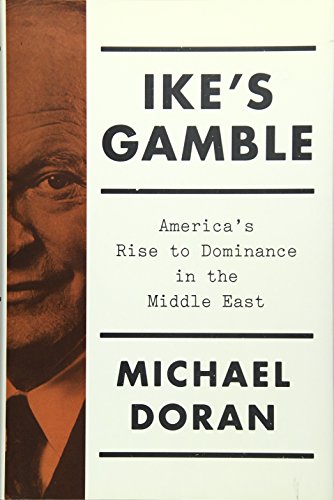
This major retelling of the Suez Crisis of 1956—one of the most important events in the history of US policy in the Middle East—shows how President Eisenhower came to realize that Israel, not Egypt, is America’s strongest regional ally.
In 1956 President Nasser of Egypt moved to take possession of the Suez Canal, thereby bringing the Middle East to the brink of war. The British and the French, who operated the canal, joined with Israel in a plan to retake it by force. Despite the special relationship between England and America, Dwight Eisenhower intervened to stop the invasion.
In Ike’s Gamble, Michael Doran shows how Nasser played the US, invoking America’s opposition to European colonialism to drive a wedge between Eisenhower and two British Prime Ministers, Winston Churchill and Anthony Eden. Meanwhile, in his quest to make himself the strongman of the Arab world, Nasser was making weapons deals with the USSR and destabilizing other Arab countries that the US had been courting. The Suez Crisis was his crowning triumph. In time, Eisenhower would conclude that Nasser had duped him, that the Arab countries were too fractious to anchor America’s interests in the Middle East, and that the US should turn instead to Israel.
Affording deep insight into Eisenhower and his foreign policy, this fascinating and provocative history provides a rich new understanding of how the US became the power broker in the Middle East.
Die Inhaltsangabe kann sich auf eine andere Ausgabe dieses Titels beziehen.
Über die Autorin bzw. den Autor
Michael Doran has served as a Middle East advisor in the White House and as a deputy assistant secretary of defense. An alumnus of Stanford and Princeton Universities, he has held several academic positions and is a senior fellow at the Hudson Institute, where he specializes in Middle East security issues. He lives in Washington, DC.
Auszug. © Genehmigter Nachdruck. Alle Rechte vorbehalten.
Ike’s Gamble
CHAPTER 1
A New President
Picking a fight was an odd way to say good-bye. In January 1953, Prime Minister Winston Churchill crossed the Atlantic to bid farewell to President Harry Truman, who was just two weeks away from retirement. At a dinner in Truman’s honor at the British embassy, the guests included Secretary of State Dean Acheson, Secretary of Defense George Marshall, and a handful of other top American officials. No sooner had dinner begun than Churchill launched into a passionate diatribe in favor of Zionism. According to his right-hand man, Jock Colville, Churchill’s position aroused “the disagreement of practically all the Americans present, though they admitted that the large Jewish vote would prevent them disagreeing publicly.”1
The choice of subjects was impolite. It forced Truman to relive a bitter dispute that had placed him at loggerheads with some of the men around the table—George Marshall in particular. Back in May 1948, Marshall, then secretary of state, nearly resigned in protest over Truman’s intention to recognize Israel. In an especially heated exchange in the White House, Marshall accused the president of pandering to the Jewish vote, and of endangering U.S. national security as a result. If the United States did recognize Israel, Marshall said, then he would cast his vote against Truman in the upcoming election.2 The president, of course, did not follow his secretary of state’s advice, and Marshall somehow made his peace with it, but raw feelings persisted.
After dinner, the argument continued, but Truman drifted away from the group, sat down at the piano, and began playing. When Churchill noticed, he instructed Colville to corral everyone around the piano. Truman performed for the group for about a quarter of an hour, and then made an exit, followed swiftly by Marshall. All the others remained behind, and the debate kicked up again, continuing uninterrupted until one in the morning.
In sidelining his guest of honor, Churchill had not acted alone: an invisible accomplice helped him usher Truman out the door. Dwight D. Eisenhower, the president-elect, was spending the evening in New York, planning his new administration, but even from afar he managed to dominate the party. He had already tapped three of Churchill’s dinner guests for jobs in his administration. One of them, Walter Bedell Smith, the director of the CIA, had served as Ike’s chief of staff during the war. Churchill, who had been on familiar terms with “Beetle” for years, could confidently assume that he would enjoy easy access to the new president. Truman may have had two more weeks in the White House, but his power was already gone.
Saying farewell was a good excuse for Churchill to come, but his true purpose was to begin influencing the new team, not to honor the old. Picking a fight was his way of doing it.
Fatuous Churchill
Once Truman had gone off to bed, the argument focused on two main issues, the European Defense Community (EDC) and the Middle East. On the surface, the issues seemed utterly disconnected, but for Churchill they were two parts of the same challenge: persuading the Americans to accept his vision of the special relationship between Britain and the United States. In both Europe and the Middle East, he argued, the United States should put the alliance with Britain ahead of all other interests. His American guests, however, were not having any of it.
Originally proposed by the French, the EDC was a plan for an integrated, pan-European army—an idea that Churchill hated. In its place he proposed a grand coalition, like the one that had defeated Germany and Japan in World War II. The Cold War alliance should be a pyramid, with the Anglo-American partnership at its apex. Emphasizing the Anglophone bond, he dismissed the multilingual EDC as nothing but “a sludgy amalgam.”3
In the Middle East, the primary threat to Churchill’s vision was the growing friendship between the United States and local nationalists. Particularly disturbing to Churchill was the warm attitude of the Americans toward Egypt’s young military rulers, who had toppled King Faruq in a bloodless coup on July 23, 1952. The Free Officers, as they called themselves, had come to power in the midst of a breakdown in Egyptian-British relations, and they were now publicly demanding nothing less than an immediate and unconditional evacuation of the 80,000 British forces who occupied the base along the Suez Canal. Outwardly, General Muhammad Naguib was in charge of the movement, but behind the scenes, a young colonel, Gamal Abdel Nasser, was the one truly calling the shots. Shortly after taking power, Nasser had quietly reached out to the Americans, whose welcoming response was unsettling to the British. The Americans believed that Egypt, as the largest and most influential Arab country, was the key to delivering the entire Arab world to the West in the Cold War. Moreover, they saw nationalists like the Free Officers as the wave of the future.
“Our last hope” was how Acheson described Naguib to Churchill that night. The phrase was poison to Churchill, who believed that the abandonment of the British position in Egypt would spell the end of empire. Courting the Free Officers was not on his agenda; cutting them down to size was—and he sought American support in doing so. But the Americans were disinclined—so unreceptive that Colville feared his boss had pressed the point too hard for his own good. “I had an uneasy feeling,” he wrote in his diary, that the “remarks—about Israel, the E.D.C. and Egypt . . . had better have been left unsaid in the presence of the three . . . who are staying with Ike and the Republicans.”4
This was not the first time on his trip that Churchill had encountered strong resistance to his message. Only the day before, in New York, he had held a series of meetings with Eisenhower himself. Hoping to build on their wartime association, Churchill described his notion of the special relationship and, in the process, floated the idea of an early bilateral conference. He was prepared, he said, to return to Washington two weeks after the inauguration. What better way for Eisenhower to jump-start his foreign policy than to remind the world of the wartime summit conferences that Churchill had conducted with Roosevelt and Truman?
Eisenhower pretended to mull over the idea. He told Churchill that he certainly agreed that the two leaders should use their warm personal relations for mutual benefit, but on the specific question of whether to convene an early summit, he deferred to the man whom he had tapped to be the next secretary of state, John Foster Dulles. He suggested that the three of them—Eisenhower, Dulles, and Churchill—discuss the issue over dinner that night. Churchill left the meeting ecstatic. Eisenhower was entertaining his plan!
Or was he? At dinner, Dulles was a wet blanket. He called Churchill’s suggestion “most unfortunate.” The American people, he explained, believed that Churchill had the ability “to cast a spell on all American statesmen.” The new administration, therefore, had to find its footing before organizing a summit conference. Churchill, according to Colville, “sat up and growled.” That night in the privacy...
„Über diesen Titel“ kann sich auf eine andere Ausgabe dieses Titels beziehen.
Suchergebnisse für Ike's Gamble: America's Rise to Dominance in...

Beispielbild für diese ISBN
Ikes Gamble Americas Rise to D
Anbieter: World of Books (was SecondSale), Montgomery, IL, USA
Verkäuferbewertung 5 von 5 Sternen

Zustand: Good. Good condition ex-library book with usual library markings and stickers. Artikel-Nr. 00104236761
Gebraucht kaufen
EUR 4,56
Versand gratis
Versand innerhalb von USA
Versand innerhalb von USA
Anzahl: 1 verfügbar
Beispielbild für diese ISBN
Ike's Gamble: America's Rise to Dominance in the Middle East
Anbieter: BooksRun, Philadelphia, PA, USA
Verkäuferbewertung 5 von 5 Sternen
Hardcover. Zustand: Very Good. With dust jacket. It's a well-cared-for item that has seen limited use. The item may show minor signs of wear. All the text is legible, with all pages included. It may have slight markings and/or highlighting. Artikel-Nr. 1451697759-8-1-29
Gebraucht kaufen
EUR 5,81
Versand gratis
Versand innerhalb von USA
Versand innerhalb von USA
Anzahl: 1 verfügbar
Beispielbild für diese ISBN
Ike's Gamble : America's Rise to Dominance in the Middle East
Anbieter: Better World Books, Mishawaka, IN, USA
Verkäuferbewertung 5 von 5 Sternen
Zustand: Good. Former library copy. Pages intact with minimal writing/highlighting. The binding may be loose and creased. Dust jackets/supplements are not included. Includes library markings. Stock photo provided. Product includes identifying sticker. Better World Books: Buy Books. Do Good. Artikel-Nr. GRP102032087
Gebraucht kaufen
EUR 6,34
Versand gratis
Versand innerhalb von USA
Versand innerhalb von USA
Anzahl: 2 verfügbar
Beispielbild für diese ISBN
Ike's Gamble : America's Rise to Dominance in the Middle East
Anbieter: Better World Books, Mishawaka, IN, USA
Verkäuferbewertung 5 von 5 Sternen
Zustand: Good. Pages intact with minimal writing/highlighting. The binding may be loose and creased. Dust jackets/supplements are not included. Stock photo provided. Product includes identifying sticker. Better World Books: Buy Books. Do Good. Artikel-Nr. 11642703-6
Gebraucht kaufen
EUR 6,34
Versand gratis
Versand innerhalb von USA
Versand innerhalb von USA
Anzahl: 1 verfügbar
Beispielbild für diese ISBN
Ike's Gamble: America's Rise to Dominance in the Middle East
Anbieter: ThriftBooks-Dallas, Dallas, TX, USA
Verkäuferbewertung 5 von 5 Sternen
Hardcover. Zustand: Very Good. No Jacket. Former library book; May have limited writing in cover pages. Pages are unmarked. ~ ThriftBooks: Read More, Spend Less. Artikel-Nr. G1451697759I4N10
Gebraucht kaufen
EUR 7,81
Versand gratis
Versand innerhalb von USA
Versand innerhalb von USA
Anzahl: 1 verfügbar
Beispielbild für diese ISBN
Ike's Gamble: America's Rise to Dominance in the Middle East
Anbieter: ThriftBooks-Atlanta, AUSTELL, GA, USA
Verkäuferbewertung 5 von 5 Sternen
Hardcover. Zustand: Good. No Jacket. Pages can have notes/highlighting. Spine may show signs of wear. ~ ThriftBooks: Read More, Spend Less. Artikel-Nr. G1451697759I3N00
Gebraucht kaufen
EUR 7,81
Versand gratis
Versand innerhalb von USA
Versand innerhalb von USA
Anzahl: 1 verfügbar
Beispielbild für diese ISBN
Ike's Gamble: America's Rise to Dominance in the Middle East
Anbieter: ThriftBooks-Phoenix, Phoenix, AZ, USA
Verkäuferbewertung 5 von 5 Sternen
Hardcover. Zustand: Very Good. No Jacket. May have limited writing in cover pages. Pages are unmarked. ~ ThriftBooks: Read More, Spend Less. Artikel-Nr. G1451697759I4N00
Gebraucht kaufen
EUR 7,81
Versand gratis
Versand innerhalb von USA
Versand innerhalb von USA
Anzahl: 1 verfügbar
Beispielbild für diese ISBN
Ike's Gamble: America's Rise to Dominance in the Middle East
Anbieter: ThriftBooks-Dallas, Dallas, TX, USA
Verkäuferbewertung 5 von 5 Sternen
Hardcover. Zustand: Very Good. No Jacket. May have limited writing in cover pages. Pages are unmarked. ~ ThriftBooks: Read More, Spend Less. Artikel-Nr. G1451697759I4N00
Gebraucht kaufen
EUR 7,81
Versand gratis
Versand innerhalb von USA
Versand innerhalb von USA
Anzahl: 1 verfügbar
Beispielbild für diese ISBN
Ike's Gamble: America's Rise to Dominance in the Middle East
Anbieter: ThriftBooks-Atlanta, AUSTELL, GA, USA
Verkäuferbewertung 5 von 5 Sternen
Hardcover. Zustand: Very Good. No Jacket. Former library book; May have limited writing in cover pages. Pages are unmarked. ~ ThriftBooks: Read More, Spend Less. Artikel-Nr. G1451697759I4N10
Gebraucht kaufen
EUR 7,81
Versand gratis
Versand innerhalb von USA
Versand innerhalb von USA
Anzahl: 1 verfügbar
Beispielbild für diese ISBN
Ike's Gamble: America's Rise to Dominance in the Middle East
Anbieter: Visible Voice Books, Cleveland, OH, USA
Verkäuferbewertung 5 von 5 Sternen
hardcover. Zustand: Good. Free Press October 2016 EX-LIBRARY clean and tight hardcover with jacket. Artikel-Nr. 179735
Gebraucht kaufen
EUR 6,13
EUR 4,00 Versand
Versand innerhalb von USA
Versand innerhalb von USA
Anzahl: 1 verfügbar