
Verwandte Artikel zu Hell and Good Company: The Spanish Civil War and the...
Inhaltsangabe
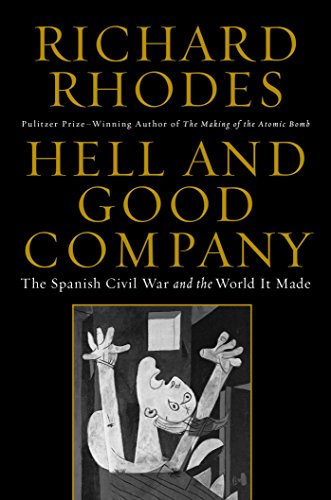
From the Pulitzer Prize–winning and bestselling author of The Making of the Atomic Bomb—the remarkable story of the Spanish Civil War through the eyes of the reporters, writers, artists, doctors, and nurses who witnessed it.
The Spanish Civil War (1936–1939) inspired and haunted an extraordinary number of exceptional artists and writers, including Pablo Picasso, Joan Miro, Martha Gellhorn, Ernest Hemingway, George Orwell, and John Dos Passos. The idealism of the cause—defending democracy from fascism at a time when Europe was darkening toward another world war—and the brutality of the conflict drew from them some of their best work: Guernica, For Whom the Bell Tolls, Homage to Catalonia, The Spanish Earth.
The war spurred breakthroughs in military and medical technology as well. New aircraft, new weapons, new tactics and strategy all emerged in the intense Spanish conflict. Indiscriminate destruction raining from the sky became a dreaded reality for the first time. Progress also arose from the horror: the doctors and nurses who volunteered to serve with the Spanish defenders devised major advances in battlefield surgery and front-line blood transfusion. In those ways, and in many others, the Spanish Civil War served as a test bed for World War II, and for the entire twentieth century.
From the life of John James Audubon to the invention of the atomic bomb, readers have long relied on Richard Rhodes to explain, distill, and dramatize crucial moments in history. Now, he takes us into battlefields and bomb shelters, into the studios of artists, into the crowded wards of war hospitals, and into the hearts and minds of a rich cast of characters to show how the ideological, aesthetic, and technological developments that emerged in Spain changed the world forever.
Die Inhaltsangabe kann sich auf eine andere Ausgabe dieses Titels beziehen.
Über die Autorin bzw. den Autor
Richard Rhodes is the author of numerous books and the winner of the Pulitzer Prize, the National Book Award, and the National Book Critics Circle Award. He graduated from Yale University and has received fellowships from the Ford Foundation, the National Endowment for the Arts, the John Simon Guggenheim Memorial Foundation, and the Alfred P. Sloan Foundation. Appearing as host and correspondent for documentaries on public television’s Frontline and American Experience series, he has also been a visiting scholar at Harvard and MIT and is an affiliate of the Center for International Security and Cooperation at Stanford University. Visit his website: RichardRhodes.com
Auszug. © Genehmigter Nachdruck. Alle Rechte vorbehalten.
Hell and Good Company
ONE
News Arrives of the Death of Others
Barcelona, 25 July 1936: In the glare of Spanish summer, the first witnesses to the igniting civil war are leaving to tell the world. Many are American and European athletes enrolled for the anti-fascist People’s Olympiad, canceled now, meant to be an alternative to the official Olympics about to open in Nazi Berlin. They crowd the deck of an overburdened Spanish boat hired to evacuate them, pressing at the dockside railing for a last look. Above the harbor the high pedestaled statue of Christopher Columbus, its gilding gone like Spanish power, points them west to the New World, but the promenade of the Ramblas behind it that follows an old streambed up into the heart of the city is strewn with shattered trees, dead horses, burned cars. Bullets have pockmarked the façades of churches; blood dries on barricades of paving stones. The city has been pacified and crowds sing, but fascist snipers still hammer death from rooftops and empty windows.
A young American woman at the railing, Muriel Rukeyser, poet leaving to tell the world, locates her Bavarian lover on the crowded pier—
At the end of July, exile. We watch the gangplank go. . . .
They met on the tourist train coming down from Paris, the tall, voluptuous woman and the tall, lean man, a runner, an exiled anti-Nazi. They wasted no time. Three days and nights of lovemaking with no common language on the hot train halted by the general strike outside the battling city and then he released her, joined the International Column—
. . . first of the faces going home into war
the brave man Otto Boch, the German exile . . .
he kept his life straight as a single issue—
left at that dock we left, his gazing Brueghel face,
square forehead and eyes, strong square breast fading,
the narrow runner’s hips diminishing dark.
An English journal had commissioned her to cover the People’s Olympiad, a last-minute substitute for an editor who had begged off to attend a wedding. She had departed London for Spain that late July unaware that the shooting had already begun. From mid-June to mid-July more than sixty people had been assassinated in Spain and ten churches set on fire; a spate of bombings had shaken the country. In that season she would remember as the “hot, beautiful summer of 1936” she was twenty-two, with dark, thick hair and gray eyes, intensely intelligent, already a prizewinning poet. It was her first time out of America.
Muriel Rukeyser was an early eyewitness to Spain’s civil war. Those germinal days would change her; the war would be a touchstone of her poetry for the rest of her life. The war of Spanish democracy against its fascist generals and landed rich and their North African mercenaries would change the lives of everyone it touched. Enlarging to a “little world war”—Time magazine’s coinage—it would serve as a test bed for new technologies both of life and of death.
In London the porter at Victoria Station had spoken to Rukeyser of European war. She found Paris bannered with “posters and notices of gas-masks.” There she had boarded the metal-green night express to little Cerbère in its Mediterranean cove, the last stop in France, where a fan of rail yard behind the town narrowed to cross the border through a tunnel and fanned out again behind Spain’s Port Bou.
The different gauges of the two countries’ tracks required a change of trains. While Rukeyser and her fellow passengers transferred on the shuttle train that Sunday, the forty-three-year-old traitor Francisco Franco Bahamonde, once the youngest general in the Spanish army, approached his country from the Atlantic side. Since March Franco had been idling in rustic exile in the Canary Islands, a thousand miles from Madrid, expelled there by the Republic to limit his influence. Now the London correspondent of a Spanish royalist newspaper was spiriting him in a chartered twin-engine Dragon Rapide to Tetuan, in North Africa opposite Gibraltar, where Spain’s faithless Army of Africa awaited him. The generals’ rebellion on the mainland needed reinforcements for its coup to succeed; the Spanish people, taking up arms, were already putting down rebel uprisings in cities all over Spain.
After Rukeyser passed through customs in Port Bou there was time for a swim. The train on the Spanish side was slow, local, and hot, Olympic teams and Spanish and foreign passengers stifling now on benches in wooden third-class cars. Beyond the train windows the terrain turned mountainous, the earth red-gold.
“The train stops at every little station,” Rukeyser notices, “rests, moves as if exhausted when it does move.” Two Spanish soldiers pass through the car in black patent-leather hats and “comic-opera uniforms with natty yellow leather straps,” smoking English cigarettes and pointing out olive orchards, castles, and churches. “There is time to point out any amount of landscape,” Rukeyser notes drily. At the stations the soldiers stick their guns out the windows, saluting the armed workers patrolling the platforms.
Nearer Barcelona the signs of fighting increase, militiamen with rifles guarding road intersections along the way. At one station a miliciana, a girl in a simple cotton dress leading a troop of boys with guns, works through the train. The determined girl searches bags and luggage for photographs, fotografías, confiscating them, pulling film from cameras. A panicked American woman tells Rukeyser the girl and the armed boys must be communists bent on stealing, but a calmer Spanish passenger says the “fascists”—Franco’s nationalists—have been killing any armed civilians they identify from photographs. The young people handle the cameras carefully and return them to their owners intact.
Around midday that Sunday the train halts in Montcada, a small town seven miles above Barcelona: the beleaguered government in Madrid has called a general strike. How long they would be stuck there no one knew. They would not have wanted to continue into the Catalan capital yet; the uprising was still raging. The New York Times’s Barcelona correspondent, Lawrence Fernsworth, described hearing “continuous volleys of rifle fire” in the city that bloody Sunday, “clattering hoofs and bugle calls . . . men shouting and others screaming in anguish . . . screeching flocks of swallows flying back and forth in a frenzy as bullets whistle among them.” Fernsworth saw “riderless horses [that] galloped over the bodies of the dead and the dying. From windows and rooftops everywhere spat more rifle and machine-gun fire. Motorcars overfilled with armed men raced through the streets. . . . Fieldpieces, now in the hands of the populace, boomed from street intersections. Their shells tore through the length of the streets, slicing off trees, exploding against a building or blowing a stalled streetcar or an automobile to bits.”
By Monday evening the republic’s militias had gained control and Fernsworth found only “splotches of blood drying on the pavement where the wounded had been taken away” in the Plaza Cataluña, the city center at the head of the long, tree-lined walk of the Ramblas. “Empty cartridges and bandoliers were lying about everywhere.” With bloodshed and more broken walls and Dolores Ibárruri, the woman they called La Pasionaria, on the radio crying...
„Über diesen Titel“ kann sich auf eine andere Ausgabe dieses Titels beziehen.
Suchergebnisse für Hell and Good Company: The Spanish Civil War and the...

Beispielbild für diese ISBN
Hell and Good Company: The Spa
Anbieter: World of Books (was SecondSale), Montgomery, IL, USA
Verkäuferbewertung 5 von 5 Sternen

Zustand: Good. Item in good condition. Textbooks may not include supplemental items i.e. CDs, access codes etc. Artikel-Nr. 00102700931
Gebraucht kaufen
EUR 4,04
Versand gratis
Versand innerhalb von USA
Versand innerhalb von USA
Anzahl: 1 verfügbar
Beispielbild für diese ISBN
Hell and Good Company: The Spanish Civil War and the World it Made
Verlag:
Simon & Schuster (edition First Edition), 2015
ISBN 10: 1451696213
ISBN 13: 9781451696219
Gebraucht
Hardcover
Erstausgabe
Anbieter: BooksRun, Philadelphia, PA, USA
Verkäuferbewertung 5 von 5 Sternen
Hardcover. Zustand: Fair. First Edition. With dust jacket. The item might be beaten up but readable. May contain markings or highlighting, as well as stains, bent corners, or any other major defect, but the text is not obscured in any way. Artikel-Nr. 1451696213-7-1-29
Gebraucht kaufen
EUR 5,52
Versand gratis
Versand innerhalb von USA
Versand innerhalb von USA
Anzahl: 1 verfügbar
Beispielbild für diese ISBN
Hell and Good Company: The Spanish Civil War and the World it Made
Anbieter: Wonder Book, Frederick, MD, USA
Verkäuferbewertung 5 von 5 Sternen
Zustand: Very Good. Very Good condition. Very Good dust jacket. A copy that may have a few cosmetic defects. May also contain light spine creasing or a few markings such as an owner's name, short gifter's inscription or light stamp. Artikel-Nr. C09K-00140
Gebraucht kaufen
EUR 6,29
Versand gratis
Versand innerhalb von USA
Versand innerhalb von USA
Anzahl: 2 verfügbar
Beispielbild für diese ISBN
Hell and Good Company: The Spanish Civil War and the World it Made
Anbieter: Wonder Book, Frederick, MD, USA
Verkäuferbewertung 5 von 5 Sternen
Zustand: As New. Like New condition. Like New dust jacket. A near perfect copy that may have very minor cosmetic defects. Artikel-Nr. V06C-04141
Gebraucht kaufen
EUR 6,29
Versand gratis
Versand innerhalb von USA
Versand innerhalb von USA
Anzahl: 1 verfügbar
Beispielbild für diese ISBN
Hell and Good Company: The Spanish Civil War and the World it Made
Anbieter: ThriftBooks-Dallas, Dallas, TX, USA
Verkäuferbewertung 5 von 5 Sternen
Hardcover. Zustand: Very Good. No Jacket. May have limited writing in cover pages. Pages are unmarked. ~ ThriftBooks: Read More, Spend Less. Artikel-Nr. G1451696213I4N00
Gebraucht kaufen
EUR 6,53
Versand gratis
Versand innerhalb von USA
Versand innerhalb von USA
Anzahl: 1 verfügbar
Beispielbild für diese ISBN
Hell and Good Company: The Spanish Civil War and the World it Made
Anbieter: ThriftBooks-Dallas, Dallas, TX, USA
Verkäuferbewertung 5 von 5 Sternen
Hardcover. Zustand: Very Good. No Jacket. Former library book; May have limited writing in cover pages. Pages are unmarked. ~ ThriftBooks: Read More, Spend Less. Artikel-Nr. G1451696213I4N10
Gebraucht kaufen
EUR 6,53
Versand gratis
Versand innerhalb von USA
Versand innerhalb von USA
Anzahl: 1 verfügbar
Beispielbild für diese ISBN
Hell and Good Company: The Spanish Civil War and the World it Made
Anbieter: ThriftBooks-Atlanta, AUSTELL, GA, USA
Verkäuferbewertung 5 von 5 Sternen
Hardcover. Zustand: Very Good. No Jacket. Former library book; May have limited writing in cover pages. Pages are unmarked. ~ ThriftBooks: Read More, Spend Less. Artikel-Nr. G1451696213I4N10
Gebraucht kaufen
EUR 6,53
Versand gratis
Versand innerhalb von USA
Versand innerhalb von USA
Anzahl: 1 verfügbar
Beispielbild für diese ISBN
Hell and Good Company : The Spanish Civil War and the World It Made
Verlag:
Simon & Schuster, 2015
ISBN 10: 1451696213
ISBN 13: 9781451696219
Gebraucht
Hardcover
Erstausgabe
Anbieter: Better World Books, Mishawaka, IN, USA
Verkäuferbewertung 5 von 5 Sternen
Zustand: Good. 1St Edition. Former library copy. Pages intact with minimal writing/highlighting. The binding may be loose and creased. Dust jackets/supplements are not included. Includes library markings. Stock photo provided. Product includes identifying sticker. Better World Books: Buy Books. Do Good. Artikel-Nr. GRP95646265
Gebraucht kaufen
EUR 6,60
Versand gratis
Versand innerhalb von USA
Versand innerhalb von USA
Anzahl: 1 verfügbar
Beispielbild für diese ISBN
Hell and Good Company : The Spanish Civil War and the World It Made
Verlag:
Simon & Schuster, 2015
ISBN 10: 1451696213
ISBN 13: 9781451696219
Gebraucht
Hardcover
Erstausgabe
Anbieter: Better World Books: West, Reno, NV, USA
Verkäuferbewertung 5 von 5 Sternen
Zustand: Good. 1St Edition. Former library copy. Pages intact with minimal writing/highlighting. The binding may be loose and creased. Dust jackets/supplements are not included. Includes library markings. Stock photo provided. Product includes identifying sticker. Better World Books: Buy Books. Do Good. Artikel-Nr. GRP95646265
Gebraucht kaufen
EUR 6,60
Versand gratis
Versand innerhalb von USA
Versand innerhalb von USA
Anzahl: 1 verfügbar
Beispielbild für diese ISBN
Hell and Good Company: The Spanish Civil War and the World it Made
Anbieter: Magers and Quinn Booksellers, Minneapolis, MN, USA
Verkäuferbewertung 5 von 5 Sternen
hardcover. Zustand: Very Good. May have light to moderate shelf wear and/or a remainder mark. Complete. Clean pages. Artikel-Nr. 1121815
Gebraucht kaufen
EUR 7,42
EUR 3,49 Versand
Versand innerhalb von USA
Versand innerhalb von USA
Anzahl: 1 verfügbar