
Verwandte Artikel zu Rust: The Longest War
Inhaltsangabe
Finalist for the Los Angeles Times Book Prize ** A Wall Street Journal Best Book of the Year
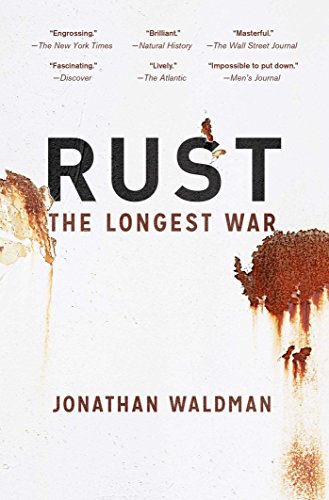
Rust has been called “the great destroyer,” the “pervasive menace,” and “the evil.” “This look at corrosion—its causes, its consequences, and especially the people devoted to combating it—is wide-ranging and consistently engrossing” (The New York Times).
It is the hidden enemy, the one that challenges the very basis of civilization. This entropic menace destroys cars, fells bridges, sinks ships, sparks house fires, and nearly brought down the Statue of Liberty’s torch. It is rust—and this book, full of wit and insight, disasters and triumphs—is its story.
“Jonathan Waldman’s first book is as obsessive as it is informative…he takes us deep into places and situations that are too often ignored or unknown” (The Washington Post). In Rust, Waldman travels from Key West to Prudhoe Bay, meeting people concerned with corrosion. He sneaks into an abandoned steelworks and nearly gets kicked out of Can School. He follows a high-tech robot through an arctic winter, hunting for rust in the Alaska pipeline. In Texas, he finds a corrosion engineer named Rusty, and in Colorado, he learns of the animosity between the galvanizing industry and the paint army. Along the way, Waldman recounts stories of flying pigs, Trekkies, rust boogers, and unlikely superheroes.
The result is a man-versus-nature tale that’s as fascinating as it is grand, illuminating a hidden phenomenon that shapes the modern world. Rust affects everything from the design of our currency to the composition of our tap water, and it will determine the legacy we leave on this planet. This exploration of corrosion, and the incredible lengths we go to fight it, is “engrossing…brilliant…Waldman’s gift for narrative nonfiction shines in every chapter….Watching things rust: who would have thought it could be so exciting” (Natural History).
Die Inhaltsangabe kann sich auf eine andere Ausgabe dieses Titels beziehen.
Über die Autorin bzw. den Autor
Jonathan Waldman studied writing at Dartmouth and Boston University’s Knight Center for Science Journalism, and worked in print, radio, and TV before landing in books. His first book, Rust: The Longest War, was a finalist for the Los Angeles Times Book Prize and winner of the Colorado Book Award. His writing has otherwise appeared in The New York Times and McSweeney’s. Visit him at JonnyWaldman.com or email him at JonnyWaldman@gmail.com.
Von der hinteren Coverseite
A thrilling drama of man versus nature-detailing the fierce, ongoing fight against the mightiest and unlikeliest enemy: rust.
Auszug. © Genehmigter Nachdruck. Alle Rechte vorbehalten.
Rust 1 A HIGH-MAINTENANCE LADY
On Saturday, May 10, 1980, her caretaker slept in. David Moffitt awoke around eight o’clock and put on civilian clothes. He had a cup of coffee, then went out to the garden on the south side of his brick house, on Liberty Island, and started pulling weeds. A trained floriculturist who’d worked on Lady Bird Johnson’s beautification efforts in Washington, DC, he had a spectacular vegetable garden. As the superintendent of the Statue of Liberty National Monument, he also had a spectacular backyard. As usual for a day off, he planned to do a little bit of gardening before going to Manhattan with his wife and three kids, to go shopping in the city or bike riding in Central Park. It was a clear day, about 50 degrees, with a steady light wind out of the southwest. Moffitt was on his knees, pruning roses, a couple of hours later, when Mike Tennent, his chief ranger, ran up and told him that two guys were climbing the outside of the statue. That was a first. Moffitt looked up, focused his hazel eyes, and confirmed the claim. So much for his day off.
It was about 150 yards from Moffitt’s house to the statue, and on the walk there, he could hear visitors yelling from the base of the pedestal up at the climbers. “Assholes!” they yelled. “Faggots!” Their visits were being interrupted, and they objected, because they knew the situation was unlikely to end in their favor. Moffitt was already as mad as the visitors, but not for the same reason. He thought the climbers were desecrating the statue, and probably damaging it. Moffitt, who was forty-one, with thick dark brown hair and a Houston accent, had gotten the job—considered a hardship assignment on account of the isolation—because of his good track record with maintenance. The island, and the statue, had fallen into disrepair; the National Park Service recognized that its maintenance programs were wholly deficient. Moffitt was the first full-time caretaker in a dozen years.
Halfway to the statue, Moffitt stopped, and watched the climbers unfurl a banner. Liberty Was Framed, it said in bold red letters, above Free Geronimo Pratt. Until then, he’d figured the climbers were just pranksters. Now, though he didn’t know who Geronimo Pratt was, he knew the duo were protesters. And he knew how to resolve the situation. The NYPD had a team skilled at removing people from high places—he’d seen footage on TV—and he would call them. So he turned around, walked to his office, and ordered the island evacuated. Inside the statue, an announcement blared over its PA system requesting that visitors proceed to the dock area due to an operational problem. In his office, Moffitt then called the National Park Service Regional Director’s Office in Boston. He’d done this a few times before, and was destined to do it many more times again.
On his watch, Puerto Rican nationals had occupied the statue for most of a day, and a handful of Iranian students had chained themselves to the statue, protesting America’s treatment of the Shah. On his watch, he dealt with about ten bomb threats a year. Before his time, the statue had been the site for college kids protesting President Richard Nixon, veterans protesting Vietnam, the American Revolutionary Students Brigade protesting the Iranian government, and the mayor of New York protesting the treatment of Soviet Jews. As Moffitt well recognized, the statue was the ideal place to protest any perceived wrong. So Moffitt called the NYPD, rather than the US Park Police—and this decision had ramifications for the climbers, and more importantly, the statue.
When the NYPD’s Emergency Service Unit arrived, its agents were cheered by the departing visitors. They quickly assessed the situation. A “removal,” they determined, would be too dangerous. They figured nets were needed. And helicopters. Given all of this, Moffitt figured that the situation might take a while to conclude and told his wife to go to Manhattan without him. Then he learned from the NYPD that Geronimo Pratt was a Black Panther convicted in the murder of a Santa Monica teacher, a crime for which he’d been imprisoned for a decade, and he remained angry. There was nothing admirable about desecrating the statue, no matter the cause. “I took the job of protecting this symbol of America very seriously,” Moffitt recalled.
Moffitt spent the day in his office, watching the climbers through a pair of government-issued binoculars. That afternoon, he took a call from a reporter at the New York Daily News. In the middle of the interview, he heard a banging sound coming from the statue. “God damn them!” someone below the statue yelled at the same time. “They’re busting my statue!” A ranger came in the office and said one of the climbers was driving pitons into the copper skin. Moffitt doesn’t recall how many bangs he heard, but he remembers being frantic. Now he was sure they were damaging his statue. He yelled at the reporter, then hung up.
Up on the statue, Ed Drummond, a thirty-four-year-old English poet from San Francisco with an arrest record for climbing buildings and hanging banners, was struggling. After traversing around the left foot, then up and left, the climbing became more difficult than he had expected, or had been prepared for. It had taken him two hours to get to the crook of Lady Liberty’s right knee, and now he was stuck on a small ledge, looking up at a short chimney in the folds of the robe on her back. The surface of the copper skin, in particular, was causing problems, rendering his two eight-inch suction cups useless. The skin was covered in millions of little bumps, almost like acne, the result of the French craftsmen who pounded the copper into shape a century before. Consequently, his suction cups stuck only for about ten seconds, even if he pushed with all of his might. “I realized that they were not going to work,” he recalled, describing the fatigue he began to feel in his arms. He slipped, slithered down a few feet, and barely caught himself with his other suction cup. He was aware of the consequences of falling. “You’d just go hurtling out into the air,” he recalled, “and end up two hundred feet down on the esplanade.” It was also almost certain that if that happened, he would pull his climbing partner, Stephen Rutherford—a thirty-one-year-old teacher-in-training from Berkeley, California—off too.
As he climbed, he could see that between the plates of copper there was often a small gap. The plates had begun to lift for some reason, though the edge formed was not big enough to use for climbing. He also noticed many little holes in the statue, which he had not seen from the ground. Rumor had it, among Statue of Liberty buffs, that they were bullet holes. As the climbing grew more desperate, with his back on one wall of the chimney and both of his feet on the other, he tried placing a tiny S-hook, which he’d bought last minute, in one of the holes, for support. Using a sling, he weighted it, and under less than his full weight, it bent alarmingly.
Drummond had planned to climb up the statue’s back, and onto her left shoulder, then stay in a little cave under the lock of hair over her left ear. Sheltered from wind and rain, anchored to that lock of hair, he planned to keep a weeklong vigil. (He brought a sleeping bag, and a supply of cheese, dates, apples, canned salmon, and water bottles.) He planned to drape his banner across the statue’s chest, like a bra. But he never made it past the chimney. Instead, he decided to spend the night on the ledge, and descend in the morning. He told as much to the NYPD, who relayed the information to Moffitt. That night,...
„Über diesen Titel“ kann sich auf eine andere Ausgabe dieses Titels beziehen.
Suchergebnisse für Rust: The Longest War

Beispielbild für diese ISBN
Rust: The Longest War
Anbieter: Wonder Book, Frederick, MD, USA
Verkäuferbewertung 5 von 5 Sternen

Zustand: Good. Good condition. A copy that has been read but remains intact. May contain markings such as bookplates, stamps, limited notes and highlighting, or a few light stains. Artikel-Nr. J13Q-00106
Gebraucht kaufen
EUR 6,24
Versand gratis
Versand innerhalb von USA
Versand innerhalb von USA
Anzahl: 1 verfügbar
Beispielbild für diese ISBN
Rust : The Longest War
Anbieter: Better World Books, Mishawaka, IN, USA
Verkäuferbewertung 5 von 5 Sternen
Zustand: Very Good. Pages intact with possible writing/highlighting. Binding strong with minor wear. Dust jackets/supplements may not be included. Stock photo provided. Product includes identifying sticker. Better World Books: Buy Books. Do Good. Artikel-Nr. 10803443-6
Gebraucht kaufen
EUR 7,58
Versand gratis
Versand innerhalb von USA
Versand innerhalb von USA
Anzahl: 1 verfügbar
Beispielbild für diese ISBN
Rust : The Longest War
Anbieter: Better World Books, Mishawaka, IN, USA
Verkäuferbewertung 5 von 5 Sternen
Zustand: Good. Pages intact with minimal writing/highlighting. The binding may be loose and creased. Dust jackets/supplements are not included. Stock photo provided. Product includes identifying sticker. Better World Books: Buy Books. Do Good. Artikel-Nr. 9947795-20
Gebraucht kaufen
EUR 7,58
Versand gratis
Versand innerhalb von USA
Versand innerhalb von USA
Anzahl: 3 verfügbar
Beispielbild für diese ISBN
Rust: The Longest War
Anbieter: ThriftBooks-Dallas, Dallas, TX, USA
Verkäuferbewertung 5 von 5 Sternen
Paperback. Zustand: Very Good. No Jacket. May have limited writing in cover pages. Pages are unmarked. ~ ThriftBooks: Read More, Spend Less. Artikel-Nr. G1451691602I4N00
Gebraucht kaufen
EUR 7,96
Versand gratis
Versand innerhalb von USA
Versand innerhalb von USA
Anzahl: 1 verfügbar
Beispielbild für diese ISBN
Rust: The Longest War
Anbieter: ThriftBooks-Dallas, Dallas, TX, USA
Verkäuferbewertung 5 von 5 Sternen
Paperback. Zustand: Good. No Jacket. Pages can have notes/highlighting. Spine may show signs of wear. ~ ThriftBooks: Read More, Spend Less. Artikel-Nr. G1451691602I3N00
Gebraucht kaufen
EUR 7,96
Versand gratis
Versand innerhalb von USA
Versand innerhalb von USA
Anzahl: 1 verfügbar
Beispielbild für diese ISBN
Rust: The Longest War
Anbieter: ThriftBooks-Atlanta, AUSTELL, GA, USA
Verkäuferbewertung 5 von 5 Sternen
Paperback. Zustand: Good. No Jacket. Pages can have notes/highlighting. Spine may show signs of wear. ~ ThriftBooks: Read More, Spend Less. Artikel-Nr. G1451691602I3N00
Gebraucht kaufen
EUR 7,96
Versand gratis
Versand innerhalb von USA
Versand innerhalb von USA
Anzahl: 1 verfügbar
Beispielbild für diese ISBN
Rust: The Longest War
Anbieter: ThriftBooks-Dallas, Dallas, TX, USA
Verkäuferbewertung 5 von 5 Sternen
Paperback. Zustand: Fair. No Jacket. Readable copy. Pages may have considerable notes/highlighting. ~ ThriftBooks: Read More, Spend Less. Artikel-Nr. G1451691602I5N00
Gebraucht kaufen
EUR 7,96
Versand gratis
Versand innerhalb von USA
Versand innerhalb von USA
Anzahl: 1 verfügbar
Beispielbild für diese ISBN
Rust: The Longest War
Anbieter: Books From California, Simi Valley, CA, USA
Verkäuferbewertung 4 von 5 Sternen

Paperback. Zustand: Good. The binding is bent. The copy is otherwise in clean condition. Artikel-Nr. mon0004135643
Gebraucht kaufen
EUR 4,44
EUR 4,30 Versand
Versand innerhalb von USA
Versand innerhalb von USA
Anzahl: 1 verfügbar
Beispielbild für diese ISBN
Rust: The Longest War
Anbieter: Books From California, Simi Valley, CA, USA
Verkäuferbewertung 4 von 5 Sternen
Paperback. Zustand: Very Good. Artikel-Nr. mon0004135675
Gebraucht kaufen
EUR 4,44
EUR 4,30 Versand
Versand innerhalb von USA
Versand innerhalb von USA
Anzahl: 5 verfügbar
Beispielbild für diese ISBN
Rust: The Longest War
Anbieter: medimops, Berlin, Deutschland
Verkäuferbewertung 5 von 5 Sternen
Zustand: good. Befriedigend/Good: Durchschnittlich erhaltenes Buch bzw. Schutzumschlag mit Gebrauchsspuren, aber vollständigen Seiten. / Describes the average WORN book or dust jacket that has all the pages present. Artikel-Nr. M01451691602-G
Gebraucht kaufen
EUR 4,37
EUR 10,00 Versand
Versand von Deutschland nach USA
Versand von Deutschland nach USA
Anzahl: 1 verfügbar