
Verwandte Artikel zu Two Hours: The Quest to Run the Impossible Marathon
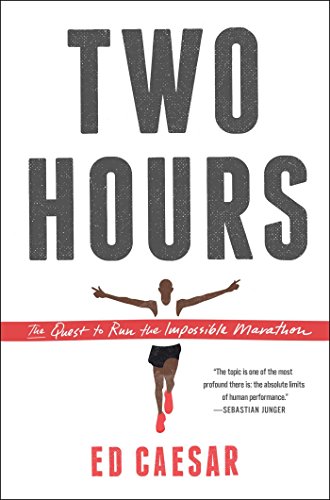
Inhaltsangabe
“Essential reading for every runner.” —Men’s Fitness
“Compelling…As becomes clear not long after its starting gun, this book transcends the search for a two-hour marathon.” —The Washington Post
Two hours to cover twenty-six miles and 385 yards. It is running’s Everest, a feat once seen as impossible for the human body. But now we can glimpse the mountaintop. The sub-two hour marathon will require an exceptional combination of speed, mental strength, and endurance. The pioneer will have to endure more, live braver, plan better, and be luckier than anyone who has run before. So who will it be?
In this spellbinding book, journalist Ed Caesar takes us into the world of elite marathoners: some of the greatest runners on earth. Through the stories of these rich characters, like Kenyan Geoffrey Mutai, around whom the narrative is built, Caesar traces the history of the marathon as well as the science, physiology, and psychology involved in running so fast for so long. And he shows us why this most democratic of races retains its brutal, enthralling appeal—and why we are drawn to test ourselves to the limit.
Two Hours is a book about a beautiful sport few people understand. It takes us from big-money races in the United States and Europe to remote villages in Kenya. It’s about talent, heroism, and refusing to accept defeat. It is a book about running that is about much more than running. It is a human drama like no other.
Die Inhaltsangabe kann sich auf eine andere Ausgabe dieses Titels beziehen.
Über die Autorin bzw. den Autor
Ed Caesar has contributed to The New Yorker, The New York Times Magazine, The Atlantic, Outside, and Smithsonian, among many other publications, and has reported from a wide variety of locations, including Iran, the Democratic Republic of Congo, and Kosovo. He has won nine journalism awards and was named the Foreign Press Association’s Journalist of the Year in 2014. Two Hours is his first book.
Auszug. © Genehmigter Nachdruck. Alle Rechte vorbehalten.
Two Hours
Chapter One
Tear Down This Wall
September 2012
SHORTLY BEFORE nine on a bright fall morning in Berlin, Geoffrey Kiprono Mutai prepared to run a marathon faster than any human being—even he—had run before. A wild, audacious proposition, to propel one’s body to such a ragged extreme, and he felt the walls of his quest closing in on him. Years of pain for this one opportunity. Competing voices crowding his head. The loudest saying, If only we could start running!
Mutai is five feet seven inches tall, and 125 pounds. He has a wide, expressive face, with a high forehead, elfin ears, and long, gleaming teeth. Most often, you find him amiable, amused, desirous of news and gossip, a flashy smile close by. But now, at this solemn moment, he looked as vulnerable as a foundling.
There were around 41,000 runners behind him. Penned together, they bobbed and lilted like a gentle sea against a harbor wall. Alongside Mutai at the head of the crowd, meanwhile, were two dozen professional athletes whose lives—like his—would be marked irrevocably by the minutes to come. As Mutai ran his final warm-up shuttles, the goosebumps on his chest were visible behind his blood-orange running vest: nerves, or the cold, or both.
Mutai attempted to relieve the tension by telling himself that he didn’t need to win the race, or make history, to be happy. Anywhere on the podium would be okay, this reasonable voice said. The marathon is tough. Anything can happen.
He knew he was fooling himself. It was true, yes, anything could happen in a marathon, and there were many events seemingly outside an athlete’s control—including the body’s reaction to the stress of racing. No athlete, not even a champion, could know when a cramp or an injury might destroy his chances. So Mutai told himself this thin truth—that his effort was enough. Although he knew that nothing but triumph could satisfy him, and even triumph might not suffice, the mental evasion somehow helped him relax. He needed to relax. Tense legs, he knew, couldn’t move.
Mutai said his habitual prayers. For clemency. For strength and for courage. For his stringy legs, veterans and repositories of tens of thousands of miles of training, to carry him another 26 miles and 385 yards. But not for a miracle. He would never ask God for a miracle.
Smiles all around him now: the effervescence of expectation. Mutai could not help but smile too. Despite longing for the starter’s pistol, there would always be a part of him that enjoyed these rich, electrified seconds—the warrior part. He was about to race. Yes, the eyes of the city, and the sport, were upon him. But where else would he want to be? He would shortly express the purest version of his being on the grandest stage imaginable, without saying a word. If the race proceeded as he had dreamed it, he would become not only the world record holder, but a vindicated man. All in a little more than two hours.
Mutai is a Kenyan, a Kalenjin, and a Kipsigis. He was born in the village of Equator, which sits at nearly 9,000 feet in the lush highlands at the western escarpment of the Rift Valley, and, as its name suggests, at the beltline of the world. He is a husband, a father, a son, a grandson, a nephew, a cousin, a coach, a businessman, and a potentate. He is a rich man who grew up without shoes.
As the minutes became seconds, and he toed the Berlin startline in his featherweight Adidas racing flats, he was aware that dozens of less successful athletes depended on him for clothes, accommodation, and transport. He knew his family relied on him for their houses, their food, their televisions, their children’s school fees, and their cars. He also knew that in this race, he had the chance not only to win 40,000 euros for first place and a possible 80,000 euros in time bonuses (30,000 euros for a time under 2:04:30; 50,000 more for a new world record), but also, if he won in Berlin, the chance to seal a $500,000 jackpot for winning the cumulative World Marathon Majors prize for 2011–2012. And that was just from the organizers of the marathon. His sponsor, Adidas, would also kick in bonuses if he won or became the new world record holder. After agent’s fees, he could be more than half a million dollars richer by lunchtime. Back home, his friends and family would be huddled around televisions, watching.
In these final moments of stillness, however, Mutai banished impure thoughts and the crowding, conflicted voices. He attempted to focus. Psychologists talk about a Zen-like state of instinctual action in which the greatest sporting performances are attained. They call it Flow. The French cyclist Jean Bobet described a similar but distinct experience called La Volupté, which “is delicate, intimate and ephemeral. It arrives, it takes hold of you, sweeps you up and then leaves you again. It is for you alone. It is a combination of speed and ease, force and grace. It is pure happiness.”
Mutai has his own term: the Spirit. The way he understood it, the brutality of his training regime—125 fierce miles a week—was endured to attain this sensation. Thousands of hours of suffering for these minutes of sweetness: speed and ease, force and grace. The more harder you train, he would say, the more you get the Spirit. . . . It gains on you. So far, in his career, the Spirit had allowed Mutai the courage to remake the sport of marathon running, and to destroy previous conceptions of what was possible; to lose his own fear, and implant it in the hearts of his competitors.
Now, on this bright cold day in Berlin, he wished to upend the marathon world once more. As he stood at the head of the vast herd, high banks of loudspeakers began to play the kind of jangling, electronic string music you hear on game shows before the host tells a contestant whether he’s landed the big prize. Over these shifting arpeggios came the sound of a stout man with a microphone, counting down the final seconds before the gun. Ten! he shouted, in English. Nine! Eight! Seven . . . Mutai stood still, his chest pushed forward in anticipation of movement. At that instant, the world receded. Mutai became the instrument of a single imperative—to run a marathon in less than two hours and three minutes.
Nine a.m. The gun.
The crowd cheered as thousands of electric-blue balloons were released into the air. The lead athletes shot off and quickly assembled themselves into a group. Within a few hundred meters, these contenders tucked in behind the four elite pacemakers, wearing black-and-white striped vests to distinguish themselves, who in turn followed a BMW on which a digital display was mounted, showing both the elapsed time and the split time for the last kilometer.
In that first group along with Mutai were a handful of extraordinary athletes. Dennis Kimetto had been “discovered” by Mutai in 2008 and now trained in the same group. Nicknamed “Mwafrica,” or “the African,” by his fellow athletes on account of his coal-black skin, he had progressed rapidly—breaking the 25km world record earlier in 2012—and was now running his first marathon outside Kenya. Geoffrey Kipsang Kamworor, meanwhile, was widely considered to possess a profound natural talent. And, although the nineteen-year-old former junior world cross-country champion was also running his full-marathon debut, he had some experience of Berlin. The previous year, he had paced Haile Gebrselassie, the Ethiopian who is considered by many to be the greatest distance runner of all time, in the race. Haile was so impressed with Kamworor’s performance that...
„Über diesen Titel“ kann sich auf eine andere Ausgabe dieses Titels beziehen.
Suchergebnisse für Two Hours: The Quest to Run the Impossible Marathon

Beispielbild für diese ISBN
Two Hours: The Quest to Run the Impossible Marathon
Anbieter: World of Books (was SecondSale), Montgomery, IL, USA
Verkäuferbewertung 5 von 5 Sternen

Zustand: Good. Item in good condition. Textbooks may not include supplemental items i.e. CDs, access codes etc. Artikel-Nr. 00095301705
Gebraucht kaufen
EUR 4,24
Versand gratis
Versand innerhalb von USA
Versand innerhalb von USA
Anzahl: 3 verfügbar
Beispielbild für diese ISBN
Two Hours: The Quest to Run the Impossible Marathon
Verlag:
Simon & Schuster (edition ), 2015
ISBN 10: 145168584X
ISBN 13: 9781451685848
Gebraucht
Hardcover
Anbieter: BooksRun, Philadelphia, PA, USA
Verkäuferbewertung 5 von 5 Sternen
Hardcover. Zustand: Very Good. It's a well-cared-for item that has seen limited use. The item may show minor signs of wear. All the text is legible, with all pages included. It may have slight markings and/or highlighting. Artikel-Nr. 145168584X-11-1
Gebraucht kaufen
EUR 5,08
Versand gratis
Versand innerhalb von USA
Versand innerhalb von USA
Anzahl: 1 verfügbar
Beispielbild für diese ISBN
Two Hours : The Quest to Run the Impossible Marathon
Anbieter: Better World Books, Mishawaka, IN, USA
Verkäuferbewertung 5 von 5 Sternen
Zustand: Very Good. Former library copy. Pages intact with possible writing/highlighting. Binding strong with minor wear. Dust jackets/supplements may not be included. Includes library markings. Stock photo provided. Product includes identifying sticker. Better World Books: Buy Books. Do Good. Artikel-Nr. 8150335-75
Gebraucht kaufen
EUR 6,03
Versand gratis
Versand innerhalb von USA
Versand innerhalb von USA
Anzahl: 1 verfügbar
Beispielbild für diese ISBN
Two Hours : The Quest to Run the Impossible Marathon
Anbieter: Better World Books, Mishawaka, IN, USA
Verkäuferbewertung 5 von 5 Sternen
Zustand: Good. Former library copy. Pages intact with minimal writing/highlighting. The binding may be loose and creased. Dust jackets/supplements are not included. Includes library markings. Stock photo provided. Product includes identifying sticker. Better World Books: Buy Books. Do Good. Artikel-Nr. 11413289-6
Gebraucht kaufen
EUR 6,03
Versand gratis
Versand innerhalb von USA
Versand innerhalb von USA
Anzahl: 1 verfügbar
Beispielbild für diese ISBN
Two Hours: The Quest to Run the Impossible Marathon
Anbieter: ThriftBooks-Atlanta, AUSTELL, GA, USA
Verkäuferbewertung 5 von 5 Sternen
Hardcover. Zustand: Very Good. No Jacket. May have limited writing in cover pages. Pages are unmarked. ~ ThriftBooks: Read More, Spend Less. Artikel-Nr. G145168584XI4N00
Gebraucht kaufen
EUR 7,03
Versand gratis
Versand innerhalb von USA
Versand innerhalb von USA
Anzahl: 1 verfügbar
Beispielbild für diese ISBN
Two Hours: The Quest to Run the Impossible Marathon
Anbieter: AwesomeBooks, Wallingford, Vereinigtes Königreich
Verkäuferbewertung 5 von 5 Sternen
Hardcover. Zustand: Very Good. Two Hours: The Quest to Run the Impossible Marathon This book is in very good condition and will be shipped within 24 hours of ordering. The cover may have some limited signs of wear but the pages are clean, intact and the spine remains undamaged. This book has clearly been well maintained and looked after thus far. Money back guarantee if you are not satisfied. See all our books here, order more than 1 book and get discounted shipping. Artikel-Nr. 7719-9781451685848
Gebraucht kaufen
EUR 17,74
EUR 4,80 Versand
Versand von Vereinigtes Königreich nach USA
Versand von Vereinigtes Königreich nach USA
Anzahl: 2 verfügbar
Beispielbild für diese ISBN
Two Hours: The Quest to Run the Impossible Marathon
Anbieter: Bahamut Media, Reading, Vereinigtes Königreich
Verkäuferbewertung 5 von 5 Sternen
Hardcover. Zustand: Very Good. This book is in very good condition and will be shipped within 24 hours of ordering. The cover may have some limited signs of wear but the pages are clean, intact and the spine remains undamaged. This book has clearly been well maintained and looked after thus far. Money back guarantee if you are not satisfied. See all our books here, order more than 1 book and get discounted shipping. Artikel-Nr. 6545-9781451685848
Gebraucht kaufen
EUR 19,37
EUR 8,14 Versand
Versand von Vereinigtes Königreich nach USA
Versand von Vereinigtes Königreich nach USA
Anzahl: 2 verfügbar
Beispielbild für diese ISBN
Two Hours: The Quest to Run the Impossible Marathon
Anbieter: Revaluation Books, Exeter, Vereinigtes Königreich
Verkäuferbewertung 5 von 5 Sternen
Hardcover. Zustand: Brand New. 288 pages. 9.50x6.50x1.00 inches. In Stock. Artikel-Nr. 145168584X
Neu kaufen
EUR 28,98
EUR 11,66 Versand
Versand von Vereinigtes Königreich nach USA
Versand von Vereinigtes Königreich nach USA
Anzahl: 1 verfügbar