
Verwandte Artikel zu Making Hope Happen: Create the Future You Want for...
Inhaltsangabe
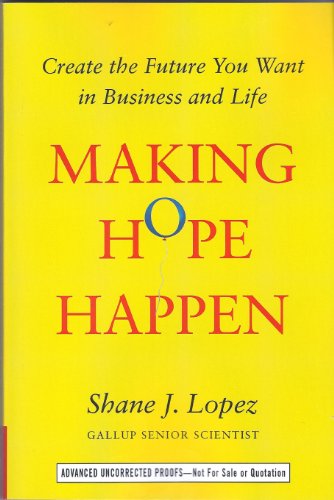
With its cutting-edge research and inspiring true stories of people who create better lives for themselves, their families, and their communities, Making Hope Happen is the first practical guide to the anatomy of hope—how to create, use, and share it.
How do some people make good things happen and bounce back from setbacks? Why do they lead happier, healthier, more productive lives? It’s because they have hope—not because of luck, or intelligence, or money. So, what exactly is hope and how can you get it, too?
Using discoveries from the largest study of hopeful people ever conducted, world-renowned expert on the psychology of hope Shane J. Lopez, Ph.D., reveals that hope is not just an emotion but an essential life tool. Hope is also a leading indicator of success in relationships, academics, career, and business. With Making Hope Happen you can measure your level of hope and learn how to create and share it.
In this newest evolution of positive psychology, Dr. Lopez provides strategies for building a high-hope mind-set and shares uplifting stories of real people—parents, educators, entrepreneurs, young and old people with health challenges, and civic leaders— who create hope and who change their own lives as well as their schools, workplaces, and communities. They include:
• The CEO who befriended a curious nine-year-old, bringing him into the company and transforming his attitude toward school and future goals.
• A young entrepreneur who worked to change laws that stood in his way, recruited friends to support his start-up, and rebuilt from scratch after a fire.
• The college president whose creative fundraising during the worst of the economic downturn kept her neediest seniors in school through graduation.
• The city council members who developed a visionary recovery plan only days after their community was flattened by a tornado.
• Two mothers and a principal who reversed decades of neglect and mismanagement to turn a failing school into a neighborhood magnet.
• A college student who is thriving after two heart transplants, and whose hopeful self-care has been key to her survival.
Making Hope Happen is for people who believe that the future can be better than the past or the present and who are looking for a way to make it so. The message is clear: Hope matters. Hope is a choice. Hope can be learned. Hope is contagious.
Die Inhaltsangabe kann sich auf eine andere Ausgabe dieses Titels beziehen.
Über die Autorin bzw. den Autor
Shane J. Lopez, Ph.D., a Gallup Senior Scientist, is the world’s leading authority on the psychology of hope. He has published numerous professional books on what is right with people, including The Encyclopedia of Positive Psychology. He lives in Lawrence, Kansas, with his wife and son.
Auszug. © Genehmigter Nachdruck. Alle Rechte vorbehalten.
Making Hope Happen
Chapter 1
What the Man with No Future Taught Me About Hope
IT WAS the fall of 1997 and I was starting my final year of clinical training at the Eisenhower VA Medical Center in Leavenworth, Kansas, trying to get good at using psychotherapy to treat depression in veterans of all ages. My primary rotation was in the Mental Health Clinic.
The clinic itself was cast in the image of its director, an old-school military psychiatrist named Dr. Theodore McNutt. McNutt’s white coat was a bit yellowed, but perfectly pressed with lots of starch, and he walked with a posture that suggested his clothes could crack at any moment. During my time in the clinic, Dr. McNutt had thrown me several softballs. Most of the veterans he had sent my way had needed little more than someone to talk to plus a few new techniques for managing sadness and stress. McNutt had a way of making me feel like a part of the treatment team without overwhelming me.
One morning, I heard McNutt’s black wingtips coming purposefully down the corridor. He walked right into my office, looking very serious and dispensing with his typical formalities, and sat in the chair reserved for patients.
“There’s a man in the lobby who just got some bad news. He needs someone to talk to.” So far, it was a typical McNutt referral—a guy needing some support and a little bit of cognitive therapy. “There’s more. He is acutely suicidal. He said he’ll shoot himself as soon as he gets home. I’d rather not hospitalize him. It’s just not a good option for this veteran. The inpatient psychiatric ward would scare the hell out of him—you know what inpatient is like—and probably make him more desperate. So he has to go home today, but he can’t be a threat to himself. I will go get him.”
Go get him? What? Now? Wait! Dr. McNutt had no time for questions and had already turned on his heels and was double-timing it to his office.
The vet who had just received the bad news was John, a full-bodied sixty-three-year-old veteran of the Korean War who had spent his life both before and after his years of military service in the cornfields of Kansas. Dr. McNutt escorted him and Paula, John’s wife, a short, sturdy woman with tired eyes, into my office. John sat silent and stared at the floor while the three of us quickly recapped the day’s events. Pragmatic from his silver flattop to his brown cowboy boots, John had never before seen a psychiatrist or a psychologist; he had never needed to.
But early that morning, John had come to the hospital complaining of fatigue and high blood pressure. He’d seen the physician, taken a bunch of tests, and then waited for the results, thinking he would just have to up his blood pressure medication. He merely wanted the new script and his discharge papers. He was ready to go back to work.
After reviewing John’s test results, however, the young VA doc had an unexpected diagnosis that he had to give John. He tried the “bad news, good news” approach: “John, the bad news is that your kidneys are failing. The good news is that you can live a relatively normal life with the help of dialysis.”
Paula said that John had handled this revelation well, initially—until the physician had described the treatment regimen. “The closest dialysis center is about an hour and a half away from you. You will need to go there three times a week. Plan on being there mid-morning. You can be done by lunch, and you’ll have the afternoon to rest.”
That’s when John started to lose it, Paula said. His first question was “Doc, how will I run my farm?” The doctor groped for an answer and came back with his own question: “Can someone else do it for you?”
To John, the diagnosis plus dialysis equaled a death sentence . . . for his farm. The internist made it clear that John could not run the farm while on dialysis, so that treatment option did not make sense. But not getting treated would also leave him too sick to work his fields.
So John was trapped:
Get kidney treatment, lose the farm.
Don’t get treatment, lose the farm.
John saw himself as a man with no future.
When John said the word suicide out loud, the internist sent him and Paula straight to the Mental Health Clinic. By the time they were shuttled over, John had mapped out a plan. He was going home to shoot himself. “I want to die. I will kill myself,” he said. And we all believed that he would.
A strong John Wayne type, he seemed like someone who would never give up. In fact, there was nothing in John’s past that suggested he would react this way. He was a survivor—he had already made it through a war, a big recession that hit his farm hard, and the summer floods of 1993, which turned his fields into a giant lake. For decades, nothing could knock this man down. But now, as he faced the idea of losing his beloved farm and the future he had worked for his entire life, John had given up on living.
When the full story was told in my office, Dr. McNutt said, “John, you are going home tonight. Shane here will see that you are safe.” McNutt patted me on the back extra hard and walked out of the room.
Fortunately, after a few hours, a few of my clinical techniques did work enough to stabilize John on that first day, and he got to the point where he was no longer a danger to himself. Though still entertaining suicidal thoughts, he shook hands with me on a deal that he would not act on those thoughts. We made sure that he had a safe home to return to and plenty of support once he got there. With the help of his family and friends, recruited by Paula with just a few phone calls, all of his guns were removed from their home. Paula, an amazingly strong woman, took responsibility for seeing that John made it through the night.
But after they left, I was confronted by my own sense of helplessness. None of my training had prepared me for this situation. How could I help a person who was so utterly hopeless? In a just a few hours’ time, the strongest of men—a battle-hardened Marine—had simply given up on the future and on his life. Could something that broken be fixed?
I had no answers. Once home, I grabbed a beer and then started trying to think of a plan. After an hour or two, I reached for another beer and a book, The Psychology of Hope, written by one of my graduate school professors, Rick Snyder. Rick talked about hope as a life-sustaining force that is rooted in our relationship with the future. He wrote, “Just as our ancestors did, today we think about getting from where we are now, let’s call it Point A, to where we want to be, say Point B.”
John had lost his way, his Point B. He needed new strategies for getting to his old goals, or he needed a new Point B.
The next day, John returned to the clinic with less intense suicidal thoughts and with a question: “So, Doc, what’s my story?” After fumbling a bit, I realized what he was asking. John needed a way to explain his illness to the “boys at the coffee shop” (his fellow farmers), to his family, and, most of all, to himself. He wanted to know how to talk about being sick, going to treatment, and getting better or getting worse. He was looking for a quick, go-to response to the simple question that now seemed difficult to answer: “How are you doing?”
We spent the next two hours talking about his future. Somehow, I had to convince John that...
„Über diesen Titel“ kann sich auf eine andere Ausgabe dieses Titels beziehen.
Suchergebnisse für Making Hope Happen: Create the Future You Want for...

Beispielbild für diese ISBN
Making Hope Happen: Create the Future You Want for Yourself and Others
Anbieter: World of Books (was SecondSale), Montgomery, IL, USA
Verkäuferbewertung 5 von 5 Sternen

Zustand: Very Good. Item in very good condition! Textbooks may not include supplemental items i.e. CDs, access codes etc. Artikel-Nr. 00110402699
Gebraucht kaufen
EUR 4,51
Versand gratis
Versand innerhalb von USA
Versand innerhalb von USA
Anzahl: 1 verfügbar
Beispielbild für diese ISBN
Making Hope Happen: Create the Future You Want for Yourself and Others
Anbieter: World of Books (was SecondSale), Montgomery, IL, USA
Verkäuferbewertung 5 von 5 Sternen
Zustand: Acceptable. Item in acceptable condition! Textbooks may not include supplemental items i.e. CDs, access codes etc. Artikel-Nr. 00103521677
Gebraucht kaufen
EUR 4,51
Versand gratis
Versand innerhalb von USA
Versand innerhalb von USA
Anzahl: 1 verfügbar
Beispielbild für diese ISBN
Making Hope Happen: Create the Future You Want for Yourself and Others
Anbieter: World of Books (was SecondSale), Montgomery, IL, USA
Verkäuferbewertung 5 von 5 Sternen
Hardback. Zustand: Good. Artikel-Nr. 00105018485
Gebraucht kaufen
EUR 4,51
Versand gratis
Versand innerhalb von USA
Versand innerhalb von USA
Anzahl: 2 verfügbar
Beispielbild für diese ISBN
Making Hope Happen: Create the Future You Want for Yourself and Others
Verlag:
Atria Books (edition 2.3.2013), 2013
ISBN 10: 1451666225
ISBN 13: 9781451666229
Gebraucht
Hardcover
Anbieter: BooksRun, Philadelphia, PA, USA
Verkäuferbewertung 5 von 5 Sternen
Hardcover. Zustand: Very Good. 2.3.2013. It's a well-cared-for item that has seen limited use. The item may show minor signs of wear. All the text is legible, with all pages included. It may have slight markings and/or highlighting. Artikel-Nr. 1451666225-11-1
Gebraucht kaufen
EUR 5,27
Versand gratis
Versand innerhalb von USA
Versand innerhalb von USA
Anzahl: 1 verfügbar
Beispielbild für diese ISBN
Making Hope Happen : Create the Future You Want for Yourself and Others
Anbieter: Better World Books, Mishawaka, IN, USA
Verkäuferbewertung 5 von 5 Sternen
Zustand: Good. 2.3.2013. Pages intact with minimal writing/highlighting. The binding may be loose and creased. Dust jackets/supplements are not included. Stock photo provided. Product includes identifying sticker. Better World Books: Buy Books. Do Good. Artikel-Nr. 1378565-6
Gebraucht kaufen
EUR 6,18
Versand gratis
Versand innerhalb von USA
Versand innerhalb von USA
Anzahl: 2 verfügbar
Beispielbild für diese ISBN
Making Hope Happen: Create the Future You Want for Yourself and Others
Anbieter: Wonder Book, Frederick, MD, USA
Verkäuferbewertung 5 von 5 Sternen
Zustand: Very Good. Very Good condition. Like New dust jacket. A copy that may have a few cosmetic defects. May also contain light spine creasing or a few markings such as an owner's name, short gifter's inscription or light stamp. Artikel-Nr. O13O-01539
Gebraucht kaufen
EUR 6,42
Versand gratis
Versand innerhalb von USA
Versand innerhalb von USA
Anzahl: 1 verfügbar
Beispielbild für diese ISBN
Making Hope Happen: Create the Future You Want for Yourself and Others
Anbieter: Wonder Book, Frederick, MD, USA
Verkäuferbewertung 5 von 5 Sternen
Zustand: Very Good. Very Good condition. Very Good dust jacket. A copy that may have a few cosmetic defects. May also contain light spine creasing or a few markings such as an owner's name, short gifter's inscription or light stamp. Artikel-Nr. J05A-02162
Gebraucht kaufen
EUR 6,42
Versand gratis
Versand innerhalb von USA
Versand innerhalb von USA
Anzahl: 1 verfügbar
Beispielbild für diese ISBN
Making Hope Happen: Create the Future You Want for Yourself and Others
Anbieter: ThriftBooks-Atlanta, AUSTELL, GA, USA
Verkäuferbewertung 5 von 5 Sternen
Hardcover. Zustand: Very Good. No Jacket. May have limited writing in cover pages. Pages are unmarked. ~ ThriftBooks: Read More, Spend Less. Artikel-Nr. G1451666225I4N00
Gebraucht kaufen
EUR 7,27
Versand gratis
Versand innerhalb von USA
Versand innerhalb von USA
Anzahl: 1 verfügbar
Beispielbild für diese ISBN
Making Hope Happen: Create the Future You Want for Yourself and Others
Anbieter: ThriftBooks-Reno, Reno, NV, USA
Verkäuferbewertung 5 von 5 Sternen
Hardcover. Zustand: Very Good. No Jacket. May have limited writing in cover pages. Pages are unmarked. ~ ThriftBooks: Read More, Spend Less. Artikel-Nr. G1451666225I4N00
Gebraucht kaufen
EUR 7,27
Versand gratis
Versand innerhalb von USA
Versand innerhalb von USA
Anzahl: 1 verfügbar
Beispielbild für diese ISBN
Making Hope Happen: Create the Future You Want for Yourself and Others
Anbieter: ThriftBooks-Dallas, Dallas, TX, USA
Verkäuferbewertung 5 von 5 Sternen
Hardcover. Zustand: Very Good. No Jacket. May have limited writing in cover pages. Pages are unmarked. ~ ThriftBooks: Read More, Spend Less. Artikel-Nr. G1451666225I4N00
Gebraucht kaufen
EUR 7,27
Versand gratis
Versand innerhalb von USA
Versand innerhalb von USA
Anzahl: 1 verfügbar