
Verwandte Artikel zu The King Years: Historic Moments in the Civil Rights...
Inhaltsangabe
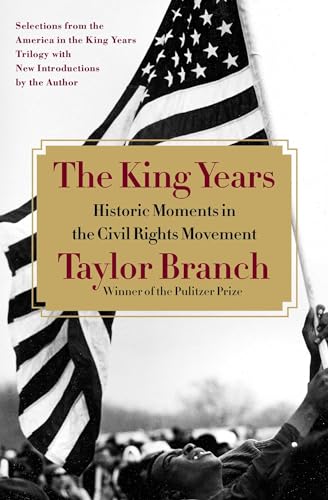
The essential moments of the Civil Rights Movement are set in historical context by the Pulitzer Prize-winning author of the magisterial America in the King Years trilogy—Parting the Waters; Pillar of Fire; and At Canaan’s Edge.
Taylor Branch, author of the Pulitzer Prize–winning America in the King Years trilogy, presents selections from his monumental work that recount the essential moments of the Civil Rights Movement. A masterpiece of storytelling on race and democracy, violence and nonviolence, The King Years delivers riveting tales of everyday heroes whose stories inspire us still. Here is the full sweep of an era that transformed America and continues to offer crucial lessons for today’s world. This vital primer amply fulfills Branch’s dedication: “For students of freedom and teachers of history.”
Die Inhaltsangabe kann sich auf eine andere Ausgabe dieses Titels beziehen.
Über die Autorin bzw. den Autor
Taylor Branch is the bestselling author of Parting the Waters: America in the King Years, 1954-63; Pillar of Fire: America in the King Years, 1963-65; At Canaan’s Edge: America in the King Years, 1965-1968; and The Clinton Tapes. He has won the Pulitzer Prize and the National Book Critics Circle Award.
Auszug. © Genehmigter Nachdruck. Alle Rechte vorbehalten.
Beyond state and local laws, which mandated racial separation everywhere from schools and businesses to public libraries, custom enforced segregation in houses of worship.
Preface
Since 1982, it took me twenty-four years and 2,306 pages to compile a three-book narrative history,America in the King Years, and the same enthrallment has distilled that work now into this slender volume. A singular wonder continues. I was not born or raised to care about politics, let alone to write history. The landmarkBrown decision of 1954 had caught me a white first-grader in segregated Atlanta, Georgia, and my college graduation fourteen years later closely followed the King assassination. Through all the formative years in between, I remained fearfully oblivious to race until the relentless freedom movement redirected my entire life’s interest. Permanent curiosity drove what would become a career ambition. As an outsider, I needed to learn what had sustained such resonant witness among near-peers of African descent.
Well before the 1988 publication of the first installment, Parting the Waters, I resolved to present my findings in storytelling form rather than the analytical synthesis common to history. No stylistic device can escape interpretation, and all history at bottom is an argument, but it seemed evident that cross-racial perspective has been especially vulnerable to distortion. Many standard histories taught, for instance, that the Civil War had little to do with slavery. President Kennedy recalled lessons at Harvard that Reconstruction trampled the rights of prominent white Southerners. Some textbooks still use an earnest, religious word—“Redeemers”—to describe the late-nineteenth-century politicians who imposed white supremacy and segregation, often by Klan-led terror. Clearly, over time, racial undercurrents have tilted and even inverted the prevailing view of our past.
This pitfall recommended a determined effort to ground cross-cultural history in fully human actors on all sides. Therefore, I resolved to avoid insofar as possible the distinctive labels of the civil rights era—“militant,” “racist,” “radical,” “integrationist”—because such terms invite comfort and caricature rather than discovery. The goal was to pursue stories of impact until the clashing characters felt convincing by all available evidence, including their own lights.
My regimen made for a sprawling text and carried its own burdens of craft. Parting the Waters is dedicated to the late Septima Clark for a peculiar reason. Interviews with her left a strong personal effect on me, confirming what others from the civil rights movement felt, but she had functioned almost entirely “offstage” from the main historical narrative, as it were, teaching literacy and citizenship to rural sharecroppers. My dedication was a personal gesture of tribute mixed with regret, because I found it impossible within my storytelling rules to include Septima Clark in proportion to her influence.
Those same rules delayed my writing altogether at the outset, because they prohibited an introductory essay on the movement’s incubator and laboratory, Southern black churches. Only luck turned up a potential solution in an unwritten trove of memory about Vernon Johns, Dr. King’s predecessor at his church in Montgomery. The opening chapter presented this remarkable but unknown character on the calculated hope that his story itself could introduce the separate world of preachers and congregations, of warring politics and inspiration, from which the civil rights movement emerged.
Septima Clark and Vernon Johns are omitted from these pages along with many other figures I consider historically significant. Brevity offsets their absence. A hybrid framework for this volume seeks to preserve the authenticity of narrative detail within limited space. I have selected eighteen historical turning points from the 1954–68 era, described here in less than ten percent of the complete trilogy. Some are simple. Others are complex. They follow the spine of consequence through a transformative period that remains controversial. Each chapter begins with a short transitional summary, sometimes covering major events and intertwined plots with a paragraph or two. These new passages are necessarily compressed, interpretive, and open to argument, but they provide economical context so that readers can experience and absorb the key moments.
Those moved to seek fuller descriptions can find them in my books and many others, with voluminous reference notes. Our goal in this edition is to convey both the spirit and sweep of an extraordinary movement. Newer generations will find here the gist of a patriotic struggle in which the civil rights pioneers, like modern Founders, moved an inherited world of hierarchy and subjugation toward common citizenship. Others can recall vivid triumph and tragedy at the heart of national purpose for the United States, whose enduring story is freedom. The unvarnished history should resist fearful tides to diminish that story. Above all, the King years should serve as a bracing reminder that citizens and leaders can work miracles together despite every hardship, against great odds.
A community-wide assembly responds to oratory during the Montgomery Bus Boycott. Within the precarious sanctuary of black churches, such mass meetings grew into a distinctive tool of solidarity for the civil rights movement.
— CHAPTER ONE —
The Montgomery Bus Boycott: Martin Luther King’s First Public Address, 1955
U.S. history has been marked and largely defined by political struggle over a “self-evident” truth asserted in the (1776) Declaration of Independence: that “all men are created equal.” From the American Revolution forward, that founding principle has ignited controversy over the role of free government to secure “civil rights.” The phrase, which pertains literally to anyone’s rights of citizenship, acquired a strong racial connotation through chronic upheavals over slavery and segregation, lasting more than a century before and after the Civil War of 1861–65. Even today, the civil rights cause is associated in common parlance with Americans of African descent.
An intense phase of this history, known as the modern civil rights movement, coincided with the short public career of its signature leader, Dr. Martin Luther King, Jr. (1954–68). The effects have rippled far and deep, from freedom abroad to cultural identities at home. The chief instigators referred to themselves first as Negroes, then black people, and subsequently African Americans. Prominent among catalyzing events came the Supreme Court’s landmarkBrown v. Board of Education decision on May 17, 1954. “Separate educational facilities are inherently unequal,” wrote Chief Justice Earl Warren, and a unanimous Court struck down as unconstitutional the school segregation laws of twenty states from Florida to Kansas.
The political earth shook, but then again it did not. Very little changed. A year later, two men kidnapped and lynched fourteen-year-old Emmett Till in rural Mississippi, allegedly for whistling at a white woman. Till’s mother insisted that her son’s bloated, mutilated corpse, when pulled from the Tallahatchie River, be displayed in an open casket “for all the world to see,” and a sensationally segregated trial promptly acquitted two defendants who all but boasted of committing their crime to enforce the racial caste code. The Till case revealed a gaping...
„Über diesen Titel“ kann sich auf eine andere Ausgabe dieses Titels beziehen.
Suchergebnisse für The King Years: Historic Moments in the Civil Rights...

Beispielbild für diese ISBN
The King Years: Historic Momen
Anbieter: World of Books (was SecondSale), Montgomery, IL, USA
Verkäuferbewertung 5 von 5 Sternen

Zustand: Very Good. Item in very good condition! Textbooks may not include supplemental items i.e. CDs, access codes etc. Artikel-Nr. 00101787681
Gebraucht kaufen
EUR 3,66
Versand gratis
Versand innerhalb von USA
Versand innerhalb von USA
Anzahl: 2 verfügbar
Beispielbild für diese ISBN
The King Years: Historic Momen
Anbieter: World of Books (was SecondSale), Montgomery, IL, USA
Verkäuferbewertung 5 von 5 Sternen
Zustand: Good. Item in good condition. Textbooks may not include supplemental items i.e. CDs, access codes etc. Artikel-Nr. 00088237953
Gebraucht kaufen
EUR 3,66
Versand gratis
Versand innerhalb von USA
Versand innerhalb von USA
Anzahl: 11 verfügbar
Beispielbild für diese ISBN
The King Years: Historic Momen
Anbieter: World of Books (was SecondSale), Montgomery, IL, USA
Verkäuferbewertung 5 von 5 Sternen
Zustand: Acceptable. Item in acceptable condition! Textbooks may not include supplemental items i.e. CDs, access codes etc. Artikel-Nr. 00095249148
Gebraucht kaufen
EUR 3,66
Versand gratis
Versand innerhalb von USA
Versand innerhalb von USA
Anzahl: 2 verfügbar
Beispielbild für diese ISBN
The King Years: Historic Moments in the Civil Rights Movement
Verlag:
Simon & Schuster (edition 7/14/13), 2013
ISBN 10: 1451662467
ISBN 13: 9781451662467
Gebraucht
Paperback
Anbieter: BooksRun, Philadelphia, PA, USA
Verkäuferbewertung 5 von 5 Sternen
Paperback. Zustand: Very Good. 7/14/13. It's a well-cared-for item that has seen limited use. The item may show minor signs of wear. All the text is legible, with all pages included. It may have slight markings and/or highlighting. Artikel-Nr. 1451662467-11-6
Gebraucht kaufen
EUR 4,34
Versand gratis
Versand innerhalb von USA
Versand innerhalb von USA
Anzahl: 1 verfügbar
Beispielbild für diese ISBN
The King Years: Historic Moments in the Civil Rights Movement
Anbieter: ThriftBooks-Dallas, Dallas, TX, USA
Verkäuferbewertung 5 von 5 Sternen
Paperback. Zustand: Good. No Jacket. Pages can have notes/highlighting. Spine may show signs of wear. ~ ThriftBooks: Read More, Spend Less. Artikel-Nr. G1451662467I3N00
Gebraucht kaufen
EUR 5,77
Versand gratis
Versand innerhalb von USA
Versand innerhalb von USA
Anzahl: 1 verfügbar
Beispielbild für diese ISBN
The King Years: Historic Moments in the Civil Rights Movement
Anbieter: ThriftBooks-Atlanta, AUSTELL, GA, USA
Verkäuferbewertung 5 von 5 Sternen
Paperback. Zustand: Very Good. No Jacket. May have limited writing in cover pages. Pages are unmarked. ~ ThriftBooks: Read More, Spend Less. Artikel-Nr. G1451662467I4N00
Gebraucht kaufen
EUR 5,77
Versand gratis
Versand innerhalb von USA
Versand innerhalb von USA
Anzahl: 1 verfügbar
Beispielbild für diese ISBN
The King Years: Historic Moments in the Civil Rights Movement
Anbieter: ThriftBooks-Dallas, Dallas, TX, USA
Verkäuferbewertung 5 von 5 Sternen
Paperback. Zustand: Very Good. No Jacket. May have limited writing in cover pages. Pages are unmarked. ~ ThriftBooks: Read More, Spend Less. Artikel-Nr. G1451662467I4N00
Gebraucht kaufen
EUR 5,77
Versand gratis
Versand innerhalb von USA
Versand innerhalb von USA
Anzahl: 1 verfügbar
Beispielbild für diese ISBN
The King Years : Historic Moments in the Civil Rights Movement
Anbieter: Better World Books, Mishawaka, IN, USA
Verkäuferbewertung 5 von 5 Sternen
Zustand: Good. Pages intact with minimal writing/highlighting. The binding may be loose and creased. Dust jackets/supplements are not included. Stock photo provided. Product includes identifying sticker. Better World Books: Buy Books. Do Good. Artikel-Nr. 4546451-6
Gebraucht kaufen
EUR 5,98
Versand gratis
Versand innerhalb von USA
Versand innerhalb von USA
Anzahl: 2 verfügbar
Beispielbild für diese ISBN
The King Years : Historic Moments in the Civil Rights Movement
Anbieter: Better World Books: West, Reno, NV, USA
Verkäuferbewertung 5 von 5 Sternen
Zustand: Very Good. Pages intact with possible writing/highlighting. Binding strong with minor wear. Dust jackets/supplements may not be included. Stock photo provided. Product includes identifying sticker. Better World Books: Buy Books. Do Good. Artikel-Nr. 4412584-6
Gebraucht kaufen
EUR 5,98
Versand gratis
Versand innerhalb von USA
Versand innerhalb von USA
Anzahl: 1 verfügbar
Beispielbild für diese ISBN
The King Years : Historic Moments in the Civil Rights Movement
Anbieter: Better World Books, Mishawaka, IN, USA
Verkäuferbewertung 5 von 5 Sternen
Zustand: Very Good. Former library copy. Pages intact with possible writing/highlighting. Binding strong with minor wear. Dust jackets/supplements may not be included. Includes library markings. Stock photo provided. Product includes identifying sticker. Better World Books: Buy Books. Do Good. Artikel-Nr. 17505129-6
Gebraucht kaufen
EUR 5,98
Versand gratis
Versand innerhalb von USA
Versand innerhalb von USA
Anzahl: 1 verfügbar