
Verwandte Artikel zu All In: How the Best Managers Create a Culture of Belief...
Inhaltsangabe
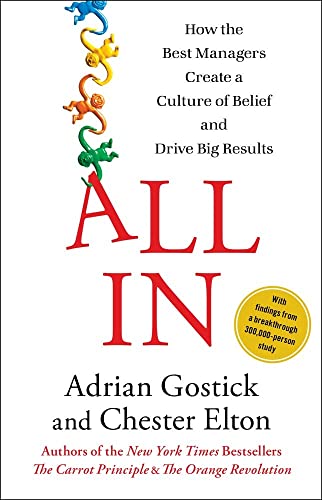
The authors of the bestsellers The Carrot Principle and The Orange Revolution present groundbreaking new findings: In the highest-performing teams and companies, managers create a “culture of belief,” following seven essential steps of leadership.
To have any hope of succeeding as a manager, you need to get your people all in.
Whether you manage the smallest of teams or a multi-continent organization, you are the owner of a work culture—congratulations—and few things will have a bigger impact on your performance than getting your people to buy into your ideas and your cause and to believe what they do matters.
Bestselling authors of The Carrot Principle and The Orange Revolution, Adrian Gostick and Chester Elton return to answer the most overlooked leadership questions of our day: Why are some managers able to get their employees to commit wholeheartedly to their culture and give that extra push that leads to outstanding results? And how can managers at any level build and sustain a profitable, vibrant work-group culture of their own?
These leading workplace experts teamed up with research giant Towers Watson to analyze an unprecedented 300,000-person study, and they made a groundbreaking finding: managers of the highest-performing work groups create a “culture of belief.” In these distinctive workplaces, people believe in their leaders and in the company’s vision, values, and goals. Employees are not only engaged but also enabled and energized (termed the three Es), which leads to astonishing results—average annual revenues three times higher than for organizations lacking such a positive culture. And this was true during a period that included this most recent recession.
Based on their extensive consulting experience and in-depth interviews with leaders and employees at exceptional companies such as American Express, Cigna, Avis Budget, Pepsi Bottling, and Hard Rock, the authors present a simple seven-step road map for creating a culture of belief: define a burning platform; create a customer focus; develop agility; share everything; partner with your talent; root for each other; and establish clear accountability. Delving into specific how-tos for each step, they share eye-opening stories of exceptional leaders in action, vividly depicting just how these powerful methods can be implemented by any manager.
All In draws on cutting-edge psychology and all of the creative genius that have made Gostick and Elton a must-read for leaders worldwide. This vital resource will empower managers everywhere to inspire a new level of commitment and performance.
Die Inhaltsangabe kann sich auf eine andere Ausgabe dieses Titels beziehen.
Über die Autorinnen und Autoren
Adrian Gostick is the New York Times bestselling coauthor of The Best Team Wins, The Carrot Principle, and All In, which are sold in more than fifty countries around the world. He is a founder of the global training firm The Culture Works, with a focus in culture, teamwork, and employee motivation. Learn more at TheCultureWorks.com or CarrotGuys.com.
Chester Elton is coauthor of The Best Team Wins, The Carrot Principle, and All In, a popular lecturer, and an influential voice in global workplace trends. He is a founder of The Culture Works and advises the leadership teams of numerous Fortune 500 firms on cultural and teamwork issues. Learn more at TheCultureWorks.com or CarrotGuys.com.
Auszug. © Genehmigter Nachdruck. Alle Rechte vorbehalten.
All In
1
Get in the Wheelbarrow
Why Aren’t They Giving Their All?
Some twenty-five thousand onlookers had turned out on June 30, 1859, as a flamboyant, mustached Frenchman known as the Great Blondin stepped out onto a three-inch cord that stretched across roaring Niagara Falls. They were in high spirits, curious to see if the daredevil would become the first person to cross the chasm on a tightrope or if he would plummet to his death. Either way it would be a day to remember.
Blondin had been born as Jean-François Gravelet and had been an acrobat since childhood, raised in the circus tents of Europe. He knew his craft, and the showman had no doubt he would be successful. It was not bravado; it was merely something he took to be a fact—as true as the sky being blue. And, as history shows, he not only crossed the fifteen-hundred-foot-wide falls without a stumble but even paused to perform a back somersault on his return trip. The breathless crowd erupted into wild cheers when he set his feet on firm ground.
The Great Blondin would cross the gorge eight times over the next decade, all with theatrical variations—blindfolded, on stilts, but most often trundling a small wheelbarrow. As you can imagine, crowds flocked to see him and he began to draw loyal devotees. According to accounts, the mob on one summer day was especially boisterous, and they gave him a chorus of hurrahs as he approached pushing his familiar barrow.
“Do you believe I can cross the falls with this wheelbarrow?” he called out.
“Yes!” they yelled as one.
“Wonderful,” he said. “Then who will get in?”
Many in the crowd laughed but then fell silent as they realized he wasn’t joking. Blondin waited as the seconds ticked by; a haze of gray cigar smoke hung just above their heads. They stood awkward and immobile. There were no takers. Blondin had hoped his fans would believe, as he did, in his infallible prowess on the high wire. They said they did, but they really didn’t.
Then someone did. Blondin’s agent, Harry Colcord, took off his silk top hat and waved it high above his head. He was volunteering.
Blondin was greatly moved by the gesture. Despite the drama of the day, he actually hadn’t intended to wheel anyone across the falls, but Colcord’s offer sparked an idea. Instead of pushing his agent then, he returned a few months later and carried Colcord across the falls on his shoulders, an amazing feat considering the man was only a few pounds lighter than the showman.
Let’s stop there. This book is clearly not about daredevils or tightrope walkers, but about a related drama that is taking place in organizations every day, all around the world. While most managers by now understand that their most reliable competitive advantage comes from their people, few of them actually know how to get people “all in”—convincing employees to truly buy into their ideas and the strategy they’ve put forward, to give that extra push that leads to outstanding results.
It’s not for lack of effort. Most leaders we meet seem to be bending over backward for their people. They walk the floor, listen respectfully to their employees’ ideas, and try to be accommodating. They’ve been taught they need to be people managers, not slaves to process, and as a result they’re focusing more, one-on-one, on the needs of each person in their care.
And yet overall performance isn’t improving, or not nearly enough.
This is backed up by the data we see. Employee engagement scores haven’t improved much at most organizations after many years of effort, and companies aren’t seeing markedly greater amounts of innovation or employee initiative. As hard as managers have been working, something’s missing: It’s culture.
Whether you manage the smallest of teams or a multicontinent organization, you are the proud owner of a culture—congratulations—and it’s important to understand that the effectiveness of that culture will have a big impact on your performance. If your culture is clear, positive, and strong, then your people will buy into your ideas and cause and, most important, will believe what they do matters and that they can make a difference. That pervasive enthusiasm and energy will spread like perfume in the atmosphere. On the other hand, if your culture is dysfunctional—chaotic, combative, or indifferent—employees will most likely spend more time thinking about why the people sitting next to them should be fired than getting fired up themselves.
Now, a reader might ask why the carrot guys are writing a book on culture. The answer is simple: We’ve worked with clients on leadership issues for almost twenty years now, and hardly a week has gone by that we haven’t excitedly called each other to talk about a fascinating corporate culture we’ve just stumbled upon. For a long time we’ve believed that culture is what makes teams and organizations great, and yet no one was talking about it in popular business literature and it seemed that no one really wanted to. Perhaps culture seemed the sole purview of CEOs and human resource departments. Unquestionably the boss of a small IT department or regional call center wouldn’t have the audacity to claim he had a culture, right?
But over the last few years something has changed. As we meet with new clients, expecting them to want us to work with them on the more focused ideas of employee recognition or teamwork, the subjects of our two last books, they keep steering the conversation back to culture. And not just their overall corporate culture; they have awoken to the fact that if the culture in their Cincinnati office isn’t working, then no amount of thank-yous or esprit de corps will help.
They have learned that if a culture works, then everything works better.
Take the case of Andrew Heath, who when we met him was the newly appointed president of the energy business of Rolls-Royce, one of the four sectors of the iconic British firm. Heath’s face lit up as he described a business improvement team of seventy people he had led years before in the company’s aerospace business. With more work than the team could reasonably achieve, he knew he needed to create a “special environment” where people would truly care about the success of the venture. He needed more than discretionary effort; he needed to create a culture “where employees would see the problem before them as a challenge rather than as something to drag them down.”
Heath realized he couldn’t achieve the assigned goals by force of character alone. He needed to change his leadership style and engage the whole team by asking them what they thought would increase their commitment to the job, what help they needed, and what would give them greater satisfaction. They came up with ideas to pair new employees with senior people, identify training needs, present above-and-beyond awards for great work (a favorite became bottles of champagne), hold regular update luncheons, and so on. Unassuming things, really, but the outcome was not only increased employee ownership and dramatic business results but also a level of camaraderie that is rare.
“We achieved more than we thought possible. The team and I had never worked so hard in our lives. It was a tough assignment, but we had such fun in the process,” Heath said. “I knew we...
„Über diesen Titel“ kann sich auf eine andere Ausgabe dieses Titels beziehen.
Suchergebnisse für All In: How the Best Managers Create a Culture of Belief...

Beispielbild für diese ISBN
All In: How the Best Managers Create a Culture of Belief and Drive Big Results
Anbieter: World of Books (was SecondSale), Montgomery, IL, USA
Verkäuferbewertung 5 von 5 Sternen

Hardback. Zustand: Good. The bestselling authors of The Carrot Principleand The Orange Revolutionprovide seven steps to creating a 'culture of belief' in the workplace. Artikel-Nr. 00063010796
Gebraucht kaufen
EUR 4,04
Versand gratis
Versand innerhalb von USA
Versand innerhalb von USA
Anzahl: Mehr als 20 verfügbar
Beispielbild für diese ISBN
All In: How the Best Managers Create a Culture of Belief and Drive Big Results
Anbieter: World of Books (was SecondSale), Montgomery, IL, USA
Verkäuferbewertung 5 von 5 Sternen
Hardback. Zustand: Very Good. The bestselling authors of The Carrot Principleand The Orange Revolutionprovide seven steps to creating a 'culture of belief' in the workplace. Artikel-Nr. 00100548424
Gebraucht kaufen
EUR 4,04
Versand gratis
Versand innerhalb von USA
Versand innerhalb von USA
Anzahl: 18 verfügbar
Beispielbild für diese ISBN
All in: How the Best Managers Create a Culture of Belief and Drive Big Results
Anbieter: ThriftBooks-Atlanta, AUSTELL, GA, USA
Verkäuferbewertung 5 von 5 Sternen
Hardcover. Zustand: As New. No Jacket. Pages are clean and are not marred by notes or folds of any kind. ~ ThriftBooks: Read More, Spend Less. Artikel-Nr. G1451659822I2N00
Gebraucht kaufen
EUR 5,96
Versand gratis
Versand innerhalb von USA
Versand innerhalb von USA
Anzahl: 1 verfügbar
Beispielbild für diese ISBN
All in: How the Best Managers Create a Culture of Belief and Drive Big Results
Anbieter: ThriftBooks-Atlanta, AUSTELL, GA, USA
Verkäuferbewertung 5 von 5 Sternen
Hardcover. Zustand: Very Good. No Jacket. May have limited writing in cover pages. Pages are unmarked. ~ ThriftBooks: Read More, Spend Less. Artikel-Nr. G1451659822I4N00
Gebraucht kaufen
EUR 5,96
Versand gratis
Versand innerhalb von USA
Versand innerhalb von USA
Anzahl: 1 verfügbar
Beispielbild für diese ISBN
All In : How the Best Managers Create a Culture of Belief and Drive Big Results
Anbieter: Better World Books, Mishawaka, IN, USA
Verkäuferbewertung 5 von 5 Sternen
Zustand: Good. 1st Edition. Pages intact with minimal writing/highlighting. The binding may be loose and creased. Dust jackets/supplements are not included. Stock photo provided. Product includes identifying sticker. Better World Books: Buy Books. Do Good. Artikel-Nr. 1378437-6
Gebraucht kaufen
EUR 6,19
Versand gratis
Versand innerhalb von USA
Versand innerhalb von USA
Anzahl: 3 verfügbar
Beispielbild für diese ISBN
All In : How the Best Managers Create a Culture of Belief and Drive Big Results
Anbieter: Better World Books, Mishawaka, IN, USA
Verkäuferbewertung 5 von 5 Sternen
Zustand: Very Good. 1st Edition. Pages intact with possible writing/highlighting. Binding strong with minor wear. Dust jackets/supplements may not be included. Stock photo provided. Product includes identifying sticker. Better World Books: Buy Books. Do Good. Artikel-Nr. 4471414-75
Gebraucht kaufen
EUR 6,19
Versand gratis
Versand innerhalb von USA
Versand innerhalb von USA
Anzahl: 1 verfügbar
Beispielbild für diese ISBN
All In : How the Best Managers Create a Culture of Belief and Drive Big Results
Anbieter: Better World Books, Mishawaka, IN, USA
Verkäuferbewertung 5 von 5 Sternen
Zustand: Very Good. 1st Edition. Former library copy. Pages intact with possible writing/highlighting. Binding strong with minor wear. Dust jackets/supplements may not be included. Includes library markings. Stock photo provided. Product includes identifying sticker. Better World Books: Buy Books. Do Good. Artikel-Nr. 10141015-6
Gebraucht kaufen
EUR 6,19
Versand gratis
Versand innerhalb von USA
Versand innerhalb von USA
Anzahl: 1 verfügbar
Beispielbild für diese ISBN
All In : How the Best Managers Create a Culture of Belief and Drive Big Results
Anbieter: Better World Books, Mishawaka, IN, USA
Verkäuferbewertung 5 von 5 Sternen
Zustand: Good. 1st Edition. Former library copy. Pages intact with minimal writing/highlighting. The binding may be loose and creased. Dust jackets/supplements are not included. Includes library markings. Stock photo provided. Product includes identifying sticker. Better World Books: Buy Books. Do Good. Artikel-Nr. 4581818-6
Gebraucht kaufen
EUR 6,19
Versand gratis
Versand innerhalb von USA
Versand innerhalb von USA
Anzahl: 1 verfügbar
Beispielbild für diese ISBN
All In: How the Best Managers Create a Culture of Belief and Drive Big Results
Anbieter: Wonder Book, Frederick, MD, USA
Verkäuferbewertung 5 von 5 Sternen
Zustand: Very Good. Very Good condition. Very Good dust jacket. A copy that may have a few cosmetic defects. May also contain light spine creasing or a few markings such as an owner's name, short gifter's inscription or light stamp. Artikel-Nr. X06A-02559
Gebraucht kaufen
EUR 7,15
Versand gratis
Versand innerhalb von USA
Versand innerhalb von USA
Anzahl: 1 verfügbar
Beispielbild für diese ISBN
All In: How the Best Managers Create a Culture of Belief and Drive Big Results
Anbieter: Wonder Book, Frederick, MD, USA
Verkäuferbewertung 5 von 5 Sternen
Zustand: Good. Good condition. Very Good dust jacket. A copy that has been read but remains intact. May contain markings such as bookplates, stamps, limited notes and highlighting, or a few light stains. Artikel-Nr. R05A-01740
Gebraucht kaufen
EUR 7,15
Versand gratis
Versand innerhalb von USA
Versand innerhalb von USA
Anzahl: 1 verfügbar