
Verwandte Artikel zu Talking Back to Facebook: The Common Sense Guide to...
Inhaltsangabe
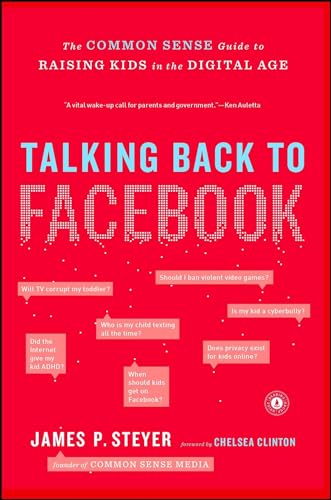
A smart, urgently needed book that helps parents and their kids navigate today’s online landscape—from the founder and CEO of the nation’s leading authority on kids and the media.
Now, more than ever, parents need help in navigating their kids’ online, media-saturated lives. Jim Steyer, founder and CEO of Common Sense Media, the nation’s leading kidsand- media organization, and the father of four children, knows that many parents and teachers—unlike their technology-savvy kids—may be tourists in the online world.
In this essential book, Steyer—a frequent commentator on national TV and radio— offers an engaging blend of straightforward advice and anecdotes that address what he calls RAP, the major pitfalls relating to kids’ use of media and technology: relationship issues, attention/addiction problems, and the lack of privacy. Instead of shielding children completely from online images and messages, Steyer’s practical approach gives parents essential tools to help filter content, preserve good relationships with their children, and make common sense, value-driven judgments for kids of all ages.
Not just about Facebook, this comprehensive, no-nonsense guide to the online world, media, and mobile devices belongs in the hands of all parents and educators raising kids in today’s digital age.
Die Inhaltsangabe kann sich auf eine andere Ausgabe dieses Titels beziehen.
Über die Autorin bzw. den Autor
Jim Steyer is the CEO of Common Sense Media. He has spent more than twenty years as one of the most respected experts and entrepreneurs on issues related to children's policy and media in the United States. Prior to founding Common Sense, Jim was Chairman and CEO of JP Kids and served as President of Children Now, a leading national advocacy and media organization for children. In addition to his duties at Common Sense, Jim teaches popular courses on civil rights, civil liberties, and children's issues at Stanford University. Jim grew up in New York City and now lives with his family in the Bay Area.
Auszug. © Genehmigter Nachdruck. Alle Rechte vorbehalten.
Talking Back to Facebook
Introduction
It’s 6:30 p.m.—dinnertime at our house—and food’s on the table. I call seven-year-old Jesse, who’s out on the street riding his bike, and he slowly strolls in with a big grin on his face.
“Hey, Dad,” he says, “can I borrow your iPhone after dinner so I can play that bowling game on it for ten minutes?”
I laugh. He knows the answer, but he’s asking anyway.
I start rounding up our other three kids. Carly, fourteen, is in the living room, bopping her head rhythmically while she listens to music on her iPod. I stand in front of her, loudly intoning—to penetrate her earbuds—that it’s time for dinner.
“Just a sec, Dad,” she says, nodding her head. “Lemme finish this song.”
I have no idea what she’s listening to, and I still haven’t seen our seventeen-year-old, Kirk, but I know where I’ll find him. I walk into the family room, where Kirk is glued to the big-screen TV, clutching his Xbox controller and playing his favorite video game, FIFA Soccer.
“Kirk,” I tell him, “dinner’s ready.”
“Can’t I finish the game, Dad?” he begs. “Just a few more minutes.”
“Nope! That’s enough video games for today. You’ve hit your one-hour limit. It’s time for dinner, now! But after that,” I say, “why don’t we toss the baseball outside? I’d like to see that new curveball you’ve been talking about.”
He grunts, switches off his controller, and mutters a few monosyllables as he follows me to the dinner table. The other kids are already sitting down, including Lily, who just graduated from high school.
“Hey, Daddy, how was your day? Can I borrow the car tonight?” she asks, sticking her cell phone in her shirt pocket. “I just saw on Facebook that there’s a party, and all my friends are going.” She gives me that adorable grin that always works.
My wife, Liz, and I smile at each other. We’re glad to have all the kids at home for a family dinner. We try to eat together at least four or five times a week. All phones and devices are strictly banned at the dinner table, parents’ included. It’s an important ritual: forty-five minutes or so of completely unplugged, screen-free time in a family life that’s overflowing with digital media. Like most kids today, Lily, Kirk, Carly, and Jesse live much of their lives in a digital world. Technology is their native language, and as devices converge and become more capable and mobile, they’re using them—far more easily than Liz and I—to connect, create, and communicate constantly, from almost anywhere, about virtually everything.
As parents, where do we draw the line? How do we balance the obvious benefits of computers and other digital technology with the growing risks of addiction, distraction, loss of innocence, and lack of privacy? With our kids’ digital reality changing so fast, how do we even know what they’re being exposed to, what we should worry about, and what common sense rules we should set?
Personally, new digital technology often seems overwhelming to me. I feel like I’m always playing catch-up, even though it’s my job as founder and CEO of Common Sense Media, the nation’s leading authority on the effects of media and technology on kids. The more I speak to education and child development experts and thousands of fellow parents and teachers around the country, the more I’m moved by the enormity of the changes occurring before our eyes with so little discussion and understanding of their impact on kids and society.
What’s at Stake for Childhood and Adolescence
Howard Gardner of the Harvard Graduate School of Education, who developed the idea of multiple intelligences, calls this an “epochal change.” He compares the revolution in digital media to the invention of the printing press because of its extraordinary impact on the way we communicate, share information, and interact with other human beings. It’s hard to believe that the biggest technology challenge parents faced in 1990 was controlling their kids’ use of telephone landlines. Boy, have things changed, and our kids’ social, emotional, and cognitive development skills have been profoundly affected. At times, it seems like they’re subjects of a vast, uncontrolled social experiment. And it’s an experiment that has dramatic implications for our notions of childhood, learning, and human relationships. As parents and educators, we have to engage with this new reality and influence it, as well as our kids, in healthy, responsible ways.
The fact is, kids are thrown into this brave new world from the day they’re born. When parents post cute pictures of their babies in adorable outfits and poses, they’re creating the first outlines of their kids’ digital footprint. By the time they’re two, more than 90 percent of all children have an online history, and many have figured out how to take pictures and watch cartoons on their parents’ smartphones. At five, many are typing on a computer keyboard and downloading and playing games on cell phones and tablet computers. I clearly remember the day when our daughter Carly, at age six, “Googled” herself for the first time.
By seven or eight, some kids have phones of their own, and they’re playing in virtual worlds and staring at screens when they’re together with friends. At ten or eleven, they’re downloading and streaming Web content, playing online games like World of Warcraft, and begging for smartphones and Facebook accounts. By twelve or thirteen, most kids have Facebook pages—with or without their parents’ permission. They’re using technology in the classroom and texting friends or Facebooking them instead of talking to them in person. Kids are getting online at home, at friends’ houses, at the library, and on the bus. As they become teens, they fully inhabit a virtual world with online and offline identities and special languages, social rules, and relationships—usually with no adult supervision. They’re performing, creating, and posing for invisible audiences—often unaware that, even when they change and mature, their online errors of judgment and personal postings might not go away. There’s no “eraser” button, and the consequences of youthful mistakes can be enormously painful.
For the past five years, I’ve been witnessing how social networks, especially Facebook, have transformed the lives of my students at Stanford University, where I teach classes on civil rights, civil liberties, and children’s issues. The technology has literally changed the way people relate to each other, get together, and present their image to the world. Interestingly, when I polled my class recently, more than half of my students said they wished Facebook didn’t exist. Several of them said they didn’t like the way it drained so much of their time and affected their interactions with friends and peers. Many told me that Facebook can diminish the quality and depth of personal relationships and weaken their basic communications skills. But, of course, they had to be on it, they said, because everyone else was.
Facebook, the world’s largest social network site, was cofounded by Mark Zuckerberg and his Harvard friend Eduardo Saverin in 2004. It started out as a social networking tool designed exclusively for students at Harvard, but it quickly spread to students at other elite universities like Stanford, Yale, and Columbia. Soon...
„Über diesen Titel“ kann sich auf eine andere Ausgabe dieses Titels beziehen.
Suchergebnisse für Talking Back to Facebook: The Common Sense Guide to...

Beispielbild für diese ISBN
Talking Back to Facebook The C
Anbieter: World of Books (was SecondSale), Montgomery, IL, USA
Verkäuferbewertung 5 von 5 Sternen

Zustand: Very Good. Item in very good condition! Textbooks may not include supplemental items i.e. CDs, access codes etc. Artikel-Nr. 00104164575
Gebraucht kaufen
EUR 4,95
Versand gratis
Versand innerhalb von USA
Versand innerhalb von USA
Anzahl: 1 verfügbar
Beispielbild für diese ISBN
Talking Back to Facebook The C
Anbieter: World of Books (was SecondSale), Montgomery, IL, USA
Verkäuferbewertung 5 von 5 Sternen
Zustand: Good. Good condition ex-library book with usual library markings and stickers. Artikel-Nr. 00107739488
Gebraucht kaufen
EUR 4,95
Versand gratis
Versand innerhalb von USA
Versand innerhalb von USA
Anzahl: 1 verfügbar
Beispielbild für diese ISBN
Talking Back to Facebook The C
Anbieter: World of Books (was SecondSale), Montgomery, IL, USA
Verkäuferbewertung 5 von 5 Sternen
Zustand: Acceptable. Item in acceptable condition! Textbooks may not include supplemental items i.e. CDs, access codes etc. Artikel-Nr. 00102647772
Gebraucht kaufen
EUR 4,95
Versand gratis
Versand innerhalb von USA
Versand innerhalb von USA
Anzahl: 2 verfügbar
Beispielbild für diese ISBN
Talking Back to Facebook: The Common Sense Guide to Raising Kids in the Digital Age
Verlag:
Scribner (edition Original), 2012
ISBN 10: 145165734X
ISBN 13: 9781451657340
Gebraucht
Paperback
Anbieter: BooksRun, Philadelphia, PA, USA
Verkäuferbewertung 5 von 5 Sternen
Paperback. Zustand: Very Good. Original. It's a well-cared-for item that has seen limited use. The item may show minor signs of wear. All the text is legible, with all pages included. It may have slight markings and/or highlighting. Artikel-Nr. 145165734X-8-1
Gebraucht kaufen
EUR 4,98
Versand gratis
Versand innerhalb von USA
Versand innerhalb von USA
Anzahl: 1 verfügbar
Beispielbild für diese ISBN
Talking Back to Facebook: The Common Sense Guide to Raising Kids in the Digital Age
Anbieter: Wonder Book, Frederick, MD, USA
Verkäuferbewertung 5 von 5 Sternen
Zustand: Very Good. Very Good condition. A copy that may have a few cosmetic defects. May also contain light spine creasing or a few markings such as an owner's name, short gifter's inscription or light stamp. Artikel-Nr. D14D-01860
Gebraucht kaufen
EUR 6,33
Versand gratis
Versand innerhalb von USA
Versand innerhalb von USA
Anzahl: 1 verfügbar
Beispielbild für diese ISBN
Talking Back to Facebook : The Common Sense Guide to Raising Kids in the Digital Age
Anbieter: Better World Books: West, Reno, NV, USA
Verkäuferbewertung 5 von 5 Sternen
Zustand: Very Good. Original. Pages intact with possible writing/highlighting. Binding strong with minor wear. Dust jackets/supplements may not be included. Stock photo provided. Product includes identifying sticker. Better World Books: Buy Books. Do Good. Artikel-Nr. 17549077-6
Gebraucht kaufen
EUR 6,47
Versand gratis
Versand innerhalb von USA
Versand innerhalb von USA
Anzahl: 1 verfügbar
Beispielbild für diese ISBN
Talking Back to Facebook : The Common Sense Guide to Raising Kids in the Digital Age
Anbieter: Better World Books, Mishawaka, IN, USA
Verkäuferbewertung 5 von 5 Sternen
Zustand: Good. Original. Former library copy. Pages intact with minimal writing/highlighting. The binding may be loose and creased. Dust jackets/supplements are not included. Includes library markings. Stock photo provided. Product includes identifying sticker. Better World Books: Buy Books. Do Good. Artikel-Nr. GRP104791129
Gebraucht kaufen
EUR 6,47
Versand gratis
Versand innerhalb von USA
Versand innerhalb von USA
Anzahl: 3 verfügbar
Beispielbild für diese ISBN
Talking Back to Facebook : The Common Sense Guide to Raising Kids in the Digital Age
Anbieter: Better World Books: West, Reno, NV, USA
Verkäuferbewertung 5 von 5 Sternen
Zustand: Very Good. Original. Former library copy. Pages intact with possible writing/highlighting. Binding strong with minor wear. Dust jackets/supplements may not be included. Includes library markings. Stock photo provided. Product includes identifying sticker. Better World Books: Buy Books. Do Good. Artikel-Nr. GRP101680249
Gebraucht kaufen
EUR 6,47
Versand gratis
Versand innerhalb von USA
Versand innerhalb von USA
Anzahl: 1 verfügbar
Beispielbild für diese ISBN
Talking Back to Facebook
Anbieter: ThriftBooks-Atlanta, AUSTELL, GA, USA
Verkäuferbewertung 5 von 5 Sternen
Paperback. Zustand: Good. No Jacket. Pages can have notes/highlighting. Spine may show signs of wear. ~ ThriftBooks: Read More, Spend Less. Artikel-Nr. G145165734XI3N00
Gebraucht kaufen
EUR 6,94
Versand gratis
Versand innerhalb von USA
Versand innerhalb von USA
Anzahl: 1 verfügbar
Beispielbild für diese ISBN
Talking Back to Facebook: The Common Sense Guide to Raising Kids in the Digital Age
Anbieter: medimops, Berlin, Deutschland
Verkäuferbewertung 5 von 5 Sternen
Zustand: good. Befriedigend/Good: Durchschnittlich erhaltenes Buch bzw. Schutzumschlag mit Gebrauchsspuren, aber vollständigen Seiten. / Describes the average WORN book or dust jacket that has all the pages present. Artikel-Nr. M0145165734X-G
Gebraucht kaufen
EUR 4,37
EUR 10,00 Versand
Versand von Deutschland nach USA
Versand von Deutschland nach USA
Anzahl: 2 verfügbar