
Verwandte Artikel zu The Power of Product Platforms
Inhaltsangabe
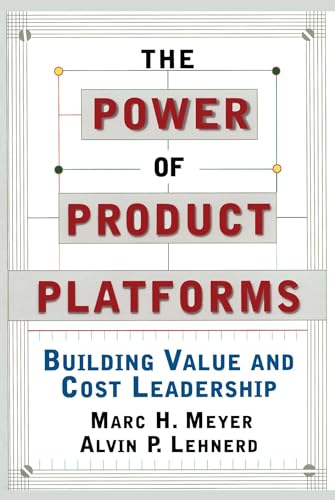
Most companies know that long-term success does not hinge on any single product but on a continuous stream of value-rich products that target growth markets. Yet many firms inexplicably develop one product at a time, and by doing so fail to embrace commonality, compatibility, standardization, or modularization among different products and product lines. At last, in this timely book, Marc H. Meyer and Alvin P. Lehnerd provide a formula for turning products into profits, enabling companies to design technologically superior products more easily. Their solution is, in two words, PRODUCT PLATFORMS. They argue that firms must focus their energies on developing families of products simultaneously which share common components and technology.
The authors describe how the champions of product development separate themselves from less sophisticated companies by building entire families of strong products from a single "platform" of common product structures, technologies, and automated product processes. These successful companies recognize and respond to new market opportunities by integrating core skills and technology in the form of new products. In this easy-to-read and practical book, the authors masterfully elucidate this dynamic and forward-thinking strategy which enables companies to develop innovative products faster, more cheaply, and with less effort.
Drawing on in-depth case studies and personal experience with successful companies such as Hewlett-Packard, EMC, Black & Decker, and Boeing, Meyer and Lehnerd show managers how to create extraordinary products and thereby set the standard for combined value and cost leadership in their products. They argue that when a company's products are robust—highly functional, elegant in their design, reasonably priced, and a pleasure to use—the corporation will be equally robust. More importantly, The Power of Product Platforms reveals the methodology and organizational approach for designing, developing, and revitalizing strong products that enable the firm to make the transition from one generation of technology to the next. The authors also explain how well-designed product platforms can generate streams of derivative products through a continuous systematic process of renewal.
Meyer and Lehnerd apply this methodology to a broad range of industries; manufacturing in both consumer and industrial markets, software firms, and Internet information services providers.
This clear prescription for transforming the bottom line by aggressively managing product development and innovation will become required reading for large and small corporations alike, including entrepreneurs, all of whom depend on the excellence of their new products for growth.
Die Inhaltsangabe kann sich auf eine andere Ausgabe dieses Titels beziehen.
Über die Autorinnen und Autoren
Alvin P. Lehnerd has held executive positions at Black & Decker, Sunbeam, and Steelcase. He has led several well-known developments and innovations resulting in new product successes, including Black & Decker's Dustbuster, Sunbeam's first electronic auto-shut off and global iron product lines, and the complete redesign on Black & Decker's double insulated consumer power tools. He teaches at Northeastern University, University of Pennsylvania, and at the MIT Sloan School of Management.
Marc H. Meyer is Associate Professor of Management at Northeastern University's College of Business Administration, Research Director of the College's Center for Technology Management, and has been a Visiting Associate Professor at the MIT Sloan School of Management. Dr. Meyer is also a co-founder of three software companies and consults actively to leading manufacturers in high-tech industries.
Auszug. © Genehmigter Nachdruck. Alle Rechte vorbehalten.
Chapter 1: The Power of Product Platforms
Product-making enterprises -- the ones that survive, that is -- are evolutionary entities. Their product portfolios change through periodic enhancements to basic product and manufacturing technologies. Some of the changes are true breakthroughs, while others are merely incremental. The appropriate changes lead to market success; those that are not appropriate lead to failure.
The long-term success of an enterprise depends on a stream of new products -- some replacing older ones, others pioneering new markets. As the world economy becomes more integrated, many new products have to be global products, satisfying worldwide customer needs and regulatory requirements. The stream of new global products, exploiting advances in both product technologies and technologies used to manufacture, distribute, and provide support, is what provides the fuel for corporate growth and renewal.
FOCUSING ON SINGLE PRODUCTS
Regardless of the importance creating streams of new products, traditional methods for managing this vital business function usually fail to deliver in the long run. That is because companies typically design new products one product at a time. The single product must compete for resources against other projects in the corporation's portfolio. Every product team must justify its own existence repeatedly throughout the process of development and commercialization. Approval gates swing open and shut as single development projects move forward. Budget, break-even, and cycle-time measures are all typically calculated on the basis of single products.
The end result of this single-product focus is a failure to embrace commonality, compatibility, standardization, or modularization among different products and product lines. For a given company, the evidence for lack of commonality is found in the products themselves and their component parts. One will observe that the products use different materials for the same purposes; different switches when one kind of switch would do; a technology developed in-house at great expense to serve a single product; components with the same technical specifications but different sizes (so they cannot be interchanged); and on and on. That is where a product portfolio can easily end up when it is developed and managed one product at a time.
Now ask yourself: Would it not be better to build an entire family of products that leverage a common market understanding, common product technologies, and a common set of highly automated production processes? Rather than have separate development teams each working on single products, wouldn't it be better to have them join forces in building a common platform or a design from which a host of derivative products could be effectively and efficiently created? In short, might not the entire product portfolio of a business segment be tackled en masse?
To see that this alternative to a single-product mentality is not so far-fetched, but rather highly feasible and operationally viable, let us reach back to the experience of Black & Decker. Most readers probably own a Black & Decker power tool. There is a very good reason for this. Black & Decker drove most of its competitors out of the consumer segments of the power tools business by developing effective product platforms for its major product families.
RENEWING THE PRODUCT PORTFOLIO AT BLACK & DECKER
In the early 1970s Black & Decker's consumer power tool product portfolio was broad and deep, consisting of eighteen power tool groups. Eight groups contributed 73 percent of sales and 91 percent of units sold: drills, jigsaws, shrub and hedge trimmers, power hammers, circular saws, grinders and polishers, finishing sanders, and edgers -- 122 different models in all.
As with most established companies, Black & Decker's product portfolio had evolved over many years; by 1970 it was a collection of uncoordinated designs, materials, and technologies. Its power tools relied on thirty different motors, each manufactured by a different set of tooling. Sixty different motor housings were needed to accommodate variations in power and application (e.g. a drill versus a saw or sander). Besides, the company relied on 104 different armatures, the part that connects the motor to the "business end" of the tool (e.g., to the drill bit or the saw blade). Each of those armatures, in turn, required its own tooling. Dozens of different switches and buttons populated the company's parts bins and bills-of-materials.
The vast majority of Black & Decker's products had crept into the power tool portfolio one at a time, with little thought given to how economies might be achieved through shared components and manufacturing processes. The thousands of parts needed for the products required thousands of square feet of stockroom space and hundreds of people to order, shelve, and inventory them. Each unique product design required either a dedicated production line or frequent and time-consuming line changeovers. Inelegant designs translated into high labor inputs.
Despite those impediments, Black & Decker had grown into a major player in consumer power tools, perhaps because its competitors also followed the same one-at-a-time approach to product development. Its products worked as well as those of rivals and were priced competitive with those of other domestic manufacturers. Circa 1970, Black & Decker controlled about 20 percent of market share worth about $200 million annually in revenue. Despite its comfortable situation, management saw three dark clouds on the horizon:
* Offshore manufacturers were making inroads into the North American market and attacking emerging markets overseas.
* Inflation and the rising cost of labor, materials, services, and capital goods were devouring Black & Decker's margins. To maintain constant labor-cost content in its products, management calculated that about one-third of the labor cost would have to be removed from products over the next three to four years. While that would be difficult for any single product, it would be impossible for the company's entire power tool line without making use of design standardization, automation, better use of materials and floor space, and intelligent capital planning.
* Consumers and regulators would be requiring higher standards of safety -- specifically, adding a backup barrier of insulation around the power tool motors to protect the users from electrical shock if the existing insulation system failed. Regulatory mandates for double insulation had already taken hold in Europe and were expected to surface in the American market. This would create havoc for Black & Decker's production process. Its management estimated that redesigning all its power tools for double insulation one product at a time would take nearly a decade.
Black & Decker's Board and its management team understood that those threats could not be met with small measures. They also understood that their competitors faced the same problems. "If we can respond more rapidly and effectively," they reasoned, "the threats we face as an enterprise might be turned into opportunities to dominate our industry."
f0 The Double Insulation Program
The need to adopt double insulation turned out to be the catalyst for renewal of the entire Black & Decker power tool portfolio. Management started the Double Insulation Program with a clear mission: (1) redesign all consumer power tools at the same time; (2) redesign manufacturing simultaneously so that all the new products could be manufactured at substantial cost advantage; and (3) offer double insulated products at no increase in price to the consumer. The implication of this mission was that current consumer...
„Über diesen Titel“ kann sich auf eine andere Ausgabe dieses Titels beziehen.
Suchergebnisse für The Power of Product Platforms

Beispielbild für diese ISBN
The Power of Product Platforms
Anbieter: World of Books (was SecondSale), Montgomery, IL, USA
Verkäuferbewertung 5 von 5 Sternen

Paperback. Zustand: Good. Most companies know that long-term success does not hinge on any single product but on a continuous stream of value-rich products that target growth markets. Yet many firms inexplicably develop one product at a time, and by doing so fail to embrace commonality, compatibility, standardization, or modularization among different products and product lines. At last, in this timely book, Marc H. Meyer and Alvin P. Lehnerd provide a formula for turning products into profits, enabling companies to design technologically superior products more easily. Their solution is, in two words, PRODUCT PLATFORMS. They argue that firms must focus their energies on developing families of products simultaneously which share common components and technology.The authors describe how the champions of product development separate themselves from less sophisticated companies by building entire families of strong products from a single "platform" of common product structures, technologies, and automated product processes. These successful companies recognize and respond to new market opportunities by integrating core skills and technology in the form of new products. In this easy-to-read and practical book, the authors masterfully elucidate this dynamic and forward-thinking strategy which enables companies to develop innovative products faster, more cheaply, and with less effort.Drawing on in-depth case studies and personal experience with successful companies such as Hewlett-Packard, EMC, Black & Decker, and Boeing, Meyer and Lehnerd show managers how to create extraordinary products and thereby set the standard for combined value and cost leadership in their products. They argue that when a company's products are robusthighly functional, elegant in their design, reasonably priced, and a pleasure to usethe corporation will be equally robust. More importantly, The Power of Product Platforms reveals the methodology and organizational approach for designing, developing, and revitalizing strong products that enable the firm to make the transition from one generation of technology to the next. The authors also explain how well-designed product platforms can generate streams of derivative products through a continuous systematic process of renewal.Meyer and Lehnerd apply this methodology to a broad range of industries; manufacturing in both consumer and industrial markets, software firms, and Internet information services providers.This clear prescription for transforming the bottom line by aggressively managing product development and innovation will become required reading for large and small corporations alike, including entrepreneurs, all of whom depend on the excellence of their new products for growth. Artikel-Nr. 00098406540
Gebraucht kaufen
EUR 9,33
Versand gratis
Versand innerhalb von USA
Versand innerhalb von USA
Anzahl: 2 verfügbar
Beispielbild für diese ISBN
The Power of Product Platforms
Anbieter: ThriftBooks-Atlanta, AUSTELL, GA, USA
Verkäuferbewertung 5 von 5 Sternen
Paperback. Zustand: Fair. No Jacket. Readable copy. Pages may have considerable notes/highlighting. ~ ThriftBooks: Read More, Spend Less. Artikel-Nr. G1451655304I5N00
Gebraucht kaufen
EUR 12,76
Versand gratis
Versand innerhalb von USA
Versand innerhalb von USA
Anzahl: 1 verfügbar
Beispielbild für diese ISBN
The Power of Product Platforms
Anbieter: ThriftBooks-Dallas, Dallas, TX, USA
Verkäuferbewertung 5 von 5 Sternen
Paperback. Zustand: Very Good. No Jacket. May have limited writing in cover pages. Pages are unmarked. ~ ThriftBooks: Read More, Spend Less. Artikel-Nr. G1451655304I4N00
Gebraucht kaufen
EUR 12,76
Versand gratis
Versand innerhalb von USA
Versand innerhalb von USA
Anzahl: 1 verfügbar
Beispielbild für diese ISBN
The Power of Product Platforms
Anbieter: Ria Christie Collections, Uxbridge, Vereinigtes Königreich
Verkäuferbewertung 5 von 5 Sternen
Zustand: New. In English. Artikel-Nr. ria9781451655308_new
Neu kaufen
EUR 21,96
EUR 11,17 Versand
Versand von Vereinigtes Königreich nach USA
Versand von Vereinigtes Königreich nach USA
Anzahl: Mehr als 20 verfügbar
Beispielbild für diese ISBN
The Power of Product Platforms: Building Value and Cost Leadership
Anbieter: Revaluation Books, Exeter, Vereinigtes Königreich
Verkäuferbewertung 5 von 5 Sternen
Paperback. Zustand: Brand New. reprint edition. 288 pages. 9.00x6.00x0.75 inches. In Stock. Artikel-Nr. x-1451655304
Neu kaufen
EUR 22,95
EUR 11,92 Versand
Versand von Vereinigtes Königreich nach USA
Versand von Vereinigtes Königreich nach USA
Anzahl: 2 verfügbar