
Verwandte Artikel zu The Smartest Kids in the World: And How They Got That...
Inhaltsangabe
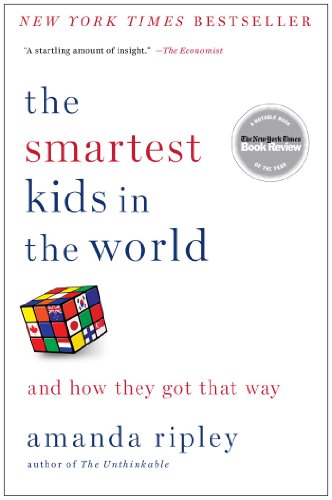
How do other countries create “smarter” kids? What is it like to be a child in the world’s new education superpowers? The Smartest Kids in the World “gets well beneath the glossy surfaces of these foreign cultures and manages to make our own culture look newly strange....The question is whether the startling perspective provided by this masterly book can also generate the will to make changes” (The New York Times Book Review).
In a handful of nations, virtually all children are learning to make complex arguments and solve problems they’ve never seen before. They are learning to think, in other words, and to thrive in the modern economy. Inspired to find answers for our own children, author and Time magazine journalist Amanda Ripley follows three Americans embedded in these countries for one year. Kim, fifteen, raises $10,000 so she can move from Oklahoma to Finland; Eric, eighteen, trades his high-achieving Minnesota suburb for a booming city in South Korea; and Tom, seventeen, leaves a historic Pennsylvania village for Poland.
Through these young informants, Ripley meets battle-scarred reformers, sleep-deprived zombie students, and a teacher who earns $4 million a year. Their stories, along with groundbreaking research into learning in other cultures, reveal a pattern of startling transformation: none of these countries had many “smart” kids a few decades ago. Things had changed. Teaching had become more rigorous; parents had focused on things that mattered; and children had bought into the promise of education.
Die Inhaltsangabe kann sich auf eine andere Ausgabe dieses Titels beziehen.
Über die Autorin bzw. den Autor
Amanda Ripley is the New York Times bestselling author of The Smartest Kids in the World, High Conflict, and The Unthinkable. She writes for The Atlantic, Politico, The Washington Post, The New York Times, and The Wall Street Journal, among other publications.
Von der hinteren Coverseite
Amanda Ripley upends American assumptions about what goes into building a good student.
Auszug. © Genehmigter Nachdruck. Alle Rechte vorbehalten.
prologue
For most of my career at Time and other magazines, I worked hard to avoid education stories. If my editors asked me to write about schools or tests, I countered with an idea about terrorism, plane crashes, or a pandemic flu. That usually worked.
I didn’t say so out loud, but education stories seemed, well, kind of soft. The articles tended to be headlined in chalkboard font and festooned with pencil doodles. They were brimming with good intentions but not much evidence. The people quoted were mostly adults; the kids just turned up in the photos, smiling and silent.
Then, an editor asked me to write about a controversial new leader of Washington, D.C.’s public schools. I didn’t know much about Michelle Rhee, except that she wore stiletto heels and tended to say “crap” a lot in interviews. So, I figured it would be a good story, even if it meant slipping into the fog of education.
But something unexpected happened in the fog. I spent months talking to kids, parents, and teachers, as well as people who have been creatively researching education in new ways. Pretty soon I realized that Rhee was interesting, but she was not the biggest mystery in the room.
The real mystery was this: Why were some kids learning so much—and others so very little?
Education was suddenly awash in data; we knew more than ever about what was happening—or failing to happen—from one neighborhood or classroom to the next. And it didn’t add up. Everywhere I went I saw nonsensical ups and downs in what kids knew: in rich neighborhoods and poor, white neighborhoods and black, public schools and private. The national data revealed the same peaks and valleys, like a sprawling, nauseating roller coaster. The dips and turns could be explained in part by the usual narratives of money, race, or ethnicity. But not entirely. Something else was going on, too.
Over the next few years, as I wrote more stories about education, I kept stumbling over this mystery. At Kimball Elementary School in Washington, D.C., I saw fifth graders literally begging their teacher to let them solve a long division problem on the chalkboard. If they got the answer right, they would pump their fists and whisper-shout, “Yes!” This was a neighborhood where someone got murdered just about every week, a place with 18 percent unemployment.
In other places, I saw kids bored out of their young minds, kids who looked up when a stranger like me walked into the room, watching to see if I would, please God, create some sort of distraction to save them from another hour of nothingness.
For a while, I told myself that this was the variation you’d expect from one neighborhood to the next, from one principal or teacher to another. Some kids got lucky, I supposed, but most of the differences that mattered had to do with money and privilege.
Then one day I saw this chart, and it blew my mind.
The United States might have remained basically flat over time, but that was the exception, it turned out. Look at Finland! It had rocketed from the bottom of the world to the top, without pausing for breath. And what was going on in Norway, right next door, which seemed to be slip sliding into the abyss, despite having virtually no child poverty? And there was Canada, careening up from mediocrity to the heights of Japan. If education was a function of culture, could culture change that dramatically—that fast?
Worldwide, children’s skills rose and fell in mysterious and hopeful ways, sometimes over short periods of time. The mystery I’d noticed in Washington, D.C., got far more interesting when viewed from outer space. The vast majority of countries did not manage to educate all their kids to high levels, not even all of their better-off kids. Compared to most countries, the United States was typical, not much better nor much worse. But, in a small number of countries, really just a handful of eclectic nations, something incredible was happening. Virtually all kids were learning critical thinking skills in math, science, and reading. They weren’t just memorizing facts; they were learning to solve problems and adapt. That is to say, they were training to survive in the modern economy.
How to explain it? American kids were better off, on average, than the typical child in Japan, New Zealand, or South Korea, yet they knew far less math than those children. Our most privileged teenagers had highly educated parents and attended the richest schools in the world, yet they ranked eighteenth in math compared to their privileged peers around the world, scoring well below affluent kids in New Zealand, Belgium, France, and Korea, among other places. The typical child in Beverly Hills performed below average, compared to all kids in Canada (not some other distant land, Canada!). A great education by the standards of suburban America looked, from afar, exceedingly average.
At first, I told myself to resist the hype. Did it really matter if we ranked number one in the world in education outcomes? Or even number ten? Our elementary students did fine on international tests, thank you very much, especially in reading. The problems arose in math and science, and they became most obvious when our kids grew into teenagers. That’s when American students scored twenty-sixth on a test of critical thinking in math, below average for the developed world. But, so what? Our teenagers had performed at or below average on international tests for as long as anyone had been counting. It had not mattered much to our economy so far; why should it matter in the future?
The United States was a big, diverse country. We had other advantages that overwhelmed our K-12 mediocrity, right? We still had world-class research universities, and we continued to invest more in research and development than any other nation. It was easier to start a business here than in most places on earth. The values of hard work and self-sufficiency coursed like electricity through the United States, just as they always had.
But everywhere I went as a reporter, I saw reminders that the world had changed. The 2,300 days that our kids spent in school before high-school graduation mattered more than ever before. In Oklahoma, the CEO of the company that makes McDonald’s apple pies told me she had trouble finding enough Americans to handle modern factory jobs—during a recession. The days of rolling out dough and packing pies in boxes were over. She needed people who could read, solve problems, and communicate what had happened on their shift, and there weren’t enough of them coming out of Oklahoma’s high schools and community colleges.
The head of Manpower, a staffing and recruiting firm with offices in eighty-two countries, said one of the hardest jobs to fill anywhere was the sales job. Once upon a time, a salesperson had to have thick skin and a good golf game. Over the years, however, products and financial markets had become wildly more complex, and information had become available to everyone, including the customer. Relationships were no longer everything. To succeed, salespeople had to understand the increasingly sophisticated and customizable products they were selling almost as well as the engineers who worked on them.
Rather suddenly, academic mediocrity had become a heavier legacy to bear. Without a high-school diploma, you couldn’t work as a garbage collector in New York City; you couldn’t join the Air Force. Yet a quarter of our kids still walked out of high school and never came back.
Not long ago, zero countries had a better high-school graduation rate than the United States; by 2009, about twenty countries did. In an era in which knowledge...
„Über diesen Titel“ kann sich auf eine andere Ausgabe dieses Titels beziehen.
Suchergebnisse für The Smartest Kids in the World: And How They Got That...

Beispielbild für diese ISBN
The Smartest Kids in the World
Anbieter: World of Books (was SecondSale), Montgomery, IL, USA
Verkäuferbewertung 5 von 5 Sternen

Zustand: Acceptable. Item in acceptable condition! Textbooks may not include supplemental items i.e. CDs, access codes etc. Artikel-Nr. 00106596705
Gebraucht kaufen
EUR 3,52
Versand gratis
Versand innerhalb von USA
Versand innerhalb von USA
Anzahl: 4 verfügbar
Beispielbild für diese ISBN
The Smartest Kids in the World
Anbieter: World of Books (was SecondSale), Montgomery, IL, USA
Verkäuferbewertung 5 von 5 Sternen
Zustand: Very Good. Item in very good condition! Textbooks may not include supplemental items i.e. CDs, access codes etc. Artikel-Nr. 00107534693
Gebraucht kaufen
EUR 3,52
Versand gratis
Versand innerhalb von USA
Versand innerhalb von USA
Anzahl: 17 verfügbar
Beispielbild für diese ISBN
The Smartest Kids in the World
Anbieter: World of Books (was SecondSale), Montgomery, IL, USA
Verkäuferbewertung 5 von 5 Sternen
Zustand: Good. Item in good condition. Textbooks may not include supplemental items i.e. CDs, access codes etc. Artikel-Nr. 00097347517
Gebraucht kaufen
EUR 3,52
Versand gratis
Versand innerhalb von USA
Versand innerhalb von USA
Anzahl: Mehr als 20 verfügbar
Beispielbild für diese ISBN
The Smartest Kids in the World: And How They Got That Way
Anbieter: ThriftBooks-Dallas, Dallas, TX, USA
Verkäuferbewertung 5 von 5 Sternen
Paperback. Zustand: Very Good. No Jacket. May have limited writing in cover pages. Pages are unmarked. ~ ThriftBooks: Read More, Spend Less. Artikel-Nr. G145165443XI4N00
Gebraucht kaufen
EUR 5,82
Versand gratis
Versand innerhalb von USA
Versand innerhalb von USA
Anzahl: 3 verfügbar
Beispielbild für diese ISBN
The Smartest Kids in the World: And How They Got That Way
Anbieter: ThriftBooks-Atlanta, AUSTELL, GA, USA
Verkäuferbewertung 5 von 5 Sternen
Paperback. Zustand: Very Good. No Jacket. May have limited writing in cover pages. Pages are unmarked. ~ ThriftBooks: Read More, Spend Less. Artikel-Nr. G145165443XI4N00
Gebraucht kaufen
EUR 5,82
Versand gratis
Versand innerhalb von USA
Versand innerhalb von USA
Anzahl: 3 verfügbar
Beispielbild für diese ISBN
The Smartest Kids in the World: And How They Got That Way
Anbieter: ThriftBooks-Atlanta, AUSTELL, GA, USA
Verkäuferbewertung 5 von 5 Sternen
Paperback. Zustand: Very Good. No Jacket. Former library book; May have limited writing in cover pages. Pages are unmarked. ~ ThriftBooks: Read More, Spend Less. Artikel-Nr. G145165443XI4N10
Gebraucht kaufen
EUR 5,82
Versand gratis
Versand innerhalb von USA
Versand innerhalb von USA
Anzahl: 1 verfügbar
Beispielbild für diese ISBN
The Smartest Kids in the World: And How They Got That Way
Anbieter: ThriftBooks-Phoenix, Phoenix, AZ, USA
Verkäuferbewertung 5 von 5 Sternen
Paperback. Zustand: Good. No Jacket. Pages can have notes/highlighting. Spine may show signs of wear. ~ ThriftBooks: Read More, Spend Less. Artikel-Nr. G145165443XI3N00
Gebraucht kaufen
EUR 5,82
Versand gratis
Versand innerhalb von USA
Versand innerhalb von USA
Anzahl: 1 verfügbar
Beispielbild für diese ISBN
The Smartest Kids in the World: And How They Got That Way
Anbieter: ThriftBooks-Atlanta, AUSTELL, GA, USA
Verkäuferbewertung 5 von 5 Sternen
Paperback. Zustand: Good. No Jacket. Pages can have notes/highlighting. Spine may show signs of wear. ~ ThriftBooks: Read More, Spend Less. Artikel-Nr. G145165443XI3N00
Gebraucht kaufen
EUR 5,82
Versand gratis
Versand innerhalb von USA
Versand innerhalb von USA
Anzahl: 1 verfügbar
Beispielbild für diese ISBN
The Smartest Kids in the World: And How They Got That Way
Anbieter: ThriftBooks-Reno, Reno, NV, USA
Verkäuferbewertung 5 von 5 Sternen
Paperback. Zustand: Very Good. No Jacket. May have limited writing in cover pages. Pages are unmarked. ~ ThriftBooks: Read More, Spend Less. Artikel-Nr. G145165443XI4N00
Gebraucht kaufen
EUR 5,82
Versand gratis
Versand innerhalb von USA
Versand innerhalb von USA
Anzahl: 2 verfügbar
Beispielbild für diese ISBN
The Smartest Kids in the World: And How They Got That Way
Anbieter: ThriftBooks-Phoenix, Phoenix, AZ, USA
Verkäuferbewertung 5 von 5 Sternen
Paperback. Zustand: Very Good. No Jacket. May have limited writing in cover pages. Pages are unmarked. ~ ThriftBooks: Read More, Spend Less. Artikel-Nr. G145165443XI4N00
Gebraucht kaufen
EUR 5,82
Versand gratis
Versand innerhalb von USA
Versand innerhalb von USA
Anzahl: 2 verfügbar