
Verwandte Artikel zu The Unstoppable Golfer: Trusting Your Mind & Your...
Inhaltsangabe
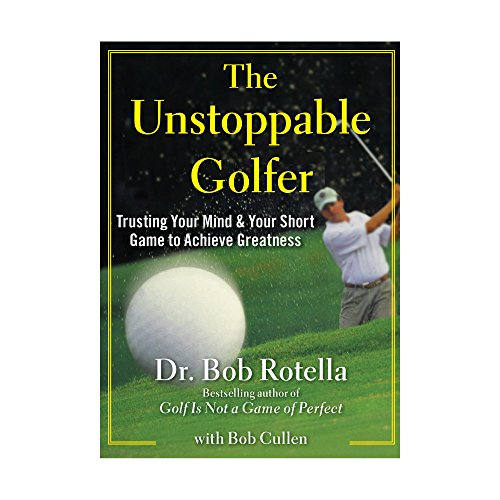
From the bestselling author of Golf Is Not a Game of Perfect and the preeminent golf psychologist to the game’s top players comes the defining guide to mastering the enormous challenges of chips, pitches, bunker shots, and putts.
Dr. Bob Rotella is the preeminent golf psychologist to the game’s top players—he has coached stars like Keegan Bradley, Padraig Harrington, and Darren Clarke—and he has offered his advice to golfers of all skill levels in his bestselling books, including Golf Is Not a Game of Perfect and Golf Is a Game of Confidence. Now, he tackles the mind’s role in the most difficult aspect of golfing—the short game.
It’s no secret that more than two-thirds of the shots a golfer makes are short ones: putts, chips, and pitches. Long drives may garner applause, but whether a golfer wants to win the Masters or just five bucks from a friend on Saturday morning, it’s the little shots that make the difference. Yet many players either fail to recognize or choose to ignore the importance of the short game. In The Unstoppable Golfer, Dr. Rotella applies the same wisdom and experience that have worked for clients like Davis Love III and Graeme McDowell to help every golfer master this special art of short shots and take all the frustration out of this increasingly challenging element of the game.
Requiring extraordinary levels of concentration, the short game is typically a source of fear for amateurs and pros alike. In this book, Dr. Rotella teaches readers how to overcome that fear by using their minds to achieve a state of calm in which the focus is on one thing alone: the hole. Rotella shares stories about professionals with whom he has worked who have mastered the psychological aspect of successful putting by adhering to simple—but hard-to-follow—rules and practices that will improve any golfer’s game: stay focused on your targets, visualize your shots, commit to your routine, and accept completely whatever happened to the golf ball.
On top of citing his experiences with golfers, Dr. Rotella also probes the science of memory and how knowledge of the brain’s workings—especially those areas that deal with physical tasks—can markedly improve a golf game, particularly when it comes to getting out of a bunker or taking the measure of a long putt. For casual and dedicated golfers alike, a better short game provides one of the ultimate pleasures of golf—a pleasure they will come to know by training their minds to allow them to become unstoppable golfers.
Since 1984, golfers coached by Dr. Bob Rotella have won a total of:
-74 major professional titles 2 Masters tournaments
-12 U.S. Opens
-12 British Opens
-11 PGA Championships
-4 U.S. Women’s Opens
-6 LPGA Championships
-5 Kraft-Nabisco Championships
-5 Tradition Championships
-7 Women’s British Opens
-2 Senior PGA Championships
-5 U.S. Senior Opens
-3 Senior Players Championships
Die Inhaltsangabe kann sich auf eine andere Ausgabe dieses Titels beziehen.
Über die Autorinnen und Autoren
Dr. Bob Rotella is the bestselling author of a dozen books, including Golf Is Not a Game of Perfect, The Unstoppable Golfer, and How Champions Think. He was the director of sport psychology for twenty years at the University of Virginia, where his reputation grew as the expert champions talked to him about the mental aspects of their game. Rotella was a consultant multiple times to the United States Ryder Cup Team. His golf client list includes Hall of Famers Pat Bradley, Tom Kite, Davis Love III, and Nick Price, as well as many of today’s stars, such as Justin Thomas, Darren Clarke, Jim Furyk, Padraig Harrington, Brad Faxon, and Rory McIlroy. A long-time consultant to Golf Digest, he lives in Virginia with his wife, Darlene.
Bob Cullen is the coauthor, with Dr. Bob Rotella, of Golf Is Not a Game of Perfect and other bestselling works on the mental game. A former contributing editor at Travel & Leisure Golf, he has reported on courses from datelines as diverse as Slovenia, Kazakhstan, Russia, and Iran.
Auszug. © Genehmigter Nachdruck. Alle Rechte vorbehalten.
The Unstoppable Golfer
ONE
THE SHORT GAME AND WINNING GOLF
By learning how to get the ball up and down, you will have mastered the art of scoring your best.
—Tom Watson
Unstoppable golf and a great short game are inseparable. If I didn’t already know this, I could learn it every April at the Masters.
In the popular mind, Augusta National Golf Club may be a course that Bob Jones and Alister MacKenzie designed to favor the heroic long hitter, a Sam Snead when the Masters began or a Bubba Watson today. And there’s certainly nothing wrong with hitting the ball a long way, especially if a golfer hits it where he’s aiming. Only a fool would say he’d rather not drive the ball 330 yards into the middle of every fairway.
But I’ve seen lots of players who can drive the ball 330 yards and yet have never won a Masters, or even come close. Augusta National tests their short games and finds them wanting.
All the grass on and around Augusta’s greens is mowed closer than the hair on the head of a boot-camp marine. The greens are so quick that inexperienced players can and do putt right off of them. And the putts on the greens are not nearly as testing as the pitches around them. From grass so short that most golf clubs would be happy to call them putting surfaces, players have to hit pitches and lobs that fly precise distances at precise trajectories and then either check up or roll out, depending on the circumstances. Moreover, the grounds crew at Augusta generally mows so that the golfer has to chip and pitch into the grain of the grass, adding another layer of complexity for the elite player.
These conditions expose a lot of doubt and fear. No one gets invited to the Masters unless he is an accomplished player. But I have had Masters contestants come up to me in the days before the tournament begins and say, “No way am I getting in the hunt this week, Doc. I am not going to pitch the ball from around these greens on national television.”
That’s an extreme example of the debilitating fear that can infect a golfer’s short game. At other times, the effect is more subtle.
A young player I work with was thrilled one year to be invited to his first Masters. For the most part, he played very well, but he missed the cut by a stroke or two. One of his playing partners during the first two rounds sent me a message about my client. The message was: “He’s a good kid and a good player. But he needs to be able to hit a high, soft lob off a tight lie.”
The truth was, my young client could hit a high, soft lob off a tight lie. But when he got to the Masters for the first time, he felt a sudden flash of doubt when the need for that shot arose, as it inevitably did. Mentally, he wasn’t quite ready to play the short game that Augusta National demands. He played other kinds of shots in those situations, shots from a ball position closer to his right foot, so he could be confident of striking the ball cleanly. They probably looked quite decent to the average spectator, but these shots too often didn’t get him close enough to the hole to save par or make birdie.
Physically, he was ready to play in the Masters. He had the skills. But my client still had work to do to develop the mental side of his short game. He had, quite understandably, felt a little bit in awe of the Masters. That had caused him to start to feel that he had to be able to hit perfect shots to compete there. He forgot that on lots of very good golf courses, he’d won because he’d trusted his skills and let himself find a way to get the ball in the hole.
The player who wins at Augusta loves the way the course challenges his short game. He loves showing off his skills. He loves knowing that his short game will separate him from many of the other contestants.
Trevor Immelman, who won the Masters in 2008, is a perfect example. Trevor learned the short game very naturally, the way I would hope any kid would learn it. He has a brother, Mark, who’s nine years older and himself a very good golfer (and now the coach at Columbus State University in Georgia). Mark took up the game at fourteen, when he enrolled at a school called Hottentot Holland High School in the Immelmans’ hometown of Somerset West, South Africa. Trevor, who was five, tried desperately to keep up with Mark and his friends. Obviously, he couldn’t hit the ball as far as his older brother. Out of necessity, he learned to hit pitches close to the hole and to putt well.
The boys’ father, Johan, responded to his sons’ passion for golf by building a rudimentary putting green with a sand bunker in the family’s front yard. Neither Johan nor Mark had to force Trevor to use the green. Trevor’s competitive instincts got him started. He remembers that sometimes he would practice his chips, pitches, and putts for hours at a time. Sometimes he would do it in spurts, practicing for fifteen or twenty minutes, then going back inside the house and watching television. Eventually, he expanded his horizons, hitting pitches to the green from neighbors’ lawns. Some of them were a full wedge away and Trevor learned to hit over trees and walls. (Somerset West must have been a kind and tolerant community.)
He did not take a lot of formal lessons. Instead, he learned by watching better players, beginning with Mark. He asked questions. He started watching professionals on South Africa’s tour. Ernie Els, for example, showed Trevor how he used the bounce on his wedges.
In 1998, when he was eighteen, Trevor came to America and won the U.S. Public Links championship, which carried with it an invitation to the 1999 Masters. He remembers being dazzled and intimidated that year by the speed of the Augusta greens and their slopes. But right away, he felt confident about his pitching and chipping capabilities. Trevor also could see that the best players at the Masters knew where to put the ball on those complex greens. They gave themselves putts they could hit confidently.
When he returned to the Masters as a professional some years later, Trevor set about mastering the subtleties of those greens. His strong short game gave him an edge at Augusta, and he had a sixth-place finish to his credit when he returned for the Masters of 2008. But he was on almost no one’s short list of favorites. He had to deal with an additional irritant that year when his swing coach decided not to go to Augusta. I told Trevor that the same thing had happened to Tom Kite in 1992 at the U.S. Open in Pebble Beach. It hadn’t proven to be an insurmountable problem—Tom won.
“Let’s decide it’s going to help,” I said to Trevor. “Your job is to find a way to play great golf even if your coach doesn’t come. Just get into trusting your golf swing and playing golf.”
Trevor had, by then, developed a very smart game plan for playing Augusta, particularly the two pivotal par fives on the second nine, Nos. 13 and 15. The plan depended on his confidence with his wedges. Basically, he decided that on those two holes, he would try to reach the green in two shots only if he had a 4-iron or less for his second shot. Otherwise, he would lay up and rely on his short game.
The plan was more complicated than that, of course. The spot from which he wanted to hit his wedges to each hole varied with the possible hole locations. For some locations, he might want a high shot with lots of backspin that hit the green and spun back. That would dictate a lay-up to a certain yardage. For others, he might want a lower pitch that bounced once and then checked. That might dictate a different yardage or a different angle.
Not every player would, or...
„Über diesen Titel“ kann sich auf eine andere Ausgabe dieses Titels beziehen.
Suchergebnisse für The Unstoppable Golfer: Trusting Your Mind & Your...

Foto des Verkäufers
The Unstoppable Golfer: Trusting Your Mind & Your Short Game to Achieve Greatness
Anbieter: Dream Books Co., Denver, CO, USA
Verkäuferbewertung 5 von 5 Sternen

Zustand: very_good. Pages are clean with no markings. May show minor signs of wear or cosmetic defects marks, cuts, bends, or scuffs on the cover, spine, pages, or dust jacket. May have remainder marks on edges. Artikel-Nr. DBV.1451650167.VG
Gebraucht kaufen
EUR 5,44
Versand gratis
Versand innerhalb von USA
Versand innerhalb von USA
Anzahl: 1 verfügbar
Beispielbild für diese ISBN
The Unstoppable Golfer: Trusting Your Mind & Your Short Game to Achieve Greatness
Anbieter: ThriftBooks-Reno, Reno, NV, USA
Verkäuferbewertung 5 von 5 Sternen
Hardcover. Zustand: Very Good. No Jacket. May have limited writing in cover pages. Pages are unmarked. ~ ThriftBooks: Read More, Spend Less. Artikel-Nr. G1451650167I4N00
Gebraucht kaufen
EUR 5,79
Versand gratis
Versand innerhalb von USA
Versand innerhalb von USA
Anzahl: 2 verfügbar
Beispielbild für diese ISBN
The Unstoppable Golfer: Trusting Your Mind & Your Short Game to Achieve Greatness
Anbieter: ThriftBooks-Phoenix, Phoenix, AZ, USA
Verkäuferbewertung 5 von 5 Sternen
Hardcover. Zustand: Very Good. No Jacket. May have limited writing in cover pages. Pages are unmarked. ~ ThriftBooks: Read More, Spend Less. Artikel-Nr. G1451650167I4N00
Gebraucht kaufen
EUR 5,79
Versand gratis
Versand innerhalb von USA
Versand innerhalb von USA
Anzahl: 2 verfügbar
Beispielbild für diese ISBN
The Unstoppable Golfer: Trusting Your Mind & Your Short Game to Achieve Greatness
Anbieter: ThriftBooks-Atlanta, AUSTELL, GA, USA
Verkäuferbewertung 5 von 5 Sternen
Hardcover. Zustand: Very Good. No Jacket. May have limited writing in cover pages. Pages are unmarked. ~ ThriftBooks: Read More, Spend Less. Artikel-Nr. G1451650167I4N00
Gebraucht kaufen
EUR 5,82
Versand gratis
Versand innerhalb von USA
Versand innerhalb von USA
Anzahl: 3 verfügbar
Beispielbild für diese ISBN
The Unstoppable Golfer: Trusting Your Mind & Your Short Game to Achieve Greatness
Anbieter: ThriftBooks-Dallas, Dallas, TX, USA
Verkäuferbewertung 5 von 5 Sternen
Hardcover. Zustand: Fair. No Jacket. Former library book; Readable copy. Pages may have considerable notes/highlighting. ~ ThriftBooks: Read More, Spend Less. Artikel-Nr. G1451650167I5N10
Gebraucht kaufen
EUR 5,82
Versand gratis
Versand innerhalb von USA
Versand innerhalb von USA
Anzahl: 1 verfügbar
Beispielbild für diese ISBN
The Unstoppable Golfer: Trusting Your Mind & Your Short Game to Achieve Greatness
Anbieter: ThriftBooks-Dallas, Dallas, TX, USA
Verkäuferbewertung 5 von 5 Sternen
Hardcover. Zustand: Very Good. No Jacket. Former library book; May have limited writing in cover pages. Pages are unmarked. ~ ThriftBooks: Read More, Spend Less. Artikel-Nr. G1451650167I4N10
Gebraucht kaufen
EUR 5,82
Versand gratis
Versand innerhalb von USA
Versand innerhalb von USA
Anzahl: 1 verfügbar
Beispielbild für diese ISBN
The Unstoppable Golfer: Trusting Your Mind & Your Short Game to Achieve Greatness
Anbieter: ThriftBooks-Atlanta, AUSTELL, GA, USA
Verkäuferbewertung 5 von 5 Sternen
Hardcover. Zustand: Very Good. No Jacket. Former library book; May have limited writing in cover pages. Pages are unmarked. ~ ThriftBooks: Read More, Spend Less. Artikel-Nr. G1451650167I4N10
Gebraucht kaufen
EUR 5,82
Versand gratis
Versand innerhalb von USA
Versand innerhalb von USA
Anzahl: 1 verfügbar
Beispielbild für diese ISBN
The Unstoppable Golfer: Trusting Your Mind & Your Short Game to Achieve Greatness
Anbieter: ThriftBooks-Dallas, Dallas, TX, USA
Verkäuferbewertung 5 von 5 Sternen
Hardcover. Zustand: Very Good. No Jacket. May have limited writing in cover pages. Pages are unmarked. ~ ThriftBooks: Read More, Spend Less. Artikel-Nr. G1451650167I4N00
Gebraucht kaufen
EUR 5,82
Versand gratis
Versand innerhalb von USA
Versand innerhalb von USA
Anzahl: 3 verfügbar
Beispielbild für diese ISBN
The Unstoppable Golfer: Trusting Your Mind & Your Short Game to Achieve Greatness
Anbieter: Wonder Book, Frederick, MD, USA
Verkäuferbewertung 5 von 5 Sternen
Zustand: Good. Good condition. Like New dust jacket. A copy that has been read but remains intact. May contain markings such as bookplates, stamps, limited notes and highlighting, or a few light stains. Artikel-Nr. V13A-03634
Gebraucht kaufen
EUR 6,90
Versand gratis
Versand innerhalb von USA
Versand innerhalb von USA
Anzahl: 1 verfügbar
Beispielbild für diese ISBN
The Unstoppable Golfer Trustin
Anbieter: World of Books (was SecondSale), Montgomery, IL, USA
Verkäuferbewertung 5 von 5 Sternen
Zustand: Good. Item in good condition. Textbooks may not include supplemental items i.e. CDs, access codes etc. Artikel-Nr. 00108995860
Gebraucht kaufen
EUR 8,19
Versand gratis
Versand innerhalb von USA
Versand innerhalb von USA
Anzahl: 4 verfügbar