
Verwandte Artikel zu The Silo Effect: The Peril of Expertise and the Promise...
Inhaltsangabe
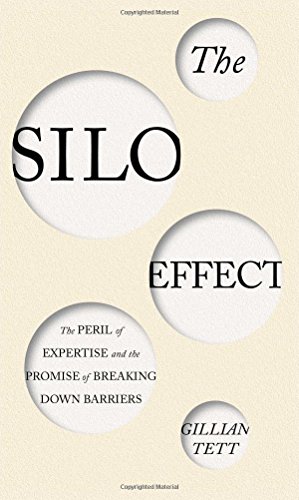
From award-winning columnist and journalist Gillian Tett comes a brilliant examination of how our tendency to create functional departments—silos—hinders our work…and how some people and organizations can break those silos down to unleash innovation.
One of the characteristics of industrial age enterprises is that they are organized around functional departments. This organizational structure results in both limited information and restricted thinking. The Silo Effect asks these basic questions: why do humans working in modern institutions collectively act in ways that sometimes seem stupid? Why do normally clever people fail to see risks and opportunities that later seem blindingly obvious? Why, as psychologist Daniel Kahneman put it, are we sometimes so “blind to our own blindness”?
Gillian Tett, journalist and senior editor for the Financial Times, answers these questions by plumbing her background as an anthropologist and her experience reporting on the financial crisis in 2008. In The Silo Effect, she shares eight different tales of the silo syndrome, spanning Bloomberg’s City Hall in New York, the Bank of England in London, Cleveland Clinic hospital in Ohio, UBS bank in Switzerland, Facebook in San Francisco, Sony in Tokyo, the BlueMountain hedge fund, and the Chicago police. Some of these narratives illustrate how foolishly people can behave when they are mastered by silos. Others, however, show how institutions and individuals can master their silos instead. These are stories of failure and success.
From ideas about how to organize office spaces and lead teams of people with disparate expertise, Tett lays bare the silo effect and explains how people organize themselves, interact with each other, and imagine the world can take hold of an organization and lead from institutional blindness to 20/20 vision.
Die Inhaltsangabe kann sich auf eine andere Ausgabe dieses Titels beziehen.
Über die Autorin bzw. den Autor
Gillian Tett oversees global coverage of the financial markets for the Financial Times, the world’s leading newspaper covering finance and business. In 2007 she was awarded the Wincott prize, the premier British award for financial journalism, and in 2008 was named British Business Journalist of the Year. Tett is the author of Saving the Sun: How Wall Street Mavericks Shook Up Japan’s Financial World and Made Billions and The Silo Effect: Ordered Chaos, the Peril of Expertise, and the Power of Breaking Down Barriers.
Auszug. © Genehmigter Nachdruck. Alle Rechte vorbehalten.
The Silo Effect
1
THE NONDANCERS
How Anthropology Can Illuminate Silos
“Every established order tends to make its own entirely arbitrary system seem entirely natural.”
—Pierre Bourdieu1
IT WAS A DARK WINTER’S evening in 1959 in Béarn, a tiny village in a remote corner of South West France. In a brightly lit hall, a Christmas dance was under way. Dozens of young men and women were gyrating to 1950s jive music. The women wore full skirts that swirled around them, the men sharp, close-cut suits.2 On the edge of the crowd, Pierre Bourdieu, a Frenchman in his thirties with an intense, craggy face, stood watching, taking photographs and careful mental notes. In some senses, he was at “home” in that dancehall: he had grown up in the valley many years earlier, the son of peasants, and spoke Gascon, a local dialect of French that was impossible for Parisians to understand. But in other senses, Bourdieu was an outsider: as a precociously brilliant child, he had left the village two decades earlier on a scholarship, and studied at an elite university in Paris. Then he traveled to Algeria, serving as a soldier in the brutal civil war, before becoming an academic.
That gave him an odd insider-outsider status. He knew the dancers’ world well, but he was no longer merely a creature of this tiny environment. He could imagine a universe beyond Béarn and a different way of arranging a dance. And when he looked around at that hall, with that insider-outsider vision, he could see something to which his own friends were blind. In the center of the hall, there was light and action: the dancers were doing the jive. That was the only thing that the villagers wanted to watch, or would ever remember from that night. Dance halls, after all, are supposed to be all about dancing. But “standing at the edge of the dancing area, forming a dark mass, a group of older men look[ed] on in silence,” as Bourdieu later wrote. “All aged about thirty, they wear berets and unfashionably cut dark suits. As if drawn in by the temptation to join the dance, they move forward, narrowing the space left for the dancers . . . but do not dance.”3 That part of the hall was not what people were supposed to watch; it was being ignored. But it was nevertheless present, as much as the dancers. “There they all are, all the bachelors!” Bourdieu observed. The people in that hall had somehow divided themselves and classified each other into two camps. There were dancers and non-dancers.
But why had that separation occurred? Bourdieu had received a clue to the answer a few days earlier, when he met up with an old school friend. At one point, the man had produced an ancient prewar photo, depicting their classmates as children. “My fellow pupil, by then a low-ranking clerk in the neighbouring town, commented on [the photo], pitilessly intoning ‘un-marriageable!’ with reference to almost half [the pictures],”4 Bourdieu wrote. It was not intended as an insult, but as a description. Numerous men in the village were finding it impossible to find wives, because they had become unattractive—at least as culturally defined by local women.
This “unmarriageable” problem reflected radical economic change. Until the early twentieth century, most of the families around Béarn were farmers, and their eldest sons were typically the most powerful and wealthy men, as they inherited the farms according to local tradition. Eldest sons were thus considered catches for local women, particularly compared to the younger sons who often had to leave the land in search of a living. But in postwar France, the pattern had changed: agriculture was declining and the men who could leave the farms were seeking better paid jobs in town. Many young women were moving to the cities in search of work. The older sons, who were tethered by tradition to the farms, were being left behind. On a day-to-day basis, the villagers did not articulate that distinction. But the classification system was constantly being expressed and reinforced in a host of tiny, seemingly mundane, cultural symbols that had come to seem natural. To the villagers in Béarn it seemed obvious that 1950s jive music, full skirts and tight male suits, were a cool, urban phenomenon; if you could dance, that signaled that you were part of the modern world, and therefore marriageable.
What really intrigued Bourdieu, though, was not just why this economic change had occurred, but why anyone accepted this classification system and the unspoken cultural norms. This distinction between marriageable and unmarriageable men—or people who could or could not jive—had not been imposed in any formal manner. Nobody had conducted a public debate on the matter. There were no official rules in 1950s France that banned farmers from doing the jive or stopped them from learning the dance steps, buying a few suits, and just jumping into the ring. But somehow those men were banning themselves: they had voluntarily placed themselves in a social category that indicated they “could not dance.” And the implications for those men were heartbreaking. “I think of an old school friend, whose almost feminine tact and refinement endeared him to me,” Bourdieu observed, noting that his friend “had chalked on the stable door the birthdates of his mares and the girls’ names he had given them” as a sad protest against his “unmarriageable” state and lonely life.5
So why didn’t the men protest against their tragic state? Why not just start dancing? And why didn’t the girls realize that they were ignoring half the men? Why, in fact, do any human beings accept the classification systems we inherit from our surroundings? Especially when these social norms and categories are potentially damaging?
A POSTWAR DANCE HALL in Béarn lies a long way from Bloomberg’s City Hall, in terms of geography and culture. Marriage strategies do not have much in common with banks. But in another sense, French peasants and New York bureaucrats are inextricably linked. What these two worlds share in common—along with every society that anthropologists have ever studied—is a tendency to use formal and informal classification systems and cultural rules to sort the world into groups and silos. Sometimes we do this in a formal manner, with diagrams and explicit rules. But we often do it amid thousands of tiny, seemingly irrelevant cultural traditions, rules, symbols, and signals that we barely notice because they are so deeply ingrained in our environment and psyche. Indeed, these cultural norms are so woven into the fabric of our daily lives that they make the classification system we use seem so natural and inevitable that we rarely think about it at all.
Insofar as anyone can tell, this process of classification is an intrinsic part of being human. It is one of the things that separate us from animals. There is a good reason for that: on a day-to-day basis, we are all surrounded by so much complexity that our brains could not think or interact if we were could not create some order by classifying the world into manageable chunks. The seemingly trivial issue of telephone numbers helps to illustrates this. Back in the 1950s, a psychology professor at Harvard named George Miller studied how short-term memory worked among people who operated telegraph systems and telephones. This research showed that there is a natural limit to how many pieces of data a human brain can remember when it is shown a list of digits or letters.6 Miller believed that this natural limit ranged between five and nine data points, but the average...
„Über diesen Titel“ kann sich auf eine andere Ausgabe dieses Titels beziehen.
Suchergebnisse für The Silo Effect: The Peril of Expertise and the Promise...

Beispielbild für diese ISBN
The Silo Effect The Peril of E
Anbieter: World of Books (was SecondSale), Montgomery, IL, USA
Verkäuferbewertung 5 von 5 Sternen

Zustand: Good. Item in good condition. Textbooks may not include supplemental items i.e. CDs, access codes etc. Artikel-Nr. 00096625818
Gebraucht kaufen
EUR 4,33
Versand gratis
Versand innerhalb von USA
Versand innerhalb von USA
Anzahl: 9 verfügbar
Beispielbild für diese ISBN
The Silo Effect The Peril of E
Anbieter: World of Books (was SecondSale), Montgomery, IL, USA
Verkäuferbewertung 5 von 5 Sternen
Zustand: Very Good. Item in very good condition! Textbooks may not include supplemental items i.e. CDs, access codes etc. Artikel-Nr. 00088166763
Gebraucht kaufen
EUR 4,33
Versand gratis
Versand innerhalb von USA
Versand innerhalb von USA
Anzahl: 2 verfügbar
Beispielbild für diese ISBN
The Silo Effect: The Peril of Expertise and the Promise of Breaking Down Barriers
Anbieter: ThriftBooks-Atlanta, AUSTELL, GA, USA
Verkäuferbewertung 5 von 5 Sternen
Hardcover. Zustand: Very Good. No Jacket. May have limited writing in cover pages. Pages are unmarked. ~ ThriftBooks: Read More, Spend Less. Artikel-Nr. G1451644736I4N00
Gebraucht kaufen
EUR 6,19
Versand gratis
Versand innerhalb von USA
Versand innerhalb von USA
Anzahl: 1 verfügbar
Beispielbild für diese ISBN
The Silo Effect: The Peril of Expertise and the Promise of Breaking Down Barriers
Anbieter: ThriftBooks-Dallas, Dallas, TX, USA
Verkäuferbewertung 5 von 5 Sternen
Hardcover. Zustand: Very Good. No Jacket. Missing dust jacket; May have limited writing in cover pages. Pages are unmarked. ~ ThriftBooks: Read More, Spend Less. Artikel-Nr. G1451644736I4N01
Gebraucht kaufen
EUR 6,19
Versand gratis
Versand innerhalb von USA
Versand innerhalb von USA
Anzahl: 1 verfügbar
Beispielbild für diese ISBN
The Silo Effect: The Peril of Expertise and the Promise of Breaking Down Barriers
Anbieter: ThriftBooks-Dallas, Dallas, TX, USA
Verkäuferbewertung 5 von 5 Sternen
Hardcover. Zustand: Very Good. No Jacket. May have limited writing in cover pages. Pages are unmarked. ~ ThriftBooks: Read More, Spend Less. Artikel-Nr. G1451644736I4N00
Gebraucht kaufen
EUR 6,19
Versand gratis
Versand innerhalb von USA
Versand innerhalb von USA
Anzahl: 1 verfügbar
Beispielbild für diese ISBN
The Silo Effect: The Peril of Expertise and the Promise of Breaking Down Barriers
Anbieter: ThriftBooks-Reno, Reno, NV, USA
Verkäuferbewertung 5 von 5 Sternen
Hardcover. Zustand: Very Good. No Jacket. May have limited writing in cover pages. Pages are unmarked. ~ ThriftBooks: Read More, Spend Less. Artikel-Nr. G1451644736I4N00
Gebraucht kaufen
EUR 6,19
Versand gratis
Versand innerhalb von USA
Versand innerhalb von USA
Anzahl: 1 verfügbar
Beispielbild für diese ISBN
The Silo Effect: The Peril of Expertise and the Promise of Breaking Down Barriers
Anbieter: Wonder Book, Frederick, MD, USA
Verkäuferbewertung 5 von 5 Sternen
Zustand: Very Good. Very Good condition. Very Good dust jacket. A copy that may have a few cosmetic defects. May also contain light spine creasing or a few markings such as an owner's name, short gifter's inscription or light stamp. Artikel-Nr. C13C-01590
Gebraucht kaufen
EUR 6,40
Versand gratis
Versand innerhalb von USA
Versand innerhalb von USA
Anzahl: 1 verfügbar
Beispielbild für diese ISBN
The Silo Effect : The Peril of Expertise and the Promise of Breaking down Barriers
Anbieter: Better World Books, Mishawaka, IN, USA
Verkäuferbewertung 5 von 5 Sternen
Zustand: Very Good. Pages intact with possible writing/highlighting. Binding strong with minor wear. Dust jackets/supplements may not be included. Stock photo provided. Product includes identifying sticker. Better World Books: Buy Books. Do Good. Artikel-Nr. 5895267-6
Gebraucht kaufen
EUR 6,72
Versand gratis
Versand innerhalb von USA
Versand innerhalb von USA
Anzahl: 1 verfügbar
Beispielbild für diese ISBN
The Silo Effect : The Peril of Expertise and the Promise of Breaking down Barriers
Anbieter: Better World Books, Mishawaka, IN, USA
Verkäuferbewertung 5 von 5 Sternen
Zustand: Good. Former library copy. Pages intact with minimal writing/highlighting. The binding may be loose and creased. Dust jackets/supplements are not included. Includes library markings. Stock photo provided. Product includes identifying sticker. Better World Books: Buy Books. Do Good. Artikel-Nr. 9899954-6
Gebraucht kaufen
EUR 6,72
Versand gratis
Versand innerhalb von USA
Versand innerhalb von USA
Anzahl: 1 verfügbar
Beispielbild für diese ISBN
The Silo Effect : The Peril of Expertise and the Promise of Breaking down Barriers
Anbieter: Better World Books, Mishawaka, IN, USA
Verkäuferbewertung 5 von 5 Sternen
Zustand: Good. Pages intact with minimal writing/highlighting. The binding may be loose and creased. Dust jackets/supplements are not included. Stock photo provided. Product includes identifying sticker. Better World Books: Buy Books. Do Good. Artikel-Nr. 7604440-6
Gebraucht kaufen
EUR 6,72
Versand gratis
Versand innerhalb von USA
Versand innerhalb von USA
Anzahl: 1 verfügbar