
Verwandte Artikel zu A Toast to Bargain Wines: How Innovators, Iconoclasts,...
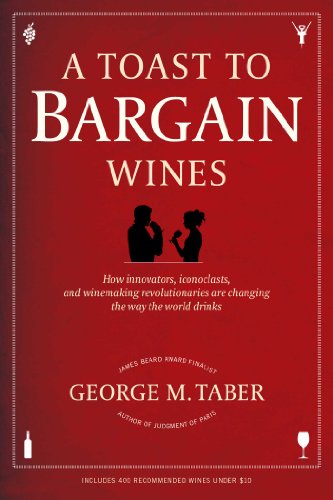
A Toast to Bargain Wines: How Innovators, Iconoclasts, and Winemaking Revolutionaries Are Changing the Way the World Drinks - Hardcover
Inhaltsangabe
THE ACCLAIMED AUTHOR OF JUDGMENT OF PARIS EXPLORES THE THRIVING BUSINESS OF BARGAIN WINES AND OFFERS HIS RECOMMENDATIONS FOR THE BEST VALUES.
Is inexpensive wine any good? Award-winning author George M. Taber shows that it is, examining the paths to success of the world’s best-selling bargain brands. Taber helps readers learn to trust their taste and make informed decisions when confronting wine lists, and reveals how innovators are turning the old vin ordinaire into something extraordinaire.
A Toast to Bargain Wines is an accessible mix of history, business, and reference, and includes a two-part guide to the world’s best buys: George’s ten favorite bargains of every varietal (plus two splurges in each category), then ten value brands from twelve regions around the world. Casual wine drinkers and connoisseurs alike will benefit from this insider’s guide to finding and enjoying good wine—at a great price.
Die Inhaltsangabe kann sich auf eine andere Ausgabe dieses Titels beziehen.
Über die Autorin bzw. den Autor
George M. Taber is the author of Judgment of Paris, the 2006 wine book of the year for Britain's Decanter magazine. His second book, To Cork or Not to Cork, won the Jane Grigson Award from the International Association of Culinary Professionals and was a finalist for the James Beard Foundation Award for best book on wine and spirits and the Andre Simon Award for best wine book. Before turning to writing wine books, Taber was a reporter and editor for Time.
Auszug. © Genehmigter Nachdruck. Alle Rechte vorbehalten.
CHAPTER ONE
Three Pioneers
Wine fans for centuries have traveled to the birthplaces of their favorite wines in order to enjoy the special pleasure of drinking them where the grapes are grown and the juice fermented. Here are just three—one from the seventeenth century, one from the eighteenth, and one from the nineteenth.
John Locke, the English political philosopher whose ideas had a major impact on the American Revolution, was one of the most influential thinkers in the Age of Enlightenment. Among Locke’s revolutionary ideas were the concepts of “government with the consent of the governed” and “the rights of life, liberty, and property.” The latter found its way into the Declaration of Independence as “life, liberty, and the pursuit of happiness.”
Because of political setbacks at home and his problems with a chronic cough probably due to tuberculosis, Locke, a trained doctor, sought out a more temperate climate away from his home in London. In November 1675, he left for France with the intention of traveling as far south as Montpellier, a city with a major medical practice and where the weather would be much warmer. During his three and a half years in France, the philosopher wrote more than fourteen hundred pages of notes on what he saw and experienced.
While living in Montpellier, Locke made several trips to nearby wine regions. He carefully recorded how winemakers went about their craft, the quality of the wine, and the prices. Locke wrote that locals “seldom make red wine without the mixture of some sort of white grapes, else it will be too thick and deep colored.” He also noted that peasants grew several varieties in the same vineyard and described in detail how farmers planted and pruned their vines.
The French taught Locke the importance of terroir, the untranslatable term for local vineyard growing conditions, and of blending different kinds of grapes. As he wrote in his notes, “The goodness of their wine to drink seems to depend on two causes besides the pressing and ordering the fermentation.” These were “the qualities of the soil” and the “mingling a good quantity of white grapes with the red.” Near Montpellier he noted with some perplexity, “Two vineyards, bounding one upon another, constantly produce the one good and the other bad wine.”
Locke learned vines could be productive for “nay 100 years,” and “the older the better” the wines. Young vines produced “commonly green i.e. sour” wine. He wrote that French wine was generally aged for many years in wooden barrels before it was drinkable, but winemakers had ways to speed up aging. “When they have a mind to have their wine fine sooner than ordinary, they put in a cask pretty good quantity of shavings of fir, and, in some places, of hazel, and with it they sometimes put some whole white grapes.”
Many local viticulture practices clearly offended the Englishman: “[A]nd in all other parts of their making wine they are sufficiently nasty, according to their manner. The grapes are often rotten and always full of spiders. Beside that, they say they put often salt, men’s dung and other filthiness in their wine to help, as they think, its purging.”
When leaving Montpellier to return to Paris in March 1677, Locke decided to take a western route to see more of southern France. On Friday, May 14, he was in Bordeaux and rode a horse out of the city to what he described as “President Pontac’s vineyard at Hautbrion,” today’s Château Haut-Brion. Locke had enjoyed wine in London, and now he wanted to see it at its place of origin. Although Locke by then spoke good French, he had trouble communicating with the working people at the winery because of his “want of understanding Gascoin,” a dialect of the Occitan language spoken in southern France. Nonetheless, he wrote an insightful description of the vineyard: “It is a little rise of ground, lying open most to the west. It is nothing but pure, white sand, mixed with little gravel. One would imagine it scarce fit to bear anything.”
Locke later wrote in a more detailed report of his visit to Château Haut-Brion: “There is such a particularity point in the soil that the merchants assured me that the wine growing in the very next vineyards, where there was only a ditch between, and the soil, to appearance, perfectly the same, was by no means so good.” That ditch, and the difference in the wines from the two vineyards, are still there today.
Locke stayed in Paris for a year before he and a student who had been placed in his charge returned to southern France in July 1678. The two again took a western route, going through Tours and the Loire Valley. They stopped at the home of Nicolas Thoynard, a fellow scholar who shared Locke’s wide range of interests. The two men discussed the writings of the evangelists in the Bible, new forms of ammunition, and Thoynard’s proposal for sealing bottles of wine with a glass stopper rather than a cork. They also shared “a large bottle of Muscat or Jenetine wine of Orléans stopped with a glass stopper.”
As he traveled, Locke was shocked to see the drop in wine prices since he had been there only a year earlier. Wines were selling for one-third as much as before. The reason was a glut of wine precipitated by a war between France and Holland, which had severely reduced exports to both Holland and England. In Saumur he wrote, “The white wine here in this town is very good & wine so plentiful that they sell it for 18 deniers the pint at their boushons i.e. where people in private houses sell their own wine by retail.” Locke also noted that ten deniers of that went to the king as excise taxes, while the vintner got only eight deniers. Later in Angers, wine was selling for one-fourth as much as before. In the port city of Rochelle, the price of wine was down 50 percent, with the exception of President Pontac’s and “some others of particular note” that still sold for twice as much as the rest. While going through Bordeaux on his second trip, Locke did not revisit Haut-Brion.
Three months before leaving France in the spring of 1679, Locke wrote a treatise entitled Observations Upon Vines that brought together all he had learned about wine in France. Despite his long stay in the country, he had not become a great fan of the French, writing in the introduction, “The country where these observations were made hath vanity enough to over-value everything it produces.” He recounted in detail when and how the French planted their vineyards. His preference for aged vines was clear: “The older the vineyard, the fewer the grapes, but the better the wine. Newly planted vineyards produce more, but the wine is not as good.” Locke added that in the village of Galliac near Montpellier, “If a peasant there should use any but birds dung about his vines, his neighbors would burn his house because they would not have the wine of that place lose its reputation.”
Locke recorded in his report the local belief that “a sheep’s horn buried at the foot of a vine will make it bear well even in barren ground.” But he quickly added, “I have no great faith in it, but mention it because it may so easily be tried.”
In late April 1679, Locke boarded the Charlotte in Calais for the return trip home, and two days later, he landed at the Temple stairs, on the Thames, in London. John Locke never again returned to France.
A little more than a century later, Thomas Jefferson, on July 31, 1784, arrived in France to join Benjamin Franklin and John...
„Über diesen Titel“ kann sich auf eine andere Ausgabe dieses Titels beziehen.
Suchergebnisse für A Toast to Bargain Wines: How Innovators, Iconoclasts,...

Beispielbild für diese ISBN
A Toast to Bargain Wines: How Innovators, Iconoclasts, and Winemaking Revolutionaries Are Changing the Way the World Drinks
Anbieter: BooksRun, Philadelphia, PA, USA
Verkäuferbewertung 5 von 5 Sternen

Hardcover. Zustand: Very Good. With dust jacket. It's a well-cared-for item that has seen limited use. The item may show minor signs of wear. All the text is legible, with all pages included. It may have slight markings and/or highlighting. Artikel-Nr. 1451644361-11-1-29
Gebraucht kaufen
EUR 6,10
Versand gratis
Versand innerhalb von USA
Versand innerhalb von USA
Anzahl: 1 verfügbar
Beispielbild für diese ISBN
A Toast to Bargain Wines : How Innovators, Iconoclasts, and Winemaking Revolutionaries Are Changing the Way the World Drinks
Anbieter: Better World Books, Mishawaka, IN, USA
Verkäuferbewertung 5 von 5 Sternen
Zustand: Good. Former library copy. Pages intact with minimal writing/highlighting. The binding may be loose and creased. Dust jackets/supplements are not included. Includes library markings. Stock photo provided. Product includes identifying sticker. Better World Books: Buy Books. Do Good. Artikel-Nr. 4982447-75
Gebraucht kaufen
EUR 6,21
Versand gratis
Versand innerhalb von USA
Versand innerhalb von USA
Anzahl: 2 verfügbar
Beispielbild für diese ISBN
A Toast to Bargain Wines: How Innovators, Iconoclasts, and Winemaking Revolutionaries Are Changing the Way the World Drinks
Anbieter: ThriftBooks-Dallas, Dallas, TX, USA
Verkäuferbewertung 5 von 5 Sternen
Hardcover. Zustand: Very Good. No Jacket. Missing dust jacket; May have limited writing in cover pages. Pages are unmarked. ~ ThriftBooks: Read More, Spend Less. Artikel-Nr. G1451644361I4N01
Gebraucht kaufen
EUR 8,07
Versand gratis
Versand innerhalb von USA
Versand innerhalb von USA
Anzahl: 1 verfügbar