
Verwandte Artikel zu Miles: The Autobiography
Inhaltsangabe
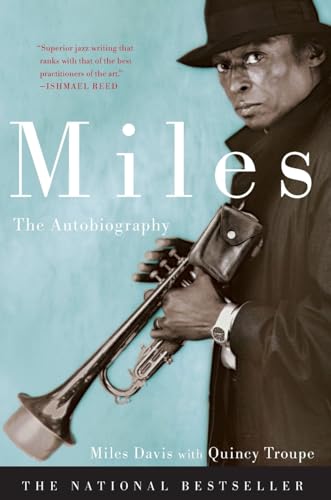
A special centennial edition of Miles Davis’s classic memoir Miles—the singular story of a jazz legend, now reintroduced by Nas and Hanif Abdurraqib.
Universally acclaimed as a musical genius, Miles Davis was one of the most important and influential musicians in the world. Here, Miles speaks out about his extraordinary life.
Miles: The Autobiography, like Miles himself, holds nothing back. He speaks frankly and openly about his drug problem and how he overcame it. He condemns the racism he encountered in the music business and in American society generally. And he discusses the women in his life. But above all, Miles talks about music and musicians, including the legends he has played with over the years: Bird, Dizzy, Monk, Trane, Mingus, and many others. The man who gave us some of the most exciting music of the twentieth century here gives us a compelling and fascinating autobiography, featuring a concise discography and thirty-two pages of photographs.
This special centennial anniversary editions features a new cover and new forewords by Nas and Hanif Abdurraqib, speaking on how Miles shaped the cultural fabric of America
Die Inhaltsangabe kann sich auf eine andere Ausgabe dieses Titels beziehen.
Über die Autorin bzw. den Autor
Miles Davis was a legendary jazz trumpeter and bandleader who shaped the direction of jazz in the mid-20th century. He died in 1991.
Von der hinteren Coverseite
A special centennial edition of Miles Davis’s classic memoir Miles―the singular story of a jazz legend, now reintroduced by Nas and Hanif Abdurraqib.
Universally acclaimed as a musical genius, Miles Davis was one of the most important and influential musicians in the world. Here, Miles speaks out about his extraordinary life.
Miles: The Autobiography, like Miles himself, holds nothing back. He speaks frankly and openly about his drug problem and how he overcame it. He condemns the racism he encountered in the music business and in American society generally. And he discusses the women in his life. But above all, Miles talks about music and musicians, including the legends he has played with over the years: Bird, Dizzy, Monk, Trane, Mingus, and many others. The man who gave us some of the most exciting music of the twentieth century here gives us a compelling and fascinating autobiography, featuring a concise discography and thirty-two pages of photographs.
This special centennial anniversary editions features a new cover and new forewords by Nas and Hanif Abdurraqib, speaking on how Miles shaped the cultural fabric of America
Auszug. © Genehmigter Nachdruck. Alle Rechte vorbehalten.
Chapter 1
The very first thing I remember in my early childhood is a flame, a blue flame jumping off a gas stove somebody lit. It might have been me playing around with the stove. I don't remember who it was. Anyway, I remember being shocked by the whoosh of the blue flame jumping off the burner, the suddenness of it. That's as far back as I can remember; any further back than this is just fog, you know, just mystery. But that stove flame is as clear as music is in my mind. I was three years old.
I saw that flame and felt that hotness of it close to my face. I felt fear, real fear, for the first time in my life. But I remember it also like some kind of adventure, some kind of weird joy, too. I guess that experience took me someplace in my head I hadn't been before. To some frontier, the edge, maybe, of everything possible. I don't know; I never tried to analyze it before. The fear I had was almost like an invitation, a challenge to go forward into something I knew nothing about. That's where I think my personal philosophy of life and my commitment to everything I believe in started, with that moment. I don't know, but I think it might be true. Who knows? What the fuck did I know about anything back then? In my mind I have always believed and thought since then that my motion had to be forward, away from the heat of that flame.
Looking back, I don't remember much of my first years -- I never liked to look back much anyway. But one thing I do know is that the year after I was born a bad tornado hit St. Louis and tore it all up. Seems like I remember something about that -- something in the bottom of my memory. Maybe that's why I have such a bad temper sometimes; that tornado left some of its violent creativity in me. Maybe it left some of its strong winds. You know, you need strong wind to play trumpet. I do believe in mystery and the supernatural and a tornado sure enough is mysterious and supernatural.
I was born May 26, 1926, in Alton, Illinois, a little river town up on the Mississippi River about twenty-five miles north of East St. Louis. I was named after my father; he was named after his father. That made me Miles Dewey Davis III, but everybody in my family called me Junior. I always hated that nickname.
My father was from Arkansas. He grew up there on a farm that his father, Miles Dewey Davis I, owned. My grandfather was a bookkeeper, so good at what he did he did it for white people and made a whole lot of money. He bought five hundred acres of land in Arkansas around the turn of the century. When he bought all that land, the white people in the area who had used him to straighten out their financial matters, their money books, turned against him. Ran him off his land. In their minds, a black man wasn't supposed to have all that land and all that money. He wasn't supposed to be smart, smarter than them. It hasn't changed too much; things are like that even today.
For most of my life my grandfather lived under threats from white men. He even used his son, my Uncle Frank, as a bodyguard to protect him from them. The Davises were always ahead of the game, my father and grandfather told me. And I believed them. They told me that people in our family were special people -- artists, businessmen, professionals, and musicians -- who played for the plantation owners back in the old days before slavery was over. These Davises played classical music, according to my grandfather. That's the reason my father couldn't play or listen to music after slavery was over, because my grandfather said, "They only let black people play in gin houses and honky-tonks." What he meant was that they -- the white people -- didn't want to listen to no black folks playing classical music anymore; they only wanted to hear them sing spirituals or the blues. Now, I don't know how true this is, but that's what my father told me.
My father also told me my grandfather told him that whenever he got some money, no matter where or who he got it from, to count it and see if it was all there. He said you can't trust no one when it comes to money, not even people in your family. One time my grandfather gave my father what he said was $1,000 and sent him to the bank with it. The bank was thirty miles away from where they lived. It was about 100 degrees in the shade -- summertime in Arkansas. And he had to walk and ride a horse. When my father got down there to the bank, he counted the money and there was only $950. He counted it again and got the same amount: $950. So he went on back home, so scared he was just about ready to shit in his pants. When he got back he went to my grandfather and said that he lost $50. So Grandpa just stood there and looked at him and said, "Did you count the money before you left? Do you know if it was all there?" My father said, no, he didn't count the money before he left. "That's right," my grandfather told him, "because I didn't give you nothing but $950. You didn't lose anything. But didn't I tell you to count the money, anybody's money, even mine? Here's $50. Count it. And then go ahead on back and put that money in the bank like I told you." Now what you got to keep in mind about all of this is that not only was the bank thirty miles away but it was hotter than a motherfucker. It was cold of my grandfather to do that. But sometimes you've got to be cold like that. It was a lesson my father never forgot and he passed it on to his kids. So today I count all my money.
My father, like my mother, Cleota Henry Davis, was born in 1900 in Arkansas. He went to elementary school there. My father and his brothers and sisters didn't go to high school, just skipped right over it and went straight to college. He graduated from Arkansas Baptist College, from Lincoln University in Pennsylvania, and from Northwestern University's College of Dentistry, so my father received three degrees and I remember looking at them motherfuckers up on his office wall after I got older and saying, "Goddamn, I hope he won't ask me to do that." I also remember seeing a picture somewhere of his graduating class from Northwestern and counting only three black faces there. He was twenty-four when he graduated from Northwestern.
His brother, Ferdinand, went to Harvard and some college in Berlin. He was a year or two older than my father, and like my father, he skipped over high school. He went straight into college after passing the entrance exam with high scores. He was a brilliant guy also; used to talk to me all the time about Caesar and Hannibal, and black history. He traveled all over the world. He was more intellectual than my father, and a ladies' man and player, editor of a magazine calledColor. He was so smart he made me feel almost dumb; he was the only person I knew growing up who made me feel this way. Uncle Ferdinand was something else. I loved being around him, hearing him talk and tell stories about his travels, his women. And he was stylish as a motherfucker, too. I hung around him so n that my mother would get mad.
My father got out of Northwestern and married my mother. She played the violin and the piano. Her mother had...
„Über diesen Titel“ kann sich auf eine andere Ausgabe dieses Titels beziehen.
Suchergebnisse für Miles: The Autobiography

Foto des Verkäufers
Miles: The Autobiography
Anbieter: Dream Books Co., Denver, CO, USA
Verkäuferbewertung 5 von 5 Sternen

Zustand: acceptable. This copy has clearly been enjoyedâ"expect noticeable shelf wear and some minor creases to the cover. Binding is strong, and all pages are legible. May contain previous library markings or stamps. Artikel-Nr. DBV.1451643187.A
Gebraucht kaufen
EUR 8,47
Versand gratis
Versand innerhalb von USA
Versand innerhalb von USA
Anzahl: 1 verfügbar
Beispielbild für diese ISBN
Miles: The Autobiography
Anbieter: World of Books (was SecondSale), Montgomery, IL, USA
Verkäuferbewertung 5 von 5 Sternen
Paperback. Zustand: Good. Universally acclaimed as a musical genius, Miles Davis was one of the most important and influential musicians in the world. Here, Miles speaks out about his extraordinary life.Miles: The Autobiography, like Miles himself, holds nothing back. For the first time Miles talks about his five-year silence, he speaks frankly and openly about his drug problem and how he overcame it, he condemns the racism he encountered in the music business and in American society in general, and he discusses the women in his life. But above all, Miles talks about music and musicians, including the legends he has played with over the years: Bird, Dizzy, Monk, Trane, Mingus, and many others. Artikel-Nr. 00109679351
Gebraucht kaufen
EUR 11,68
Versand gratis
Versand innerhalb von USA
Versand innerhalb von USA
Anzahl: 1 verfügbar
Beispielbild für diese ISBN
Miles: The Autobiography
Anbieter: World of Books (was SecondSale), Montgomery, IL, USA
Verkäuferbewertung 5 von 5 Sternen
Paperback. Zustand: Fair. Universally acclaimed as a musical genius, Miles Davis was one of the most important and influential musicians in the world. Here, Miles speaks out about his extraordinary life.Miles: The Autobiography, like Miles himself, holds nothing back. For the first time Miles talks about his five-year silence, he speaks frankly and openly about his drug problem and how he overcame it, he condemns the racism he encountered in the music business and in American society in general, and he discusses the women in his life. But above all, Miles talks about music and musicians, including the legends he has played with over the years: Bird, Dizzy, Monk, Trane, Mingus, and many others. Artikel-Nr. CIN1451643187A
Gebraucht kaufen
EUR 11,68
Versand gratis
Versand innerhalb von USA
Versand innerhalb von USA
Anzahl: 1 verfügbar
Beispielbild für diese ISBN
Miles
Anbieter: PBShop.store US, Wood Dale, IL, USA
Verkäuferbewertung 5 von 5 Sternen
PAP. Zustand: New. New Book. Shipped from UK. Established seller since 2000. Artikel-Nr. DB-9781451643183
Beispielbild für diese ISBN
Miles
Anbieter: PBShop.store UK, Fairford, GLOS, Vereinigtes Königreich
Verkäuferbewertung 5 von 5 Sternen
PAP. Zustand: New. New Book. Shipped from UK. Established seller since 2000. Artikel-Nr. DB-9781451643183
Neu kaufen
EUR 21,40
EUR 5,92 Versand
Versand von Vereinigtes Königreich nach USA
Versand von Vereinigtes Königreich nach USA
Anzahl: 15 verfügbar
Beispielbild für diese ISBN
Miles: The Autobiography
Anbieter: Magers and Quinn Booksellers, Minneapolis, MN, USA
Verkäuferbewertung 5 von 5 Sternen
paperback. Zustand: New. Reissue. Brand New. Artikel-Nr. 1538873
Neu kaufen
EUR 25,68
EUR 3,56 Versand
Versand innerhalb von USA
Versand innerhalb von USA
Anzahl: 1 verfügbar
Beispielbild für diese ISBN
Miles: The Autobiography
Anbieter: Revaluation Books, Exeter, Vereinigtes Königreich
Verkäuferbewertung 5 von 5 Sternen
Paperback. Zustand: Brand New. reissue edition. 448 pages. 9.25x6.25x1.00 inches. In Stock. Artikel-Nr. __1451643187
Neu kaufen
EUR 24,24
EUR 14,73 Versand
Versand von Vereinigtes Königreich nach USA
Versand von Vereinigtes Königreich nach USA
Anzahl: 1 verfügbar
Beispielbild für diese ISBN
Miles
Anbieter: Majestic Books, Hounslow, Vereinigtes Königreich
Verkäuferbewertung 4 von 5 Sternen

Zustand: New. 441 32 of lates Illus. Artikel-Nr. 5451546
Neu kaufen
EUR 32,35
EUR 7,66 Versand
Versand von Vereinigtes Königreich nach USA
Versand von Vereinigtes Königreich nach USA
Anzahl: 1 verfügbar
Beispielbild für diese ISBN
Miles
Anbieter: Kennys Bookstore, Olney, MD, USA
Verkäuferbewertung 5 von 5 Sternen
Zustand: New. 2011. Paperback. . . . . . Books ship from the US and Ireland. Artikel-Nr. V9781451643183
Neu kaufen
EUR 31,58
EUR 9,36 Versand
Versand innerhalb von USA
Versand innerhalb von USA
Anzahl: 1 verfügbar
Beispielbild für diese ISBN
Miles: The Autobiography
Anbieter: Revaluation Books, Exeter, Vereinigtes Königreich
Verkäuferbewertung 5 von 5 Sternen
Paperback. Zustand: Brand New. reissue edition. 448 pages. 9.25x6.25x1.00 inches. In Stock. Artikel-Nr. xr1451643187
Neu kaufen
EUR 26,92
EUR 14,73 Versand
Versand von Vereinigtes Königreich nach USA
Versand von Vereinigtes Königreich nach USA
Anzahl: 2 verfügbar