
Verwandte Artikel zu Knocking on Heaven's Door: The Path to a Better...
Inhaltsangabe
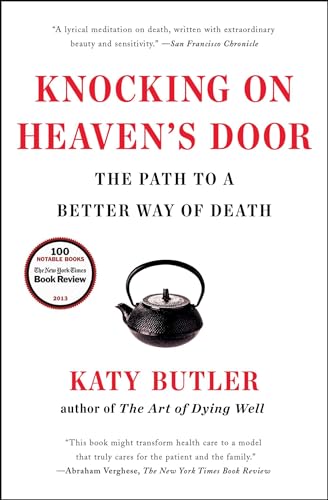
“A thoroughly researched and compelling mix of personal narrative and hard-nosed reporting that captures just how flawed care at the end of life has become” (Abraham Verghese, The New York Times Book Review).
This bestselling memoir—hailed a “triumph” by The New York Times—ponders the “Good Death” and the forces within medicine that stand in its way.
Award-winning journalist Katy Butler was living thousands of miles from her aging parents when the call came: her beloved seventy-nine-year-old father had suffered a crippling stroke. Katy and her mother joined the more than 28 million Americans who are shepherding loved ones through their final declines.
Doctors outfitted her father with a pacemaker, which kept his heart going while doing nothing to prevent a slide into dementia, near-blindness, and misery. When he said, “I’m living too long,” mother and daughter faced wrenching moral questions. Where is the line between saving a life and prolonging a dying? When do you say to a doctor, “Let my loved one go?”
When doctors refused to disable the pacemaker, condemning her father to a lingering death, Butler set out to understand why. Her quest had barely begun when her mother, faced with her own grave illness, rebelled against her doctors, refused open-heart surgery, and met death the old-fashioned way: head-on.
Part memoir, part medical history, and part spiritual guide, Knocking on Heaven’s Door is a map through the labyrinth of a broken medical system. Technological medicine, obsessed with maximum longevity, is creating more suffering than it prevents. Butler chronicles the rise of Slow Medicine, a movement bent on reclaiming the “Good Deaths” our ancestors prized. In families, hospitals, and the public sphere, this visionary memoir is inspiring the difficult conversations we must have to light the path to a better way of death.
“A lyrical meditation written with extraordinary beauty and sensitivity” (San Francisco Chronicle).
Die Inhaltsangabe kann sich auf eine andere Ausgabe dieses Titels beziehen.
Über die Autorin bzw. den Autor
Katy Butler’s articles have appeared in The New York Times Magazine, The Best American Science Writing, and The Best American Essays. A finalist for a National Magazine Award, she lives in Northern California. She is the author of Knocking on Heaven’s Door and The Art of Dying Well.
Auszug. © Genehmigter Nachdruck. Alle Rechte vorbehalten.
Knocking on Heaven’s Door
PROLOGUE
On an autumn day in 2007, while I was visiting from California, my mother made a request I both dreaded and longed to fulfill. She’d just poured me a cup of tea from her Japanese teapot shaped like a little pumpkin; beyond the kitchen window, two cardinals splashed in her birdbath in the weak Connecticut sunlight. Her white hair was gathered at the nape of her neck, and her voice was low. She put a hand on my arm. “Please help me get your father’s pacemaker turned off,” she said. I met her eyes, and my heart knocked.
Directly above us, in what was once my parents’ shared bedroom, my eighty-five-year-old father, Jeffrey—a retired Wesleyan University professor, stroke-shattered, going blind, and suffering from dementia—lay sleeping. Sewn into a hump of skin and muscle below his right collarbone was the pacemaker that had helped his heart outlive his brain. As small and shiny as a pocket watch, it had kept his heart beating rhythmically for five years. It blocked one path to a natural death.
After tea, I knew, my mother would help my father up from his narrow bed with its mattress encased in waterproof plastic. After taking him to the toilet, she’d change his diaper and lead him tottering to the living room, where he’d pretend to read a book of short stories by Joyce Carol Oates until the book fell into his lap and he stared out the sliding glass window.
I don’t like describing what the thousand shocks of late old age were doing to my father—and indirectly to my mother—without telling you first that my parents loved each other and I loved them. That my mother could stain a deck, sew a silk blouse from a photo in Vogue, and make coq au vin with her own chicken stock. That her photographs of Wesleyan authors had been published on book jackets, and her paintings of South African fish in an ichthyologists’ handbook. That she thought of my father as her best friend.
And that my father never gave up easily on anything.
Born in South Africa’s Great Karoo Desert, he was a twenty-one-year-old soldier in the South African Army when he lost his left arm to a German shell in the Italian hills outside Siena. He went on to marry my mother, earn a PhD from Oxford, coach rugby, build floor-to-ceiling bookcases for our living room, and with my two younger brothers as crew, sail his beloved Rhodes 19 on Long Island Sound. When I was a teenager and often at odds with him, he would sometimes wake me chortling lines from The Rubaiyat of Omar Khayyam in a high falsetto: “Awake, my little one! Before life’s liquor in its cup be dry!” On weekend afternoons, he would put a record on the stereo and strut around the living room conducting invisible orchestras. At night he would stand in our bedroom doorways and say good night to my two brothers and me quoting Horatio’s farewell to the dying Hamlet: “May flights of angels sing thee to thy rest!”
Four decades later, in the house where he once chortled and strutted and sometimes thundered, I had to coach him to take off his slippers before he tried to put on his shoes.
My mother put down her teacup. She was eighty-three, as lucid and bright as a sword point, and more elegant in her black jeans and thin cashmere sweater than I could ever hope to be. She put her hand, hard, on my arm. “He is killing me,” she said. “He. Is. Ruining. My. Life.” Then she crossed her ankles and put her head between her knees, a remedy for near-fainting that she’d clipped from a newspaper column and pinned to the bulletin board behind her. She was taking care of my father for about a hundred hours a week.
I looked at her and thought of Anton Chekhov, the writer and physician who died of tuberculosis in 1904 when he was only forty-four. “Whenever there is someone in a family who has long been ill, and hopelessly ill,” he wrote, “there come painful moments when all, timidly, secretly, at the bottom of their hearts long for his death.” A century afterward, my mother and I had come to long for the machine in my father’s heart to fail.
* * *
How we got there is a long story, but here are a few of the bones. On November 13, 2001, when my father was seventy-nine and apparently vigorous, he suffered a devastating stroke. A year later—gravely disabled yet clear-minded enough to know it—he was outfitted with a pacemaker in a moment of hurry and hope. The device kept his heart going while doing nothing to prevent his slide into dementia, incontinence, near-muteness, misery, and helplessness. The burden of his care crushed my mother. In January 2007, when my father no longer understood the purpose of a dinner napkin, I learned that his pacemaker could be turned off painlessly and without surgery, thus opening a door to a relatively peaceful death. It was a death I both feared and desired, as I sat at the kitchen table while my mother raised her head from her knees.
Her words thrummed inside me: Please help me get your father’s pacemaker turned off. I’d been hoping for months to hear her say something like this, but now that she’d spoken, I was the one with doubts. This was a moral choice for which neither the Anglicanism of my English childhood nor my adopted Buddhism had prepared me. I shook when I imagined watching someone disable his pacemaker—and shook even more when I contemplated trying to explain it to him.
At the same time, I feared that if I did nothing, his doctors would continue to prolong what was left of my father’s life until my mother went down with him. My fear was not unfounded: in the 1980s, while working as a reporter for the San Francisco Chronicle, I spent six weeks in the intensive care unit of San Francisco General Hospital, watching the erasure of the once-bright line between saving a life and prolonging a dying. I’d never forgotten what I saw.
If my father got pneumonia, once called “the old man’s friend” for its promise of an easy death, a doctor might well feel duty-bound to prescribe antibiotics. If he collapsed and my mother called 911, paramedics would do everything they could to revive him as they rushed his gurney toward the emergency room.
With just a little more bad luck, my father might be wheeled into an intensive care unit, where my mother and I—and even my dying father—would become bystanders in a battle, fought over the territory of his body, between the ancient reality of death and the technological imperatives of modern medicine. It was not how we wanted him to die, but our wishes might not mean much. Three-quarters of Americans want to die at home, as their ancestors did, but only a quarter of the elderly currently do. Two-fifths of deaths now take place in a hospital, an institution where only the destitute and the homeless died before the dawn of the twentieth century. Most of us say we don’t want to die “plugged into machines,” but a fifth of American deaths now take place in intensive care, where ten days of futile flailing can cost as much as $323,000. If my mother and I did not veer from the pathway my father was traveling, he might well draw his last breath in a room stripped of any reminder of home or of the sacred, among doctors and nurses who knew his blood counts and oxygen levels but barely knew his name.
Then again, the hospital might save his life and return him home to suffer yet another...
„Über diesen Titel“ kann sich auf eine andere Ausgabe dieses Titels beziehen.
Suchergebnisse für Knocking on Heaven's Door: The Path to a Better...

Beispielbild für diese ISBN
Knocking on Heaven's Door: The
Anbieter: World of Books (was SecondSale), Montgomery, IL, USA
Verkäuferbewertung 5 von 5 Sternen

Zustand: Very Good. Item in very good condition! Textbooks may not include supplemental items i.e. CDs, access codes etc. Artikel-Nr. 00101963709
Gebraucht kaufen
EUR 4,05
Versand gratis
Versand innerhalb von USA
Versand innerhalb von USA
Anzahl: 4 verfügbar
Beispielbild für diese ISBN
Knocking on Heaven's Door: The
Anbieter: World of Books (was SecondSale), Montgomery, IL, USA
Verkäuferbewertung 5 von 5 Sternen
Zustand: Good. Item in good condition. Textbooks may not include supplemental items i.e. CDs, access codes etc. Artikel-Nr. 00086608637
Gebraucht kaufen
EUR 4,05
Versand gratis
Versand innerhalb von USA
Versand innerhalb von USA
Anzahl: 16 verfügbar
Beispielbild für diese ISBN
Knocking on Heaven's Door: The Path to a Better Way of Death
Verlag:
Scribner (edition Reprint), 2014
ISBN 10: 1451641982
ISBN 13: 9781451641981
Gebraucht
Paperback
Anbieter: BooksRun, Philadelphia, PA, USA
Verkäuferbewertung 5 von 5 Sternen
Paperback. Zustand: Very Good. Reprint. It's a well-cared-for item that has seen limited use. The item may show minor signs of wear. All the text is legible, with all pages included. It may have slight markings and/or highlighting. Artikel-Nr. 1451641982-11-1
Gebraucht kaufen
EUR 5,19
Versand gratis
Versand innerhalb von USA
Versand innerhalb von USA
Anzahl: 1 verfügbar
Beispielbild für diese ISBN
Knocking on Heaven's Door: The Path to a Better Way of Death
Anbieter: ThriftBooks-Reno, Reno, NV, USA
Verkäuferbewertung 5 von 5 Sternen
Paperback. Zustand: Very Good. No Jacket. May have limited writing in cover pages. Pages are unmarked. ~ ThriftBooks: Read More, Spend Less. Artikel-Nr. G1451641982I4N00
Gebraucht kaufen
EUR 5,99
Versand gratis
Versand innerhalb von USA
Versand innerhalb von USA
Anzahl: 1 verfügbar
Beispielbild für diese ISBN
Knocking on Heaven's Door: The Path to a Better Way of Death
Anbieter: ThriftBooks-Phoenix, Phoenix, AZ, USA
Verkäuferbewertung 5 von 5 Sternen
Paperback. Zustand: Very Good. No Jacket. May have limited writing in cover pages. Pages are unmarked. ~ ThriftBooks: Read More, Spend Less. Artikel-Nr. G1451641982I4N00
Gebraucht kaufen
EUR 5,99
Versand gratis
Versand innerhalb von USA
Versand innerhalb von USA
Anzahl: 1 verfügbar
Beispielbild für diese ISBN
Knocking on Heaven's Door: The Path to a Better Way of Death
Anbieter: ThriftBooks-Atlanta, AUSTELL, GA, USA
Verkäuferbewertung 5 von 5 Sternen
Paperback. Zustand: Very Good. No Jacket. May have limited writing in cover pages. Pages are unmarked. ~ ThriftBooks: Read More, Spend Less. Artikel-Nr. G1451641982I4N00
Gebraucht kaufen
EUR 6,01
Versand gratis
Versand innerhalb von USA
Versand innerhalb von USA
Anzahl: 1 verfügbar
Beispielbild für diese ISBN
Knocking on Heaven's Door: The Path to a Better Way of Death
Anbieter: ThriftBooks-Atlanta, AUSTELL, GA, USA
Verkäuferbewertung 5 von 5 Sternen
Paperback. Zustand: Good. No Jacket. Former library book; Pages can have notes/highlighting. Spine may show signs of wear. ~ ThriftBooks: Read More, Spend Less. Artikel-Nr. G1451641982I3N10
Gebraucht kaufen
EUR 6,01
Versand gratis
Versand innerhalb von USA
Versand innerhalb von USA
Anzahl: 1 verfügbar
Beispielbild für diese ISBN
Knocking on Heaven's Door: The Path to a Better Way of Death
Anbieter: ThriftBooks-Dallas, Dallas, TX, USA
Verkäuferbewertung 5 von 5 Sternen
Paperback. Zustand: Very Good. No Jacket. May have limited writing in cover pages. Pages are unmarked. ~ ThriftBooks: Read More, Spend Less. Artikel-Nr. G1451641982I4N00
Gebraucht kaufen
EUR 6,01
Versand gratis
Versand innerhalb von USA
Versand innerhalb von USA
Anzahl: 1 verfügbar
Beispielbild für diese ISBN
Knocking on Heaven's Door : The Path to a Better Way of Death
Anbieter: Better World Books: West, Reno, NV, USA
Verkäuferbewertung 5 von 5 Sternen
Zustand: Very Good. Reprint. Pages intact with possible writing/highlighting. Binding strong with minor wear. Dust jackets/supplements may not be included. Stock photo provided. Product includes identifying sticker. Better World Books: Buy Books. Do Good. Artikel-Nr. 3969838-6
Gebraucht kaufen
EUR 6,19
Versand gratis
Versand innerhalb von USA
Versand innerhalb von USA
Anzahl: 1 verfügbar
Beispielbild für diese ISBN
Knocking on Heaven's Door : The Path to a Better Way of Death
Anbieter: Better World Books, Mishawaka, IN, USA
Verkäuferbewertung 5 von 5 Sternen
Zustand: Good. Reprint. Pages intact with minimal writing/highlighting. The binding may be loose and creased. Dust jackets/supplements are not included. Stock photo provided. Product includes identifying sticker. Better World Books: Buy Books. Do Good. Artikel-Nr. 5646858-6
Gebraucht kaufen
EUR 6,19
Versand gratis
Versand innerhalb von USA
Versand innerhalb von USA
Anzahl: 2 verfügbar