
Verwandte Artikel zu No, They Can't: Why Government Fails-But Individuals...
Inhaltsangabe
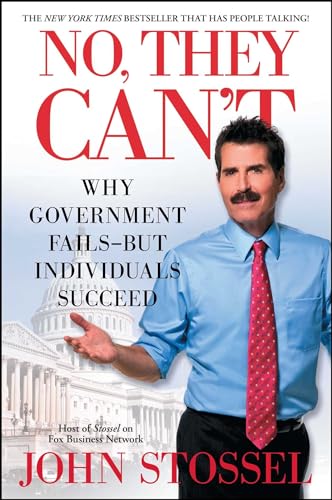
New York Times bestselling journalist John Stossel shows how the expansion of government control is destructive for American society.
Politicians—and we voters—can dream of guaranteed incomes or green energy. But the mature response to cries of “Yes, we can!” should be “No, we can’t”—not when “we” means government. There is nothing that government can do that we cannot do better as free individuals. —John Stossel in No, They Can’t
John Stossel debunks the most revered of society’s sacred cows in this spirited New York Times bestseller: our belief that government can solve our problems. Stossel insists that we discard the myth of the “perfect” government—left or right—and retrain our brain to rethink our lives as independent individuals in light of such topics as
HEALTH CARE • DEFENSE SPENDING
JOB CREATION • GUN CONTROL
PUBLIC EDUCATION • ENERGY
MINIMUM-WAGE LAWS • CLIMATE CHANGE
THE NATIONAL DEBT • POLITICAL CORRECTNESS
THE ASSAULT ON FOOD . . . and much more!
Die Inhaltsangabe kann sich auf eine andere Ausgabe dieses Titels beziehen.
Über die Autorin bzw. den Autor
New York Times bestselling author John Stossel hosts his own one-hour weekly Fox Business Network show, called Stossel, and a series of one-hour specials on Fox News. He also appears regularly on The O’Reilly Factor and on other Fox News shows. During three decades in journalism, Stossel has received numerous honors and awards. He is a nineteen-time Emmy winner and a five-time honoree for excellence in consumer reporting by the National Press Club.
Auszug. © Genehmigter Nachdruck. Alle Rechte vorbehalten.
1
“FIXING” THE ECONOMY
We spend too much time waiting for orders—and money—from Washington.
This happens because people think “something must be done” (by government) whenever bad things happen. When the housing bubble burst and stock prices tanked, President Obama told us: “The consensus is this: We have to do whatever it takes to get this economy moving again—we’re going to have to spend money now to stimulate the economy. . . .”
The idea, always implicit in the government’s thinking, but made explicit in the past few years, was that whatever the government spends money on will create a “multiplier effect”—that is, each dollar spent by the government will somehow generate more than a dollar’s worth of economic activity. That activity will create jobs.
The recession gave politicians a license to do what they wanted to do all along: spend. The usual checks on extravagance, weak as they are, were washed away. Budgets? We’ll worry about that later. Inflation? We’ll worry about that later.
WHAT INTUITION TEMPTS US TO BELIEVE:
Government can “get the economy moving again.”
WHAT REALITY TAUGHT ME:
Government does not spend money better than individuals do.
A true free market doesn’t require much. It needs property rights, so no one can take your stuff. Then, people trade property to their mutual advantage, life never being perfect, but generally improving with each trade. Resources move around without the need for a central, coercive government telling people which resources should go where—or telling them that they must get permission to do what they think advantageous.
Ever see the website that tells the story of the guy who starts with a paper clip and trades his way up to a house? It was just a stunt, but that’s roughly what happens when the market is left alone. People combine resources in new ways to create wealth—and, in the process, jobs.
When President Obama took office, he promised to “save or create” 3.5 million jobs. Should we credit him for saving any jobs? He says that unemployment would be worse without his stimulus. But how can we know? I assume his spending on expensive government jobs crowded out better, more sustainable jobs.
If the economy recovers and President Obama claims he caused that, it wouldn’t be the first time a “leader” ran in front of a crowd and claimed to have led the way. But politicians don’t deserve credit for what free people do.
Given time, an economy, unless crippled by government intervention, will regenerateitself. The Keynesians in the administration said government had to “jump-start” the economy because businesses weren’t hiring. But an economy is not a machine that needs jump-starting. The economy is people who have objectives they want to achieve.
For now, the big-government media are baffled that big spending hasn’t paid off. “Companies are sitting on billions of dollars of cash. And still, they’ve yet to amp up hiring or make major investment,” wrote theWashington Post.
C’mon, Post, don’t blame the companies. CEOs don’t just wake up one day and decide not to hire. They hold back, quite reasonably, because they don’t know what obstacles they’ll face next. Will activist government prop up housing prices? Impose a new health-care mandate? Forbid me to move to South Carolina?
When rules are unpredictable or unintelligible (is the investment firm you use in compliance with the 2,300-page Dodd-Frank finance regulatory act?), then businesses hesitate to hire. When new employees are threats because byzantine Labor Department regulations make it impossible to fire them, businesses hesitate to hire. When tax increases lie ahead, businesses hesitate to hire. I don’t blame them.
Nothing more effectively freezes business than what historian Robert Higgs calls “regime uncertainty.”
WHAT INTUITION TEMPTS US TO BELIEVE:
Government creates good things.
WHAT REALITY TAUGHT ME:
We see what government creates—but don’t see what might have existed instead.
Despite politicians’ talk of “giving” money to this or that (remember those tax rebate checks with President George W. Bush’s name emblazoned on them?), government has no money of its own. It has to take it from the private sector. Grabbing those scarce resources stifles the real economy.
One of the most important questions in politics should be: “Would the private sector have done better things with that money?” (And we should ask a similar question about the decision-making authority government takes from us every time it regulates.)
A healthy economy does not just create jobs-of-any-kind, it creates productive jobs. The pharaohs of ancient Egypt created plenty of jobs building pyramids, but who knows how much better the lives of ancient Egyptians (especially the slaves) might have been had they been free to engage in other work? They would all have had better housing, more food, or snazzier headdresses. Even as smart a person as economist John Maynard Keynes seemed to forget about that when he wrote in hisGeneral Theory back in 1936, “Pyramid-building, earthquakes, even wars may serve to increase wealth.”
By that logic, government could create full employment tomorrow by outlawing machines. Think of all the work there’d be to do then! Or government could hire people to dig holes and then fill them up (sadly, some government work resembles that).
Think about the two other methods to “increase wealth” that Keynes lumped in with pyramid-building: earthquakes and war. Now, sure, after a war or earthquake, there’s plenty of construction to be done. After the Haitian earthquake, Nancy Pelosi actually said, “I think that this can be an opportunity for a real boom economy in Haiti.”New York Times columnist Paul Krugman made a similar error. On CNN, he saidif “space aliens were planning to attack and we needed a massive buildup to counter the space alien threat . . . this slump would be over in eighteen months.” Before that, he’d said the 9/11 attacks would be good for the economy.
This is Keynesian cluelessness at its worst. Sure, rebuilding after 9/11 or a Mars invasion would be good for the economy—but only if you ignore the fact that the same money and effortcould have been used to make Crock-Pots, save for college, invest in Apple, or for countless other things.
Isn’t it obvious that those same workers could have done more productive work—with the resulting overall standard of living higher...
„Über diesen Titel“ kann sich auf eine andere Ausgabe dieses Titels beziehen.
Suchergebnisse für No, They Can't: Why Government Fails-But Individuals...

Beispielbild für diese ISBN
No, They Can't: Why Government Fails-But Individuals Succeed
Verlag:
Threshold Editions (edition Reprint), 2013
ISBN 10: 1451640951
ISBN 13: 9781451640953
Gebraucht
Paperback
Anbieter: BooksRun, Philadelphia, PA, USA
Verkäuferbewertung 5 von 5 Sternen

Paperback. Zustand: Fair. Reprint. The item might be beaten up but readable. May contain markings or highlighting, as well as stains, bent corners, or any other major defect, but the text is not obscured in any way. Artikel-Nr. 1451640951-7-1
Gebraucht kaufen
EUR 4,98
Versand gratis
Versand innerhalb von USA
Versand innerhalb von USA
Anzahl: 1 verfügbar
Beispielbild für diese ISBN
No, They Can't: Why Government Fails-But Individuals Succeed
Anbieter: ThriftBooks-Reno, Reno, NV, USA
Verkäuferbewertung 5 von 5 Sternen
Paperback. Zustand: Very Good. No Jacket. May have limited writing in cover pages. Pages are unmarked. ~ ThriftBooks: Read More, Spend Less. Artikel-Nr. G1451640951I4N00
Gebraucht kaufen
EUR 5,82
Versand gratis
Versand innerhalb von USA
Versand innerhalb von USA
Anzahl: 1 verfügbar
Beispielbild für diese ISBN
No, They Can't: Why Government Fails-But Individuals Succeed
Anbieter: ThriftBooks-Atlanta, AUSTELL, GA, USA
Verkäuferbewertung 5 von 5 Sternen
Paperback. Zustand: Very Good. No Jacket. May have limited writing in cover pages. Pages are unmarked. ~ ThriftBooks: Read More, Spend Less. Artikel-Nr. G1451640951I4N00
Gebraucht kaufen
EUR 5,82
Versand gratis
Versand innerhalb von USA
Versand innerhalb von USA
Anzahl: 1 verfügbar
Beispielbild für diese ISBN
No, They Can't : Why Government Fails-But Individuals Succeed
Anbieter: Better World Books, Mishawaka, IN, USA
Verkäuferbewertung 5 von 5 Sternen
Zustand: Very Good. Former library copy. Pages intact with possible writing/highlighting. Binding strong with minor wear. Dust jackets/supplements may not be included. Includes library markings. Stock photo provided. Product includes identifying sticker. Better World Books: Buy Books. Do Good. Artikel-Nr. 5829465-6
Gebraucht kaufen
EUR 6,41
Versand gratis
Versand innerhalb von USA
Versand innerhalb von USA
Anzahl: 1 verfügbar
Beispielbild für diese ISBN
No, They Can't : Why Government Fails-But Individuals Succeed
Anbieter: Better World Books: West, Reno, NV, USA
Verkäuferbewertung 5 von 5 Sternen
Zustand: Good. Pages intact with minimal writing/highlighting. The binding may be loose and creased. Dust jackets/supplements are not included. Stock photo provided. Product includes identifying sticker. Better World Books: Buy Books. Do Good. Artikel-Nr. 10563933-6
Gebraucht kaufen
EUR 6,41
Versand gratis
Versand innerhalb von USA
Versand innerhalb von USA
Anzahl: 1 verfügbar
Beispielbild für diese ISBN
No, They Can't : Why Government Fails-But Individuals Succeed
Anbieter: Better World Books, Mishawaka, IN, USA
Verkäuferbewertung 5 von 5 Sternen
Zustand: Good. Pages intact with minimal writing/highlighting. The binding may be loose and creased. Dust jackets/supplements are not included. Stock photo provided. Product includes identifying sticker. Better World Books: Buy Books. Do Good. Artikel-Nr. 10563933-6
Gebraucht kaufen
EUR 6,41
Versand gratis
Versand innerhalb von USA
Versand innerhalb von USA
Anzahl: 1 verfügbar
Foto des Verkäufers
No, They Can't: Why Government Fails-But Individuals Succeed
Anbieter: WeBuyBooks, Rossendale, LANCS, Vereinigtes Königreich
Verkäuferbewertung 5 von 5 Sternen
paperback. Zustand: Good. Most items will be dispatched the same or the next working day. A copy that has been read but remains in clean condition. All of the pages are intact and the cover is intact and the spine may show signs of wear. The book may have minor markings which are not specifically mentioned. Artikel-Nr. rev9420720985
Gebraucht kaufen
EUR 10,82
EUR 7,36 Versand
Versand von Vereinigtes Königreich nach USA
Versand von Vereinigtes Königreich nach USA
Anzahl: 1 verfügbar
Beispielbild für diese ISBN
No, They Can't: Why Government Fails - But Individuals Succeed
Anbieter: Revaluation Books, Exeter, Vereinigtes Königreich
Verkäuferbewertung 5 von 5 Sternen
Paperback. Zustand: Brand New. reprint edition. 336 pages. 9.00x6.00x1.00 inches. In Stock. Artikel-Nr. __1451640951
Neu kaufen
EUR 18,31
EUR 11,66 Versand
Versand von Vereinigtes Königreich nach USA
Versand von Vereinigtes Königreich nach USA
Anzahl: 1 verfügbar
Beispielbild für diese ISBN
No, They Can't: Why Government Fails - But Individuals Succeed
Anbieter: Revaluation Books, Exeter, Vereinigtes Königreich
Verkäuferbewertung 5 von 5 Sternen
Paperback. Zustand: Brand New. reprint edition. 336 pages. 9.00x6.00x1.00 inches. In Stock. Artikel-Nr. x-1451640951
Neu kaufen
EUR 22,37
EUR 11,66 Versand
Versand von Vereinigtes Königreich nach USA
Versand von Vereinigtes Königreich nach USA
Anzahl: 2 verfügbar
Beispielbild für diese ISBN
No They Cant
Anbieter: Kennys Bookstore, Olney, MD, USA
Verkäuferbewertung 5 von 5 Sternen
Zustand: New. Artikel-Nr. V9781451640953
Neu kaufen
EUR 25,82
EUR 9,14 Versand
Versand innerhalb von USA
Versand innerhalb von USA
Anzahl: Mehr als 20 verfügbar